The Virginian: Where Nobody Knows Your Name

As we get ready to “Go West Young Man,”  today our blog series is getting to know the The Virginian (which is sometimes confusing because it was renamed The Men from Shiloh later for part of the series). This series debuted on NBC in 1962. It produced 249 episodes, running until 1971, making it the third longest-running western (Gunsmoke and Bonanza were the top two).
📷wikipedia.com

Lew Wasserman was involved with Universal, and they produced Wagon Train which was on NBC. Universal sold the series to ABC in 1962 after it had been on the air for three years, and NBC was not happy, but Wasserman told them that he had a new show for them, The Virginian.

It was also the first 90-minute western. Like Stagecoach West, it was set in the Wyoming Territory. While the pilot was black and white, the rest of the series was filmed in color.

The series was based on an Owen Wister novel, The Virginian: Horseman of the Plains which was published in 1902.

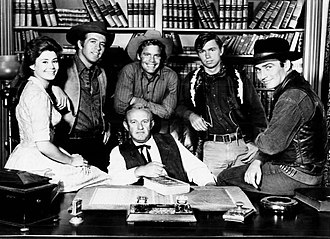
The series featured a foreman at the Shiloh Ranch near Medicine Bow played by James Drury. The foreman was never referred to by his name. Drury once said, “Nobody knows the name of my character, not even me.” His sidekick was Trampas (Doug McClure). Sheriff Abbott (Ross Elliott) also shows up on and off throughout the nine seasons. For the first four seasons, the ranch owner, Judge Henry Garth (Lee J. Cobb) and his daughter Betsy (Roberta Shore) also live there. The cast changed fairly often throughout the series, but Drury and McClure were along for the entire ride.

📷ebay.com

The plots of the show often revolve around themes of prejudice, injustice, being a responsible and hard worker, and standing up for the right thing.

During the final season, the show changed its title, and the series changed quite a bit. There was a new theme song, and it took on more of the character of the popular spaghetti westerns. Stewart Granger and Lee Majors joined the cast. While the ratings increased, the network was intent on cancelling the show, along with the rural purge that happened at that time.

Later when the show was no longer on the air, Drury discussed two of his castmates, one he admired and considered a friend and one he did not! About Grainger who joined the show for the last year, Drury said, “He was a disaster, and I couldn’t stand him. He wanted everything changed to make him the star of the show.  . . . He also fired the whole camera crew and hired a new crew for his episodes.” However, on reflecting about his co-star Doug McClure, Drury recalled “off-screen Doug was quite like his character, and you couldn’t help but smile when he walked into a room because he was full of good humor and good spirits all the time. He could cheer anybody up. He became my best friend, and I still miss him terribly—you couldn’t ask for a better co-star.”

As you can imagine, being on the air for nine years meant a lot of guest stars showed up on the series, including Eddie Albert, Charles Bronson, Robert Culp, Joan Crawford, Bette Davis, Patty Duke, Robert Duvall, Harrison Ford, Jack Lord, Lee Marvin, Vera Miles, Leonard Nimoy, Ryan O’Neal, Robert Redford, George C. Scott, William Shatner and Franchot Tone.

📷facebook.com

The Virginian was on Wednesday nights for its entire run. When it began, it was up against Wagon Train on ABC while CBS ran CBS Reports and The Many Loves of Dobie Gillis. Both The Virginian and Wagon Train managed to hit the top thirty that year. The next year, its biggest competition was The Adventures of Ozzie and Harriet followed by The Patty Duke Show. The Nelsons hit the top thirty and The Virginian and The Patty Duke Show were in the top twenty. The show continued to be in the top twenty or top thirty for the rest of its run, hitting the top ten in 1966, despite being on at the same time as many popular sitcoms during those years, including Batman, The Beverly Hillbillies, The Courtship of Eddie’s Father, Gomer Pyle USMC, Lost in Space, Mister Ed, and My Living Doll. It was still in the top twenty when it was canceled.

This show is fondly remembered by viewers who tuned it at the time. It’s been in syndication for decades, racking up new generations of fans. In one of his later interviews, Drury talked about the appeal of the show. He said, “People now tell me about their grandkids who discover the show on cable and start watching it. It’s a wonderful feeling to know the show is still viable after all these years.” That alone is reason to be proud of working on this show.

Julie Newmar: Batman’s Most Beautiful Villain

This month we are learning a bit about the Batman villains and their careers. No study of Batman’s favorite nemesis would be complete without Cat Woman, Julie Newmar. Julie shared the role of Cat Woman with Eartha Kitt who appeared the final television season and Lee Meriwether who was so catty in the Batman movie. What else did Julie Newmar do during her career? Let’s find out.

📷pinterest.com

Born Julia Chalene Newmeyer in 1933, Julie Newmar as she is known in the acting world, was a television and film actress, dancer, singer, and stage performer. But, as they say in the commercials, that’s not all. She also was known for writing, designing lingerie, and managing real estate investments.

Newmar was born in LA. Her father Don was head of the physical education department for the Los Angeles College. Her mother, of both Swedish and French descent, was a fashion designer under the name Chalene and later worked in real estate.

Julie began dancing early in life and performed as a prima ballerina with the Los Angeles Opera when she was only 15. With an IQ of 135, Newmar graduated from John Marshall High School at age 15. She continued dancing in films in the early fifties. At age 19, she was also working as a dancer/choreographer for Universal Studios. In 1954, she appeared in Seven Brides for Seven Brothers as Dorcas, one of the seven brides.

📷facebook.com

In 1955 she got her first Broadway appearance in “Silk Stockings.” She continued her movie and Broadway careers throughout her years in entertainment, appearing in 33 films in all.

Television is where Newmar gained most of her fame. Her first television appearance was on The Phil Silvers Show in 1957 and then Ominbus in 1959. But it was in the sixties that she became a household name. She started the decade in Adventure in Paradise in 1960, followed by a variety of shows including The Defenders, Route 66, and The Twilight Zone in the early sixties.

In 1964 she was offered the role of Rhoda on My Living Doll, where she played a robot. She was not enthralled with the choice of Bob Cummings as her costar and did not seem to enjoy her time on this show. She said that “They originally wanted Efrem Zimbalist Jr. It was not a flip part—it needed a straight actor who could play opposite this bizarre creature so the comedy would come off. That quality was lost when they hired Bob. The show could have been wonderful. I think it would have run for many seasons had they hired Efrem because he had the right qualities.”

📷classicfilmandtvcafe.com

After appearing in several comedies including The Beverly Hillbillies and F Troop, she received another recurring role as Cat Woman in Batman. She would appear in the series 13 times, 12 as Cat Woman, the only villain to make Batman question his morals, because we knew he was in love with her, and if she showed any sign of remorse, who knows where things might have gone. Her Cat Woman costume now lives at the Smithsonian Institution.

Newmar lived in Beekman Place in New York in the mid-sixties. One weekend her brother had come to visit her from Harvard. They were sitting around chatting when the phone rang. She was asked if she would like to play Cat Woman on the Batman series. She was a bit miffed because they said they were casting in California, and the role started on Monday. Her comment was “That’s how television is done: they never know what they are doing until yesterday.” When her brother heard Batman, he jumped up and said that was the favorite show at Harvard and they even skipped classes to watch it. He told her to take the role, so she did.

📷firstforwomen.com

After Batman, she finished out the sixties in The Monkees, Star Trek, Get Smart and It Takes a Thief. With 11 seventies offers, you can see her in shows such as Bewitched, Columbo, McMillan and Wife, Love American Style, The Bionic Woman, and The Love Boat. One of my favorite made-for-tv movies was The Feminist and the Fuzz. It had an exceptional cast, including Newmar who appeared in the movie along with Barbara Eden, David Hartman, Jo Anne Worley, Farrah Fawcett, Harry Morgan, Herb Edelman, Penny Marshall, and John McGiver. This ensemble was directed by Jerry Paris, who directed so many great shows from The Dick Van Dyke Show to Happy Days.

Her other starring role in the seventies was a marriage to J. Holt Smith, an attorney. After the wedding, Newmar moved to Forth Worth, Texas until 1984 when they divorced.

📷remindmagazine.com

The eighties was a more quiet decade for the actress but she did accept roles on CHiPs, Fantasy Island, and Hart to Hart. In 1992, she appeared in George Michael’s music video, “Too Funky,” She was still working in 2016 and 2017 in Batman animation features.

If you were a fan of Batman and Dark Shadows in the sixties, you were in luck when Newmar took on the role of Dr. Julia Hoffman (played in the original series by Grayson Hall) in Dark Shadows: Bloodline, the audio drama miniseries.

She was not just a pretty face, however. She received two US patents for pantyhose and one for a bra, under the name Nudemar. She also began investing in LA real estate and was credited with helping to improve the neighborhoods of La Brea Avenue and Fairfax Avenue. In one episode of My Living Doll, Rhoda is asked to play Chopin’s “Fantasie Impromptu” on the piano. Newmar played the piece herself. She had studied under concert pianist Dr. MacIntyre, and she said that scene is the only one she’s done with her playing the piano which had been her career choice before acting. One of Julie’s comments about herself was “Tell me I’m beautiful, it’s nothing. Tell me I’m intellectual—I know it. Tell me I’m funny, and it’s the greatest compliment in the world anyone could give me.”

📷closerweekly.com

Julie also enjoys art and gardening. She has a rose, a day lily, and an orchid named for her. Her gardens are often chosen as a spot for holding charity events.

Like Barbara Feldon from Get Smart, Julie Newmar is beautiful, bright, and funny. I hope she enjoyed her career. Obviously, she could have been a brain surgeon or any other profession of her choice. She seems like she would be a fun person to just hang out with and the conversation would never run out. Thank you, Julie Newmar for choosing the entertainment business over medical science for our sakes.

Not Many of Us Can Compute Small Wonder

We are in the midst of our blog series “I Robot.” If you read last week’s blog, you will remember we were discussing My Living Doll, a science fiction comedy from the mid-sixties created by Howard Leeds.

Cast Photo: twitter.com

Today we are moving ahead two decades to look at another Howard Leeds’ show from the mid-eighties called Small Wonder, another science fiction sitcom.

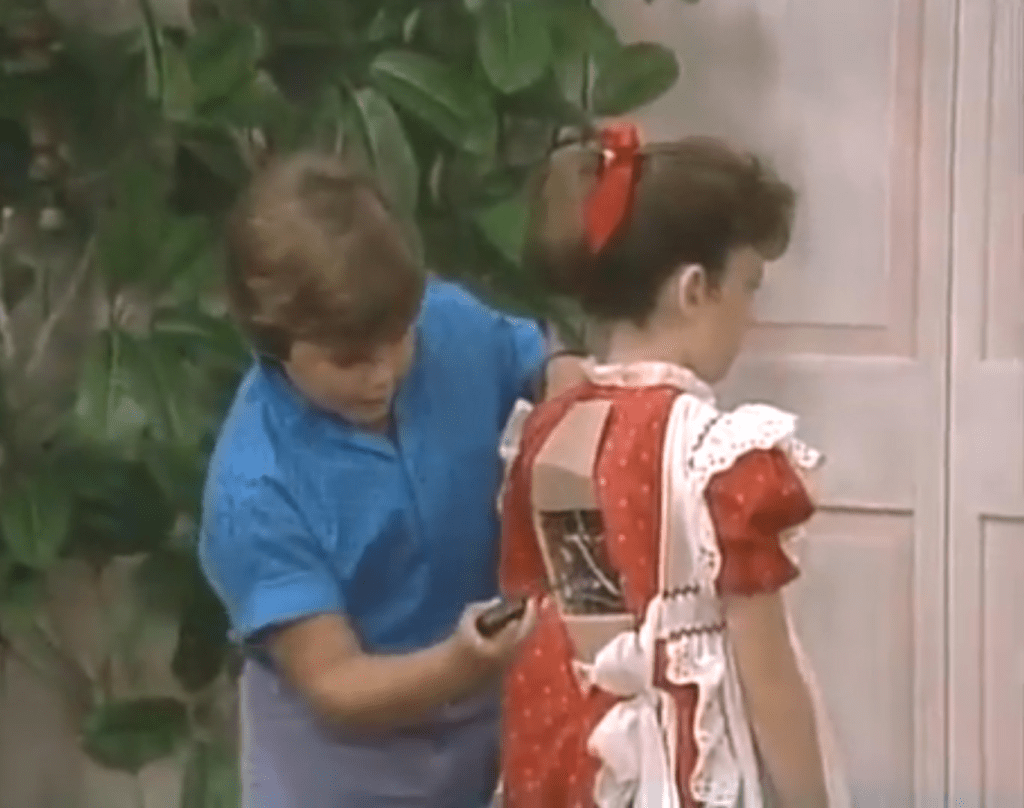
The concept of the show is that Ted Lawson (Dick Christie) and his family–wife Joan (Marla Pennington) and son Jamie (Jerry Supiran)–live in a typical residential area. Lawson has created V.I.C.I., an android that contains Voice Input Child Indenticant whom he calls Vicki (Tiffany Brissette). Lawson created the robot to help handicapped children, and she looks like a ten-year-old girl. Lawson has to take her home to learn about family environments and be “trained” for home service. Similar to Rhoda on My Living Doll, Vicki has an outlet under her right arm, a data port under her left arm, and an access panel in her back. She possesses superhuman strength and speed. Seth Green auditioned for the role of Jamie and, Candace Cameron Bure was up for the role of Vicki, along with 398 other girls.

The Lawsons have to keep her identity a secret and pass her off for a daughter they adopted. Their neighbor, ten-year-old Harriet (Emily Schulman), a la Gladys Kravitz, was very nosy and made the secret hard to maintain. Jamie works hard to scheme and find ways to get Vicki to make his life easier.

Rounding out the cast were Brandon and Bonnie Brindle (William Bogert and Edie McClurg) who were Harriet’s parents; Brandon was also Ted’s boss; Reggie (Paul C. Scott), Jessica (Lihann Jones), and Warren (Daryl Bartley), Jamie’s friends.

The show was on for four seasons and, of course, Brissette continued to grow and age, so in season three Ted gives Vicki an upgrade which allows her to wear current fashions, eat, and drink, making it easier to conceal her identity.

Photo: smallwonderreviewed.blogspot.com

Unfortunately for Leeds, this show has also been dubbed one of the worst sitcoms of all time, despite the fact that it was on for four years. Robert Bianco, TV critic for USA Today, wrote in 2002 that it was a contender for one of the worst TV shows of all time, and the BBC described it as the worst low-budget sitcom of all time (as an aside, the first season provided $300,000 per episode). Lest you think Leeds could not come up with a successful show; know that he also produced The Brady Bunch, The Ghost and Mrs. Muir, Silver Spoons, and The Facts of Life. He also wrote scripts for forty-two different shows.

Although it was not popular with critics, viewers seemed to enjoy it. The show was later sold to more than twenty countries, including Brazil, France, India, and Italy.

In 2015, Dave Nemetz spoke with Marla Pennington Rowan and Emily Schulman Webster about their time on the show. They both felt sorry for Brissette. She had a lot of skills such as singing, dancing, gymnastics, and piano playing, but all she could do on the show was to be a robot. She had to talk in a monotone while showing no emotions. Webster said it was so challenging for her but she was a pro. She mentioned that “she had to bite the inside of her cheeks to keep from smiling. That was tough. My heart sort of broke for her.”

Photo: pinterest.com

Both stars mentioned how hard the special effect filming was for Tiffany. It might be her head spinning around and around or lifting the couch with one arm to clean under it. Those scenes were filmed on Thursdays with the use of green screen technology. Webster said it was not easy and that “Tiffany had to endure it, it would take a lot of trial and error.” In addition to these talents, Vicki could shrink down to the size of a doll, extend to ten feet tall, channel electricity through her hands, and she possessed unlimited learning ability to improve products.

Rowan and Webster said the cast got along great, just like one big family. However, the parents of the minor stars surely did not. Three tutors were employed on the set because the parents could not agree on choosing the same one. Rowan mentioned that apparently, the parents thought they were the stars of the show.

The show was very popular with kids especially. However, power struggles were not confined to overbearing parents; the corporate level had plenty of controversy as well. I’m not sure why, but the show was owned by five different companies, and they did not agree on much either. Once they knew there were enough shows to put it into syndication the show was done. No one knew if they were going to be picked up for the next season or not; they weren’t, so there was never any finale produced.

One of the most memorable parts of the show might be the theme song. It’s lyrics are:

She’s a small wonder; pretty and bright with soft curls.

She’s a small wonder; a girl unlike other girls.

She’s a miracle and I grant you, she’ll enchant you at first sight.

She’s a small wonder, and she’ll make your heart take flight.

She’s fantastic, made of plastic; microchips here and there.

She’s a small wonder, brings love and laughter everywhere.

We understand her pain at watching the show. Photo:smallwonderrevisited.blogspot.com

So how did it work out for the trying parent/managers? None of the three children are actors any longer. Brissette is a nurse in Colorado, Supiran was broke and homeless in 2012 but is in a better place today, and Schulman Rowan writes cookbooks and is considering acting again. Her last role was in the show Christy in the mid-nineties.

If you watch Antenna TV you might be very familiar with the show. It’s no longer in the rotation, but I have watched it several times on the network in the past. It definitely is not anything I would clear my schedule for. I’m not sure I would classify it as the worst sitcom of all time; it seems in the past 40 years, we have come up with some pretty bad options. However, I certainly would not spend my time watching this one. I’m just going to chalk it up to fulfilling a need in the eighties on Saturdays that does not age well.

How My Living Doll Became Cat Woman

This month we are learning more about some of our favorite robots in this blog series called “I Robot.” Today we go back to the mid-sixties for My Living Doll.

Photo: pinterest.com

This was both a science fiction and comedy show that debuted in September of 1964. Jack Chertok produced it for Television Productions with CBS. The show was filmed at Desilu studios. Chertok had been the creative force behind My Favorite Martian. James Aubrey, president of CBS, approached Chertok about doing another show. He did not even require a pilot to be made. Chertok’s writers from My Favorite Martian, Bill Kelsay and Al Martin, created the show from an idea proposed by Leo Guild. Kelsay wrote many of the episodes for Date with the Angels starring Betty White and several My Three Sons plots. Martin wrote for many earlier shows and screenplays including Roy Rogers.

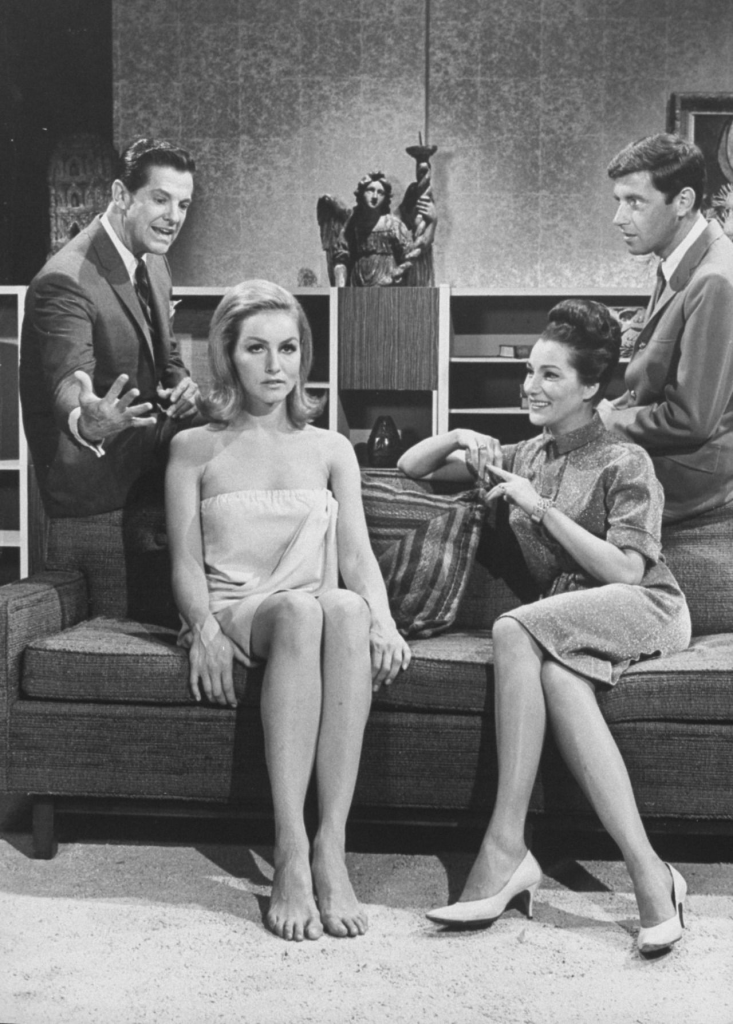
The plot they created was that Dr. Bob McDonald (Bob Cummings), a psychiatrist for the Air Force, was given Rhoda Miller (Julie Newmar), a lifelike robot to protect. He was trying to keep her out of the hands of the military. Rhoda’s formal name was AF709. Dr. Carl Miller (Henry Beckman) built her for the US Air Force but she eventually lands in McDonald’s care when Miller is transferred to Pakistan. His job is to help educate her to be the perfect woman while keeping her true identity a secret. Beauty marks on her back were the control buttons. Her main power switch was on her right elbow. Her eyes could be covered to prompt a system relaxation. Rhoda’s memory bank contained 50 million pieces of information. Bob told his coworkers Rhoda was Dr. Miller’s niece, and she took on the role of his secretary at the office, typing 240 words a minute. On other episodes, she learned to calculate where dice would fall and how to make trick shots playing pool.

In one episode, Rhoda is asked to play Chopin’s “Fantasie Impromptu” on the piano. Newmar actually played the piece herself. She had studied under concert pianist Dr. MacIntyre, and she said that scene is the only one she’s done with her playing the piano which had been her career choice before acting.

Meeting the Robot Photo: pinterest.com

Like I Dream of Jeanne, many of the episodes deal with Bob trying to keep Rhoda out of trouble while she is learning what society and the current culture is like. Rhoda learns human emotions throughout the first season; perhaps this would have led to a romantic relationship between the robot and the doctor.

Rounding out the cast was Peter Robinson (Jack Mullaney), Bob’s neighbor and coworker who thinks Rhoda is someone he wants to date. Irene Adams (Doris Dowling) plays Bob’s sister who moves in to act as housekeeper and chaperone so the neighbors are not suspicious of a single woman living there. On Love That Bob, Rosemary DeCamp played Bob’s sister who moves in to take care of the household for him. Mrs. Moffat was added later on as Peter’s housekeeper.

The show never really found its viewer base. The New York Times reviewer Jack Gould noted that it “very probably had the makings of a popular novelty hit . . . with Miss Newmar giving a light and amusing performance as the automated dish, the premise could work out . . . Bob Cummings, an old hand at chaperoning pretty girls, again is cast in his familiar assignment.”

Newmar didn’t feel that Cummings was the right actor for the role. She said that “They originally wanted Efrem Zimbalist Jr. It was not a flip part—it needed a straight actor who could play opposite this bizarre creature so the comedy would come off. That quality was lost when they hired Bob. The show could have been wonderful. I think it would have run for many seasons had they hired Efrem because he had the right qualities.”

Photo: yiddio.com

The ratings were not good; however, another issue was the fact that it was on Sunday nights against Bonanza, one of the most popular shows ever. In December, CBS moved the show to Wednesday nights but the ratings did not improve. In January, Cummings asked to be written off the show. CBS agreed but never got a replacement for him. He was said to have been transferred to Pakistan, and Robinson took over caring for Rhoda with his housekeeper living in his house again to keep the neighbors from talking.

Apparently, Cummings and Newmar never hit it off. She complained that he had tried to teach her to act and that he seemed unhappy that she was getting more press attention. Later Newmar stated that the real trouble on the set was Cumming’s addiction to methamphetamines. She said he had erratic behavior and became increasingly more depressed and insecure.

In her new home Photo: imdb.com

After Cummings left the show, another five episodes were aired, and then the show was canceled. The show ended up ranking 79th out of 96 shows. Two decades later, producer Howard Leeds would go on to create the show we will discuss next week, Small Wonder.

I was not able to confirm it, but I read several sources that said this show coined the term, That does not compute” which is what Rhoda said when she was asked something she did not understand.

During the summer of 1965, CBS aired repeats of the show. After that, the show was never seen on television again in the United States. Rumors were rampant about whether the 26 episodes had been damaged in a fire, hidden by Chertok, or destroyed. Two episodes seemed to have survived, but there were also reports that six or ten existed in all. CBS was able to obtain about half the episodes somewhere and released a DVD with them on it. We will have to see if the additional episodes ever show up or not.

Transitioning to Cat Woman Photo:designyoutrust.com

This was another of those shows that seemed to suffer from an identity complex. Cummings was known as a ladies’ man to viewers from his seasons on Love That Bob. If the show was not going for romance, then it seems that Newmar was correct in her assessment of Cummings being the wrong person for the role. With Bewitched debuting the same year and I Dream of Jeanne coming right on the heels of My Living Doll, it seems like one of the shows might not obtain enough viewers. Cummings’ addiction problems certainly did not help the show. Newmar should probably be happy the show ended when it did, allowing her to step into the role of Cat Woman on Batman. Like My Living Doll, Cat Woman had all the qualities Batman admired and wanted in a romantic partner, but unlike Rhoda who was not human, Cat Woman was all too human and too much of a villain to allow Batman to act on his passion for her.

Although the show debuted almost sixty years ago, many of the issues of working with a robot are still with us today as scientists work on giving robots a sense of humor and some empathy. We are seeing more of them in the workplace, and it will be interesting to see if any new shows take up the subject in the near future.