This week we are finishing up our “Supportive Women” blog series. If you watched a lot of television in the sixties and seventies, you will remember today’s blog star very well: Morgan Fairchild.
Photo: dallasfandom.com
Morgan Fairchild was born Patsy Ann McClenny in 1950 in Dallas, Texas. In grade school, she was too shy to read her book report in class, so her mother, an English teacher, signed her up for drama lessons. At age ten, she began performing in dinner theater and stock productions in Dallas which led to several local commercials.
In 1967 she married Jack Calmes; they would divorce in 1973.
In 1967, a young Morgan was hired as a double for Faye Dunaway in Bonnie and Clyde. At age 20 she was cast in her first movie where we could see her face, A Bullet for a Pretty Boy. She would receive roles for another 35 big-screen features during her career.
However, most of her work was on the small screen. Her first role was Jennifer Pace on Search for Tomorrow. She stayed with that show for four years but she would come back to soap operas on and off throughout her acting time and could be seen on The Bold and The Beautiful, Days of Our Lives, General Hospital, and most recently as Sydney Chase in The City in 1996. Most of her roles were the stereotype of an elegant and wealthy woman who will do whatever it takes to get what she wants.
In between work on soap operas, Morgan showed up on many of the most popular shows as a guest star or regular cast member. In 1976 she was on Kojak. After her time on Search for Tomorrow, during the 1970s she appeared on other dramas including Police Woman, Barnaby Jones, and Dallas and on sitcoms like The Bob Newhart Show, Happy Days, and Morkand Mindy.
Flamingo Road Photo: nbcwikifandom.com
During the 1980s she did make a few guest appearances on The Love Boat, Simon and Simon, Magnum PI, and Hotel. Morgan received an Emmy nomination for her appearance on Murphy Brown in 1989. However, it was during this decade that Fairchild was a regular cast member on three different shows: Flamingo Road, Paper Dolls, and Falcon Crest (attorney Jordan Roberts), all night-time soap operas.
Flamingo Road was based on a novel written in 1949. It features the small town of Truro, Florida. The wealthy citizens live on Flamingo Road in their mansions, while the lower classes do what they have to do to make that street their address. Morgan played a woman with one of the longest names on television: Constance Weldon Semple Carlyle. After two years, the show was done.
Photo: IthinkthereforeIreview.com
Paper Dolls was about the modeling world. Fairchild played Racine, an agent, and the show is about the jobs that her models take on including a perfume company that uses her models exclusively. The series only lasted for thirteen episodes.
Morgan played Jordan Roberts, an attorney, on Falcon Crest. This long-running drama from 1981-90 featured the Gioberti family who operates the Falcon Crest Winery in California.
In the nineties, she appeared on a variety of shows including Roseanne, Empty Nest, Murder She Wrote, Diagnosis Murder, Cybill, and Home Improvement.
Her career continued during the 2000s where you could see her on Dharmaand Greg and Hot in Cleveland, as well as five appearances on Friends as Chandler Bing’s mother Nora. She also had another series, Fashion House, in 2006 as Sophia Blakely. The concept of the show was another fashion-themed one where a ruthless executive played by Bo Derek defends her company against a hostile takeover.
Friends Photo:netflixlife.com
With so many movie channels, we forget today that for a few decades we could not watch movies on television. The networks came up with a solution: made-for-tv movies, and Morgan was a queen of the genre with thirty movies and six miniseries.
Morgan has continued to stay busy. She has two finished productions listed on imdb that have not been released yet.
Fairchild has used her platform as a celebrity to advocate for AIDS research, the pro-choice movement, and many environmental issues. She collects movie memorabilia, especially Marilyn Monroe items, and antique clothing. She seems to have had a long-lasting career. It would have been fun to see her star in a sitcom instead of just playing ruthless women who just care about fame and money.
This month we are looking at some of our favorite “Supportive Women.” Today we are taking a closer look at the career of Linda Evans.
Photo: vintageeveryday.com
Born Linda Evenstad in 1942 in Hartford, Connecticut, she was the middle child of three sisters. Both her parents were professional dancers. When she was six months old, the family moved to North Hollywood. Linda graduated from Hollywood High School with Stefanie Powers, who we will be talking about next week. Like Morgan Fairchild, who we will be discussing in two weeks, Linda took drama classes to help her deal with shyness.
Linda was engaged to Patrick Curtis, but they never married. He later became a press agent and married Raquel Welch.
Linda’s first two roles were on two of my favorite sitcoms. In 1960, she guest starred on Bachelor Father where Bentley Greg (John Forsythe) raised his niece Kelly (Noreen Corcoran) with the help of his houseboy Peter (Sammee Tong). Her second appearance was on The Adventures of Ozzie and Harriet. During the sixties, she would appear on a variety of shows including Dr. Kildare, Wagon Train, and My Favorite Martian.
Photo: pinterest.com
Her first made-for-tv movie was 1962’s Buttons with Beaus, and her first big screen feature came a year later in Twilight of Honor; her second movie was Beach Blanket Bingo in 1965 where she played Sugar Kane.
It was in 1965 that Evans began dating film director John Derek. They would marry in 1968 and separate in 1973 when Linda learned he was dating the actress who became known as Bo Derek.
1965 was also the year she was offered her first role as a regular cast member of a series. She became Audra Barkley from 1965-1969 on The Big Valley. The western was very popular. Similar to Bonanza, in this show, Victoria Barkley managed to raise her family and keep the villains at bay.
She and Barbara Stanwyck, who played her mother Victoria on the show, became very close. Stanwyck continued to refer to her as Audra after the show ended. Linda says Barbara was a great mentor and friend to her.
In 1967 when Derek was filming Evel Knievel’s famous motorcycle jump over the fountains at Caesar’s Place in Las Vegas, he asked Linda to take over one of the cameras, and she shot the famous footage of Knievel’s devastating crash.
During the 1970s she kept busy with television appearances on dramas including McCloud, Banacek, Harry O, McMillan and Wife, and The Rockford Files.
With “mom” Barbara Stanwyck Photo: imdb.com
In 1975, she married Stan Herman, a real estate tycoon. They were married four years before splitting up. She never married again.
From 1976-1977 she again accepted a role as a regular on the show Hunter. The series only lasted fourteen episodes before being canceled. Not to be confused with the show from the 1980s, in this one, US government special agents James Hunter (Tony Franciscus) and Marty Shaw (Evans) take on missions around the world. He posed as a bookstore owner, and her cover was a model. I admit I have never seen this show, but it sounds like a seventies version of I Spy.
During the 1980s, her career was split between two primary shows: The Love Boat and Dynasty. Dynasty was on the air from 1981-1989. When Dallas became extremely popular, ABC commissioned Aaron Spelling to come up with a primetime soap opera of its own. Evans was back on the air working with John Forsythe again as Blake Carrington, her wealthy husband. The basic premise of the show was that it was an upper-class version of the Hatfields and the McCoys with the Carringtons and the Colbys feuding in the oil business in Denver, Colorado.
Dynasty with Forsythe and Collins Photo: imdb.com
Evans and Forsythe remained close friends for the rest of his life. She said he was “so magical. This show was so serious and he was funny personally. We’d be fighting and people would be strangling each other and he made me laugh all day long, I’ll be forever grateful to him for that.” The person Linda was often strangling was Joan Collins who played Alexis Carrington Colby, Blake’s first wife.
By 1984 the show had reached number one in the rankings. Linda was nominated for an Emmy for Outstanding Lead Actress in a Drama Series in 1983. She was beat out by Tyne Daly from Cagney and Lacey.
After the show was canceled, Evans stepped out of the limelight for the most part. She did film five made-for-tv movies during the 1990s and guest starred on Germany’s version of The Love Boat, Das Traumschiff, in 2020. In 2021, she was in a big-screen feature, Swan Song.
In 2011 Evans published a book, Recipes for Life: My Memories, a combination of candid memoir and inspirational cookbook. Despite her perfect figure, one of her weaknesses is pizza. On premierspeakers.com on April 10, 2018, she was quoted as saying “I love pizza so much, that if you wake me up in the middle of the night and ask me if I’d like to eat a slice, I’ll say YES. Kenny Rogers used to have it delivered to me while I was filming The Gambler.
Photo: dailyexpress.com
Linda seemed to enjoy her career. She is remembered for several well-known characters in Audra Barkley and Crystal Carrington. While she has given up acting for the most part, I would not be surprised to see her back on the big screen for another part or two if it’s the right offer.
Continuing the theme “Living in the Past: Timeless Comedies,” we find ourselves transported to Milwaukee, WI in the 1950s getting to know the Cunninghams. Beginning September of 1984, Happy Days entertained fans for more than a decade, producing 255 episodes. When the show began, it was set in 1955, and when it went off the air eleven seasons later, it was 1965.
Photo: aceshowbiz.com
Garry Marshall developed the pilot which first aired on Love American Style in 1972 as “Love and the Television Set.” The network wasn’t interested in turning the pilot into a show when it first came up. However, once George Lucas released American Graffiti in 1973, also starring Ron Howard, ABC took another look at the period show. The first two seasons, the show focused more on Richie Cunningham as he interacted with his friends and family. Jerry Paris (Jerry Helper on The Dick Van Dyke Show) directed 237 of the episodes. Happy Days was described as relentlessly ordinary. The plots revolved around the same types of problems most teens experienced in the fifties: dating, wanting to be popular, peer pressure, and similar experiences.
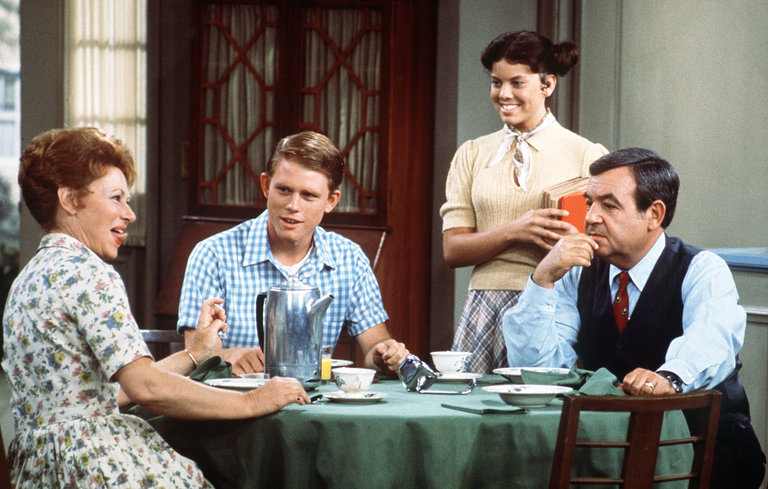
Richie’s family includes his father Howard (Tom Bosley) who owns a hardware store, and his mother Marion (Marion Ross). Howard is a family man and is also loyal to his lodge. Marion is content to stay at home, except for a brief stint when she gets a job as a waitress at Arnold’s. The cast also includes his younger sister Joanie (Erin Moran) and an older brother Chuck.
Photo: parade.com
Chuck would not be around long. At the end of the series, Tom Bosley says “he had the joy of raising two wonderful kids and watching them and their friends grow up into wonderful adults.” Poor Chuck. His existence wasn’t even acknowledged in the finale. When a character just disappears without an explanation, it is often referred to as the “Chuck Cunningham Syndrome.”
Photo: sharetv.com
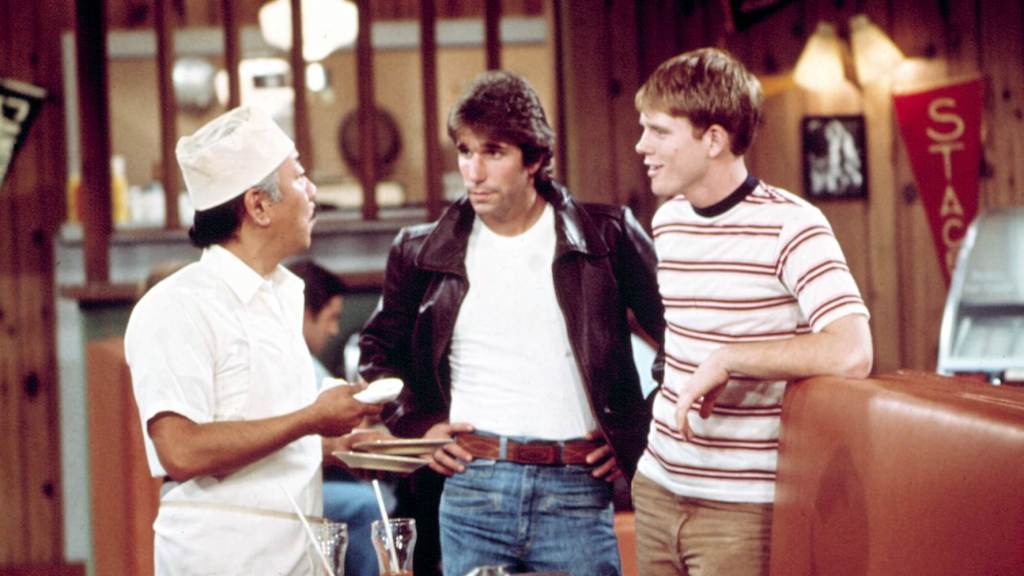
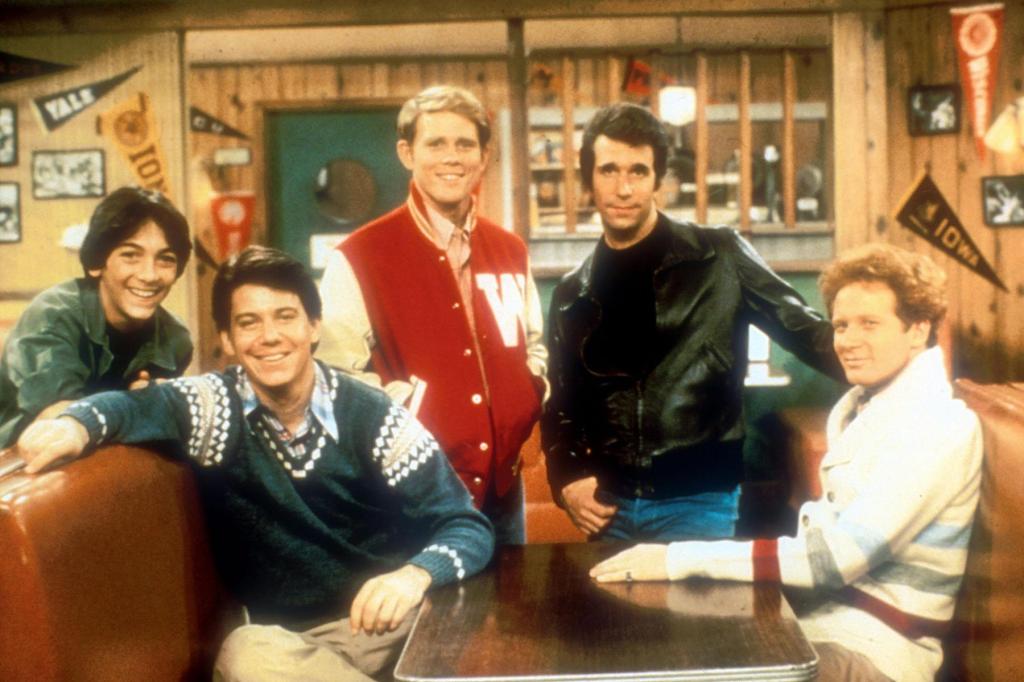
Richie’s friends include Potsie Weber (Anson Williams) and Ralph Malph (Donny Most). Potsie, whose real name is Warren, was a singer. When Richie went into the Army so did Ralph. A famous catchphrase from the show was Ralph’s uttering “I still got it!” after he told a joke. Richie’s girlfriend is Lori Beth Allen (Lynda Goodfriend). She and Richie marry later in the series. The friends hung out at Arnold’s and got to know Arnold (Pat Morita) well. They listen to a lot of music at the restaurant; Richie’s favorite song was “Blueberry Hill” by Fats Domino. One fun fact about the drive-in was that the restrooms were labeled “Guys and Dolls.” Eventually, Arnold sells the restaurant to Al (Al Molinaro).
Photo: nbcnews.com
The pilot included Ross, Howard, and Williams in their later roles. Harold Gould played the part of Howard and Susan Neher was Joanie. When the show got the go-ahead, Gould was involved in a play abroad and declined, so the role was given to Bosley.
Photo: businessinsider.com
Robby Benson and Donny Most were both under consideration for the role of Richie. They had appeared in a commercial for Reese’s Peanut Butter Cups together. When Howard was given the role, the role of Ralph was created for Most.
There are several references during the show made about Ron Howard’s past acting roles. One of these occurred when the family is leaving a theater where they watched The Music Man in 1962. Marion comments that she thought the little boy in the movie looked just like Richie when he was little. Howard did in fact play the role of Winthrop Paroo in The Music Man in 1962 when he was eight years old.
Photo: neatorama.com
There were two primary sets for the show: The Cunningham residence and Arnold’s Drive-In. The real exterior of the house was in Los Angeles. However, Arnold’s found its inspiration in The Milky Way Drive-In located on Port Washington Road in Glendale, WI, more recently Kopp’s Frozen Custard.
Photo: hollywood.com
The ratings began to decline during the second season, so Garry Marshall made Fonzie (Henry Winkler) more involved in the show. Fonzie moved into the apartment above the Cunninghams’ garage. Eventually he and Richie become best friends, and Fonzie is a basically a member of the family. Marion is the only person who is allowed to call him Arthur. Fonzie was also fond of Joanie and nicknamed her “Shortcake.” His best-known catchphrase was “Heyyyy!” By 1976 the show was number one.
Photo: sidereel.com
In season four, Arnold sells his restaurant to Al (Al Molinaro). That same year, Fonzie’s cousin Chachi (Scott Baio) comes to town. He would eventually fall in love with Joanie. After season nine, Ron Howard left the show, and Howard’s nephew Roger (Ted McGinley) joins the cast as the new phy-ed teacher at the high school.
In season ten, Joanie and Chachi also leave the show; Moran and Baio starred in the spinoff Joanie Loves Chachi, but when the new show failed, both characters returned to Happy Days. Richie’s leaving was explained by him joining the Army. In season 11 he returns briefly to learn his parents have obtained an interview for him with the Milwaukee Journal. Not wanting to hurt their feelings, he eventually admits his wish is to go to California and try his hand at screenwriting.
Photo: happydays.wikia.com
Some of the best-known guest stars include sports star Hank Aaron, singer Frankie Avalon, western star Lorne Greene, Brady kids Maureen McCormick and Christopher Knight, legends Tom Hanks and Danny Thomas, and blonde beauties Morgan Fairchild, Charlene Tilton, and Cheryl Ladd.
The show’s theme song was a new version of an old standard, “Rock Around the Clock” by Bill Haley & His Comets. The theme was so popular it reached #39 in 1974; in real life, in 1955, the song had been a number one hit. Beginning in season three, a newer song, “Happy Days” was featured at the beginning of the show.
Photo: fanarttv.com
Amazingly, the show would be the source for a variety of spinoffs including Laverne & Shirley, Mork and Mindy, Joanie Loves Chachi, Blansky’s Beauties, and Out of the Blue.
Once so many of the main characters began leaving the show, the writing was on the wall. “Jumping the shark” is an expression that was coined when The Fonz actually jumped a shark. It’s a symbol for when a show grasps at straws to increase the ratings. Rarely is that type of exaggeration successful and it was not for Happy Days.
The show was so popular it never left its Tuesday night line-up. It aired at 8 pm EST for the first ten seasons and switched to 8:30 for its final season. However, the show had lost its magic, and the cancellation was inevitable. In fact, the show probably should have ended a season earlier. In addition to actors wanting to move on to new projects, the sixties were a very different time period than the fifties. The warm and fuzzy family themes that carried the show through the fifties and early sixties could not continue as the series had to survive the hippy era and the Vietnam War.
Photo: theweeklings.com
Although the show was a team effort, there is no denying that Winkler’s portrayal of the Fonz was the most popular character of the decade and one of the most iconic in television history. After the show was cancelled, his leather jacket was acquired by the Smithsonian Institution for the National Museum of American History. A bronze statue of the Fonz was erected in Milwaukee in 2008 along the Milwaukee Riverwalk.
This character warrants a closer look. One of the people who auditioned for the role of Fonzie was Micky Dolenz from The Monkees. He was a lot taller than the other cast members, so he was bypassed while they looked for a shorter actor which ended in Winkler’s hiring. Fonzie’s real name is Arthur Herbert Fonzarelli. His grandmother raised him and his nickname was Skippy. His hero is The Lone Ranger, and he carries a picture of him in his wallet.
Photo: realtor.com
Winkler said he based some of Fonzie’s movements and speech after Sylvester Stallone whom he had worked with in The Lords of Flatbush. The Fonz loved motorcycles, but Winkler decidedly did not, so most scenes were shot with the bike attached to a platform which was pulled by a truck, so Winkler never had to ride it. The cycle was the same model Steve McQueen rode in The Great Escape in 1963.
Photo: commonsensemedia.com
This show had a slew of catchphrases, and one of them came from The Fonz whenever he was trying to get someone to answer a question correctly. When they said the right answer, his response was “correctamundo.”
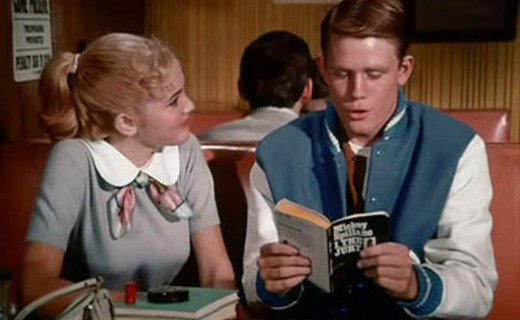
Fonzie was adored by many kids, especially kids who needed some extra help or attention. Marshall was asked if the show could do something to help kids realize how important reading was. On one of the episodes, The Fonz went to the library and checked out a book, saying “Everybody is allowed to read.” That week, library card registrations increased by 500%. During one day of filming, a call came to Paramount Studios. It was from a teenage boy who was contemplating suicide. He wanted to talk to Fonzie. Winkler picked up the call and gave the boy hope, convincing him not to take his life.
The only negative thing about Fonzie was the result he had on Winkler’s future acting career. It took a long time before he could shake that image and be considered for other types of acting roles.
Photo: happydays.wikia.com
In 2019, the cast reunited to celebrate the life of Garry Marshall who passed away in 2016. In an article by Gina Vivinetto in Today on November 14, 2019, Donny Most discussed the cast. “We were so good at what we did because we respected each other and loved each other.” He went on to say “we made it look easy and it wasn’t.”
In another article during that same event written by Zach Seemayer November 17, 2019], Williams and Howard both talked about the mentoring they received from Marshall. Williams said, “He really cared about us. More than as actors. He really inspired us to learn because he said [we might] wanna wear many hats.” Howard also learned from his mentor, saying “Garry was a natural teacher and he loved collecting theories and axioms about life but also making a show. They were all hilarious but they all rang true and they were great lessons.”
Both Howard and Winkler told writer Stephanie Nolasco of Fox News how they felt about each other and their time on Happy Days. Winkler had a hard time dealing with his sudden fame, and Howard was able to provide some grounding for him. Winkler described this time, “It’s unnatural—the human condition does not prepare you for stardom. That’s just the way it is. So, you have to hold on to yourself and then you’ve got friends like Ron who doesn’t take it all seriously. I learned from him; he was my teacher. And Garry Marshall never took bad behavior from anybody. He was a father figure. He was very funny and very idiosyncratic, and then he was very strict.”
UNITED STATES – JULY 10: HAPPY DAYS – Gallery – Season Two – 7/10/75 Fonzie (Henry Winkler) Richie (Ron Howard) Potsie (Anson WIlliams) and Ralph (Donny Most) (Photo by ABC Photo Archives/ABC via Getty Images)
Winkler also discussed his friendship with Howard. “I think people gravitate to the Fonzie/Richie relationship because Ron and I are ten years apart. He was 19 and I was 27. We had a connection that you cannot describe in real life, and it was similar off-camera. He gave me my first mitt; I’d never played baseball before. He’s my brother.”
Howard echoed the sentiments. “We were fast friends from the beginning. It continues all these years later. It was exciting for me to work with Henry because he was really a trained actor who attended Yale Drama School; just a trained New York actor. And, I’d grown up sort of through the Hollywood television system, so for me to work with this guy who was so thoughtful, so creative, and yet so hilarious, was really an opportunity for me to learn and grow and we just clicked, you know.”
UNITED STATES – AUGUST 11: HAPPY DAYS – “Get a Job” 2/25/75 Ron Howard, Henry Winkler (Photo by ABC Photo Archives/ABC via Getty Images)
The entire cast spent a lot of time together and participated in softball events. Marshall put the league together with casts from other television shows partly to help keep actors out of trouble and away from drugs. Winkler described the cast being “very much like a family. I love them, I talk to them, I email them, and I see them.”
Photo: thenewyorktimes.com
For eleven years Happy Days provided all of us with lovely memories of the Cunningham family and their friends. It is one of the best sitcoms of the 1970s and has held up beautifully in syndication. Life in the fifties was a fun and heart-warming time (at least on television), but all good things must come to an end, and Happy Days was no exception. The good news is we can get immersed back into the Cunninghams’ lives whenever we want to. Eleven seasons provides for a lot of binge watching. Better make some extra popcorn.






 thewritelife61