The Tony Randall Show: It May Have Been Judged Too Quickly

As we wind up our “Don’t Judge Me” blog series, today we’ve been sent to the bench to sit along side Judge Walter Franklin (Tony Randall) on The Tony Randall Show. Judge Franklin is a middle-aged, single-parent, widower living in Philadelphia. His extremely bright kids–teenage daughter Roberta (Devon Scott) and preteen son Oliver (Brad Savage) live with the judge, along with daffy housekeeper Bonnie (Rachel Roberts). At work we get to know his severe secretary “Miss” Janet Reubner (Allyn Ann McLerie), court reporter Jack Terwilliger (Barney Martin), and Mario Lanza (Zane Lasky), no not THAT Mario Lanza, but an overbearing assistant the judge does not care for. Judge Eleanor Cooper (Diana Muldaur) plays his co-worker and “lady friend.”

Photo: wikipedia.com

In the second season, Penny Peyser took over the role of Roberta, and Hans Conried joined the cast as Walter’s father. A lot of famous guest stars found themselves in front of the judge during the two years it was on the air. A handful of stars who appeared around Judge Franklin included Victor Buono, Beverly Garland, Michael Keaton, Hal Smith, David Ogden Stiers, and Dick Van Patten.

If this sounds a little bit like the concept of The Mary Tyler Moore Show where we see a professional at work and at home, that’s because The Tony Randall Show was produced by MTM Enterprises and created by Tom Patchett and Jay Tarses. This was the duo that produced The Bob Newhart Show a few years earlier.
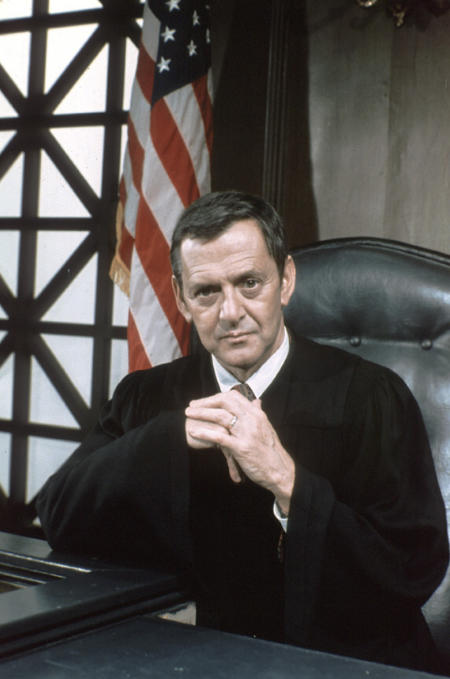
Photo: tvdads.com

The Tony Randall Show debuted on ABC in 1976. When ABC cancelled the show, it was picked up by CBS for a second season. Surprisingly, the show was not cancelled by ABC for low ratings. The show was holding its own going up against Hawaii Five-0 and Best Sellers on Thursday nights. Apparently, Patchett and Tarses did not get along with Tony Randall.  Unfortunately, they did not get along with each other either, and on top of that, they refused to take calls from ABC president Fred Silverman. Tiring of the drama, Silverman ended the show. On CBS, the show moved to Saturday nights and was on at the same time as Operation Petticoat and The Bionic Woman. When CBS cancelled the show, it was done for good.

Photo: jacksonupperco.com

Reflecting on the show, Grant Tinker remembered “Tony was born to work in front of a live audience, and the writing was largely first rate. Ultimately, however, three strong egos could not live together. Since Tony was obviously essential, Tom and Jay retreated to their office and oversaw from a distance, giving two of MTM’s younger writers, Hugh Wilson and Gary David Goldberg their first chance to produce.” (Wilson would go on to create WKRP in Cincinnati and Goldberg would create Family Ties and Brooklyn Bridge.)
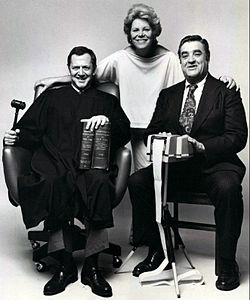
Photo: wikipedia.com

At least this turmoil produced some good results. Goldberg said from his time on The Tony Randall Show, he learned you need to hire good people and let them do their job, and that if you have to remind people you are the producer, you’re probably not a very good one.

Ken Levine discussed working with Randall in his blog from June of 2007 (kenlevine.blogspot.com/2007/06/working-with-tony-randall.html). According to Levine, Randall “was the consummate professional. Not only did he know all of his lines, he knew everyone else’s too. . . . I loved working with Tony Randall. Of course, it helped that he thought I was funny and that I didn’t smoke.”

Photo: imdb.com

Everyone seemed to enjoy working with Randall. In a Television Academy interview, Asaad Kelada, one of the directors for the show, described Randall as a “fascinating, erudite, funny man.” He talked about the way he warmed up an audience before the show with his stories. It must have been a fun set sometimes because Kelada said he used to wear a sweater over his shoulders, and it became his trademark. One day he said there was a bit of extra energy on the set, and he suddenly realized absolutely everyone on set from the cameramen to gophers to stars were wearing sweaters, blankets, or towels around their shoulders. The Television Academy also did interviews with Abby Singer, production manager for the show, and Hugh Wilson about his writing and producing. Singer said Randall was “a good guy.” When asked if the rumors that Randall was particular were true, he said “Yes, he was so particular it was unbelievable. You couldn’t even whisper when he was on the set, but he was a sweet guy.” Wilson backed their comments up, saying “It was super to work with Tony Randall. He was a vast library of show business information and very nice.”

Despite all the problems on the set, Randall was nominated for a Golden Globe for his role of Judge Franklin. He lost to Henry Winkler for Happy Days.
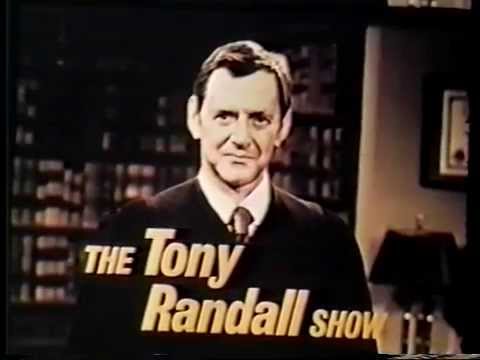
Photo: youtube.com

I could not find any official DVDs for The Tony Randall Show, but some of the episodes can be found online. It sounds like the show had all the right ingredients but either did not have enough time to find its true voice or appeared a bit too late in the 1970s at a time when things were changing in television programming. Anytime you can watch Tony Randall on the small screen (or the big screen for that matter) is a special opportunity.

Developing A Negative Perspective

We can all name a ton of shows featuring lawyers, doctors, and teachers.  Once you begin looking at other careers, it’s not easy to find more than one or two successful shows about each profession. Let’s look at a few series about photographers and see what develops.


Love That Bob – 1955-1959

Bob Collins (Bob Cummings) is a bachelor and a professional photographer. He lives with his sister Margaret McDonald (Rosemary DeCamp), a widow, and his nephew Chuck (Dwayne Hickman). Bob spends his time trying to get dates with his models while his sister spends her time trying to get him to settle down. Although he was not aware of it yet, we all knew the real love of his life was his assistant Schultzy (Ann B. Davis) who was obviously in love with him.

Not only did Bob get around, but his show followed suit. This show debuted on NBC for a half season and then moved to CBS for two years. Then it went back to NBC for two years and finally finished its life on ABC.

The opening of every show was Bob and his camera; he said “Hold It.  I think you’re going to like this picture.” Though Bob tried hard to be a playboy, he was so insecure we liked him in spite of himself and because of Schultzy.

Among the beautiful bevy of models on the show, we also got to know his best pal Harvey Helm (King Donovan) and his next-door neighbor Pamela Livingston (Nancy Kulp), an avid bird watcher.

The writers had a great perspective for the series because the show lasted five seasons for a total of 157 episodes.

The Box Brothers – 1956-1957

The Box brothers lived in San Francisco. They badly needed money and were offered a chance to buy a photography studio.  They developed more trouble than photographs. The brothers were total opposites. Mild-mannered Gilmore (Bob Sweeney) dated quiet Marilee Dorf (Nancy Hadley) while strong-willed Harvey (Gale Gordon) dated the self-assured Dr. Margaret Kleeb (Ann Morriss).

The show was one of the first series to feature a character who was heard off camera but never seen. Andy worked in the darkroom, so we never saw him in person.  The show also featured Howard McNear soon to run a barber shop in Mayberry and Barbara Billingsley who would dress in pearls and parent the Beaver.

After 26 episodes, the network had a flash of inspiration to cancel the whole thing.

Shirley’s World – 1971-1972

Shirley Logan (Shirley MacLaine) is a mod, young photographer who works for World Illustrated magazine based in London for editor Dennis Croft (John Gregson). She travels the world taking pictures, and the shows were filmed in England, Scotland, Japan, and Hong Kong, among other spots. She usually becomes involved in the lives of the subjects she is sent to photograph.

The show was a collaboration between British ITC and Sheldon Leonard.  It was expensive to film due to the traveling costs for shooting around the world and MacLaine’s salary which was reported as $47,500 per episode. This salary would be the equivalent of about $275,000 per episode today.

After 17 episodes, the network either ran out of money or changed its focus to cheaper production methods because this series was cancelled.

All’s Fair — 1976-1977

In 1976, Norman Lear created this sitcom about 49-year-old Richard Barrington (Richard Crenna) involved with 23-year old Charlotte Drake (Bernadette Peters).  He was a political columnist and she was a photographer, and they both lived in Washington DC.  That was about all they had in common.  He was conservative, lived in a luxurious townhouse, and was a gourmet cook.  She was liberal, lived cheaply, and was a vegetarian.  Most of the series centered around their generation gap and their political differences.

Jack Dodson, no longer living in Mayberry, played Senator Joplin, Barrington’s friend and Michael Keaton played President Carter’s aide.

The dialogue was fast-paced. One reviewer described it as “the best new comedy of the year” and the New York Times said, “casting is first rate and the finger-snapping pace of the show leaves just about everything looking easy and undemanding.”

Peters was nominated for a Golden Globe.  The only other well-known show to debut in 1976 was Alice.  I’m not sure if the writing quality was uneven or if the jokes just got tired and predictable, but after 24 episodes, the network decided it had been overexposed and moved on.

We’ve Got Each Other – 1977-1978

Mary Tyler Moore’s company produced this sitcom.  Stuart Hibbard (Oliver Clark) was a copywriter who worked from home and took care of the house and cooked the meals.  His wife Judy (Beverly Archer) commuted to Los Angeles for her career as a famous photographer’s assistant. Tom Poston played Damon Jerome the photographer.  He was great with a camera but a terrible businessman, so he relied on Judy for everything.

Stuart had to deal with their nutty neighbor Ken Redford (Martin Kove), and Judy had to put up with a self-centered model DeeDee Baldwin (Joan Van Ark). Damon’s secretary Donna (Red Woods) tried to keep peace between the women at work.

Thirteen was an unlucky number for this show which was cancelled after that many episodes. I guess Damon was a underexposed photographer whose contract was not renewed.

Whitney – 2011

We started with star Bob Cummings in this blog and we end with Whitney Cummings, no relation.  Whitney created and starred in this show about a photographer and her friends, a group of 20 somethings, who live in Chicago. Her boyfriend Alex Miller is played by Chris D’Elia.

Beverly D’Angelo from the Vacation movies played her mom in the original pilot, but was replaced by Jane Kaczmarek with all the scenes re-shot. The show did not garner great reviews.  The debut was watched by 6.8 million viewers in September, but by December only 4 million of them were still watching.

After 38 episodes, the network thought too large a time lapse had happened and ended the show.  Cummings also was the co-creator of 2 Broke Girls the same year.  That show had better luck, lasting five years, being cancelled this past May.

Obviously shows about photographers did not do too well over the television decades.  But if anyone can handle it, it’s these characters – after all they deal with negatives all day long.