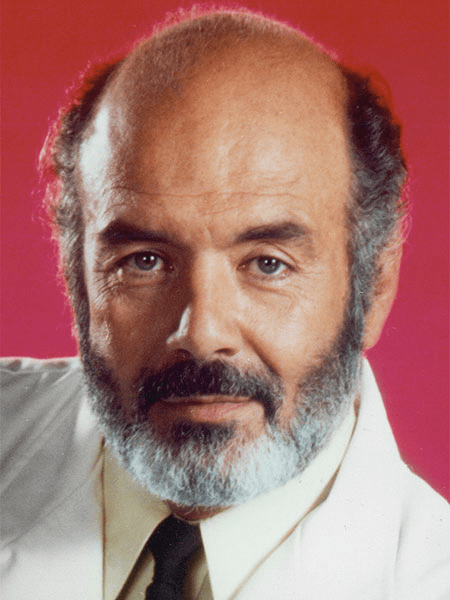
This month we are right in the middle of one of my favorite blog series, What a Character. This week we are delving into the career of Noam Pitlik; in addition to his acting, he won an Emmy for his work as a director. Which show? Let’s find out.
Pitlik was born in Philadelphia in 1932. After graduating from high school, he enrolled at Gratz College and later was a theater major at Temple University in 1954. Pitlik had a two-year stunt in the Army and earned a master’s degree in theater at New York University.
He began his acting career on WCAU in a western. In 1951, he was hired for the set design and construction crew for the Philadelphia Experimental Theater. He carried a bit of his hometown with him when he was part of the Summer Theater Guild in Indiana, Pennsylvania in the “Philadelphia Story.” He was hired for his Broadway debut in an off-Broadway production of The Threepenny Opera.”
📷imdb.com
In 1961 he moved to Los Angeles and received his first television roles, appearing on Cain’s Hundred and Dr. Kildare. Cain’s Hundred was not a show I remembered hearing much about. It was about a former underworld lawyer who works with the federal government to bring the top 100 criminals to justice. The show lasted one season. Pitlik had a variety of offers for shows throughout the sixties. Most of them were dramas and westerns, but we also see him on My Favorite Martian, The Munsters, Gidget, The FlyingNun, The Monkees, The Andy Griffith Show, The Doris Day Show, Get Smart, That Girl, and I Dream of Jeannie.
During the sixties, he married for the first time. His marriage with Jesse Blostein in 1967 would only last three years.
Pitlik also appeared in fourteen films and eight made-for-tv movies. The most memorable films are The Graduate, Fitzwilly, and The Fortune Cookie.
📷famousfix.com
The seventies were his most prolific decade of acting. He appeared in 26 different series, often in 2-5 different episodes. You’ll see Pitlik in reruns in a variety of genres including Hogan’s Heroes, Room 222, Bewitched, LoveAmerican Style, All in the Family, The FBI, Cannon, Mannix, The PartridgeFamily, The Bob Newhart Show, The Odd Couple, and Barney Miller. His last acting appearance was in Becker in 1998.
The seventies were also when he tried the role of husband again, marrying Linda Hirsch in 1974; this marriage also lasted three years.
He began directing in the seventies and obtained 39 directing credits throughout the next two decades.
📷imdb.com
In an interview with Temple University for the Alumni Review in 1979, Pitlik said that the switch in his career was not “a case of my needing to change functions for economic reasons. I used to figure out what I made a day as an actor, and it was obscene. I changed for emotional reasons. I had become very frustrated by the kinds of things I was doing in acting, and I was looking for a change in my life that would be more challenging. I enjoyed acting, but I never seemed to get enough to do.” His first episode as director was on The New Dick Van Dyke Show. He directed 12 episodes for The Practice and 11 for Taxi.
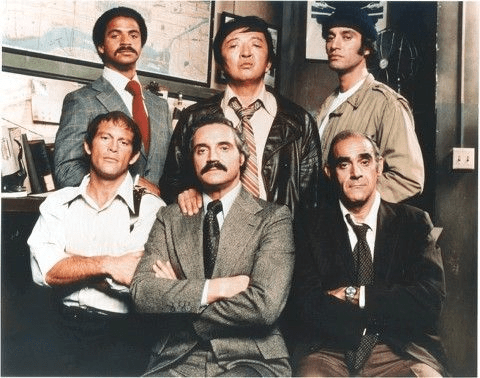
However, Barney Miller was where he perfected his skill as director for 102 of its 171 episodes. In 1979, he won an Emmy as Director for the show. He beat out Paul Bogart for All in the Family, Alan Alda and Charles Dubin for M*A*S*H, and Jay Sandrich for Soap. He also received a Peabody Award and a Directors Guild of America Award for his work on Barney Miller. He lost the Emmy in 1981 to James Burrows for Taxi. His co-nominees included Jerry Paris for Happy Days, Linda Day for Archie Bunker’s Place, Burt Metcalfe and Alan Alda for M*A*S*H, and Rod Daniel for WKRP in Cincinnati.
📷tumblr.com Cast of Barney Miller
In the Temple interview, Pitlik said that his “main responsibility is to create an atmosphere in which each of the people involved in the production can conform to their best work. Although a director oversees all aspects of the production, there are many people involved, and he’s dependent on all of them. There’s no more collaborative business than the television business. Each person contributes to the success or failure of a show whether he or she is a writer, actor, cameraman, or whatever.”
In 1995 he began directing episodes of The Home Court and did so for 14 of the 20 episodes. I must admit I do not remember this show at all. The synopsis was Sydney Solomon was a family court judge who had to deal with the toughest prosecuting attorneys and repeat offenders. However, her biggest challenges came when dealing with her kids, four boys aged 11-19.
📷pinterest.com
Pitlik had better luck with his third marriage to Susan Whittaker which lasted from 1986 until his death in 1999. Whittaker was a television producer. Noam passed away from lung cancer at age 66.
Like Jerry Paris, Pitlik had a very successful acting career before finding his passion behind the camera. If you are responsible for directing a series, Barney Miller is a great accomplishment. It was fun to learn more about his career both in front of and behind the camera.
Today we began our “What a Character” blog series. Typically, when we discuss character actors, we are looking at actors who were busy in the forties, fifties, and sixties, but in the past sixty years, there have been a lot of great character actors as well. Today we are looking at the career of Richard Schaal.
Schaal was born in Chicago in 1928. His dad was a machinist, and his mom was a telephone operator. After he graduated, he ran a construction company before joining the Second City comedy troupe in 1959, not long after it began.
In 1950 he married Lois Treacy. I could not find a divorce date, but it was some time before 1964. They had a daughter Wendy who is also an actress.
Eventually he made his way to California. He had seventeen film credits on his resume; most of them were not too memorable, but he was in The Russians Are Coming, The Russians Are Coming and Slaughterhouse Five.
📷imdb.com
Television is where he made most of his acting appearances. He began his TV career in 1964 in East Side/West Side. This was a show I had not heard of before. Apparently, it was on for one year and starred George C. Scott as a social worker trying to help his clients in the mix of cultures that makes up New York City.
Schaal would find a few more roles in the sixties on several shows including The Dick Van Dyke Show, That Girl, and I Dream of Jeannie.
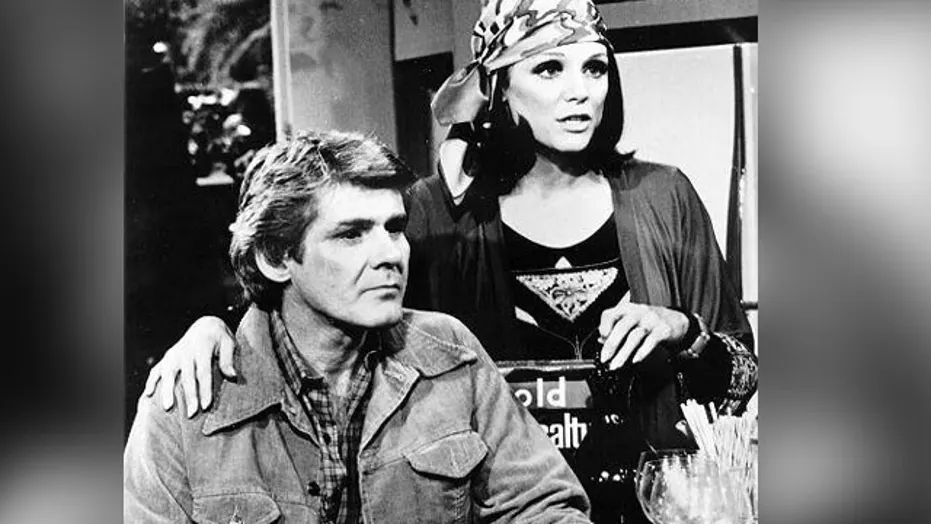
In the sixties, Schaal met Valerie Harper and they married in 1964.
During the seventies, he collected roles on many sitcoms including The Doris Day Show, The Partridge Family, Love American Style, The Bob Newhart Show, and The Mary Tyler Moore Show.
📷foxnews.com
On The Mary Tyler Moore Show, he played Howard Arnell, Paul Arnell, Chuckles the Clown, and Dino. Not surprisingly, he made appearances on Rhoda and Phyllis.
In 1970, Schaal and Harper wrote a script for Love American Style for “Love and the Visitor” which aired on season two, episode 5 where a bridegroom ends up in the wrong girl’s bedroom. Harper said they were part of the Writers Guild, but their hearts were in acting and once she got the part of Rhoda, the writing stopped.
Harper discussed Schaal during an interview with the Television Academy. She describes him as her former husband and good friend. She said she and Schaal hosted a talk show with Skitch Henderson for about a year in the mid-sixties. They did interviews and sketches. She said after that they decided to move to Los Angeles.
📷imdb.com The Russians Are Coming The Russians Are Coming
The seventies were also a busy time for Schaal who continued to find roles on television. You can see him on dramas such as Nero Wolfe and Hardcastle and McCormick. He also was on sitcoms including Harper Valley PTA and JustOur Luck. He had a recurring role during this decade on Trapper John MD from 1981-85. The show was a sequel of M*A*S*H and portrayed Trapper later in life. Schaal played Dr. David Sandler. He also accepted a role on It’s a Living in 1980. His daughter Wendy was part of the cast. She has a very successful career and has appeared in many popular series. From 2005-2023, she was one of the voices in American Dad.
In 1980 he tried marriage a third time with Tasha Brittain. They would divorce in 1989.
📷pinterst.com
Schaal retired in 1990 and passed away in 2014 in Los Angeles. No cause of death was provided. He did have spinal surgery in the late 90s and was in a wheelchair after that.
Sadly, I could not find a lot of information about Schaal or his personal life. He had a successful career, but it’s too bad there wasn’t more improvisational work at the time. It sounds like he was very gifted in that area. He didn’t have as much luck in love, but at least, according to Valerie Harper, he was a great guy and they remained good friends. He was one of those character actors who added so much to the television industry, especially in the sixties and seventies.
This month we are Riding the Range, exploring some of the westerns from the fifties and sixties. One of those shows that was on the air from 1957-1962 was Tales of Wells Fargo.
The show was produced by Revue Productions and set in the 1870s and 1880s. Gene Reynolds was one of the creators of the show, along with Frank Gruber and James Brooks. Reynolds would go on to great success as a director, producer and writer, and my favorite of his was M*A*S*H. Although this show was set in the same time as Daniel Boone, it was better at getting history correct. The show featured special agent Jim Hardie (Dale Robertson) with his horse Jubilee. It was loosely based on the life of real detective Fred J. Dodge. Sometimes Hardie ran into characters from history including Jesse James and Belle Starr.
📷pinterest.com Fred J. Dodge
Fred Dodge was born in California in 1854. He went to work as an undercover agent for Wells Fargo, working in California, Nevada, and Arizona. In 1979 he was in Tombstone and recommended hiring Wyatt Earp as guard for the stage line. He became great friends with Earp. Later Dodge became constable of Tombstone while working undercover. In 1890 he left his undercover work and became a known employee of Wells Fargo in Texas. He purchased a 2,000-acre ranch near Boerne, Texas and when he retired in 1917, he lived there with his family. Dodge was described as an intelligent and successful investigator. He wrote 27 journals during his career, noting his activities and travels in them. Some of these were used for Tales of West Fargo.
I had always assumed this show was about stagecoach travel, but it was not, although stage coaches played a part. In the mid-1800s, the Wells Fargo stage line was the primary connection between the East and West coasts. Wells Fargo did not operate a stage coach line, but they did use that form of transportation for money, gold and other valuables to be delivered. Trains are involved in many of the plots. One of the trains used in the show would eventually travel to Hooterville and be renamed the Cannonball.
📷imdb.com
The first five seasons were black and white half-hour shows, while the final season switched to a color, hour-long show. During the last season, Hardie settles on a ranch near San Francisco and several recurring characters (Jack Ging, William Demarest, Virginia Christine, Lory Patrick, and Mary Jayne Saunders) were added to the series. Earle Lyon replaced Nat Holt as producer in 1960.
The theme song was written by Stanley Wilson and Mort Greene. Wilson was a prolific composer, amassing 147 credits for composing and 278 for music department credit on television and in movies. Mort Greene was best known as a writer for The Red Skelton Show and for his musical role for Leave it to Beaver.
The number of well-known actors who appeared on the show was surprising. Here are just a few of the huge number: Claude Akins, Eddie Albert, Hugh Beaumont, Dan Blocker, Charles Bronson, Edgar Buchanan, Harry Carey Jr., Chuck Connors, Buddy Ebsen, Beverly Garland, George Kennedy, Tina Louise, Steve McQueen, Jack Nicholson, Leonard Nimoy, Denver Pyle, Jason Robards, Vito Scotti, Dawn Wells, and Adam West.
📷mysteryfile.com
It was an NBC show. The pilot premiered on Schlitz Playhouse of Stars. Its biggest competition was Father Knows Best in seasons two and three. It was very popular with the viewers. The show was in the top ten during seasons one through four. For the sixth season, with an entire new cast, new theme song, and color, it was almost like a new show. NBC moved it to Saturday nights against Perry Mason and ratings declined drastically, costs went up significantly, and it was canceled.
Robertson thought the key to the popularity of the show was because it was not geared specifically to adults or kids. It was a family show. When Robertson first read the script, it was terrible, but he owed Nat Holt a favor, so he accepted the role, assuming that it would never make it. Robertson received a 50% ownership in the show, so he said of course it made him want the show to be better and he convinced them to replace most of the original script. He said that he enjoyed his time on the show a lot and that the crew was close and professional. They never went over schedule or over budget during the entire run.
📷thehollywoodreporter.com
The first two seasons were released on DVD in 2011 if you want to check them out. It sounds like this was a solid show. The network supported them, the cast was close, the production team was on top of things, and they all enjoyed their time with the show. That is a rare thing to hear in the television business. They took a gamble in the last season, and it didn’t work out, but perhaps it was for the best. It sounds like the actual show ended the season before because the last season things changed so much it was a completely new production. I would like to read more about Fred Dodge. His life sounds fascinating.
In this last blog in our series of Supportive Men, today’s actor might not be someone most people expect to see when talking about television. When most people think about Leslie Nielsen, they think of Airplane! and some of his other movies. While he did have a prolific movie career, he also has a well-deserved place in television. This guy amassed 259 (150 in television) acting credits during his six-decade long career.
📷tmdb.com
Nielsen was born in Saskatchewan, Canada in 1926. His mother was from Wales, and his father was a Royal Canadian Mounted Policeman. His older brother served in politics, being a Canadian Member of Parliament, a cabinet minister, and a Deputy Prime Minister of Canada. I read several sources that said his father was abusive, and Leslie wanted to move out as soon as possible.
Leslie enlisted in the Royal Canadian Air Force, serving until the end of WWII. He was legally deaf, wearing hearing aids most of his life, but he was able to train as an aerial gunner.
After the war, he worked as a disc jockey in Calgary, Alberta before enrolling at the Lorne Greene Academy of Radio Arts in Toronto. He was offered a scholarship at the Neighborhood Playhouse in New York.
📷wikipedia.com Bonanza
He made five television appearances in 1950 with the first being on The Actor’s Studio. He continued working in television, primarily on dramatic theater series, through the 1950s. In 1956, he had his first big-screen roles, appearing in four movies that year including Ransom, Forbidden Planet,The Vagabond King, (Nielsen later referred to this film as the “Vagabond Turkey”) and The Opposite Sex.
Leslie discussed his role in Forbidden Planet: “Supposedly a science fiction version of Shakespeare’s The Tempest . . . The Trekkies today regard it as the forerunner of StarTrek. I just had to wear a tight uniform and make eyes at Anne Francis. I was pretty thin back then.”
He became an American citizen in 1958 but continued to be proud of his Canadian citizenship as well.
While most of his credits for the late fifties were movies, he jumped back into television in the sixties, appearing in forty different shows. Many of them were dramatic theater roles, but you can spot him in Alfred Hitchcock Presents, Route 66, Wagon Train, DanielBoone, The Wild Wild West, Dr. Kildare, Bonanza, The Man From U.N.C.L.E., and Gunsmoke. His only recurring role during this decade was on Peyton Place where he played Kenneth and Vincent Markham in 18 episodes.
📷pinterest.com on M*A*S*H
The seventies were almost a repeat of the sixties. His recurring role was on The Bold Ones. He also appeared in Medical Center, Mod Squad, M*A*S*H, Barnaby Jones, Hawaii Five-0, Kojak, Columbo, and The Love Boat.
1980 brought him the role of Dr. Rumack on Airplane!. Nelson’s deadpan delivery of lines in that movie is what most fans today remember about his career. Of course, his response to the line of “Surely you can’t be serious?” of “I am serious. And don’t call me Shirley” is still repeated today. Leslie said, “he was pleased and honored that he had a chance to deliver that line.” Film critic Roger Ebert once called him “the Laurence Olivier of spoofs.”
📷themoviebuff.com Airplane!
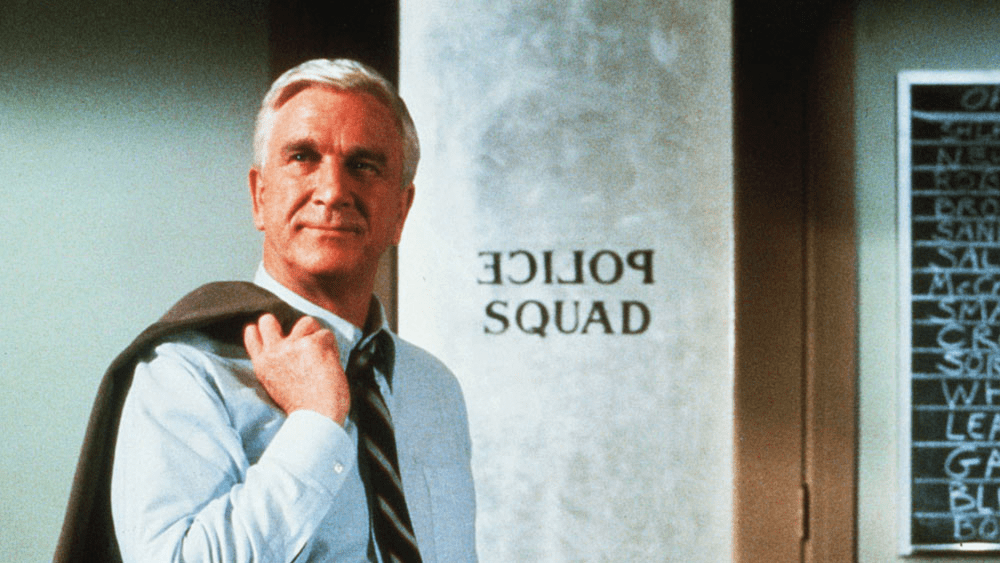
He continued in these types of roles in Police Squad and Naked Gun and the sequels. His movie roles increased in the eighties and nineties, but he continued to accept television roles off and on. You can catch him on Murder She Wrote, Highway to Heaven, Who’sthe Boss, The Golden Girls, and Evening Shade.
His roles continued throughout the 2000s until his death, but the last decade included fewer memorable shows, although he worked less overall. When reflecting on this, Neilsen said that “I’m afraid if I don’t keep moving, they’re going to catch me . . . I am 81 years old, and I want to see what’s around the corner, and I don’t see any reason in the world not to keep working. But I am starting to value my down time a great deal because I am realizing there might be other things to do that I am overlooking.”
📷npr.org Police Squad
While Nielsen was very successful in his career, he was not as successful with his marriages. From 1950-56, he was married to Monica Boyar. His longest relationship was with wife Alisande Ullman from 1958-1973. He then married Brooks Oliver for two years from 1981-83 and then Barbaree Earl from 2001-2010.
One of his hobbies was golfing, and he later did some humorous instruction videos about the sport. He once said, “I have no goals or ambition. I do, however, wish to work enough to maintain whatever celebrity status I have so that they will continue to invite me to golf tournaments.”
Nielsen died in his sleep in 2010 from pneumonia.
He received two Walk of Fame stars: one in Hollywood in 1988 and one in Toronto in 2001. Nielsen was known for his flatulence gags, especially on movie sets, and his tombstone says “Let ‘er Rip.”
While Nielsen’s career is impressive, what I loved most about him is that he seemed to thoroughly enjoy life. That’s a great reminder for us all. Our best role should be enjoying life to the best of our ability.
This month is our blog series is “Potpourri Month” and we have a sub-theme every day; today’s is Propourri” for the pro who handles props. When you think of your favorite shows, there are props included in those great memories: the couch at Central Perk, Fonzie’s leather jacket, or the cereal boxes on Seinfeld’s refrigerator. First let’s learn a little about the Props Master and then we’ll take a look at some of our most-loved props.
The Fonz’s jacket Photo: ebay.com
The Prop Master heads up the Props Department. They are charged with acquiring, organizing, and safely handling the props for the shows.
Each episode has a list of props that will be needed for the show. The props master reviews the scripts and has meetings with various department heads to ensure everything that is needed is on the list.
Sometimes the props master does research to see what would be appropriate for a specific era or place. Cars were quite different in the fifties than the eighties. A grocery store does not look the same in China as it does in Atlanta.
During filming, the props master has to keep track of props and make sure everything is put back in its place.
So, what are some of the props that have become synonymous with our favorite series? Let’s put together a prop list that includes props from our favorite shows.
Living rooms have a lot of cool furniture. When you think of comfortable places to sit, you have to think of Modern Family’s couch, Archie’s chair from All in the Family, Chandler and Joey’s Barcaloungers from Friends, and Martin Crane’s duct-taped, worn chair on Frasier.
The Bunkers’ Chairs Photo: comparativemediastudies.com
Many of the Modern Family characters are interviewed on their couch which sits in front of their stairs to the second floor right as you enter the front door. The walls are Benjamin Moore’s Labrador Blue. The couch itself is from Sofu-U-Love and the primary-colored striped pillows are from Pottery Barn just in case you want an interview sofa of your own.
Archie Bunker’s chair is from the 1940s. It’s covered in an orange and yellow woven fabric. The props master purchased the chair from a thrift store in Southern California. Whenever anyone but Archie sits in the chair, it is made obvious to them that they need to find another seat.
The barcaloungers Joey and Chandler use were originally made in Buffalo New York, named after the company that made them. They have moving parts to allow for footrests and reclining. Joey’s Barcalounger is brown leather and he calls it “Rosita.”
Martin Crane’s chair is in the same color family as Archie Bunker’s. The prop department made it, so it’s a one-of-a-kind piece. It’s striped and quite unattractive looking especially with Frasier’s expensive tastes echoing in the rest of the room, but Martin loves it and Frasier loves Martin so it stays. In the first episode, a guy carries in the chair when Martin and his dog Eddie move in with Frasier. On the last episode, the same guy carries the chair out when Martin gets married and moves out. The chair is really almost a character during the run of the series.
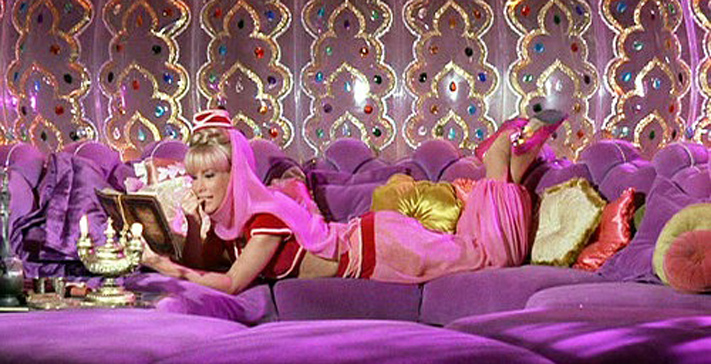
Jeannie in her bottle Photo: blazenfluff.com
There are a lot of fun accessories from our favorite living rooms. Just a couple include Jeanne’s bottle from I Dream of Jeanne, the “M” that was on the wall in Mary Richard’s apartment on The Mary Tyler Moore Show, and the Chihuly sculpture from Frasier. Who can remember The Dick Van Dyke Show without thinking about the ottoman Rob Petrie might trip over?
Jeannie uses her Arabian glass bottle to sleep in and to hide in when someone other than Tony and Roger is in the house. The bottle has a long, purple couch with her blankets and pillows. She also has an Arabian candle, a photo of Tony, a mirror, and her book about genies.
Mary’s “M” stood for so much more than her first name. We knew that an independent, smart woman lived in that apartment. Everyone wanted to grow up and be able to put their own initial on the wall just like the brass one Mary had. When she moved to her newer, more modern apartment, the M went with her.
Martin’s chair on Frasier Photo: jacksonville.com
In contrast to Martin’s puke-colored chair on Fraiser, Frasier had so many expensive items scattered around his home. One of them was Dale Chiuly’s Macchia. This blown-glass vase was green and brown. It was worth $30,000 at the time, and the props master locked it up after filming each episode.
We all recall the opening of The Dick Van Dyke Show. Will he or won’t he? I think most of us remember him falling over the ottoman, but do you know sometimes he walked around it? Reiner wanted a clever opening for the show and while talking with John Rich, the director, they decide Rob will fall. But then Reiner suggested a variation, so they filmed him not tripping. No one ever knew from episode to episode if he would fall or not.
Burns and Allen have their closet adjoining the living room. While Fibber McGee and Molly have a ton of items in their closet, whenever Gracie opens hers, we see a collection of hats that men have left when they are in a hurry to get out of the Burns house after dealing with Gracie’s logic.
When I think of some of my favorite kitchen items, I think about Jerry Seinfeld’s refrigerator with its revolving display of cereals. I know if I visited My Three Sons, I would get to sit around the kitchen table where all the action happens on the show. And Gracie would definitely take me into her kitchen to have some coffee from the pot she almost always kept full for her and Blanche to talk over.
Jerry always has cereal in his cupboard. Some sources say he had up to seventeen at a time. Knowing that cereal doesn’t last all that long, he ate a lot of cereal. I’m hoping Fruit Loops was one of those choices.
My Three Sons’ table Photo: pinterest.com
While as viewers we love that the kitchen was the heart of the Douglas home. From the first episode when Steve got Chip to help him with the dishes to talk to him about “love,” to the grown boys gulping down orange juice at the table to leave early for their busy day, we spent a lot of time in that room. Uncle Charlie’s bedroom was just off the area, so he could come and talk with someone getting warm milk in the middle of the night. The actors might not have had the same warm, fuzzy feelings. Barry Livingston discussed their filming schedule because Fred MacMurray did all his filming in two short groups of days. He said sometimes, “you would sit at the kitchen table all day long and they would do close-ups. You would be sitting in the same place at the same table and you would do a close-up from 12-15 different episodes. All you would do was change your shirt because they couldn’t see anything below.”
Burns and Allen Photo: pinterest.com
Gracie and Blanche always made time to have coffee to talk over things. Whether it was 7 am, 1 pm, or 7 pm, the coffee pot was always on. Burns and Allen also did coffee ads for Maxwell House, so I am assuming that it was Maxwell House the friends drank daily on Burns and Allen.
I know if I explained every item to you in detail, we would still be on this blog next week, so I’ll just some up the rest of the categories.
Bedrooms: Beds are definitely the focal point. We have the Petries’ twin beds that are not convenient for a married couple. Lisa and Oliver Douglas had a very large bed on Green Acres; unfortunately, it was open to the outside where anyone could come in or out. Oscar Madison had a bed on The Odd Couple, but no one knew it because his room was so messy. We definitely remember Bob and Emily Hartley’s bed because not only was it important in The Bob Newhart Show but it was in the finale of Newhart. It is also hard not to recall Alex Keaton’s Ronald Regan poster that took up one of his bedroom walls on Family Ties.
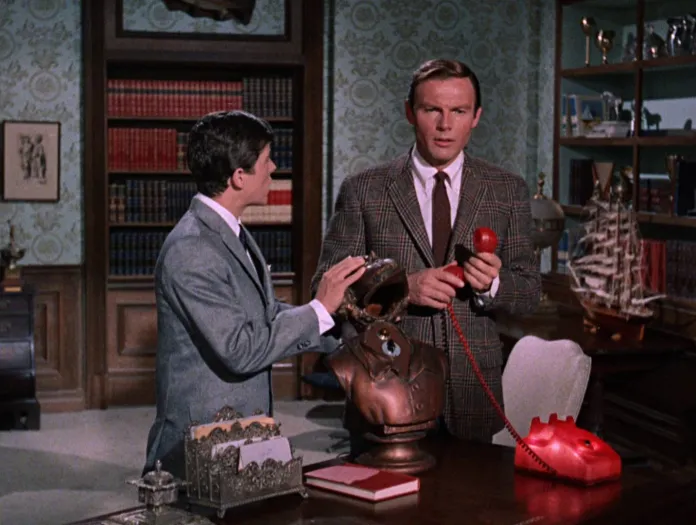
Batman with bust and phone Photo: batnews.com
Libraries and Dens. Three specific rooms come to mind. On Batman, we had the Shakespeare bust that hid the bat phone in their library. We had George Burn’s television on Burns and Allen where he could watch was going on during the show without the other characters knowing he was listening in. Finally, we think back to The Brady Bunch where the six kids fought over what to watch on television and did their homework after school.
Garages: The Jetsons they kept their flying car in the garage, Last Man Standing where Tim kept his antique car, and The Adventures of Ozzie and Harriet, where they kept everything but the car. Ozzie was always out there looking for something.
Workplace: When characters go to work, we get a whole new scene full of fun props. Who would visit Dunder Mifflin without stopping by to see Pam at the front reception desk? Rob Petrie had a couch where the writers worked their magic. Central Perk featured the orange couch everyone remembers from Friends. The sofa was so beloved that replicas of it went on a world tour in 2019 for the shows’s 25th anniversary. The actual sofa used on the set was sold at auction in 2011 and it went for about $5000. Of course, Cheers would not have been the same without the stools for Norm and Cliff. Get Smart had so many fun props, it’s hard to choose; the Cone of Silence was certainly fun for everyone who could hear what was said inside by characters who thought they were speaking where no one could hear them. And Hogan’s Heroes also had a lot of fun items including the coffee pot that could relay anything said in Colonel Klink’s office.
Laverne Photo: pinterest.com
Clothing: While I love almost everything they wore on Burns and Allen, The Brady Bunch, and The Partridge Family, there are a few other pieces that really stand out. Who would not want to wear Fonzie’s leather jacket? Columbo’s coat might be a bit rumpled but it had been around to solve a lot of mysteries. Sally on McMillan and Wife had the San Francisco jersey that she wore to bed. And talk about special clothing, Laverne’s wardrobe with her iconic “L” on everything was a big part of Laverne and Shirley.
Unusual Items: Last, but definitely not least, we have those special objects that belong to specific characters. When you think about Radar on M*A*S*H, don’t you also think about his teddy bear? Barney Fife would never leave the house without his silver bullet. Half the plots would disappear if Gilligan’s Island did not have a radio for the Professor to try to repair and hear about the world outside the island. Buffy’s Mrs. Beasley on Family Affair was very popular; the doll was sold for decades after the show went off the air. Kojak’s lollipops had to be on the list. Also, if you are talking about “things,” how could we not include the “Thing” from The Addams Family?
I hope you enjoyed getting to know something about some of our favorite furniture and recalling special props from well-loved shows. If you want to see a couple of these items, visit The Smithsonian Museum in Washington D.C. where you can see Archie’s chair and Fonzie’s leather jacket. I’d love to hear your favorites.
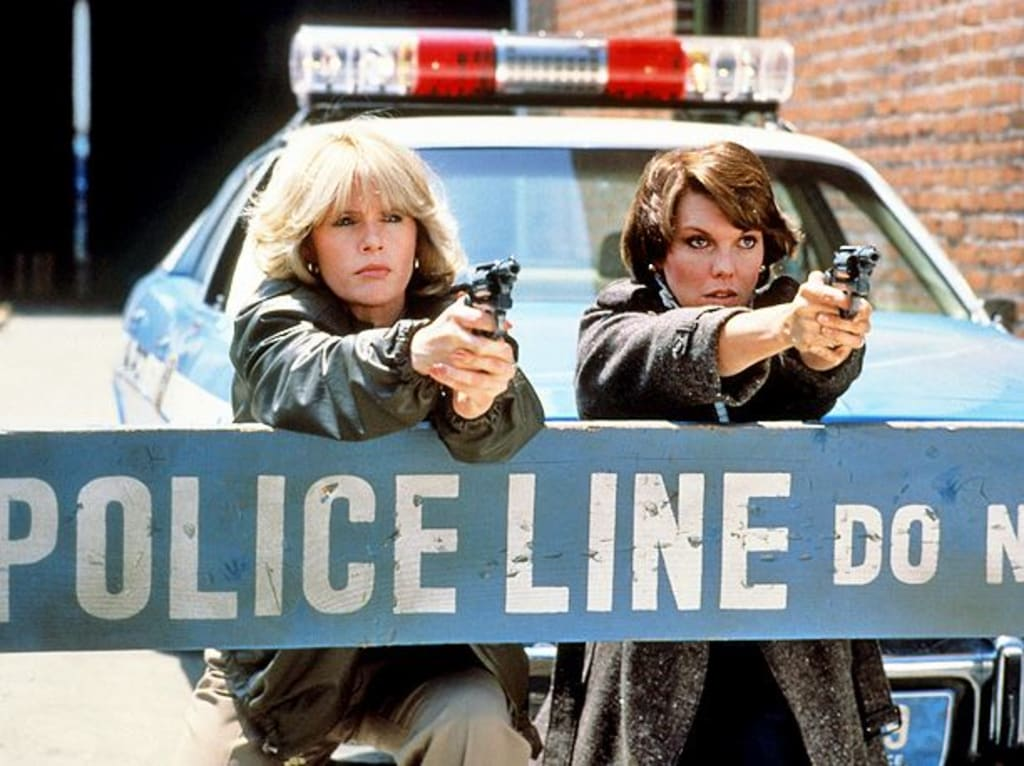
During the month of November we are going to learn about a few of my favorite crime dramas. As the saying goes, “Ladies first,” so we are beginning with Cagney & Lacey starring Sharon Gless and Tyne Daly.
Photo: datebook-sfchronicle.com
The show debuted in March 1982 and continued to May of 1988. We solve cases with a pair of detectives that seem very different from each other. Christine Cagney (Gless) is a career woman all the way while Mary Beth Lacey (Daly) is also busy raising her family. Cagney’s mother had been a well-to-do professional career woman. She was involved with Charles Cagney, a police officer; the two separated soon after the birth of Chris and her brother Brian. She swung back and forth between the upper-class world and the blue-collar world her father traveled in. She was also an admitted alcoholic and was only committed to her job. Lacey was louder and more talkative and quick to express her opinions. She was a mother first–living in a solidly middle-class world. The duo works in the 14th precinct in Manhattan. Unlike other crime dramas of the past, these two partners were not best friends. They did, however, totally depend on each other and trusted and respected each other. They would die for each other, if necessary, but they never had a close relationship or hung out together after work.
Photo: imdb.com
In the pilot movie, Loretta Swit from M*A*S*H was cast as Cagney; when the show was a go, she could not get out of her M*A*S*H contract, so the role was given to Meg Foster, but when it came back the next season, Gless took over and stayed for the rest of the run of the series. According to CBS, Foster was seen as too aggressive.
Filling out the primary cast was their supervisor, Lt. Bert Samuels (Al Waxman), fellow detectives Marus Petrie (Carl Lumbly) and Victor Isbecki (Martin Koye), and veteran detective Paul La Guardia (Sidney Clute). John Karlen played Lacey’s husband Harvey and her two sons were Harvey Jr. (Tony La Torre) and Michael (Troy Slaten). Cagney was involved with Sgt Dory McKenna (Barry Primus) who struggled with drug addiction and, later, a local attorney, David Keeler (Stephen Macht).
The show was actually canceled after six episodes in 1982. Executive producer Barney Rosenzweig was on a mission to reverse the decision. (Fun fact, Rosenzweig was married to the co-creator of the show, Barbara Corday, at the time, but later married Sharon Gless.) After casting Gless, the network relented. Ratings the next year weren’t that great either. CBS again canceled the show. Fans staged a letter-writing campaign to protest; Daly won the Emmy that year, so the network once again brought the show back. However, by the time they reached that decision, the sets had been destroyed and the stars let out of the contracts. Critics had always loved the show and during the six seasons it was on, either Gless or Daly won the Emmy for Best Lead Actress in a Drama every year. (It actually earned 36 nominations total with 14 wins overall including Best Drama in 1985 and 1986.) Season three found the show in the top ten.
Photo: pinterest.com Cast of Cagney and Lacey
Airing Monday nights, it held its own against Monday Night Football. However, midway through season seven, it was moved to Tuesdays up against thirtysomething. By spring, Cagney and Lacey had slipped to 53rd place and the network canceled it for the third time.
The theme song for the first season was “Ain’t That the Way” by Michael Stull and sung by Marie Cain. Season two brought about a new beginning using an instrumental theme composed by Bill Conti.
Although the series was over, the duo of Cagney and Lacey continued to attract viewers. They appeared in four made-for-television movies: The Return in 1994, Together Again in 1995, The View Through the Glass Ceiling in 1995, and True Convictions in 1996.
Photo: vocalmedia.com
No big surprise for those of you who regularly read my blog–a reboot was put together in January of 2018 featuring Sarah Drew and Michelle Hurd as Cagney and Lacey. In an echo from the past, the pilot was rejected by CBS.
Cagney and Lacey was an influential show. It was more than a show about two women leads though. It was brilliantly written and tackled tough issues: breast cancer, alcoholism, trying to balance the life of a mother with a career. The characters were two of the most interesting characters on television. They redefined what women could be; they acted and appeared like real women in their thirties. They were not Charlie’s Angels.
Photo: pinterest.com
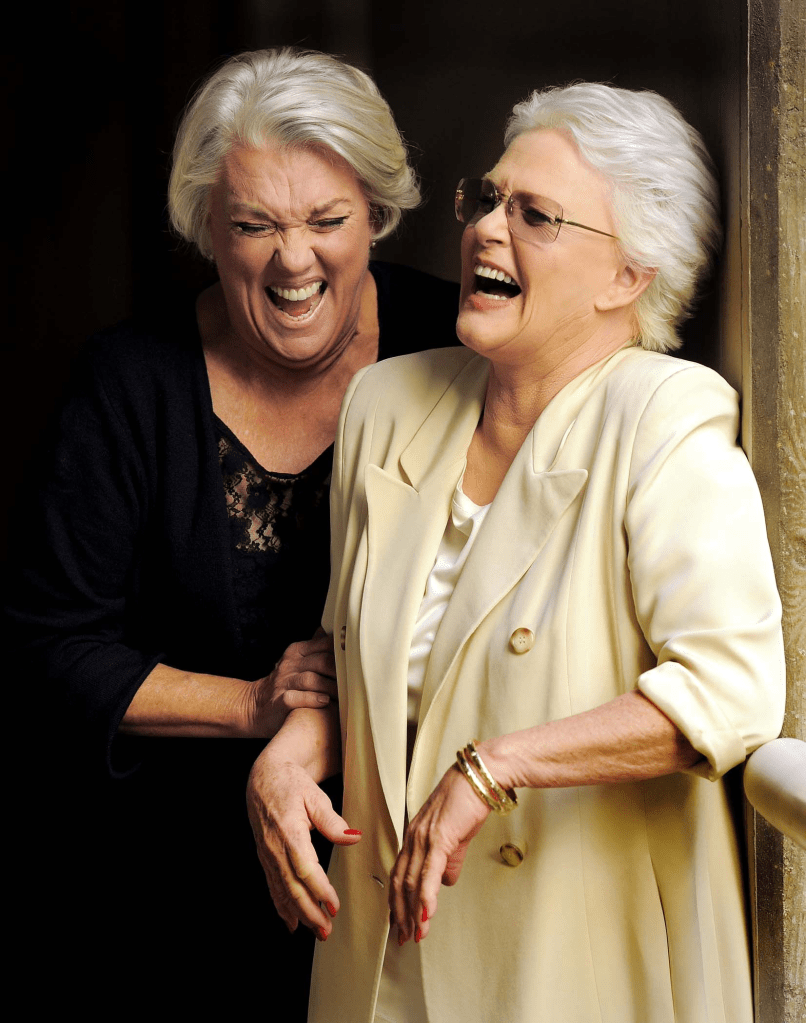
Cagney and Lacey were not close friends but Gless and Daly surely are. In an interview with Sarah Crompton in December of 2011, she described them as “sassy and attractive, they sit alongside each other, cracking jokes, finishing each other’s sentences.”
I love that we all can search for our dreams on television. Sharon Gless shared that “All my life, I sat in front of the little TV that we had and I watched the Oscars every year. My little heart would get so excited and where I lived in Hancock Park you could see the lights in the sky from the Hollywood Theater. Now I’ve made my career in television . . . this year I got into the Motion Picture Academy.” I love to picture another little girl sitting in her living room, watching Cagney andLacey and dreaming about becoming a police officer.
We are up close and personal this month with some of our favorite male television stars, and Pernell Roberts is definitely on that short list. Pernell Roberts was well known to television viewers in the early sixties and the early eighties. Some fans might not even realize the two characters he was best known for, Adam Cartwright on Bonanza and Dr. John McIntyre on Trapper John, MD were played by the same man.
The Family of Bonanza Photo: toledoblade.com
Pernell Elven Roberts Jr. was born an only child in 1928. He was named for his father who was a Dr. Pepper salesman. During high school, Roberts played the horn, acted in several school and church plays, played basketball, and sang in the local USO shows. He enrolled at Georgia Tech but then enlisted in the US Marine Corps. He played both the tuba and horn in the Marine Corps Band while sometimes tackling the sousaphone and percussion parts. After his time in the Marines, he enrolled at the University of Maryland where he enjoyed participating in classical theater. He left college to continue his acting career.
In 1949, he had his professional stage debut in “The Man Who Came to Dinner” with Moss Hart and Kitty Carlisle. He then took on several roles in Philadelphia.
In 1951, Roberts married Vera Mowry; she was a professor of theatre history at Washington State University. They divorced in 1959. They had one son who was killed in a motorcycle accident in 1989.
In 1952, Roberts made the big move to New York City appearing in off-Broadway shows. Several of his costars were Joanne Woodward and Robert Culp. He performed several Shakespeare roles.
In 1956, Roberts made his television debut in Kraft Theatre. In 1957, he signed with Columbia Pictures. His first big-screen role was as Burl Ives’ son in Desire Under the Elms. His second role was with Glenn Ford and Shirley MacLaine in The Sheepman.
Roberts continued to accept television roles with ten appearances in 1958 and six in 1959.
Photo: simple.wikipedia.org
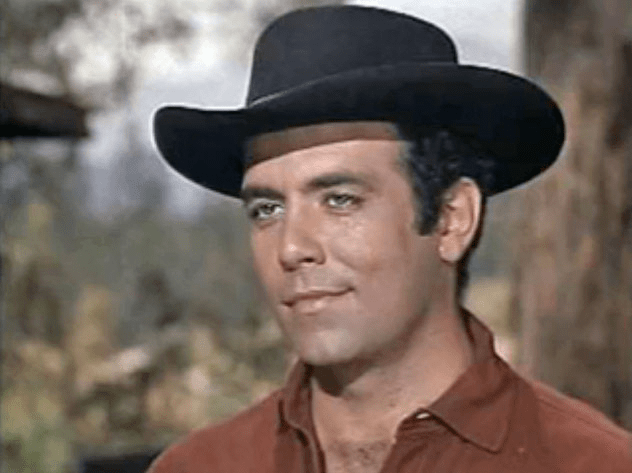
From 1959-1965 he would portray Adam Cartwright, Ben’s oldest son on Bonanza. Each of the brothers had a different mother, and Adam was the only Cartwright to attend college, studying architectural engineering. After acting in classical theater for so much of his early career, the transition to a weekly series was a difficult one for Roberts. He thought it a bit ridiculous that the independent sons had to get their father’s permission for everything they did. He wanted to act in a show with greater social relevance. So, although the show would continue until 1973, he left in 1965 after appearing in 202 episodes. The storyline was that Adam was traveling in Europe or living on the east coast. Bonanza producer David Dortort said Roberts was “rebellious, outspoken . . . and aloof, but could make any scene he was in better.”
The Odd Couple Photo: sitcomsonline.com
During this time on the show, Roberts married again in 1962; he wed Judith Roberts and they would divorce in 1971.
After leaving Bonanza, Roberts returned to theater, playing a variety of roles. He toured with many musicals including “The King and I”, “Kiss Me Kate”, “Camelot”, and “The Music Man.”
Pernell also became involved in the civil rights movement, joining Dick Gregory, Joan Baez, and Harry Belafonte in the sixties demonstrations including the March on Selma.
On Mission Impossible Photo: ebay.com
From 1972-1996, Roberts was married to Kara Knack. They also divorced.
Throughout the late sixties and seventies, Pernell continued appearing in television series and made-for-tv movies. You’ll see him in westerns such as Gunsmoke, The Big Valley, and The Virginian; spy genres including Wild Wild West, Mission Impossible, and The Girl from U.N.C.L.E.; crime shows including Hawaii Five-0, Mannix, Police Story, Ironside, Cannon, and TheRockford Files; and several medical series—Marcus Welby, West SideMedical, and Quincy. He even showed up on The Twilight Zone and The OddCouple.
Photo: televisionacademy.com
Perhaps he enjoyed those medical shows because he returned to television to star in his own series in 1979, playing Trapper John, MD. The plot was featured Trapper John from M*A*S*H later in his career at San Francisco Memorial Hospital where he was Chief of Surgery. He worked with a young surgeon who had also served in a MASH unit, Alonzo “Gonzo” Gates (Gregory Harrison). The series lasted seven seasons.
In 1979, he told TV Guide that he chose to return to a weekly show because he had “seen his father age and realized it was a vulnerable time to be without financial security.” Roberts felt the role allowed him to use his dramatic range of acting skills and to address important social issues.
In the 1990s, Roberts took on very few television appearances; his last television performance was in Diagnosis: Murder in 1997.
Roberts would attempt marriage one last time in 1999 when he wed Eleanor Criswell. When Pernell passed away in 2010 from pancreatic cancer after being diagnosed in 2007, they were still together.
Photo: Facebook.com
Pernell also enjoyed golfing, swimming, playing tennis, running, reading, cooking, and singing. He appeared on two record albums during his career. The cast of Bonanza recorded an album in 1959 and he released a folk music album in 1962, titled “Come All Ye Fair and Tender Ladies.”
He certainly had a long and varied career: music, movies, Broadway, and television. He also used his fame to help causes he believed in. I don’t think he is remembered as well as he should be. Maybe it’s because he left Bonanza too early to be included on a lot of the memorabilia that came out of that show or because there was such a gap between his two series that he starred in. Whatever the reason, I hope this blog has helped recall some of our memories of the three decades he spent entertaining us.
We are in the middle of our “What A Character” blog series. No overview of television character actors during the golden age would be complete without Bernard Fox.
As a young tyke, you still expect him to say, “Come along old chap.” Photo: tagswrc.com
Fox was meant to be an actor. He was born to Queenie and Gerald Lawson in Glamorgan, Wales. Both his parents were actors. Fox had his first film role at the age of 18 months. By 14 he was an apprentice assistant manager of a theater.
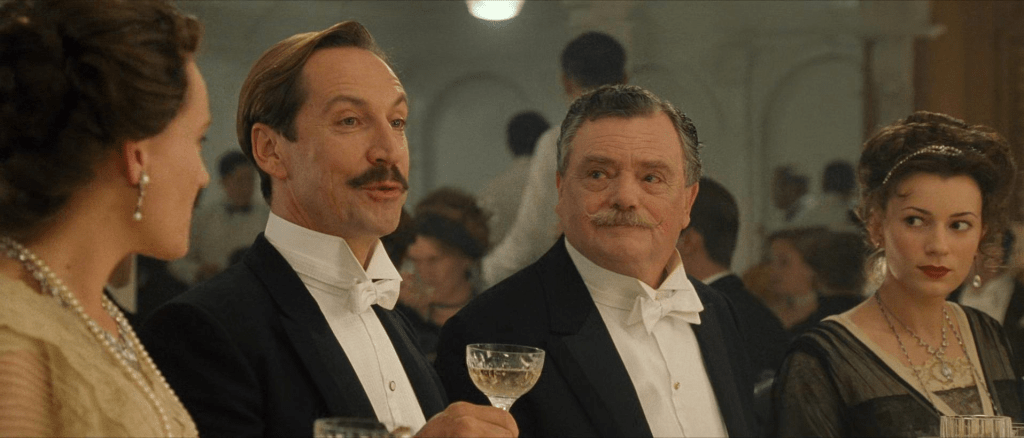
Bernard served with the Royal Navy during WWII as a minesweeper and then in the Korean War. From 1956-2004 he made more than 30 films. Ironically, he was in two different Titanic movies. In 1958 at the beginning of his career, he was in A Night to Remember and in 1997, at the end of his career, he was in the Oscar-nominated Titanic. He liked to say that he was the only person to survive the Titanic twice.
He began his television career in 1955 when he received a recurring role on the United Kingdom show Sixpenny Corner as Tom Norton. The show was centered around Bill and Sally Norton, a young married couple who ran a garage together. Fox played Bill’s youngest brother.
Titanic 1997 Photo: imdb.com
Eventually, he made his way to the United States. His first US show was in Wire Service in 1957, a show filmed at the Desilu studio. His next seven shows were filmed in the United Kingdom.
Fox mentioned that being a character actor was a mental strain. Early in his career, he had to worry about when the next job would be coming. He did post office work, logging, and other interesting jobs to get by. Once he got to America, he was able to rely on his acting career and didn’t have to moonlight anymore.
In 1962, he married his wife Jacqueline. They had two daughters. The same year he was back on US television with a regular role on The Danny Thomas Show. He played Danny’s English friend, Alfie Wingate. In 1963 he appeared on Ensign O’Toole, The Great Adventure, and General Hospital. The mid-sixties showed him in a variety of shows including McHale’s Navy, Perry Mason, The Dick Van Dyke Show, F-Troop, I Spy, I Dream of Jeannie, The Man From U.N.C.L.E., and The Farmer’s Daughter.
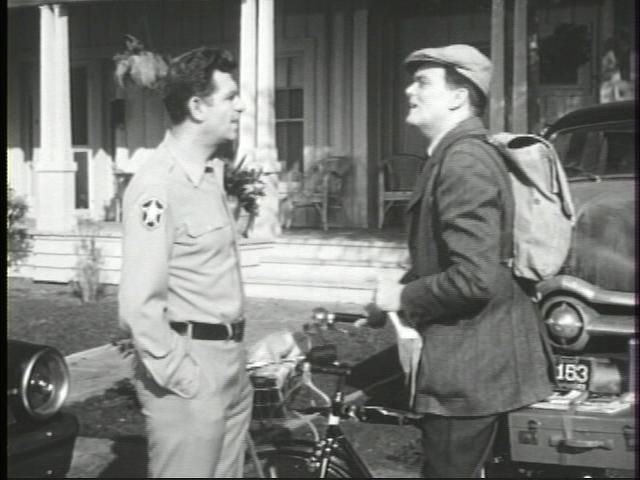
Hello Constable Photo: pinterest.com
He had another recurring role during this era on The Andy Griffith Show as Andy’s friend/valet Malcolm Merriweather. Fox appeared on the show in season three. We see him pedaling his bike next to Andy’s squad car at Andy’s house and says, “Excuse me, Constable.” When Andy understands what he is saying, he explains that he is the sheriff. With all the quirky characters in Mayberry, Malcolm fit right in and it’s a charming scene.
He continued receiving regular work in the late sixties for The Monkees; The Wild, Wild West; Here Come the Brides; and Daniel Boone.
Monkeeing Around Photo: sunshinefactory.com
Bernard did not enjoy his time on The Monkees set. He called them “an amateur bunch of rabble rousers . . . a bunch of unprofessional idiots.” He said that “they’d have cans of chocolates or something in the cupboards and in between shots, they’d be cramming chocolates in their mouths.” Fox was amazed, he said he got used to it but “professionally speaking, I expected a bit more.”
It was in the late sixties that he received the role he may be best known for: Dr. Bombay on Bewitched.
In an interview on bewitched.net, Fox was asked about his popular character, Dr. Bombay. He said that the spin he put on the doctor made him more interesting, saying, “If I’d just gone for an ordinary doctor, you wouldn’t have heard any more about it. But because I made him such a colorful character, that’s why they wanted him back.” He said the character was “easy to write for” and the writers had him being summoned from all over the world. He showed up in a variety of costumes including a wet suit, a football uniform, a toga, a towel, and a matador costume among others.
On Bewitched Photo: closerweekly.com
Bernard discussed the stars on Bewitched. He said Marion Lorne was a “dear lady.” When asked about Agnes Moorhead, he said she was a “thoroughly professional lady” and that praise from her was a thrilling thing to get. He said that he “liked Dick very much, a fine actor. He was a darling man.” And about Elizabeth, he said, “she was always very sweet and knew her lines.” She liked to bet on horses and whenever she won, she treated the cast to a party on the set. He also said once she found out he had a vegetable garden, she got him a subscription to Gourmet Magazine which she renewed every year.
He fondly recalled one episode where he was supposed to be squeezing a lemon into clam dip. When he squeezed it, it went in Elizabeth’s eye. The director yelled, “cut” and re-filmed it, but it happened again. The director said, “Bet you can’t do it a third time,” but he did, so they left it in the show.
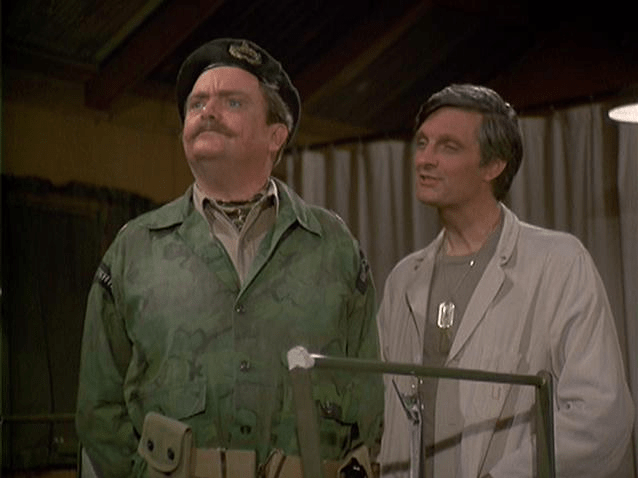
Visiting MASH Photo: imdb.com
His career did not slow down in the seventies where you could watch him on The Partridge Family, Night Gallery, Love American Style, Columbo, Cannon, Soap, and MASH. When asked about his appearance on The Partridge Family, Fox said, “Oh, I loved Shirley, she’s a doll, she’s a really nice lady.”
Following the pattern, he also had a recurring role in this decade as Colonel Crittendon on Hogan’s Heroes. As Crittendon, he was incompetent and dense and drove Colonel Hogan crazy with his ineptness.
Colonel Crittendon Photo: pinterest.com
In his bewitched.net interview, Fox also discussed his role on Hogan’s Heroes a bit. He said that in one episode he had hidden some maps in a corn bin. When he lifted the lid, it came down on his head. He just put the lid up and carried on with the script. When the director asked about reshooting, Fox said it was fine, and they left it in the film. He did say when he was playing a role on Hogan’s Heroes and Bewitched at the same time, it could get a bit confusing. They typically worked it out. For example, he said one time the studios agreed that Fox would be on the Bewitched set Tuesday and Wednesday and on Hogan’s Heroes Thursday and Friday.
Offers did slow down a bit in the eighties and nineties, and he ventured into animation work during those two decades. However, he still accepted offers for Fantasy Island, Lou Grant, The Love Boat, Hart to Hart, The Jeffersons, Simon and Simon, and Murder She Wrote among others.
His last acting credit occurred in 2001 for Dharma and Greg.
Not only was Fox an actor but he was an expert in history of the theater. For fun, he enjoyed gardening, painting landscapes, and performing magic.
Photo: walmart.com
In 2016, Fox died from heart failure.
I’m so glad he was able to find a successful career on television in the United States. After learning in a previous blog what a legend Marion Lorne was in England where she lived much of her life, I like to think about Aunt Clara and Dr. Bombay sharing some time talking about the delightful English ways that they missed. Hopefully they served tea on the set once in a while.
Before we get into this month’s series, I just wanted to say a big THANK YOU to all of you who read my blog. Today is my 300th blog post. I have absolutely thoroughly enjoyed getting to know so many classic television cast and crew members, and I have learned so much the past six years. This month we are looking at “Life with Pets” blog series by learning a bit more about some of the classic shows about families and their pets. So far, we have learned about some unusual pets: monkeys, dolphins, and bears. Today is no exception; we are looking at the series Born Free which featured a lion.
Photo: imdb.com
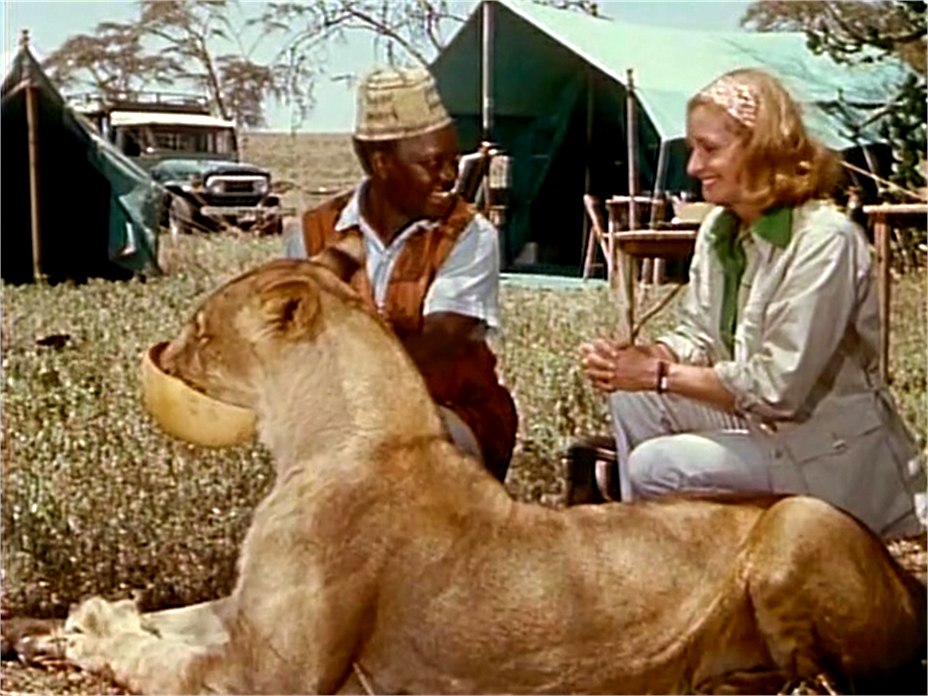
Like Flipper and Gentle Ben, Born Free was also based on a movie titled Born Free. which was released in 1966. In 1974, it became a television series. The film was based on a true story. Considering how many people fondly remember the show, I was surprised to learn that it only was on the air from September to December.
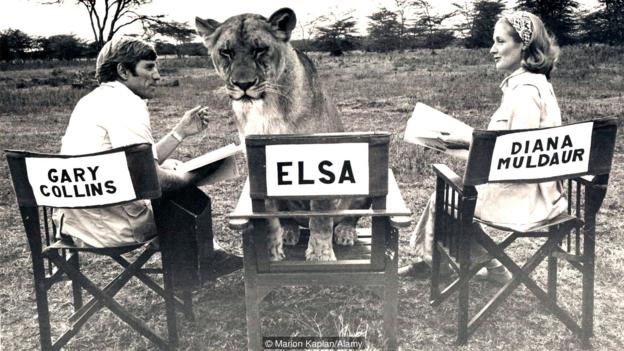
Muldaur and Collins Photo: imdb.com
The show tells the story of George (Gary Collins) and Joy Adamson (Diana Muldaur) who lived in Kenya with their lioness Elsa. George and Joy were game wardens who helped care for wildlife. They primarily protected them from weather disasters and poachers. Part of the show’s mission was to educate viewers about animal conservation. Other cast members included Hal Frederick as Makedde; Dawn Lyn, Dodie from My Three Sons, as Reagan one of their friend’s granddaughters who lives with them for a while; and Peter Lukoye as Nuru.
In the Adamsons’ true story, Elsa and her sisters who were orphaned were treated like pets by the couple. George was forced to kill their mother when she charged him, but he later said he understood she felt threatened. Joy fed the four-day-old cubs unsweetened milk mixed with cod liver oil, glucose, bone meal, and salt. After the first couple of weeks, they took their food from baby bottles. They were allowed to roam like house pets but at night they were put into a pen of rock and sand to protect them from hyenas, jackals, elephants, and other lions.
Eventually, Elsa’s two siblings were sent to a zoo in the Netherlands, but Elsa being a runt, could not make the trip. Joy then taught her how to behave like a wild lion so she could survive with the other animals.
On the show, the episodes were a bit different. In “Maneaters of Merti,” two lions have begun killing humans, so George leads a search with villagers and game wardens to find them.
In the middle of the season, “The Flying Doctor of Kenya” aired with Juliet Mills starring as Dr. Claire Hanley who is making her first village medical tour. She needs to learn the customs of the villagers as well as how to adapt to the tough living conditions. Joy helps her get acclimated to the new job.
The theme song was composed by John Barry which was the same song used in the movie. Barry won an Oscar for the film’s soundtrack. Lyrics were provided by Don Black. Most of us remember the words to the song from hearing it on the radio. They were:
Born free, as free as the wind blows As free as the grass grows Born free to follow your heart
Live free and beauty surrounds you The world still astounds you Each time you look at a star
Stay free, where no walls divide you You’re free as the roaring tide So there’s no need to hide
Born free, and life is worth living But only worth living ’cause you’re born free
(Stay free, where no walls divide you) You’re free as the roaring tide So there’s no need to hide
Born free, and life is worth living But only worth living ’cause you’re born free
George Adamson Photo: kateonconservation.com
I was also surprised to learn that the show was actually filmed in Kenya. NBC put the show on Monday night against The Rookies and Gunsmoke which were both in the top 20-30% of popular shows. After 13 episodes, the show was canceled due to low ratings.
Joy Adamson and Elsa Photo: pinterest.com
Although Joy and George were divorced by the time the television series was created, she served as a consultant for the show and supervised the stories. Sadly, she was stabbed to death in 1980, and George was shot by poachers in 1989 while trying to help a tourist.
Elsa did acclimate to the wild but visited George and Joy from time to time. She brought her three cubs to show the couple. Elsa was five when she contracted a tick-borne blood disease similar to malaria. She passed away and was buried in the Meru National Park. When Joy died, she was buried next to Elsa. George was buried in the Kora National Park in northern Kenya where he was working. He was buried near his brother and Boy, another lion featured in the film version.
The legacy of the film and television show is that the Born Free Foundation has a mission to protect the lions of Meru National Park.
Photo: twitter.com
Although I was surprised by a few things in this show, one thing I was not surprised by was its quick cancellation. For some reason, so many shows in the sixties were adapted from movies and could not be sustained as a weekly show. M*A*S*H was one of the few shows to do this well. It seems though it would be a tough thing to sustain interesting shows when you are limited to natural disasters and poachers. Here again, you would assume the scenery would almost be a character you could develop. I’m also sure it was not cheap to film the show in Africa which would make it harder to keep if it was not producing decent ratings.
While none of the shows we have learned about in the series became long-running shows, next week we wind up our series with a look at one of the enduring pet shows.
We are celebrating National State days this month. This week we are celebrating Oregon. I’m sure a lot of stars grew up in Oregon, but my choice is David Ogden Stiers. Although Stiers was born in Illinois on Halloween in 1942, his family moved to Eugene, Oregon when he was in high school. Based on his life, I think Oregon has the better claim to him. After graduation, Stiers enrolled in the University of Oregon.
Photo: ebay.com
Early in his career, Stiers moved to San Francisco, performing with the California Shakespeare Theater, the San Francisco Actors Workshop, and the improv group, The Committee. I would like to learn more about The Committee whose members included Rob Reiner, Howard Hesseman, and Peter Bonerz.
In the 1960s, Stiers moved to New York to study at Juilliard for a couple of years and was able to appear in numerous Broadway productions. At Juilliard, Stiers was mentored by John Houseman.
Stiers was a prolific actor, appearing in 38 big screen movies, 39 made-for-tv movies, and more than 90 different television series.
Stiers with Mary Tyler Moore–Photo: amazon.com
In the 1970s, he showed up on Kojak, Charlie’s Angels, Phyllis, The Mary Tyler Moore Show, Rhoda, The Tony Randall Show, and Paper Chase.
Most of us got to know him as Major Charles Emerson Winchester III on M*A*S*H. He became part of the cast in 1977 and continued with the show until it ended in 1983. As Winchester, Stiers would receive two Emmy nominations in 1981 and 1982. Both years he got beat by a Taxi alumni, Danny DeVito in 81 and Christopher Lloyd in 82.
Stiers with Harry Morgan and William Christopher–Photo: thenewyorktimes.com
Winchester replaced Frank Burns whom Hawkeye and Hunnicutt made fun of for his inept medical skills. Charles was a brilliant surgeon but was an aristocrat from Boston and never let anyone forget it. However, as with all M*A*S*H characters, Winchester continues to evolve, and we learn more about his past and how that affected his personality.
Stiers with Morgan and Loretta Swit–Photo: enews.com
Stiers always described Harry Morgan as his acting mentor, but he loved the entire cast. Although Stiers could come off a bit like Winchester at first meeting, once he got to know you, his castmates said “the walls came down and you saw a sweet, tender man.” Kellye Nakahara (Nurse Kellye) shared that she used to jump into Stier’s arms every morning so he could twirl her around like a princess at a ball.” Loretta Swit said “he was very much his own person, but he loved and adored us as we did him.” Executive producer Burt Metcalfe reported that “I have always felt that one of the reasons for the show’s success was that the audience sensed that the characters loved another and they loved the characters. And that love goes down to the actors.” All his coworkers described Stiers as a prankster on the set.
His life after M*A*S*H included roles on a variety of shows, including Alf, Wings, Star Trek, Murder She Wrote, Dr. Quinn, Ally McBeal, The Outer Limits, Touched by An Angel, and Frasier.
He would also receive recurring roles in four additional series during his career. In Two Guys, A Girl and A Pizza Place, he played Mr. Bauer.
Stiers with Swoosie Kurtz, Paget Brewster, and Brian Van Holt Photo: pinterest.com
I never watched Love & Money, but Stiers played the wealthy Nicholas Conklin; the show is described as “The penthouse-residing Conklin family of scholars and the basement-dwelling McBride family of maintenance men find themselves unhappily linked when the heiress daughter and blue-collar son fall in love.”
I also never watched the Dead Zone, but Stiers played Reverend Purdy in the show where “Johnny had the perfect life until he was in a coma for six years When he awoke, he found his fiancé married to another man, his son doesn’t know him, and everything had changed including Johnny because he can now ‘see’ things.”
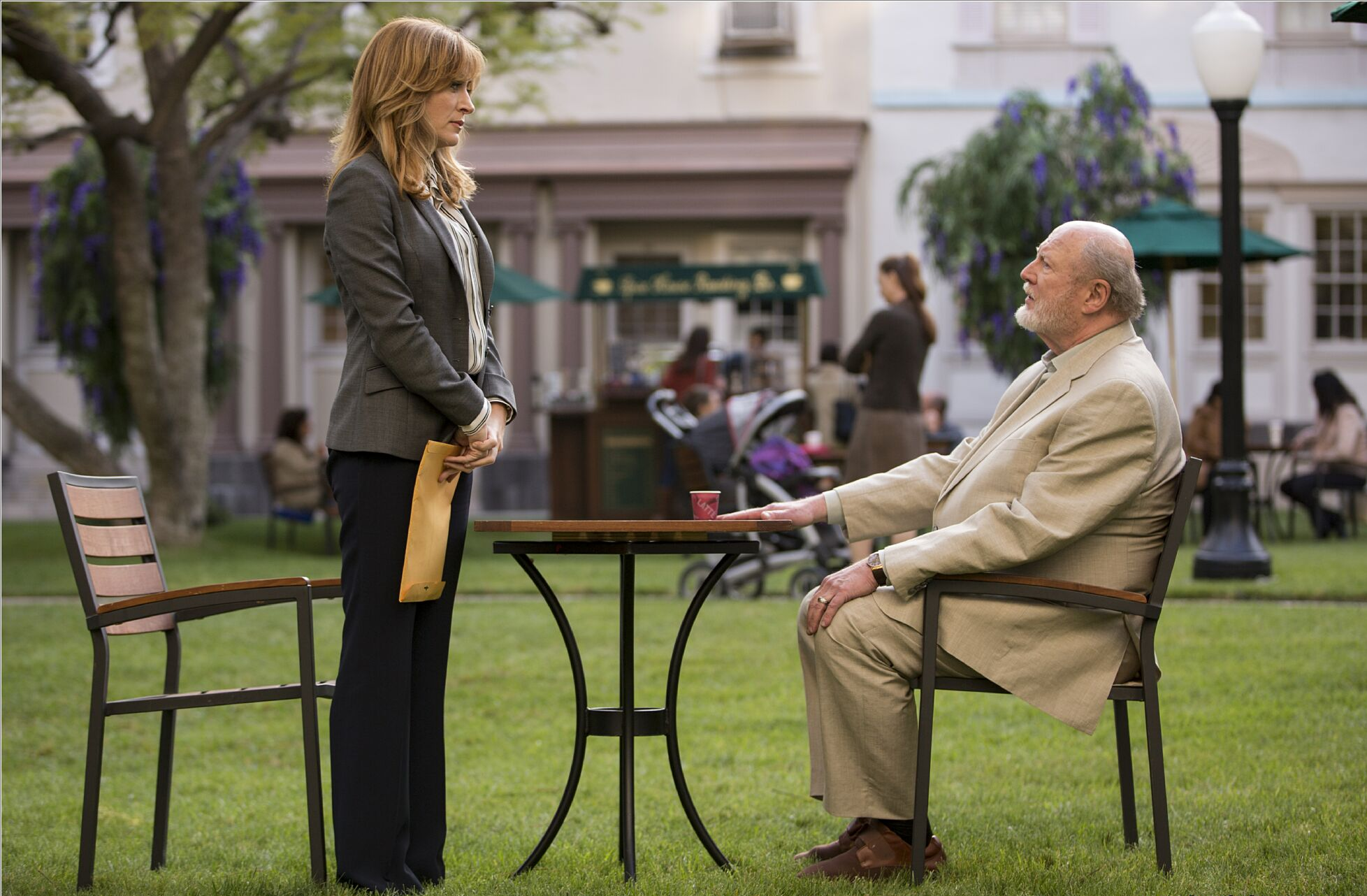
Stiers with Sasha Alexander–Photo: popcitylife.com
He also played Arthur Isles in Rizzoli & Isles, one of my favorite shows from the past few years.
You could also hear Stiers in a number of animation films including Beauty and the Beast, Pocahontas, and the Lilo and Stitch movies. He narrated many audiobooks as well.
Photo: OregonCoastDailyNews
One of the reasons Oregon can lay claim to Stiers is because he continued to live in Newport and spent his later years as a conductor for the Newport Symphony Orchestra. As a fan of classical music, Stiers was able to be a guest conductor in more than 70 orchestras around the world. Newport seems to be a quirky, but fun, place with a population of only about 10,000. It is definitely on my list of places to visit.
In 2018, Stiers passed away from bladder cancer. He generously bequeathed funding for a variety of cultural groups including the Newport Symphony, the Newport Public Library, and the Oregon Coast Council for the Arts.
Photo: amazon.com
I appreciate that Stiers loved and celebrated the arts. One of his thoughts about experiencing culture was: “The thing I love about the arts—music, theater, museums, galleries—is that everybody wins. You are touched and hopefully moved, and it is unique to each person. Even though you may have listened to the same performance, what you heard could be vastly different from what anyone else heard.” I’m happy that he was able to spend the last years of his life doing something he enjoyed so much after a life of giving to others through his acting performances—something we can all aspire to.





























 thewritelife61