Little House on the Prairie: Drama On and Off the Set

This month we are visiting with some of our favorite families. I absolutely would have included The Waltons this month if we had not covered the show recently. However, another historic family, the Ingalls, is on the schedule. Little House on the Prairie was on the air for nine seasons. Many of us got to know the family through Laura Ingalls Wilder’s books.
đź“·lovemoney.com

Television producer Ed Friendly acquired the film and television rights from the books. Oddly enough, the other show Friendly is known for as producer is Rowan and Martin’s Laugh In. He decided to make Little House a two-hour pilot and asked Michael Landon to direct it. Landon agreed to do so if he could also play Pa, Charles Ingalls. The pilot aired in March of 1974, and in September the series began.

Along with starring in the show, Landon continued to direct as well; he directed 87 of the 204 episodes. The other directors included William F. Claxton, Victor French, Maury Dexter, and Leo Penn.

Landon also got in on the writing of several episodes. He had written several scripts for Bonanza when he appeared on that show, and several of them were recycled for Little House.

đź“·showbizcheatsheet.com

Like The Waltons, while this series was often happy with comedic notes, it dealt with many serious issues as well, including alcoholism, drug addiction, poverty, racism, child abuse, and rape. The show focused on the struggles and joys of a pioneer family living in the late 1800s.

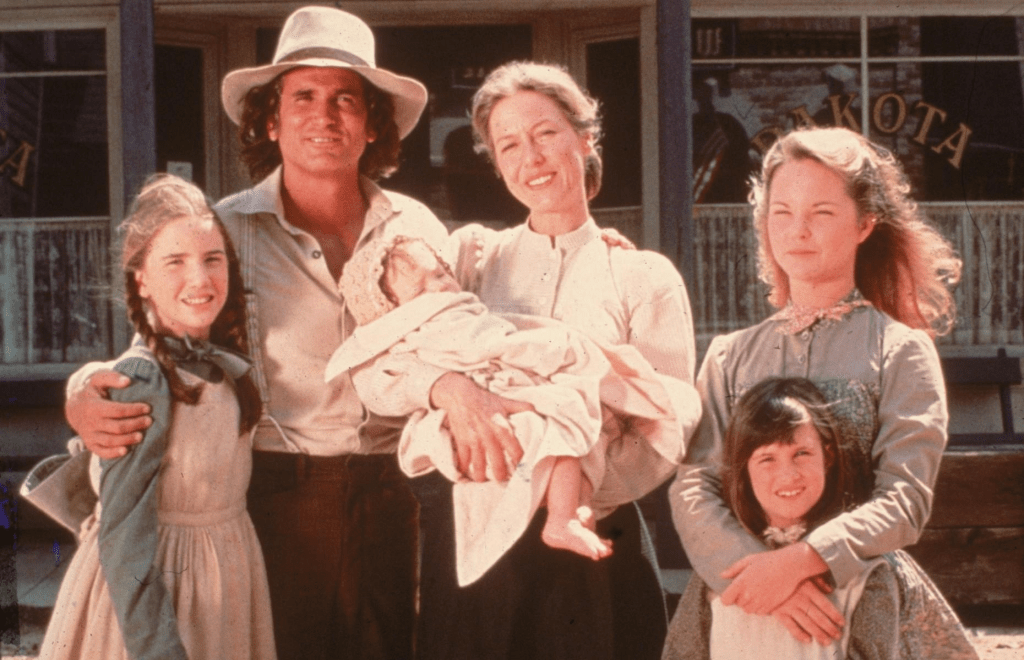
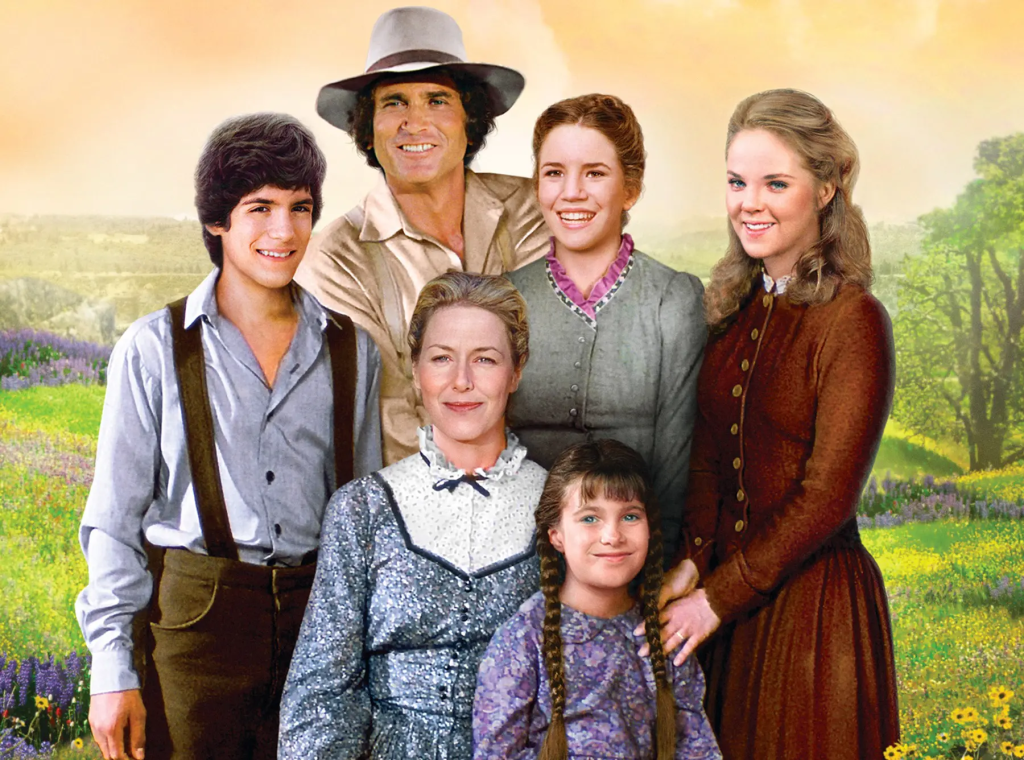
Along with Landon, Karen Grassle played Ma, Melissa Gilbert played Laura, Melissa Sue Anderson was Mary, with Lindsay and Sidney Greenbush alternating as Carrie. In addition to the Ingalls family, other town folk on the show included Nellie Oleson (Alison Arngrim), Nels Oleson (Richard Bull), Harriet Oleson (Katherine “Scottie” MacGregor, and Miss Beadle (Charlotte Stewart).

Some of the guest stars included Willie Aames, Anne Archer, Lew Ayres, Hermione Baddeley, Ken Berry, Ray Bolger, Ernest Borgnine, Johnny and June Carter Cash, Burl Ives, Charles Lane, Vera Miles, Sean Penn, and Ray Walston.

đź“·wikifandom.com

The theme song, “The Little House,” was written and conducted by David Rose. Rose won two Emmys for his work on the show.Although the pilot ranked #3 for the 1974 ratings, the first two seasons were much lower. Season 3 found the show on Monday nights where it remained one of the highest-ranking series through season 7. Season 8 had a significant decline and season 9, with the loss of most of the family members, never really caught on with viewers. However, season two is the only year the show was not in the top 30. The schedule was a bit crazy when you analyze it. Although, this show did have to compete with The Jeffersons and WKRP in Cincinnati, because they were half-hour shows and this was an hour show, many people probably continued watching the second half. For many of these years, there were up to six different shows in this time spot on CBS and many of them changed from year to year, so there were rarely shows in this spot against Little House for more than a month or two.

After eight seasons, both Michael Landon and Karen Grassle were ready to move on; however, Landon did stay on as a director and writer. The show focused on Laura Almanzo and the younger generation for the ninth and final season.

The show was loved by critics as well as viewers and received sixteen Emmy nominations. The series won four of them, all for music and cinematography. The only cast member nominated was Melissa Sue Anderson; she lost to Sada Thompson for Family.
đź“·littlehouseontheprairie.com

Viewers were not ready to leave the Ingalls for good. Three made-for-tv movies were written: Little House: Look Back to Yesterday in 1983, Little House: The Last Farewell and Little House: Bless All the Dear Children, both in 1984. In 2008 the Ingalls’ lives also became a musical at the Guthrie Theater.

One fun story is when the show moved from Paramount to MGM Studios in the late seventies, they were uncovering sets so they could build new ones and found the yellow brick road from the Wizard of Oz which delighted the kids in the cast; I’m guessing it delighted many of the adults as well.

Another fun story was learning what the cast ate on the show. Since beef stew was a popular meal in the 1800s, the family often had that for its meal and when they did, they were actually eating Dinty Moore Beef Stew. When they had chicken, it was KFC that appeared on their plates.

The kids must have been troopers because each episode took about seven days to shoot. They were on location at Big Sky Ranch for four days and in the studio for interior shots about three days. In addition, they were probably witnesses to off-air scenes that were not the best. Grassle and Landon were not close, probably because his role seemed much bigger than hers and he was directing as well. Unfortunately, both Grassle and Landon were alcoholics, and alcohol was part of their life on set. During season four, Grassle quit when she realized the seriousness of her problem. Landon was never able to kick his dependence and died from pancreatitis.

đź“·pinterest.com

Gilbert said that Michael Landon had interesting ways to inspire his kids to get emotional on the set. He worked himself up to become very emotional and with eyes full of tears would ask her “Do you know how much I love you?” which would bring tears to her eyes as well.

It might have been a way to get her to cry, but it was not a lie. Gilbert lost her own father when she was eleven, and Landon became a second father to her. He often had Gilbert at his house on the weekends. She said it was a huge house and the kids ran through the house at will. Often Landon would hide behind doorways and jump out and scare them. Gilbert said Landon provided her with a lot of great advice. The most memorable for her was that nothing is more of a priority than home and family, and no success is as important as loving your people and contributing to a community. And to have fun above all in your career.

That is sage fatherly advice for us all to remember.
Dr. Kildare: The “Perfect” Doctor

Photo: collectors.com

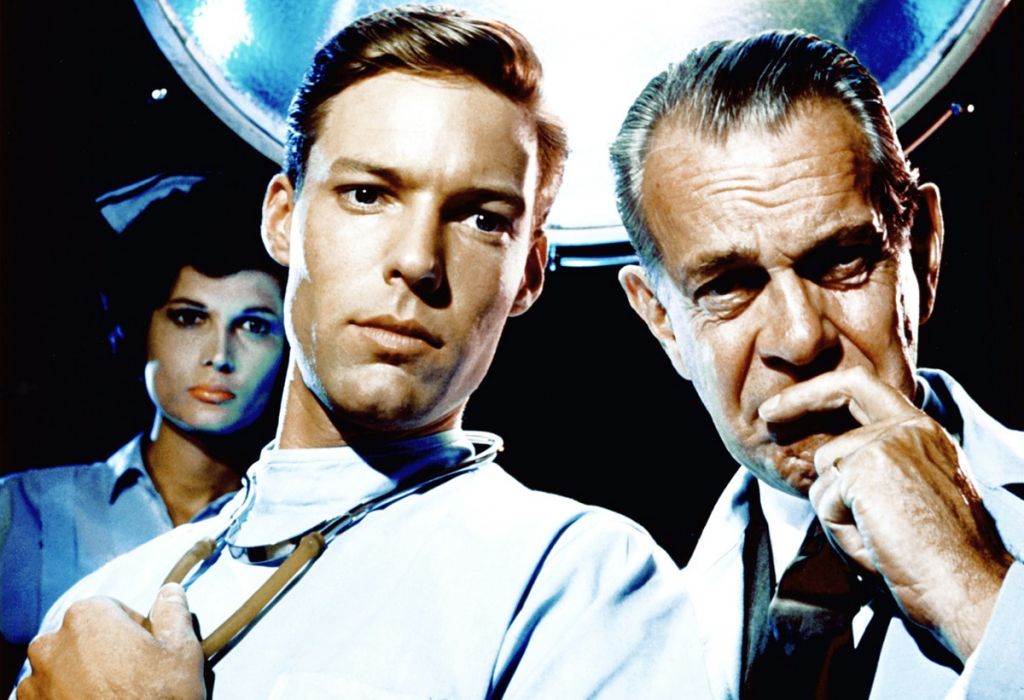
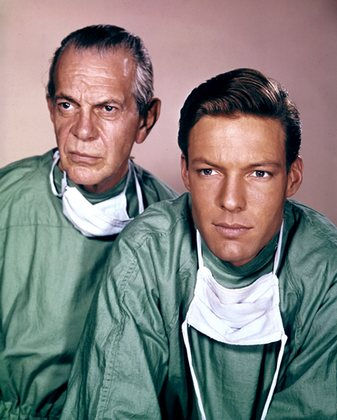
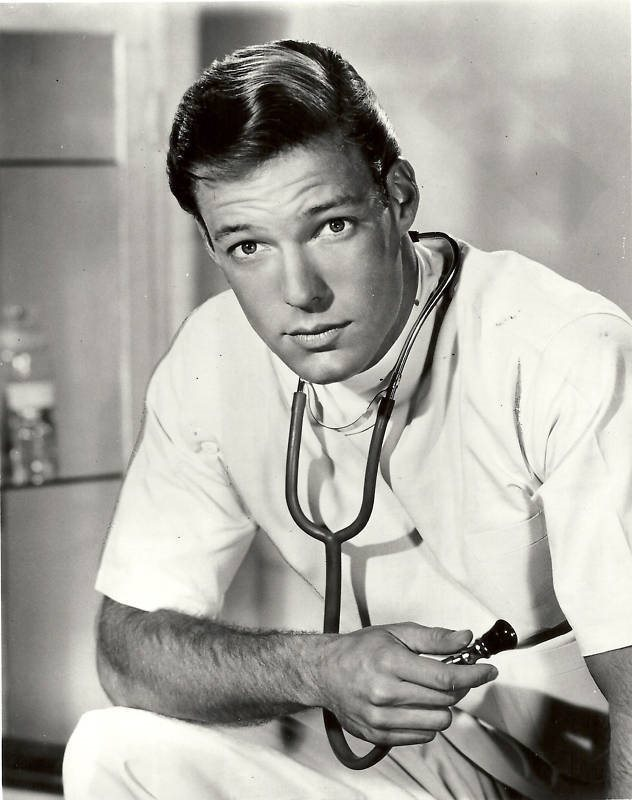
This month we are checking out a few favorites in a blog series: “Examining Our Favorite Medical Shows.” Last week we learned a bit about Ben Casey. Today we are looking at a similar show to Ben Casey, although in many ways it was very different: Dr. Kildare.  Dr. Kildare was also on the air from 1961-66. MGM produced this show created by Max Brand in the 1930s. The show had previously been a movie and a radio series. Unlike Ben Casey who seemed to argue with everyone, Dr. Kildare (Richard Chamberlain) was a respectful intern at Blair General Hospital. He wants to help his patients and listens to his mentor, Dr. Leonard Gillespie (Raymond Massey). In season three, Kildare became a resident, and the episodes focused more on the stories about the patients.

In 1960 a pilot was filmed with Joseph Cronin in the Kildare role and Lew Ayres as Gillespie which did not sell. The role of Kildare was offered to William Shatner and James Franciscus who both turned it down. In 1961, a new pilot was produced with Chamberlin and Massey. One of the reasons Massey accepted the role is because he was certain the show would only last one season, and he wanted to continue with his movie career. The popularity of the show put his film career on hold for five years.

Photo: medium.com

Other cast members who appeared on the show included Dr. John Kapish (Ken Berry), Nurse Fain (Jean Inness), Dr. Agurski (Eddie Ryder), Dr. Gerson (Jud Taylor), Dr. Lowry (Steve Bell) Nurse Conant (Jo Helton), and Nurse Lawton (Lee Kurty).

The guest stars on this show were amazing. I feel like this should be read in auctioneer mode but here goes: Eddie Albert, Jack Albertson, Fred Astaire, Ed Asner, Lauren Bacall, Ed Begley, Joan Blondell, Tom Bosley, Beau Bridges, Charles Bronson, James Caan, Robert Culp, Ossie Davis, Ruby Dee, Angie Dickinson, Olympia Dukakis, Barbara Eden, Linda Evans, Douglas Fairbanks Jr., Peter Falk, Beverly Garland, Ron Howard, Kim Hunter, Celeste Holm, Carolyn Jones, James Earl Jones, Brian Keith, Ted Knight, Harvey Korman, Cloris Leachman, Jack Lord, Walter Matthau, Gavin McLeod, Ricardo Montalban, Harry Morgan, Jack Nicholson, Leonard Nimoy, Carroll O’Connor, Suzanne Pleshette, Basil Rathbone, Robert Redford, Robert Reed, Cesar Romero, Gena Rowlands, William Shatner, Jean Stapleton, Gloria Swanson, Rip Torn, Sam Waterston, Dennis Weaver, and Robert Young. For a show that was only on five years, it was an impressive guest cast.

Photo: imdb.com

To add more realism to the show, writer E. Jack Neuman spent several months working with interns in a large hospital. Technical advice was provided by the American Medical Association.

The show was realistic in portraying all the drama that is truly found in a city hospital. The plots involved a lot of medical and social issues including smallpox, physician competency, drug addiction, malpractice, and euthanasia. Neuman definitely captured what life in a large, city hospital was like. Kildare makes about $60 a month, or $500 in today’s terms, works long hours, rotates through the various medical departments and has senior physicians overrule his diagnoses.

Just like Ben Casey, the first seasons produced stand-alone episodes and after the success of Peyton Place, storylines carried over from one show to another to entice the audience to tune in again the next week.

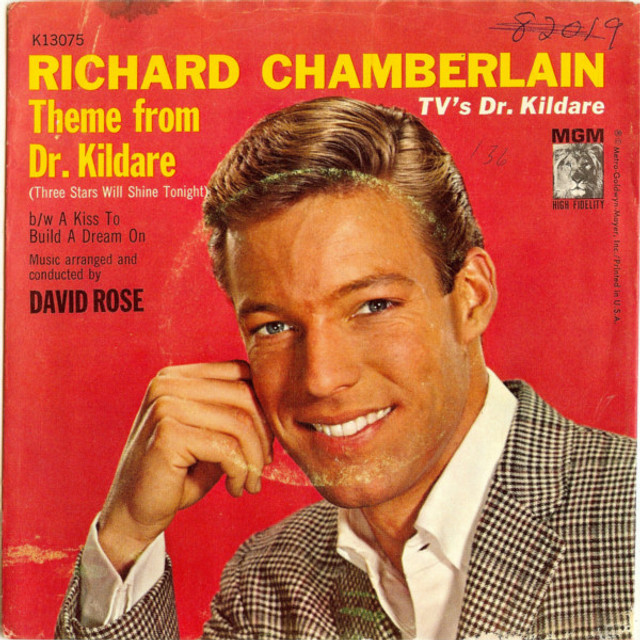
The theme music for the series was composed by Jerry Goldsmith. A CD set was released in 2009 which included the theme, the original music from the 1960 pilot, Richard Chamberlain’s recording of “Three Stars Will Shine Tonight,” and musical scores from the five seasons by Hurr Sukman, Richard Markowitz, Morton Stevens, Lalo Schifrin, John Green, and Burt Bacharach.

Airing on Thursday nights, the show was in the top ten during season one and the top twenty for seasons two and three. The show received about 12000 fan letters weekly, and, in addition, Chamberlain received letters personally asking for medical advice.

The network moved the show to Tuesday nights against Red Skelton and McHale’s Navy for season five and the viewers did not follow. The ratings declined, and the show was canceled.

This show really changed Chamberlain’s career. He had always been a small-role guy before this show, but he suddenly became a teen idol. He received more than 35,000 fan letters a month. Onscreen the idealistic Kildare and the wise, sometimes cantankerous, Gillespie don’t always agree but they had great chemistry on the set and apparently off the set as well. Unlike Ben Casey, the cast on this show did get along and Chamberlain mentioned that he always enjoyed working with Massey.

Richard said he grew up in a family where they all pretended to be perfect. So, he went through life trying to be perfect too. He said that philosophy did not work well for his life, but it did work well for Dr. Kildare.

Following the show he would take a turn on Broadway, in big-screen movies, and back on television where he specialized in mini-series like Shogun and The Thorn Birds, both in the 1980s.

One fact I found interesting was that the DVD release of the show included a never-aired pilot from a different medical show, The Eleventh Hour in 1962. The episode originally was written for Dr. Kildare. Drs. Kildare and Gillespie assist Dr. Bassett (Wendell Corey), a psychiatrist diagnosing one of his patients Ann (Vera Miles). Instead of airing on Dr. Kildare, Chamberlain and Massey were cut out of the film and it was submitted as a pilot for the show, with the title “Ann Costigan: a Duel on a Field of White.”

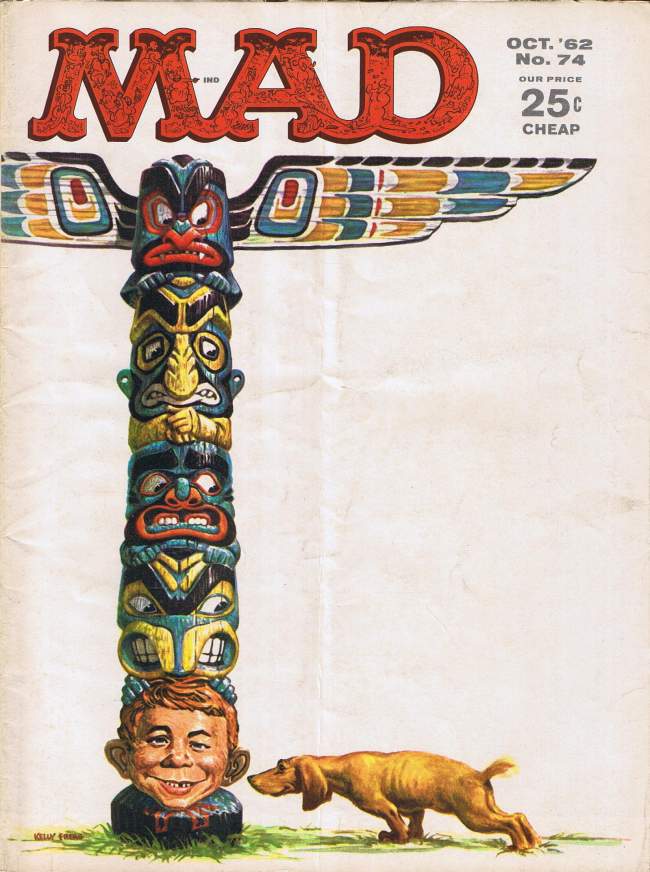
Even Mad Magazine got on the Kildare bandwagon. The 1962, #74 issue, featured “Dr. Killjoy,” a parody of the show.

Everyone seemed to like this show. Then again, what is not to like? You have a handsome doctor, exhilarating drama, a fun guest star every week, and realistic stories. The show would go on to inspire the talents behind a variety of medical series including Marcus Welby MD, ER, House, and Grey’s Anatomy.

Big Valley: Home of the Barkleys

We are in the midst of our western series, and today we turn our attention to a show that was on ABC for four years, from 1965-1969: The Big Valley. Created by A. I. Bezzerides and Louis F. Edelman and produced by Levy-Gardner-Laven (a trio of Jules V. Levy, Arthur Gardner, and Arnold Laven).

Photo: amazon.com

The series is set on the Barkley Ranch in the 1870s, home of the Barkleys, one of the wealthiest families in the area. The ranch is based on the 30-acre Hill Ranch which existed from 1855-1931. Lawson Hill was murdered in 1861 ad then his wife Euphemia ran it. They also had three sons and one daughter. Today the ranch is covered by Camanche Reservoir waters. The exterior shot of the house used in the show was also Tara in Gone with the Wind.

Photo: pinterest.com

On Big Valley, Victoria Barkley (Barbara Stanwyck) runs the ranch with the help of her sons Jarrod (Richard Long), Heath (Lee Majors), and Nick (Peter Breck) and daughter Audra (Linda Evans).

Barbara Stanwyck in The Big Valley by Silver Screen | Barbara stanwyck,  Actresses, Silver screen
Barbara Stanwyck Photo: pinterest.com

Heath was her husband’s illegitimate son, but she considered him her own child. He never met his father who had never been told of his existence; Heath learned it from his mother on her deathbed.

Three Great Stories in the Barkley Library - The Big Valley Writing Desk
The boys of Big Valley Photo: tapatalk.com

Jarrod was an attorney and was refined and well educated. He was briefly married but his wife was killed shortly after by a bullet meant for him. Nick was the younger, hot-tempered son who helped his mother run the ranch. He was a soldier in the Union Army during the Civil War. He had a great sense of humor and was very loyal to his family.

15 Things You Don't Know About Linda Evans - INSP TV | TV Shows and Movies
Linda Evans Photo: insp.com

Audra was rather bold for the times. She was a tomboy but had a soft heart and tended to children at the local orphanage.

There was another younger Barkley, Eugene (Charles Briles), who was a medical student at Berkeley. He was seen off and on through season one, then drafted into the army and never really mentioned again.

Considering that the show was only on the air four years, a lot of stars appeared. A small sample includes Jack Albertson, Lew Ayres, Anne Baxter, Milton Berle, Charles Bronson, John Carradine, Yvonne Craig, Yvonne DeCarlo, Richard Dreyfuss, Robert Goulet, Julie Harris, Ron Howard, Cloris Leachman, Gavin MacLeod, Leslie Nielsen, Regis Philbin, Lou Rawls, Pernell Roberts, Wayne Rogers, Katharine Ross, William Shatner, and Adam West.

The Big Valley" Joshua Watson (TV Episode 1969) - IMDb
Lou Rawls guest star Photo: imdb.com

The Big Valley was a western but with a few twists and never predictable. It was the first time a woman would have the lead in a western.  The Barkleys may have been wealthy, but they were raised right. They were hardworking and fought for the underdog, making sure justice prevailed. However, it was not a cliché; no one could be trusted and nothing was exactly as it looked. Characters who appeared angelic ended up being truly evil.

Photo: hulu.com

Unfortunately for the show, it was coming in at the end of the western’s popularity and was never in the top 30 during its time on the air. The other new shows that began when it did included Get Smart, I Dream of Jeannie, Hogan’s Heroes, Lost in Space, F Troop, and The Wild Wild West.

However, it received good reviews, and in 1966, Stanwyck was nominated and won the Emmy for drama series. She would also be nominated in 1967 and 1968, losing to Barbara Bain from Mission Impossible both years.

The theme was composed by George Duning. In 1966, a soundtrack from the show was released in mono and stereo versions. During his career Duning would work on more than 300 movie and television scores.

Like many television shows in the fifties and sixties, Dell Comics published six comic books based on the show. For some reason, I did not see much in the way of merchandising for this show compared to other westerns or shows from the sixties.

A warmhearted retrospective with 'Big Valley' cowgirl Linda Evans | Medium
Photo: pinterest.com

The cast got along well. Evans and Stanwyck were exceptionally close and rehearsed at Barbara’s house every Saturday. When Arthur Gardner was interviewed on the Television Academy, he said that Stanwyck mentored the younger cast members. He said “he could not praise her enough” for the work she did.

52 The Big Valley ideas | tv westerns, barbara stanwyck, linda evans
Photo: pinterest.com

It’s too bad the show didn’t begin earlier in the decade; it might have been able to stay on the air a bit longer. It was a unique concept with a powerful woman as the star. You can currently see it on Me TV on Saturdays as well as a few other networks.