The Dick Van Dyke Show: Writing At Its Best

This blog series is “It’s My Show,” about actors who featured their names in the titles of shows. I’ve definitely saved the best for last: The Dick Van Dyke Show. During the past five plus years of writing my blog, I have realized that my favorite shows are those that feature amazing writing and concentrate on relationships. This show is no exception.

Review: The Dick Van Dyke Show, “The Curious Thing About Women” | This Was  Television
Photo: thiswastelevision.com

From 1961 till 1966, this show aired on CBS, resulting in 158 episodes. Created by Carl Reiner, it was produced by Calvada Productions. Calvada was named for Carl Reiner, Sheldon Leonard, Dick Van Dyke, and Danny Thomas. The show was filmed at Desilu Studios in front of a live audience. Bill Persky and Sam Denoff wrote 29 of the episodes.

The theme song was written by the great Earle Hagen. (For more on Hagen, you can see my blog from December 10, 2018; Hagen wrote many great theme songs including The Danny Thomas Show, Gomer Pyle, I Spy, The Mod Squad, and most memorably, The Andy Griffith Show.)

The Story of Dick Van Dyke and the Ottoman – Once upon a screen…
Photo: pinterest

The opening of the show had Rob walking into the living room. In one version, he trips over an ottoman, falling on the floor. In the another, he steps around the ottoman. You never knew which opening you would see, a fun element of the show.

I love that this show realized our professional lives are equally important to our personal and family life, and this show not only featured both, but often they meshed together just like all our lives do.

Not only was Rob Petrie’s (Dick Van Dyke) work life part of the show, but he was a television writer, which provided even more insights into what we were watching. Rob writes “The Alan Brady Show” with cowriters Sally (Rose Marie) and Buddy (Morey Amsterdam). Mel (Richard Deacon) is star Alan Brady’s (Carl Reiner) producer. Buddy and Mel have an ongoing feud, insulting each other on a daily basis. (In real life, Deacon and Amsterdam were good friends and often came up with new insults when they had drinks together after work.) Reiner originally planned on starring in the show and played Petrie in the pilot, but he was persuaded to give the role to another actor by Leonard.

The Dick Van Dyke Show' Changed Television as We Know It
Moore, Van Dyke and Mathews–Photo: wideopencountry.com

Rob’s home life consisted of wife Laura (Mary Tyler Moore), son Ritchie (Larry Mathews), and neighbors/best friends Jerry and Millie Helper (Jerry Paris and Ann Morgan Guilbert). Paris directed 84 of the show’s episodes and would go on to a career as a director later.

Recap and React: The Dick Van Dyke Show, season 2, episodes 11 – 15 – The  Motion Pictures
Moore, Paris, Guilbert, and Van Dyke
Photo: motionpictures.com

In the pilot, titled “Head of the Family,” Barbara Britton played Laura, Gary Morgan played Ritchie, Morty Gunty played Buddy, and Sylvia Miles played Sally. Jack Wakefield played Alan Sturdy who was the star of the tv show.

The characters are very much like people we all know, except maybe a bit funnier. Rob loved his wife and son. He was a big fan of cowboy movies and Laurel and Hardy. He met Laura, a USO dancer, when he was in the Army as a Special Services Sergeant in Camp Crowder, Missouri. His brother Stacey appeared on the show a few times (played by real life brother Jerry Van Dyke). Richie is a typical kid who gets in trouble sometimes but is a good kid, just curious and looking to test his boundaries. Their neighbors Millie and Jerry have a son about Richie’s age, and they are their best friends; Jerry is also their dentist.

Mary Tyler Moore | Couple sleeping, Bed, Classic television
Moore, Van Dyke–Photo: pinterest.com

The only thing not realistic about his home life is that Rob and Laura have twin beds. Reiner asked the network to allow the couple to sleep in the same bed, but they would not approve it, so like most sitcom married couples, they had separate beds.  About the only couples who were able to get around the challenge were the Stephens on Bewitched and Katie and Robbie on My Three Sons. The network also didn’t love that Moore wore capri pants but they did end up allowing her to do so.

Rob’s coworkers are also endearing characters. Buddy is energetic and sarcastic. He is married to Pickles and shares a lot of jokes about some of the scatterbrained things she does. We know he is in love with Sally, but they never take their relationship anywhere other than friendship. She is often making fun of herself for looking for a man, but we realize she is very lonely. Mel is an excellent producer who puts up with a lot from both Buddy and Alan.
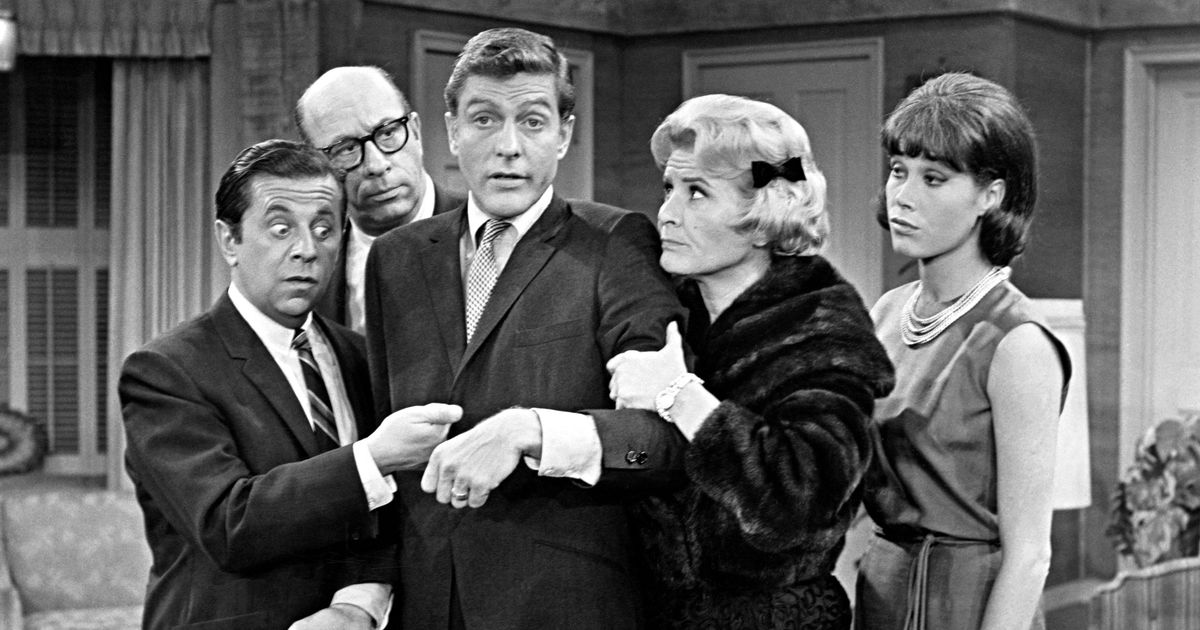
The Best 'Dick Van Dyke Show' Episodes, Ranked
Amsterdam, Deacon, Van Dyke, Marie, Moore–Photo: vulture.com

Van Dyke had to give up Bye, Bye Birdie to star in the show but definitely made the right choice. The role of Laura was a hard one to cast. Sixty actresses auditioned for the character. Moore almost chose not to go, and when she did, she lied about her age, making herself older than she was. Sally Rogers was based on Lucille Kallen who wrote for Your Show of Shows and Selma Diamond who wrote for Caesar’s Hour.

After the first season, CBS said they were cancelling the show. Procter & Gamble threatened to remove all its advertising and viewers complained loudly. The network didn’t need to worry about ratings in season two; the show was in the top ten by episode three and was popular for the rest of its time on air.

To color or not was a big question during the sixties. Reiner actually considered filming the show in color in the third season until he found out it would add $7000 per episode (the equivalent of about $59,000 today).

Carl Reiner, beloved creator of 'Dick Van Dyke Show,' dies | Taiwan News |  2020/07/01
Deacon, Moore, Van Dyke, Leonard, Reiner, Paris
Photo: taiwannews.com

I’m not the only one who thought this was an amazing show. The series was nominated for 25 Emmy awards and won 15 of them. Reiner won three times for writing, Van Dyke three times for acting, and Moore twice for leading actress in a comedy role.

Some of my favorite episodes are “Pink Pills and Purple Parents” (season 4) a flashback to when Laura meets Rob’s parents. She takes some anti-anxiety medicine Millie gives her. She gets a bit loopy and Rob’s mother thinks she has a drinking problem; “The Ghost of a Chantz” (season four) where Rob, Laura, Buddy, and Sally spend the night in what’s said to be a haunted cabin. Characters disappear one by one and finally we learn that Mel pranked them to test out a concept for a show called Sneaky Camera; “Coast to Coast Big Mouth” (season five) when Laura reveals on a TV game show that Alan is bald and wears a toupee. Laura bravely goes to the office to apologize; another one about Laura, “The Curious Thing About Women” (season one) when Rob writes a comedy skit about Laura’s bad habit of reading his mail. All her friends tease her after it airs, and she tries to deny it, but when a package comes to the house, she opens it and an inflatable raft opens up which she cannot put back; and finally, “That’s My Boy” (season 3) when Rob is convinced that the hospital switched their son with another boy born that day. He has to resolve this, and invites the other couple over to discuss the situation.  When Rob opens the door, he sees an African American couple, and it gets one of the longest audience laughs than any other sitcom episode.

Carl Reiner Knew TV Like the Back of His Head - The New York Times
Moore, Reiner–Photo: nytimes.com

CBS may have wanted to end the show after season one, but they did not want to end it after season five. However, the cast made the decision to quit while they were still producing high-quality shows. I appreciate that they did this. One of the saddest things for me as a viewer is when a show goes on a year or two longer than it should and the quality diminishes greatly.

I just can’t think of anything about this show that needed improving.  It had a great cast, great writers, likable characters, and a timeless quality. Sixty years after the show began, it is just as funny and easy to watch as it was then. Thank you, Carl Reiner and cast, for knowing how to make a memorable show and when to end it to keep it that way.

Write On!

Happy Monday.  It’s National Encourage a Young Writer Day.  I love to encourage writers of all ages.  If you’re a writer, you know the two golden rules of writing.  (1) Write what you know and (2) Be original.  With those two qualifiers, one would think there would be a myriad of great shows out there about writers.  Not so.  It took a lot of exploring on my part to come up with 12 shows about writers in the past 70 years!

If writers are writing what they know, it seems writers know much more about incompetent parents, complex medical surgeries, and dating bachelors than they do about writing and writers.

Don’t get me started on being original. Unfortunately, any viewer knows that when one genre show succeeds, the next year will feature ten more just like it;  hence, the number of medical and police dramas currently on the schedule.  This doesn’t hold true anywhere else in life.  No grocer says avocados are so popular, let’s replace the oranges and apples with them.  No radio station decides to play the top five songs to the exclusion of the other songs.  That being said, I’ll jump off my soapbox before ranting about how the shows on today’s schedule are either amazingly written or not worth the time it takes to turn on the television. So, let’s look at shows about writers.

Apartment 3-C. In 1949 John and Barbara Gay played themselves.  Living in New York City, he was a writer.  The 15-minute show went off the air after one season. They moved to California where they raised their family and spent 66 years together. As far as I can tell, neither of them acted again, but John went on to be a prolific scriptwriter.

bethel leslie

Young and Gay/The Girls. Debuting in 1950 as Young and Gay, this series was based on an autobiographical novel written by Cornelia Otis Skinner and Emily Kimbrough. CBS bought the rights. After the first two episodes, the name was changed to The Girls.  The premise of the show was that two Bryn Mawr graduates come to Greenwich Village after spending time in Europe, trying to develop careers as an actress and a writer.  After a few more episodes, their acting career ended when the show was cancelled.

Dear Phoebe. In 1954, ex-college professor Bill Hastings, played by Peter Lawford, decided he wanted to try his hand at journalism.  The option he receives is becoming Phoebe Goodman, providing advice to the lovelorn. Ironically, his girlfriend, Mickey (Marcia Henderson), is the paper’s sports writer. After one season, they both received advice to seek new work when the show was cancelled.

mysistereileen1

My Sister Eileen. It would take half a decade before another show about a writer was produced. In 1960, My Sister Eileen aired.  The concept will sound vaguely familiar.  It’s based on a book and two movies about two sisters from Ohio who move to Greenwich Village wanting to be an actress and a writer. The sisters were played by Elaine Stritch and Shirley Boone. The only memorable thing about the show was the pairing of Rose Marie and Richard Deacon who went on to try their hand at another show a year later called The Dick Van Dyke Show.

The Dick Van Dyke Show. Hands down, this was the best comedy to debut about a writer.  It was also the longest running show, going off the air five years because the cast wanted to quit while the show was still successful. Rob Petrie (Dick Van Dyke) is the head writer of the Alan Brady Show, creating scripts with Sally (Rose Marie) and Buddy (Morey Amsterdam). Mel (Richard Deacon) is the long-suffering producer. This is one of the first shows to concentrate on work life. We get to see what goes on behind the scenes of a comedy/variety show. While Rob, Sally, and Buddy have lives outside the office, they are somewhat married to their work. Sally is always hunting for Mr. Right.  Buddy deals with more comedy at home because of his not-so-bright wife Pickles, although it’s obvious he is in love with Sally. Rob and Laura (Mary Tyler Moore) are both confident and intelligent adults and insecure parents, raising their son Richie (Larry Mathews) in New Rochelle. The show won an Emmy its first year and never left the top 20, producing 157 of the best-written sitcom episodes ever created.

Window on Main Street. Mention the name Robert Young, and most viewers fondly recall Father Knows Best or Marcus Welby.  In this 1961 show, Robert Young plays Cameron Garrett Brooks, an author.  After his son and wife pass away, he returns to his small home town of Millsburg to write about the town’s citizens. It must have been a very small town with few people to write about, because the series was cancelled after one year.

The New Loretta Young Show. Loretta Young starred in several shows using her name so it gets a bit confusing, but in this 1962 version, she plays Christine Massey, a children’s author and widow with 7 children. Living in Connecticut, she decides to get a job with Manhattan Magazine.  However, after meeting the editor she falls in love and marries him. Perhaps the network had a policy banning inter-company marriages, because the show was cancelled after six months.

writersblog2

Glynis. In 1963 Glynis Granville (played by Glynis Johns) moved to town. She is an amateur sleuth who solves crimes to have something to write about. Her husband Keith (Keith Andes) is an attorney.  She consults with a former policeman Chick Rogers (George Mathews). The show only lasted three months.  Jess Oppenheimer, the producer of I Love Lucy, apparently forgot this was a different show, airing episodes that were very Lucy-esque.

Please Don’t Eat the Daisies. In 1968, Please Don’t Eat the Daisies came to the small screen.  Based on Jean Kerr’s book, it was also a movie starring Doris Day about the Nash family.  James (Mark Miller) is a college professor and his wife Joan (Patricia Crowley) is a free-lance writer. The show featured their four sons, two of whom were twins, their large dog, and their housekeeper Martha (Ellen Corby). Faring better than most of our shows, this one lasted two years.

The Ghost and Mrs. Muir. This show about a writer, a widow Carolyn Muir (Hope Lange) who moves into an old house in Schooner Bay in New England, appeared in 1968. The house turns out to be haunted by Captain Daniel Gregg (Edward Mulhaney), a captain who built the house in the 1800s. This show was also based on a movie. Captain Gregg is annoyed with the interruption and noise of the new family, but ultimately falls in love with Carolyn. Charles Nelson Reilly plays the Captain’s nephew Claymore Gregg. Dabbs Greer is Noorie Coolidge, the owner of a local lobster restaurant, and Reta Shaw is their housekeeper Martha. The show was on NBC for one year then moved to ABC for one year.  Apparently, CBS declined its turn, so the show was cancelled.

The Debbie Reynolds Show. In 1969, another show produced by Jess Oppenheimer eerily reminiscent of I Love Lucy was on the fall schedule. Jim Thompson (Don Chastain) is a sports writer. His wife Debbie (Debbie Reynolds) is a stay-at-home wife who wants to be a feature writer. Jim discourages her, wanting her to stay home.  Instead of Ethel and Fred, we have her sister Charlotte (Patricia Smith) and her brother-in-law Bob (Tom Bosley).  After one season, the network decided they did not care if  Debbie worked or stayed home and sent the crew packing.

Suddenly Susan. Jump almost thirty years to 1996 and we have another show about a writer, Suddenly Susan, starring Brooke Shields. Susan leaves her husband-to-be at the altar and is forced to ask her ex brother-in-law (Judd Nelson) to hire her back at his magazine.  Most of the show is set in the workplace.  Luis Rivera (Nestor Carbonell), Vicki Groener (Kathy Griffith), and Nana (Barbara Barrie) round out the cast and appear on all the episodes.  (The photo above also includes Andrea Bendewald [the blonde] and David Strickland [laying down] who were in about half the episodes.) The show continued until 2000.

I should mention that because I focused on comedies I did not include Murder She Wrote or Castle, both having long runs of 12 and 8 years respectively. I did not include Everybody Loves Raymond because that show concentrated on his family life, and rarely revealed his writing profession.

I wish I had more encouraging words for writers who wanted to get involved in television.  About the only thing I can tell you, is if you want to develop a successful show around a writer, make it a drama for job security.