I am excited that today is my 100th blog, and I have saved a very special show for the occasion. Today you learn everything you ever wanted to know about the George Burns and Gracie Allen Show, one of my all-time favorites.

The George Burns and Gracie Allen Show, which premiered on 12 October 1950, was one of the first comedy series to make the successful transition from radio to television. When George and Gracie started in show business, Gracie was the “straight man,” but George figured out quickly that the audience responded to her immediately. They switched roles and they never veered from the formula again. The Burns and Allen Show was the first domestic comedy set in a real couple’s home and the first television series to depict the home life of a working show business couple.
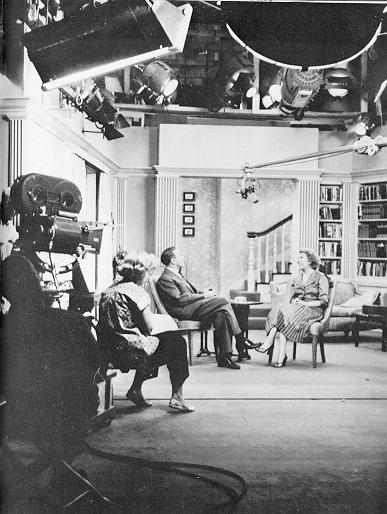
CBS was lucky enough to have Burns and Allen on their radio and television networks. In 1930, an NBC executive told them the public would not accept them and Gracie’s voice was too squeaky! William Paley was a huge fan of their comedy and wanted them to try this new medium. The television show was very similar to their radio show. One of the first tag lines for the show was “You’ve HEARD them on radio, now SEE them on television.”

Ralph Levy was the first producer/director. Previously he had worked on variety shows and sports events. When he and George first met, it was not a great first impression. He thought it was the craziest concept he had ever heard for a show. George considered him a bit of a young punk. They put aside their differences and not only became close friends but greatly respected each other’s business decisions. Ralph would leave in 1953 to work for Jack Benny. When Jack did not have weekly shows, Ralph was working for both comedians, but the jobs became too much for one person.

Ralph Levy with George and Gracie
The show was broadcast on Thursdays from October of 1950 until March of 1953. From March of 1953 until September of 1958 when it went off the air, it was on Monday nights. Originally, it was staged live and broadcast every other week. In the fall of 1952, they decided on a weekly format. Shows debuting in New York were considered better commercial successes, so the first six episodes were set in the Mansfield Theatre in New York. The West Coast would not see the show until two weeks after the East Coast did. A kinescope was filmed with a 16 mm camera. Duplicates were made, and these shows were sent on kinescopes across the country. In December of 1950, the cast was allowed to go back home to California to film the rest of the series.
In 1951, George would broadcast all over the US with the placement of coaxial cables. George realized filming the episodes would allow for syndication of the show. The show continued for eight years, producing 239 filmed episodes.
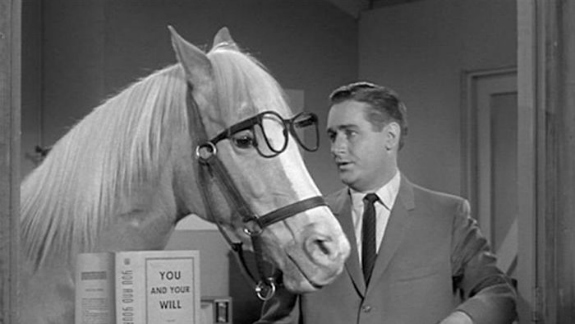
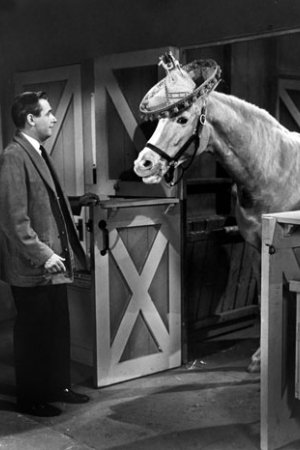
Burns and Allen started McCadden Productions. It was named for the street where George’s brother Willy, one of the writers of the show, lived on. Willy was also their manager. They employed more than 300 people and would go on to produce many shows including Mister Ed and the Bob Cummings Show. George truly valued everyone’s opinion and anyone, even the janitor, could make comments and suggestions for improvements.
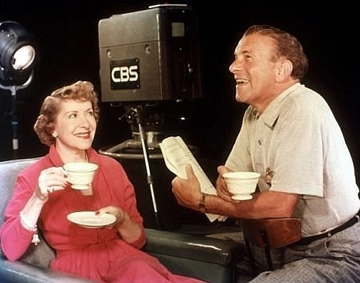
It was a grueling schedule to stick to for eight years. George and the writers met Monday morning. Gracie had wardrobe fittings and studied the newest script. They had rehearsals on Tuesdays, and Wednesdays were typically 12-hour days with filming beginning after another rehearsal. Thursday was Gracie’s only day off. The writers met Thursday as well as all day Friday. On Friday Gracie went shopping for her next show’s wardrobe. George devoted Saturday to narrowing down the script to fit the shooting time. On Sunday George and Gracie met with the director at 10 am to go over the script. Sunday afternoon and evening (as well as other scattered times during the week) Gracie studied and memorized the script.
Carnation Milk became a sponsor immediately and would stay with the show for all eight years. Carnation was like another character on the series. Actors were pitchmen for the products and commercial breaks were often part of the show. Gracie had their milk in full view in her kitchen. Their prop man who helped with this for all eight years was Nat Thurman.
George took his writers off to Palm Springs to work on the new show. The head writer was Paul Henning who would later go on to write, produce, and direct many classic sitcoms including The Beverly Hillbillies, Green Acres, and Petticoat Junction. The other writers were Sid Dorfman, Harvey Helm, Willy Burns and George. The writers were truly funny. One day Jack Benny sent George a telegram from London. It just read “What’s new?” George and his writers took an entire afternoon to answer it. They told Jack everything that was new including restaurant menus.

Paul Henning
The show would often begin with George doing a monologue with his trusty cigar that would explain the beginning of the plot to the viewers. George frequently spoke to the audience during the show. In later years, he would retire to his study to watch the show on his television, therefore knowing what was going on in his absence. The rest of the cast was oblivious to the fact he could do so.
The first show had a very simple plot which was the key to many of their episodes. Gracie and Blanche want to go to the movies. The boys want to go to the fights. George makes up a complicated card game that doesn’t really make sense. He thought the nonsense rules would confuse the girls who would get mad and quit. Instead, Gracie thought the rules made perfect sense and she won the game, dragging the boys to the movies.

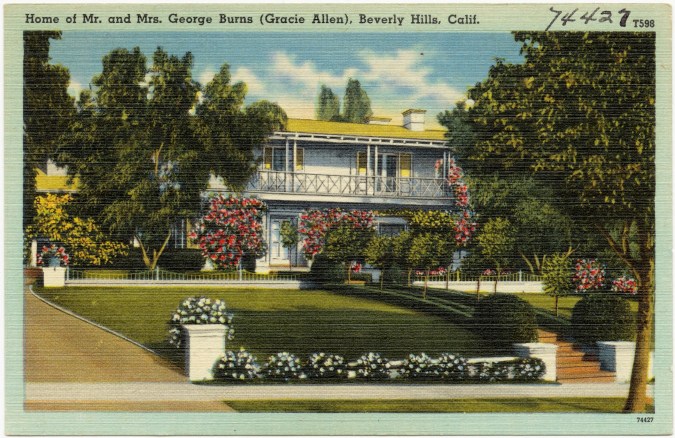
The Burns lived at 312 Maple Drive in Beverly Hills and their best friends and next-door neighbors, Blanche and Harry Morton, lived at 320 Maple Dr. The sets were copied from the Burns’ actual home. A shot of their real home was used on the show for exterior scenes. George continued to live in the house even when they became quite wealthy and George was still living there when he passed away at age 100.The house still exists today. They were not arrogant people. Gracie continued to wear the same $20 engagement ring George bought for her when they had no money.
The edge of the Burns’ swimming pool which was sometimes seen in the live episodes was an eighteen-inch tank of water which was designed to be quickly rolled on and off the stage. Lighting tricks were employed to create the illusion that the shallow tank had depth. George used the pool in his asides to the audience. One time he was supposed to have fallen in, and he showed up dry and made a comment about how quick things happen on television. Later he has to go into the pool again. He once again is seen completely dry, but this time he says nothing and he wrings a bunch of water out of his cigar.
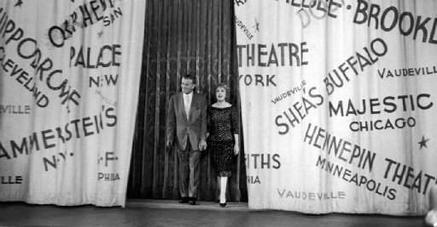
Starting in the fall of 1955, Burns and Allen would often reappear after the end of the episode, before a curtain decorated with the names and locations of the various theaters where they headlined in their vaudeville days. They would perform one of their routines, often discussing Gracie’s relatives.
The theme music was “Love Nest,” composed by Otto Harbach and Louis Hirsch. It was written for a musical comedy show, “Mary.” There are lyrics, but only the instrumental version was used on the Burns and Allen Show.
Bill Goodwin and Harry Von Zell
Several staff members transitioned from radio with George and Gracie. Bill Goodwin continued to play himself, providing announcing duties. When he left in the second season to host his own show, Harry Von Zell took over the announcing duties. In real-life, Harry Von Zell had written several episodes of Wagon Train in 1957. The writers incorporated it into the show by having Harry pitch George ideas for western-themed shows. That year, George dressed like a cowboy from time to time and would say things like, “Meanwhile, back at the ranch.”

Larry Keating, circa 1951
Bea Benaderet and Larry Keating
Bea Benaderet also moved from radio to television. She was Blanche Morton for the run of the show, but she went through several husbands (Hal March, John Brown, Fred Clark, and Larry Keating). George was extremely creative in his interaction with the audience. Hal March did the first seven shows; John Brown took over the for the next ten months; and Fred Clark was Harry through 1953 for 74 episodes. In a program “Morton Buys Iron Deer/Gracie Thinks George Needs Glasses,” Blanche is holding a catalog ready to hit Harry who spent $200 on an iron deer. George walks on stage and stops the action. He introduces Larry Keating and tells Bea that he is her new husband. They have a small chat about each other’s work. George stops them and says if they are that nice to each other, no one will believe they are married. He gives a cue, Blanche resumes her position, and hits Harry when he re-enters the scene.

1952 — Fred Clark — Image by © John Springer Collection/CORBIS
Fred Clark, Hal March and John Brown
Bea and Gracie were close friends. Blanche truly loved Gracie and was extremely loyal to her. They laughed continuously. Bea also loved Gracie in their personal lives.

George and Gracie’s daughter Sandra and son Ronnie also appeared in the show. In later years, Ronnie would become a regular. Ronnie became very popular; he and Gracie often covered for each other with George, and Ronnie was often busy trying to get her out of a bad situation. When he joined in 1955, the show moved back to New York. Harry Morton gets a temporary job there, so the Burns family went too. This change called for new sets, including the hotel where they all were living and Rumpelmayer’s sandwich and ice cream shop.

Ronnie Burns
In the seventh year, the cast went back to Los Angeles. Fred de Cordova, who had taken over for Ralph Levy, left after three years to direct movies. Rod Amateau was brought on for the final two years. In many ways, the seventh season was their most creative—this is when the “magic” TV screen appeared.
While the ensemble around them was incredible, the heart of the show was Gracie. Gracie always said that her character believed she was the smart one and everyone else was a little off. There was always a touch of reality in her logic. Gracie played her that way and the audience felt protective of her.

Gracie was a bit of a perfectionist, but no one worked harder than she did. If she had to perform a task on the show, she did it. In a New York Times article, she commented, “It makes me furious to see an actor go through the motion of writing an address on a piece of paper. They scribble it off in a second and you know they couldn’t have written anything.” Whenever Allen performed a task on the show, whether it was writing a name, sewing a handkerchief, or chopping up vegetables, she meticulously performed the duty while reciting her dialogue.
Everyone around her said she never blew her lines and was in almost every scene. George described her work ethic in his book I Love Her That’s Why: “On the set she gives absolutely no trouble and makes no demands. She arrives on time, does the job, jokes with the crew, and in general behaves less like a star than any actress I know.”
During the eight years that the show was on the air, Gracie Allen never appeared in the same outfit twice, and she had three costume changes in some episodes. Gracie Allen chose her own wardrobe. Jane Vogt was the wardrobe mistress for the rest of the cast. Bertha French was the show’s hair stylist and Gene Roemer did make-up. Gracie trusted Gene so much she typically slept while he got her ready.
The writers knew there were a few rules for writing for Gracie. Cheryl Blythe and Susan Sackett sum them up in their book Say Goodnight Gracie!: “(1) She thinks she is smart. (2) Keep her reactions consistent from week to week. (3) Her logic was illogical and her illogic was logical and then her reasoning worked.” Examples of her logic are: “Shorter cars use so much more gas. With a short car, you have to travel further to go the same distance.” When the delivery boy tells Gracie he’s in a hurry because Mrs. Vanderlip is waiting for a chicken to make sandwiches, Gracie tells him she’ll wait a long time because it took her 2 years to teach their canary to sing. Gracie keeps her clocks unplugged to save electricity. When she wants to know the time, she plugs it in. Or take the time she froze a bunch of water; it will save her time when she needs it because she just has to defrost it.
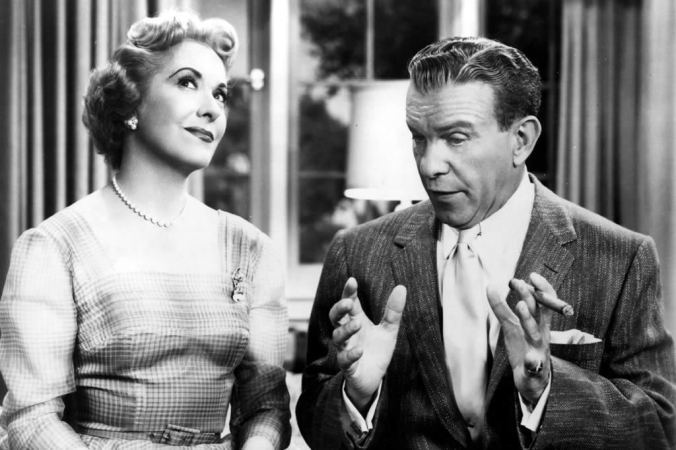
George gave Gracie most of the credit. Once he commented “You see, to be a straight man you have to have a talent, you have to develop this talent, then you gotta marry her like I did.” The audience liked George because they intuitively realized he adored Gracie.
George was the calm in the middle of the storm around him. Because he always knew what was going on, he remained relaxed when everyone else was confused. And the audience loved the fact that he shared information with them, so they were in on the fun.
Allen announced her retirement on February 17, 1958—effective at the end of the current season. Burns and Allen filmed their last show June 4, 1958. The plot of the final program was Ronnie fearing he was going to lose his girlfriend to an exchange student. The filming was an emotional experience, although nothing was said about it being Allen’s last performance in the show itself. At the wrap party, Allen took a token sip of champagne from a paper cup, hugged her friend and co-star Bea, and said “Okay, that’s it.” After a brief last look around the set, she said, “And thank you very much, everyone.”

“She deserved a rest,” Burns said. He explained that she had been working all her life and her lines were the hardest to learn. She had to memorize every word because some lines didn’t make sense.
Although Burns and Allen was never among the top-rated series, it maintained consistently high ratings throughout its eight seasons. The show received a total of twelve Emmy nominations: four for best comedy series, six for Allen as best actress and comedienne, and two for Bea Benaderet as best supporting actress.

Inspired writing complemented the comic performances, making Burns and Allen an all-time classic. The show holds up remarkably well. The writers purposely kept topical and political humor out of the scripts. They also made sure there were no specific references to the 1950s, so the show did not sound dated in reruns. Their words can say it much better than I ever could, so here are some examples of their creative scripts.
Ralph Hanley: I’m here to help you with your income taxes.
Gracie: Oh, we’re glad, we got tired of paying them all ourselves.
Ralph: For medical you put down a full-length mirror, $50.
Gracie: That’s right, I got it for my father, so he won’t get pneumonia.
Ralph: How’s that?
Gracie: Well, you see, before he only had a half-length mirror, so when he went outside he forgot his pants.

George: Would you ever think that such a beautiful mink coat would come from such an unattractive little thing that looks like a weasel?
Gracie: Oh, George, you’re just fishing—you know I think you’re handsome.

Blanche: I just got a phone call from Lucille Vanderlip and she told me Margie Bates got a beautiful diamond bracelet from her husband.
Gracie: I can’t believe it.
Blanche: Why not?
Gracie: If Lucille’s husband gave another woman a diamond bracelet, you’d think she’d be the last one to mention it.
Blanche: Er . . . Gracie . . . you misunderstood me.
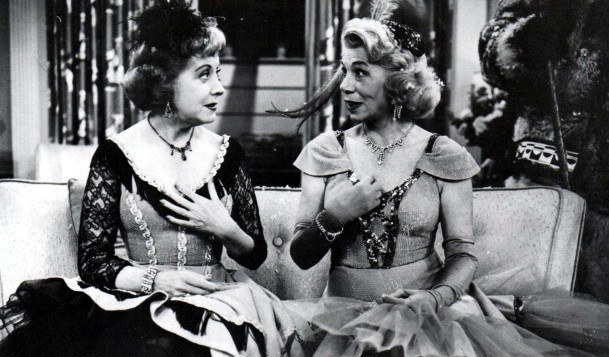
Gracie: The night before last, George came home from the office feeling terrible.
Blanche: Probably flu.
Gracie: No, he drove the car.
My top ten favorite shows are:
#13, March 15, 1951: The Vanderlips are having a party. Gracie was hoping they would invite the Mortons but there is no room, so she and George decide not to go so they can spend time with Blanche and Harry. Once Burns and Allen decline, the Vanderlips call the Mortons because they now have room, so the Mortons happily attend.
#17, February 12,1953: On the train home from San Francisco, Gracie thinks one of the passengers is planning on murdering his wife. She reports it and confuses the cops who believe Harry Morton has killed Blanche who is missing. Blanche actually is off on a shopping trip.
#38, August 3, 1953: Gracie is a witness to a bank heist. Johnny Velvet, the gangster behind the crime (played by one of my favorites, Sheldon Leonard), kidnaps Gracie so she cannot testify in court. After a couple hours, he takes her back because she is driving him crazy. He decides to kidnap George instead, but his men keep nabbing the wrong guy.
#40, August 17, 1953: Gracie is shopping in a department store when she trips. The store wants to settle quickly before it turns into a big lawsuit. Gracie thinks they are trying to sue her for putting a hole in the carpet. The adjustor meets her and assumes the store is in bigger trouble because she now has a head injury.
#79, April 5, 1954: Gracie, known for denting the car, explains the new ding when she tells him an elephant sat on the car. No one believes her. When the circus owner comes to the house to bring her a check for damages, George thinks it’s a prank to convince him, so he tears up the check. George finally realizes an elephant did indeed sit on the car.
#90, August 2, 1954: George and Gracie decide they want to see a movie with some friends. They are having a tough time coming up with a movie that someone in the group has not already seen. They finally find one everyone can agree on, but then someone else stops by to go with the group and they have seen it.
#118, January 3, 1955: Gracie is talking with a woman in the post office. She wants to retrieve a letter she mailed asking her husband for a divorce. She wrote it when he refused to let her mother come visit. Harry Von Zell overhears part of the discussion and assumes Gracie is divorcing George because he won’t let her mother come. He finally convinces George to invite Gracie’s mother. When George learns the actual story, he fires Harry again.
#192, June 4, 1956: George has given his coat to Harry Von Zell to use because he’s taking a date to the Stork Club. George gets locked into the steam room at the club and can’t get out till morning. He tells Gracie why he didn’t come home, but someone returns his coat from the Stork Club, so she thinks he is lying. He has to bring over everyone who had been involved in getting him out of the steam room to convince her he is telling the truth.
#213, October 29, 1956: Gracie misunderstands a conversation, thinking that the Mortons are moving to Pasadena. Gracie decides she and George will move too and tries to sell their house. As a subplot, Ronnie’s fraternity initiation requires him to say the exact opposite of what people expect to hear for a day. Having Gracie and Ronnie there all day truly confuses George.
#219, Ronnie is dating a girl he met at the store where he works. He leaves his coat at her house and her mother drops it off for him. Gracie assumes the mother is Ronnie’s girlfriend. She decides to get Ronnie fired from his job so he is no longer working with the older woman. She also mentions his seeing an older woman to his real girlfriend, not knowing who she is. Luckily, George sees this on his study television, so he is able to straighten out the mess.
If you have never seen the show, you might want to check out some of these on YouTube. There are also numerous DVD collections from their show specifically to sets of golden age classics variety packs. You can also catch their show on Antenna TV from 5-6 am every weekday, 4-5 am Saturday and Sunday mornings, as well as 9 pm Saturday night and 11 pm Sunday night.








 thewritelife61