In looking at war-themed television shows, M*A*S*H has to be number 1. An episode could have you sobbing one minute and laughing hysterically the next minute. Hogan’s Heroes might not be at the same level, but it is a fun, well-written show with an interesting cast of characters. Debuting about two decades after the war ended, the show first aired in September 1965 and continued till April 1971, producing 168 episodes.

The setting of the show is Luft Stalag 13, a prisoner of war camp where Allied prisoners are held north of the town of Hammelburg.
The POWs are using the camp as their base for Allied espionage tactics to sabotage the Nazis and to help other Allied POWs and defectors escape Germany. Colonel Robert E. Hogan, played by Bob Crane, is the mastermind of the crew. While Hogan and his boys help the Allied cause, the two men who aid the cause the most do it unwittingly. Colonel Wilhelm Klink (Werner Klemperer) and Sergeant of the Guard Schultz (John Banner) are easily tricked and proud of the fact that no prisoner has ever escaped Stalag 13. The incompetent Germans are more concerned with making sure they do not cause trouble with their superiors which could get them sent to the Russian front. The Germans in the camp are portrayed as inept and easily manipulated. In later episodes Sgt Schultz tends to look the other way, realizing that Hogan and his men are much more than mere prisoners.

A series of tunnels allows Hogan and his men to come and go at will. A doghouse in the guard dog compound is one of their doors and they make friends with the dogs who never track them down. A bunk in the barracks is another trap door and the main entrance into the tunnels. A periscope disguised as a sink faucet allows them to view the compound. Hogan is also able to listen in to the telephone switchboard and to make phony calls when necessary. A planted microphone in Klink’s office allows the men to hear any conversation taking place there. A portion of the barbed wire fence is a frame that can be lifted to get in and out of camp. Sometimes the guys “borrow” cars from the Germans or have planes land near the fence for air drops.
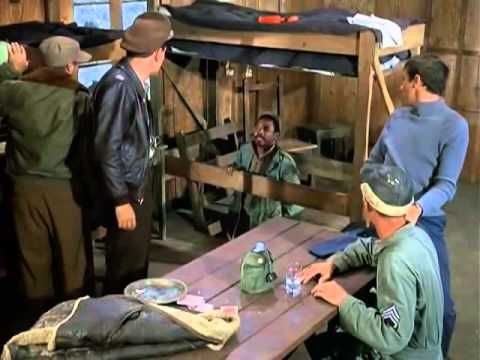
NBC actually turned down the show. From what I read, they didn’t think the pilot was bad; they seemed to think it was so good that the innovative story lines could not be sustained in a weekly show. The pilot was filmed in black and white, but after CBS put the show on the schedule, it decided to film the rest of the episodes in color.

The show ranked in the top 20 for most of the seasons it was on television. However, the show engendered debate because it was a comedy about WWII. One critic wrote “Granted, this show is often funny and well-acted. But there’s simply no excuses for turning the grim reality of Nazi atrocities . . . for yet another brainless joke.”
The outdoor scenes were filmed on the 40 Acres Backlot in Culver City, California. The set was also used in a Mission Impossible show as a South American prison. In 1975 it was destroyed and became part of an industrial park.
The instrumental theme song was composed by Jerry Fielding. He wrote lyrics for it, so it could be featured on an album, “Hogan’s Heroes Sing the Best of World War II,” songs sung by cast members Ivan Dixon, Robert Clary, Richard Dawson, and Larry Hovis. It was also on Bob Crane’s album, “Bob Crane, His Drums and Orchestra Play the Funny Side of TV.”
Actors often played a variety of roles on the show. For example, William Christopher (who would later star in M*A*S*H) played a POW, a German soldier, and a British pilot. Arlene Martel appeared as a resistance fighter in one show and Olga and Gretchen in other episodes.
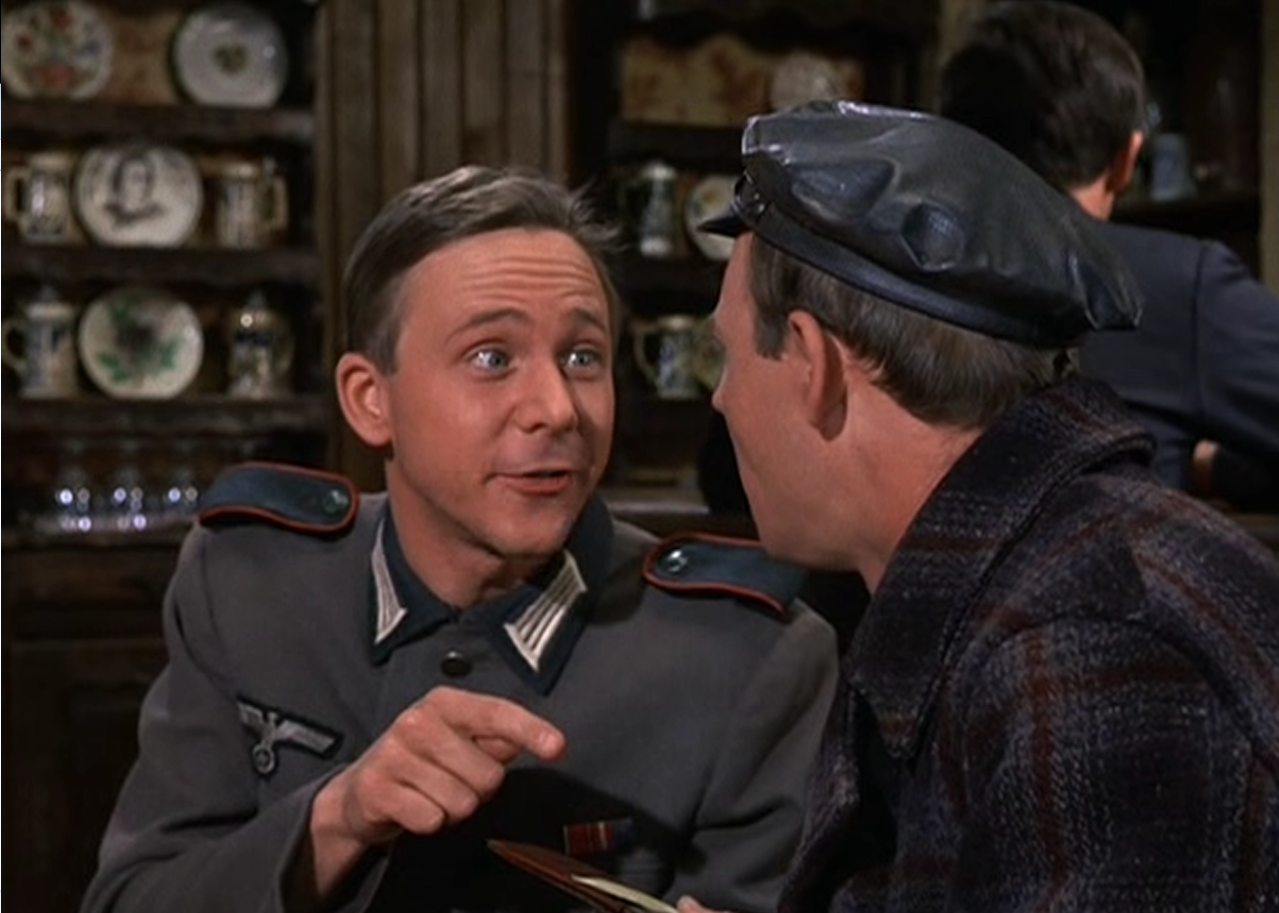
The regular cast included the following:
Colonel Robert E. Hogan (Bob Crane). He is the senior ranking POW officer and the leader of the group. He commanded the 504th Bombardment Group. He was shot down during a raid on Hamburg. Many of his plans are quite complex. Being a ladies’ man, all the women fall for Hogan. Bob provided the drums for the theme song. He also played them in a couple of episodes.

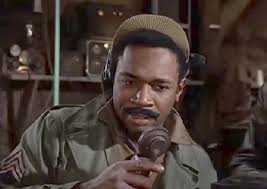
Staff Sergeant James Kinchloe (Ivan Dixon). Part of the US Army Air Force, “Kinch” is responsible for the radio, telephone, and other electronic communications for the POWs. He can also mimic German officers. He worked for the telephone company in Detroit before the war. He left the show after the fifth season. He was replaced by Kenneth Washington for the final episodes.
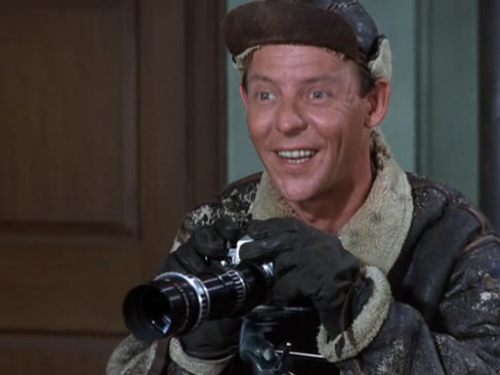
Technical Sergeant Andrew Carter (Larry Hovis). United States Army Air Corps Technical Sergeant Andrew J. Carter is in charge of ordnance and bomb-making. Hovis was intended to be in the pilot only, but he was then offered a regular role moving from lieutenant to a sergeant. He worked in a drug store in Indiana and hoped to become a pharmacist after the war. He produces formulas, various chemicals, and explosive devices.
Corporal Louis LeBeau (Robert Clary). Free French Air Force Corporal Louis LeBeau is a Master Chef who is passionate about his cooking and a notoriously patriotic Frenchman. Schultz and Klink nickname him “The Cockroach.” His cooking talent often get the Germans out of bad situations. Hogan uses LeBeau’s culinary skills to bargain for extra privileges. In real life, Clary was a French Jew who was in the Nazi concentration camps at Ottmuth and Buchenwald and had his serial number tattooed on his arm.
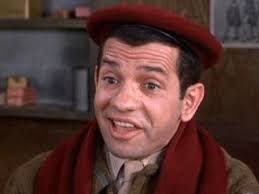
Corporal Peter Newkirk (Richard Dawson). Royal Air Force Corporal Peter Newkirk is the group’s jack of all trades. When necessary he performs as a conman, magician, pick-pocket, card sharp, forger, bookie, tailor, lock picker, and safe cracker. He does numerous impersonations of German officers and a voice imitation of Adolf Hitler. Newkirk was convinced to dress as a woman for various plots.

Colonel Wilhelm Klink (Werner Klemperer). Wilhelm Klink is an old-line Luftwaffe officer from aristocratic Prussian descent, but he is portrayed as inept, a bit dimwitted, cowardly, and often clueless. He has been stuck at the rank of colonel for twenty years with an efficiency rating a few points above “miserable.” Klink often gets splashed with water or snow.

Sergeant Hans George Schultz (John Banner). Hans Schultz is Klink’s clumsy, but lovable, Sergeant of the Guard who is forever taking small bribes from the prisoners, with whom he is overly friendly. Sometimes the boys talk in front of him or tell him exactly what they are going to do. He always says, “I hear nothing, I see nothing, I know nothing!” Before the war, he owned the most successful toy company in Germany.

General Albert Hans “Hansi” Burkhalter (Leon Askin). General Albert Burkhalter is Klink’s superior officer, a gruff man. Burkhalter frequently tires of Klink’s babbling and says, “Shut up, Klink!” He regularly threatens to send him to the Russian Front or have him shot.

Some of the other regular roles included Sigrid Valdis as Hilda, Howard Caine as Major Hochstetter, and Cynthia Lynn as Helga.
There are some famous “goofs” in the filming of the show. (1) In one scene, a periodic table of elements is hanging on a wall. It shows all the 103 elements known to science in the 1960s; however, in the 1940s, fewer than 92 elements were known. (2) On numerous occasions Eva Braun, Hitler’s mistress, is mentioned either by Hogan’s men or the Germans. Braun’s association with Hitler was a closely guarded secret only known to Hitler’s inner circle, whose existence wasn’t revealed until after the war. (3) The center top ribbon on Colonel Hogan’s dress uniform is the Air Force Distinguished Service Medal, an award that was created by the Air Force after World War II.
The most surprising thing I learned about the cast members were their backgrounds. Werner Klemperer, Howard Caine, Leon Askin, and John Banner, who portrayed the Germans Klink, Hochstetter, Burkhalter, and Schultz, were all Jewish. All of them also served in the U.S. Armed Forces during World War II. Klemperer was born in Cologne, Germany, and Banner and Askin were both born in Vienna, Austria; the three of them immigrated to the United States after fleeing the Nazi regime. Banner had been held in a pre-war concentration camp, and his family was killed during the war. Robert Clary, John Banner, and Leon Askin were all survivors of the Holocaust. Werner Klemperer escaped Nazi Germany in 1933 with his parents. When asked about their willingness to play these roles, Klemperer said, “I am an actor. If I can play Richard III, I can play a Nazi.” Banner’s response was “Who can play Nazis better than us Jews?”
As mentioned earlier, Robert Clary was imprisoned for three years in Nazi camps. His comment when asked about his participation on the show was “Hogan’s Heroes was very different—we weren’t really dealing with Nazism.”
While it is surprising that this show was able to get produced so soon after WWII, the show received a lot of praise from critics. Hogan’s Heroes had 12 Emmy nominations, with two wins, both for Werner Klemperer for outstanding supporting actor in a comedy.

The show has held up amazingly well since it aired 53 years ago. All seasons are available on DVD, and the show is currently seen on Me TV weeknights from 9-10 pm, CST. Tune in some night when you want to go to bed laughing–it’s a nice break from the news.




 thewritelife61