David White: The Man Behind McMahon and Tate

This month our blog series is Supportive Men. These actors were not the stars of the series, but they contributed a lot of fun to the show. First up is David White who we know best as Larry Tate from Bewitched.

White was born near Denver, Colorado, in 1916. His family moved around a bit. He lived in Pennsylvania and Missouri and graduated from Los Angeles City College. He worked at the Pasadena Playhouse before enlisting in the Marine Corps during WWII. After his four years in the military, he began acting again with the Cleveland Play House.

📷pinterest.com On The Phil Silvers Show

In 1949, White found himself living in New York where he made his Broadway debut in “Leaf and Bough.” The theater critics were not kind in their reviews, and the show closed after three performances. The following year, he tried the stage again in “The Birdcage” with Maureen Stapleton. He was then given a role in “The Anniversary Waltz,” co-starring Macdonald Carey and Kitty Carlisle which ran for 611 nights. He paid his dues, working in a variety of jobs while trying to establish his acting career. His resume included a farm laborer, a truck driver, a doorman at the Roxy Theater, and working at the J.H. Taylor Management Co.

In the 1950s, David began his long television career. His first appearance was in The Philco Playhouse production of “Rich Boy” with Grace Kelly. While most of his roles were in dramatic shows and westerns, he did a few comedies including Father Knows Best, My Favorite Martian, The Farmer’s Daughter,  and My Three Sons. Most of his roles were as corrupt businessmen or arrogant politicians.

📷dvdizzy.com In The Apartment

In 1952, David married actress Mary Welch. Welch appeared in several successful plays on Broadway. She was a member of Lee Strasberg’s Actor’s Studio before opening her own school called The Welch Workshop. White and Welch worked together in only one production, at a regional theater, in “Tea and Sympathy.” In 1958 she died of complications from their second pregnancy. They had a son Jonathan and sadly, he died in 1988 in the bombing of the Pan Am Flight 103 over Lockerbie, Scotland. (This was a tragic incident when Libyan terrorists planted a bomb on a plane flying from London to New York. It exploded 35 minutes into the trip and killed all 259 people on board and 11 people in the neighborhood where it landed.)

After his wife died, White and his son moved to Hollywood where White launched a big-screen career. His film debut was in 1957 with Tony Curtis, Barbara Nichols and Burt Lancaster in The Sweet Smell of Success. He only had 16 movies in his credits, but they included The Apartment, Sunrise at Campbello, and Brewster’s Millons.

📷closerweekly.com On Bewitched

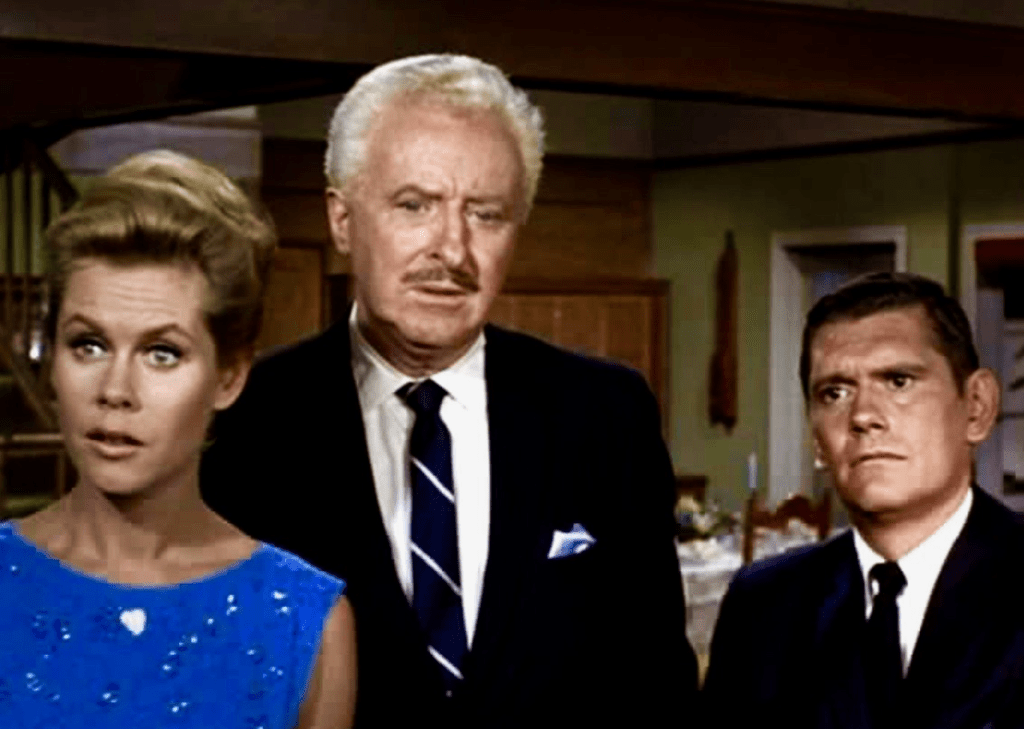
From 1964-1972, he perfected the comedic role of Larry Tate on Bewitched. As president of McMann & Tate, he was constantly firing Darrin for one reason or another, usually related to some circumstance caused by Samantha’s family. White also directed one episode of the series, “Sam’s Double Mother Trouble.”

During an interview with Herbie J. Pilato (author of Bewitched Forever), White said he “got the part because I was an honest man, and that’s how Larry and I were different. I’m not two-faced, and he was. I had more integrity than Larry ever had. I was smarter and had a deeper sense of values. I had to diminish who I was to play Larry, whom I viewed as a very insecure person who only had a certain brilliance in certain areas. He was smart enough to hire people who possessed the skills he did not—like Darrin. I wasn’t born to play Larry. I had to create him. He was a make-believe character of his own truth slated in a comedy series. When playing humor and farce you take that truth and stretch it as far as it will go. But not any farther. When I was playing Larry, though he was a funny character, I never tried to be funny. To me, acting has to do with fulfilling the needs of the character you’re playing, not the actor who’s playing him. Although the one thing the actor and the character have in common is that both have needs. A real heavy is a man who doesn’t have any moral structure whatsoever; one who ends up cheating or even killing someone. Larry was selfish, but he was never that extreme. If anything, he was still a little kid who never matured.”
📷x.com Bewitched

In that same interview, White said his favorite Bewitched episodes were “Moment of Truth” (Season 3, Episode 2 when Samantha has to tell Darrin Tabitha is also a witch and they try to keep the secret from the Tates), “Bewitched, Bothered and Infuriated” (Season 3, Episode 31 when Clara tells them about a future newspaper article that says Larry broke his leg on their trip, so Darrin and Samantha try to protect him while causing a lot of annoyance to Larry and Louise), and “Toys in Babeland” (Season 4, Episode 2 when Endora brings one of Tabitha’s toys to babysit her while she runs a quick errand which leads Tabitha to bring a lot of toys to life).

After the show ended, White continued both his television and film careers. He also continued in the theater, primarily with Theatre West and the Mark Taper Forum in Los Angeles.
📷imdb.com My Three Sons

During the seventies and eighties, he showed up in a variety of popular shows including Adam-12, Cagney and Lacey, Cannon, Columbo, Dallas, Dynasty, Love American Style, Mission Impossible, Qunicy M.E., Room 222, The Odd Couple, The Love Boat, The Mary Tyler Moore Show, and The Rockford Files.

After his son’s death, White became a bit of a recluse. He had just begun working again when he passed away from a heart attack in 1990 at the age of 74. Certainly, David White had a successful career, amidst his personal heartbreaks, appearing on the stage, in films, and on television. It would have been wonderful if he had another chance to be part of the cast of another hit show, maybe a dramatic role. However, if you only costar in one show, the role of Larry Tate and the memories we have of him on Bewitched is a great one to have.

Kitty Carlisle Tries To Tell the Truth

We are in the middle of learning more about four of the regular members of To Tell the Truth. We have looked at Orson Bean and Peggy Cass, and today Kitty Carlisle is up.

Photo: bingcrosbynewsarchive.com

Kitty was born Catharine Conn in 1910 in New Orleans. Her grandfather was the mayor of Shreveport, a Confederate veteran of the Civil War. He was on the USS Virginia as a gunner during the battle with the USS Monitor. Her father, a gynecologist, died when she was only ten. Her mother took her to Europe the following year. Apparently, her mother thought European royalty would be more likely to marry a Jewish girl than a wealthy American. Kitty was enrolled at some of the best schools on the continent: Chateau Mont Chois in Switzerland, Sorbonne and the London School of Economics. She studied acting at the Royal Academy of Dramatic Art in London and studied singing with Estelle Liebling who taught Beverly Sills.

In 1932 she and her mother returned to the United States, settling in New York. Under her stage name, Kitty Carlisle, she appeared in several operettas and musical comedies. She apprenticed with the Bucks County Playhouse in New Hope, Pennsylvania. She also appeared on the radio during the early thirties. She studied with Julliard teacher Anna E. Schoen-Rene and appeared in 16 theater productions.

Kitty dated George Gershwin for a while in the 1930s. In April of 2007 in an interview on NPR, Kitty talked about her relationship with George: “Oh, George was fun. George was a really most interesting man. He was an egomaniac, but then I’d grown up with egomaniacs, so that didn’t bother me. He did ask me to marry him, but he wasn’t in love with me, nor was I in love with him.”

Photo: charlesmatthewsblogspot.com

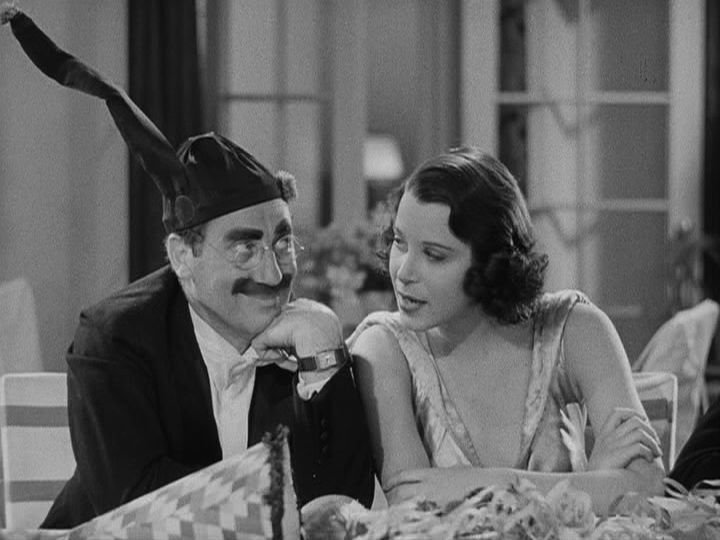
Not long after her arrival back home, she began her movie career.  Her first film was Murder at the Vanities in 1934. She appeared with the Marx Brothers in A Night at the Opera. That must have been quite an experience. In a trivia post on imdb, Kitty is quoted as saying during her filming, “Groucho would come up to me from time to time to ask me, ‘Is this funny?’ Then totally deadpan he’d try out the line. I’d say, ‘No I don’t think it is funny,’ and he would go away absolutely crushed and try it out on everyone else in the cast. Chico was always playing cards in the back room and had to be called on the set. Harpo would work until about eleven o’clock. Then he’s stretch out on the nearest piece of furniture and start calling out at the top of his voice, ‘Lunchie. Lunchie.’”

Carlisle also made several films with Bing Crosby. However, her movie career never took the direction she was hoping for, and she only appeared in six movies, two as herself.

With Moss Hart Photo: theatermania.com

In 1946, she married playwright Moss Hart. The first time she met him was in Hollywood when she was introduced to several theater playwrights and musicians. She was so excited that she tripped over a cable and fell right in front of Moss. A few years later she was introduced to Moss at a dinner party at Lillian Hellman’s house. They would have two children. She appeared in several of his productions including “The Man Who Came to Dinner” in 1949.

They were married until 1961 when he passed away at their home. She never remarried; at one time she said, “When you’ve had the best of it, why fiddle around? He was so wonderful. He was so witty and it was such fun to be with him. I loved it and I loved him.” Carlisle lived another 46 years after his death and she did have several important romances, including a long-time relationship with Ivo John Lederer, a historian for sixteen years until his death in 1998.

In 1966, Kitty made her debut with the Metropolitan Opera in Strauss’s “Die Fledermaus.” Her final performance with the company was in 1973.

She also showed up on a couple of television shows: Nash Airflyte Theater in 1951 and Max Liebman Spectaculars in 1956, as well as one made-for-tv movie, Kojak: Flowers for Matty in 1990.

Photo: televisionacademyinterviews.com

Carlisle appeared on To Tell the Truth from 1956 to 1978 and again in reboots in 1980, 1990, and one episode in 2000. In fact, she was the only panelist to appear on every version of the game show. She always showed up elegantly dressed in evening gowns or beautiful dresses and jewelry. The show has a reboot currently on television, but if you have not seen it, the format was that three contestants all claimed to be the same person. The panelists ask them questions to try to figure out which one was really the person. Some of the original contestants on the show included aviator Douglas Wrong-Way Corrigan, a concert pianist who was also a judo expert; a female bullfighter, Winston Churchill’s butler, President Eisenhower’s barber, and a gondolier from Venice. Kitty also appeared on Password, Match Game, Missing Links, and What’s My Line.

After her fame on To Tell the Truth, she was probably best known for her support of the arts. She participated in a variety of councils and was chairman of the New York State Council of the Arts for two decades from 1976-1996, as well as other cultural institutions.

Later in her career, she performed in a one-woman show, telling anecdotes about the men she knew from musical theater including Irving Berlin, George Gershwin, Oscar Hammerstein, Alan Jay Lerner, Frederick Loewe, and Kurt Weill, performing some of their more famous songs.

Photo: playbill.com

Kitty died in 2007 from congestive heart failure after a battle with pneumonia.

Both Kitty and Moss wrote autobiographies. Carlisle’s is called Kitty: An Autobiography. Hart’s was Act One. Kitty said that she believed it was the best book ever written about theater life. Both books have a 4.5 rating. I have not had a chance to read Kitty’s book, but I did read Hart’s. It is a detailed look at how a boy born into poverty in New York was able to become a musical playwright. The book ends before Moss becomes famous. If you love the theater, it’s an amazing piece of history of early theater life in New York City.

I had a lot of fun learning about Kitty Carlisle. She overcame life with an overbearing mother who often criticized her and constantly reminded her she wasn’t the prettiest girl or the best singer or actress. She had a lot of interesting romantic relationships including a wonderful marriage, had two children, performed on stage and in movies and on television, and did an incredible amount of work to support the arts. I hope she knows how much we appreciate her. I am looking forward to reading her book to continue learning about her interesting life.

Pernell Roberts: A Man of Many Talents

We are up close and personal this month with some of our favorite male television stars, and Pernell Roberts is definitely on that short list. Pernell Roberts was well known to television viewers in the early sixties and the early eighties. Some fans might not even realize the two characters he was best known for, Adam Cartwright on Bonanza and Dr. John McIntyre on Trapper John, MD were played by the same man.

The Family of Bonanza Photo: toledoblade.com

Pernell Elven Roberts Jr. was born an only child in 1928. He was named for his father who was a Dr. Pepper salesman. During high school, Roberts played the horn, acted in several school and church plays, played basketball, and sang in the local USO shows. He enrolled at Georgia Tech but then enlisted in the US Marine Corps. He played both the tuba and horn in the Marine Corps Band while sometimes tackling the sousaphone and percussion parts. After his time in the Marines, he enrolled at the University of Maryland where he enjoyed participating in classical theater. He left college to continue his acting career.

In 1949, he had his professional stage debut in “The Man Who Came to Dinner” with Moss Hart and Kitty Carlisle. He then took on several roles in Philadelphia.

In 1951, Roberts married Vera Mowry; she was a professor of theatre history at Washington State University. They divorced in 1959. They had one son who was killed in a motorcycle accident in 1989.

In 1952, Roberts made the big move to New York City appearing in off-Broadway shows. Several of his costars were Joanne Woodward and Robert Culp. He performed several Shakespeare roles.

In 1956, Roberts made his television debut in Kraft Theatre. In 1957, he signed with Columbia Pictures. His first big-screen role was as Burl Ives’ son in Desire Under the Elms. His second role was with Glenn Ford and Shirley MacLaine in The Sheepman.

Roberts continued to accept television roles with ten appearances in 1958 and six in 1959.

Photo: simple.wikipedia.org

From 1959-1965 he would portray Adam Cartwright, Ben’s oldest son on Bonanza. Each of the brothers had a different mother, and Adam was the only Cartwright to attend college, studying architectural engineering. After acting in classical theater for so much of his early career, the transition to a weekly series was a difficult one for Roberts. He thought it a bit ridiculous that the independent sons had to get their father’s permission for everything they did. He wanted to act in a show with greater social relevance. So, although the show would continue until 1973, he left in 1965 after appearing in 202 episodes. The storyline was that Adam was traveling in Europe or living on the east coast. Bonanza producer David Dortort said Roberts was “rebellious, outspoken . . . and aloof, but could make any scene he was in better.”

The Odd Couple Photo: sitcomsonline.com

During this time on the show, Roberts married again in 1962; he wed Judith Roberts and they would divorce in 1971.

After leaving Bonanza, Roberts returned to theater, playing a variety of roles. He toured with many musicals including “The King and I”, “Kiss Me Kate”, “Camelot”, and “The Music Man.”

Pernell also became involved in the civil rights movement, joining Dick Gregory, Joan Baez, and Harry Belafonte in the sixties demonstrations including the March on Selma.

On Mission Impossible Photo: ebay.com

From 1972-1996, Roberts was married to Kara Knack. They also divorced.

Throughout the late sixties and seventies, Pernell continued appearing in television series and made-for-tv movies. You’ll see him in westerns such as Gunsmoke, The Big Valley, and The Virginian; spy genres including Wild Wild West, Mission Impossible, and The Girl from U.N.C.L.E.; crime shows including Hawaii Five-0, Mannix, Police Story, Ironside, Cannon, and The Rockford Files; and several medical series—Marcus Welby, West Side Medical, and Quincy. He even showed up on The Twilight Zone and The Odd Couple.

Photo: televisionacademy.com

Perhaps he enjoyed those medical shows because he returned to television to star in his own series in 1979, playing Trapper John, MD. The plot was featured Trapper John from M*A*S*H later in his career at San Francisco Memorial Hospital where he was Chief of Surgery. He worked with a young surgeon who had also served in a MASH unit, Alonzo “Gonzo” Gates (Gregory Harrison). The series lasted seven seasons.

In 1979, he told TV Guide that he chose to return to a weekly show because he had “seen his father age and realized it was a vulnerable time to be without financial security.” Roberts felt the role allowed him to use his dramatic range of acting skills and to address important social issues.

In the 1990s, Roberts took on very few television appearances; his last television performance was in Diagnosis: Murder in 1997.

Roberts would attempt marriage one last time in 1999 when he wed Eleanor Criswell. When Pernell passed away in 2010 from pancreatic cancer after being diagnosed in 2007, they were still together.

Photo: Facebook.com

Pernell also enjoyed golfing, swimming, playing tennis, running, reading, cooking, and singing. He appeared on two record albums during his career. The cast of Bonanza recorded an album in 1959 and he released a folk music album in 1962, titled “Come All Ye Fair and Tender Ladies.”

He certainly had a long and varied career: music, movies, Broadway, and television. He also used his fame to help causes he believed in. I don’t think he is remembered as well as he should be. Maybe it’s because he left Bonanza too early to be included on a lot of the memorabilia that came out of that show or because there was such a gap between his two series that he starred in. Whatever the reason, I hope this blog has helped recall some of our memories of the three decades he spent entertaining us.