This month our blog series is “Kinda Creepy.” Today we are moving forward a couple of years into the late sixties with Land of the Giants.
This science-fiction show was aired on ABC from fall of 1968 to spring of 1970. It was created and produced by Irwin Allen. Five novels were released during this time, three by well-known author Murray Leinster.
The show was set in 1983 and features the crew and passengers who were on a suborbital transport ship, the Spindrift. The Spindrift is en-route from Los Angeles to London when it encounters a magnetic space storm. It goes through a time warp to an unknown planet where everything is 12 times bigger than on Earth. When the Spindrift lands, it crashes and becomes inoperable.
The crew and passengers include Captain Steve Burton (Gary Conway), First Officer Dan Erickson (Don Marshall), Flight Attendant Betty Hamilton (Heather Young), Passenger Valerie Scott (Deanna Lund), Wealthy Passenger Mark Wilson (Don Matheson), Orphan Passenger Barry Lockridge (Stefan Arngrim), Passenger and Bank Robber Alexander Fitzhugh (Kurt Kasznar), and Inspector Kobick (Kevin Hagen). Fun fact, Matheson and Lund were married in 1970 but divorced before the decade was over.
Photo: deviantart.com
The Giant society resembles that of the United States in 1968. The survivors get around in drains leading from interior rooms to the pavement. The Giants realize they are there somewhere and have offered a reward for their capture. An authoritarian government seems to dominate part of the planet but other groups are at work to help the small Earth people survive. The Giants do have advanced technology including cybernetics, cloning, force fields, magnetic stunners, androids, and teleporters.
Not only do Earthlings have to survive being caught by the Giants, but they have to be wary of pets, especially cats and dogs. Occasionally someone is captured, and other members of the crew have to rescue them.
One article said that in 1969, “boys could be found sitting in front of the television captivated by the antics of red-haired, mini-skirted Valerie as she was menaced by cats, imprisoned in a dollhouse, cloned, prodded by scientists, carried off by an ape, and even used as a pawn on a giant chessboard.”
Photo: invisiblethemeparks.com
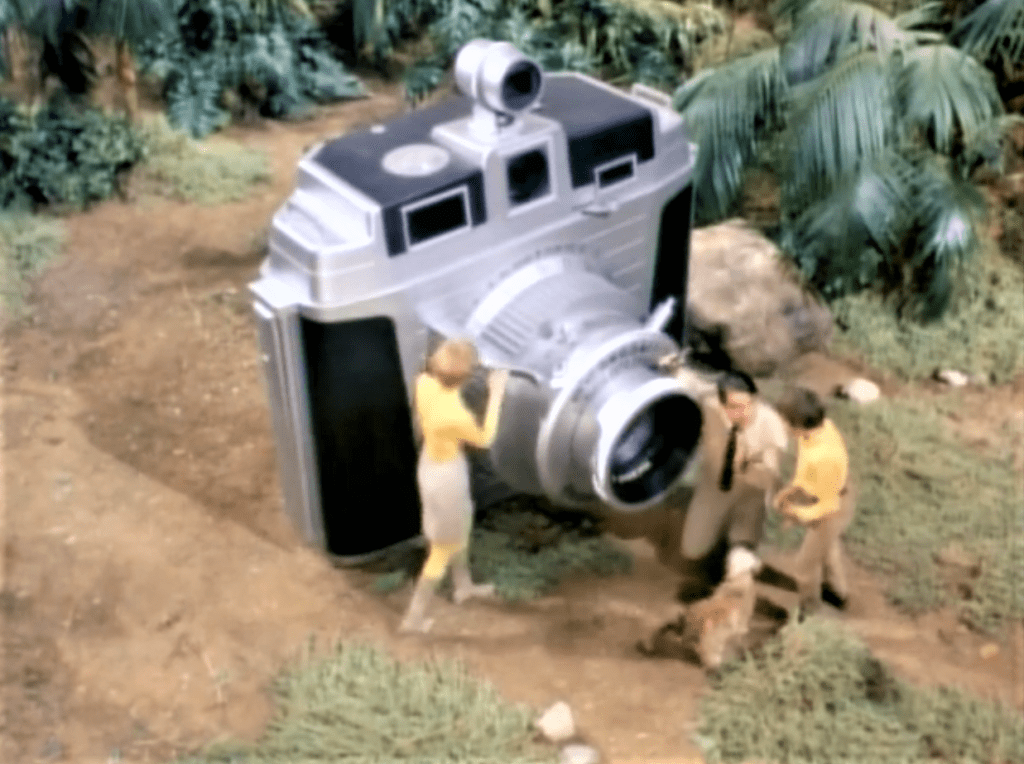
The show had a budget of $250,000 an episode. In 1968, it was the most expensive show produced on television. There were a lot of special effects. Gigantic mechanical props were built and used. For example, a slice of bread was made from a four-foot slab of rubber, and one episode had a nine-foot revolver. Some of the props were recycled from Lost in Space, Voyage to theBottom of the Sea, and Batman. Actors had to do a lot of their own stunts like climbing up curbs and phone cords. The one-hour episodes were filmed in color.
The show aired on Sunday nights against Lassie, so I was surprised it achieved decent ratings so quickly. It stayed on Sunday nights for season two but was up against World of Disney which probably created a bit of a ratings decline. The other show, To Rome with Love, moved around a lot and was probably not much competition. The network decided to cancel the show before the third season, but since the writers were not aware that it was going to happen, no finale was written, and we never learned if the characters made it back to Earth or not. The financial cost was the reason the network cited for the cancellation.
Photo: art.com
Composer extraordinaire John Williams composed the theme for the show; he also composed the theme for Lost in Space.
I don’t really remember the merchandise for this show, but it included comic books, View Master reels, model kits, and a lunch box.
I do remember watching this show and I remember being scared when a large dog was growling at one of the Earthlings. It definitely earned the kinda creepy description. I think I was a bigger fan of The Borrower books. I always wondered if this was one of the inspirations behind Honey I Shrunk the Kids. From what I recall, the concept of the show was better than the reality of the show.
Airing in 1965, Lost in Space follows the travels of a family whose ship is off course, traveling through outer space. The show was on the air for three seasons, producing 84 episodes.
Photo: nytimes.com
The premise
of the show was that in 1997, earth becomes overpopulated. Professor John
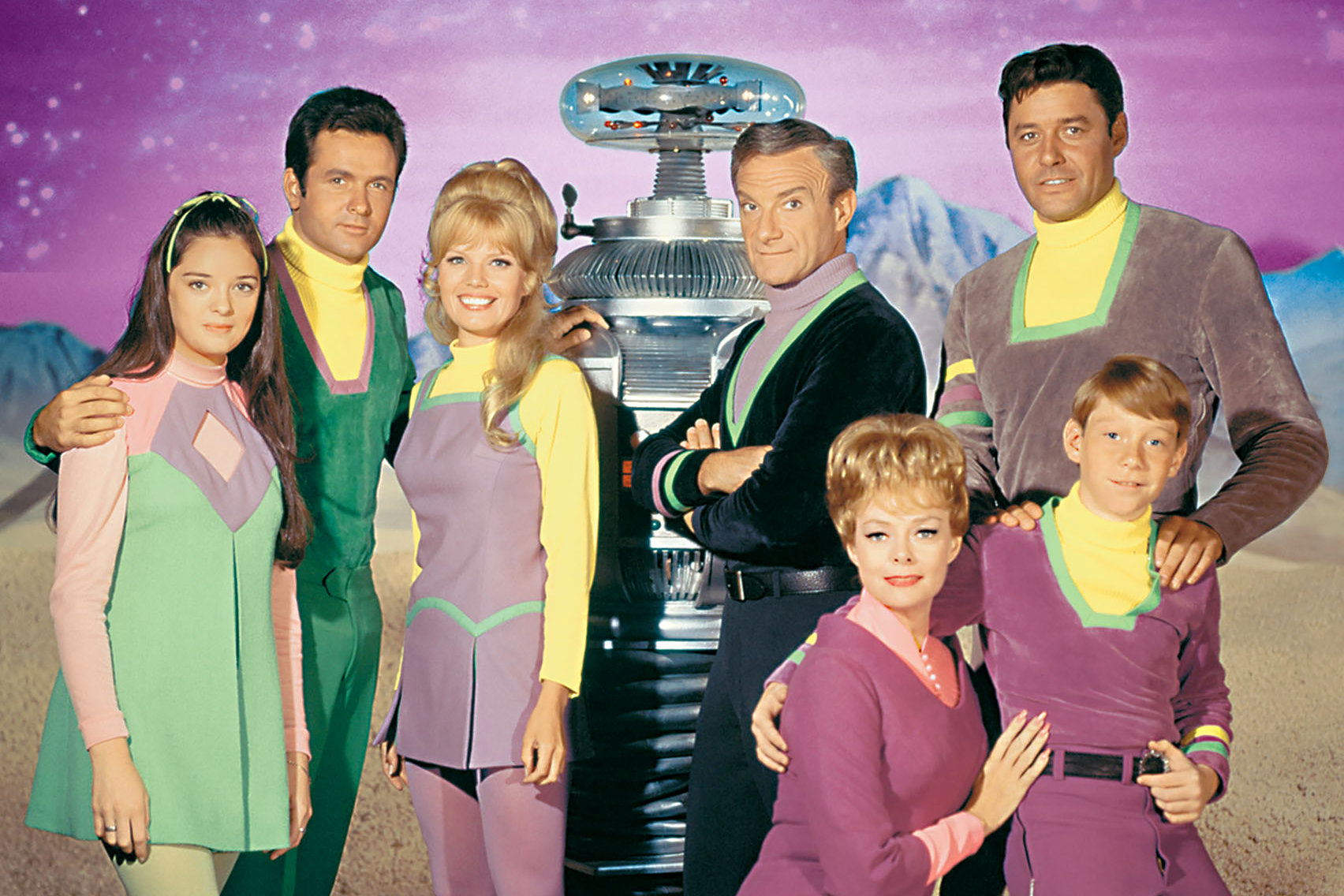
Robinson (Guy Williams); his wife Maureen (June Lockheart); and their kids,
Judy (Marta Kristen), Penny (Angela Cartwright), and Will (Billy Mumy) are
selected to go to the third planet in the Alpha Centauri star system to
establish a new colony. Major Don West (Mark Goddard) is also accompanying
them. Doctor Zachary Smith (Jonathan Harris) an enemy government agent is sent
to sabotage the mission. He becomes trapped on the ship after he reprograms the
robot (voiced by Dick Tufeld), altering the course for the spaceship, the
Jupiter 2. The group is now lost and trying to find their way back home. During
the course of the show, Smith becomes less sinister. It was no secret that the
show was a science fiction version of Swiss
Family Robinson.
The pilot, created by Irwin Allen, was titled “No Place to Hide.” A ship called the Gemini 12 was supposed to take a family on a 98-year journey to a new planet. When an asteroid knocks the shop off course, the family must try to find their way back. CBS bought the series, choosing Lost in Space over another new show, Star Trek. Dr. Smith and the Robinsons’ robot were added to the cast and the ship was renamed Jupiter 2.
Photo: fandom.com
Dr. Robinson was an astrophysicist who specialized in planetary geology. Williams who played the part was a well-known actor who had starred in the show Zorro. He thought his lead role would be a dramatic part, but the show became increasingly campy like Batman, and Williams’ role was more of a supporting character than a star. He was bitter about the turn of events and when the show was cancelled, he moved to Argentina where Zorro was popular and never acted again.
Photo: en.wikipedia.org
Maureen Robinson was also a doctor; she was a biochemist who also performed housewife duties such as preparing meals and tending the garden. Her chores were not too taxing though because the “auto-matic laundry” took seconds to clean, iron, fold, and package clothing in plastic bags. The dishwasher also did a load in seconds. In addition to the hydroponic garden maintained by Maureen, the crew had protein pills available that would substitute for food during emergencies. One fun fact I learned about Lockhart was that she had the largest parking spot on the 20th Century Fox lot because she often drove a 1923 Seagrave fire truck.
West was the pilot of the Jupiter 2 and the only crew member who could land the ship.
Photo: digitalvortex.info
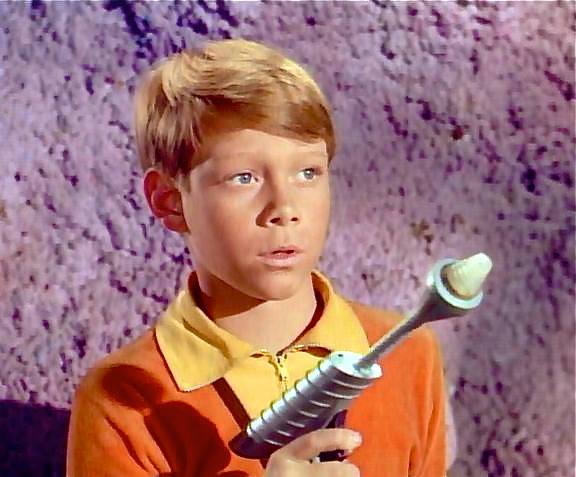
Judy is the oldest child. Being the oldest, she was allowed a more glamorous wardrobe and hairstyle. There was always the undercurrent that she and West would get together. Penny is eleven and loves animals and classical music. She finds a pet similar to a chimpanzee which she named “Bloop.” Will is nine and the youngest member of the family, but he is a genius when it comes to electronics and computer technology.
Photo: pinterest.ca
Photo: tvdatabase.wiki.com
Dr. Smith is an expert in cybernetics. Carroll O’Connor, Jack Elam, and Victor Buono were all considered for the part of Dr. Smith. Smith was only supposed to be a guest star but became the best-loved character in the show. Harris rewrote many of his lines that he considered boring. He redefined his character as an attention-getting egoist with a flamboyant style and arrogant dialogue.
Photo: nytimes.com
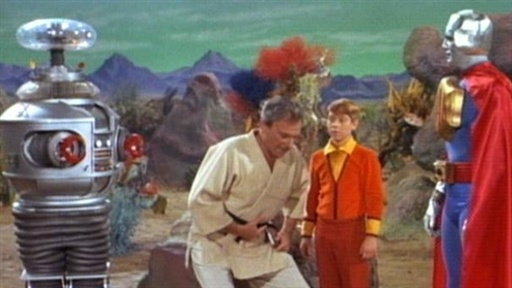
The Robot is an M-3, Model B9, General Utility Non-Theorizing Environmental Robot which had no name. It did have superhuman strength and weaponry that was futuristic in nature. It can display human characteristics such as laughter, sadness, and mockery.
Photo: denofgeek.com
The robot was designed by Robert Kinoshita. It cost $75,000 to produce and weighed more than 200 pounds. Kinoshita also designed Robby the Robot for the Forbidden Planet in 1956. The Lost in Space robot was a Burroughs B-205. It had a flashing light and large reel-to-reel tape drives. It could be seen in a variety of movies and television shows, including Voyage to the Bottom of the Sea (1964), Batman (1966), The Land of the Giants (1968), and Austin Powers: The Spy Who Shagged Me (1999).
A number of
stars chose to appear on the show including Werner Klemperer, Kurt Russell,
Wally Cox, Lyle Waggoner, Arte Johnson, Hans Conried, and Daniel J. Travanti.
The pilot and many shows from season one used Bernard Herrmann’s score from The Day the Earth Stood Still, a 1951 film. John Williams wrote the opening and closing themes for the show. Season three used a faster tempo version and the opening featured live action shots of the cast. The theme music is unforgettable, and although I haven’t seen the show since its original airing until recently, I immediately remembered the entire score.
Photo: friends-club.info
In season one, the ship crashes on an alien world, later identified as Priplanus. The crew spends most of the season on the planet, surviving many adventures. Most of the episodes emphasize the daily life of the Robinsons adjusting to their new conditions. The show was on Wednesday nights against The Adventures of Ozzie and Harriet and The Patty Duke Show on ABC and The Virginian on NBC.
Photo: pinterest.ca
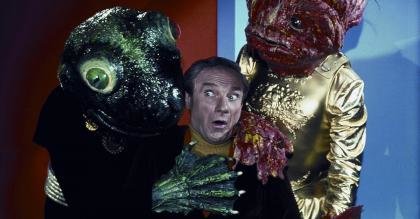
In season two, the ship is repaired and launched into space. Priplanus is destroyed after a series of earthquakes. Eventually, the spaceship lands on another planet and is delayed there. The show became campier during this time because it was scheduled against Batman for a second year. Costumes were brighter and the show was filmed in color. Most of the plots featured outlandish villains. More emphasis was placed on Will, Dr. Smith, and the robot and serious science fiction was sacrificed. Like season one, each episode ended with a cliff hanger.
Photo: pinterest.com
Season three shows the Jupiter 2 travelling through space visiting a new setting on each episode. A space pod allows transportation between the ship and the planets they explore. Humor was still a mainstay of the show and the crew encountered space hippies, pirates, intergalactic zoos, and ice princesses. The cliff hanger disappeared, and the robot would show highlights from the upcoming episode before the closing credits. The show continued its slot on Wednesdays and was still on opposite The Virginian on NBC but also The Avengers on ABC
Photo: mightymega.com
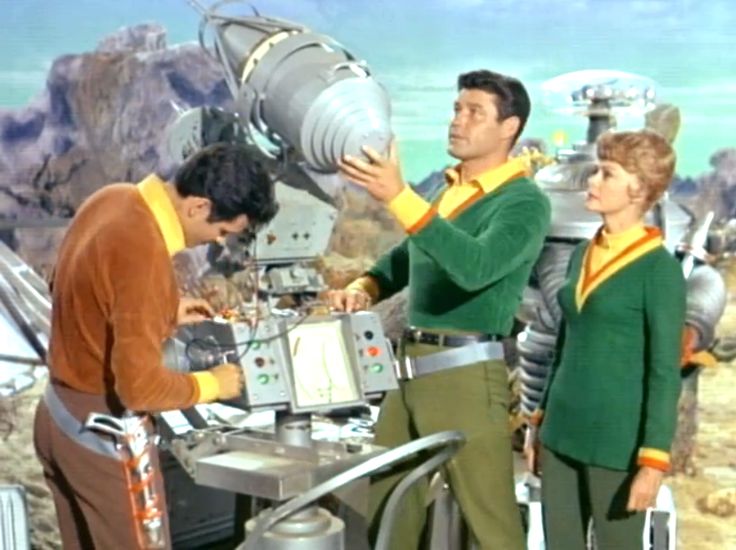
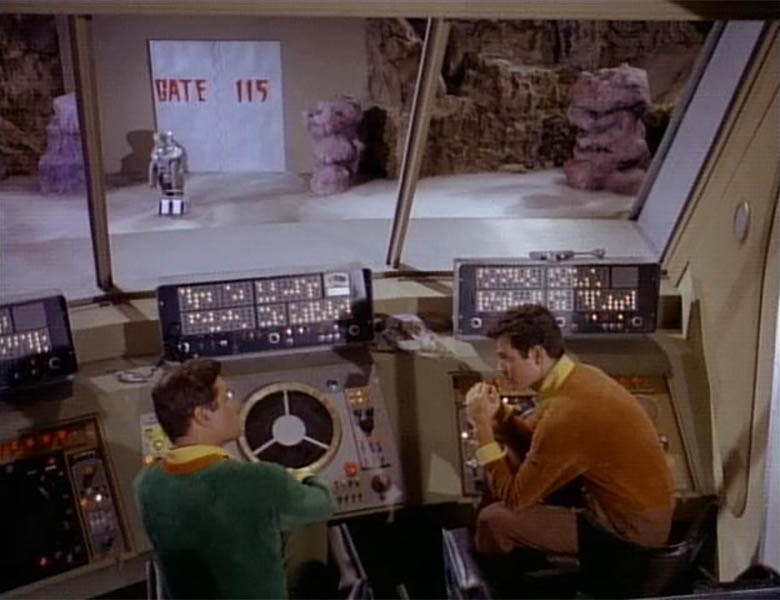
The show was probably best known for its technology and futuristic props. The Jupiter 2 was a two-deck spacecraft, nuclear powered. It used “deutronium” for fuel. The crew slept in Murphy beds. A laboratory was also designed as part of the spaceship. The characters could travel between two levels by an electronic glide tube elevator or a ladder. The ship could be entered or exited through an airlock on the upper deck or landing struts on the lower deck.
Photo: pinterest.com
The crew
traveled on the Chariot. It had six bucket seats for passengers, a radio
transceiver, a public address system, a rack holding laser rifles, and interior
spotlights.
The crew members could use a jet pack, the Bell Rocket Belt. The robot ran air and soil tests. He could detect threats with his scanner and produce a smoke screen for protection. He could understand speech and speak to the crew. He claimed he could read minds by translating thought waves back into words.
Photo: view.yahoo.com
One of the things Lost In Space is best remembered for is the catchphrase, “Danger Will Robinson.” What is funny is that it was only used one time in the series. Smith also had several lines he is remembered for: “Oh, the pain, the pain” and “Never fear, Smith is here” are two of them. He also was famous for his alliterative phrases such as “Bubble-headed booby,” “Cackling Cacophony,” “Tin-Plated Traitor,” “Blithering Blatherskyte,” and “Traitorous Transistorized Toad” which he used to insult the robot.
Photo: en.wikipedia.org
Lost in Space ranked in the top 35 shows all three
seasons it was on the air (32nd, 35th, and 33rd
respectively). It was ranked number three in the top five favorite new shows of
1965-66, along with The Big Valley, Get Smart, I Dream of Jeannie, and F-Troop.
The show was nominated for an Emmy for Cinematography Special Photographic
Effects in 1966 and for Achievement in Visual Arts & Make-up in 1968 but
did not win either award.
Despite its good ratings, CBS Chairman William Paley hated the show and didn’t understand why it was popular. He instructed his executives to cancel it the minute its ratings dipped. Unfortunately, it was never able to air a finale.
Photo: metv.com
In the 1970s,
Mumy wrote a script for a reunion movie. He arranged for the casting and had approval
from 20th Century Fox and CBS. However, Allen who was worried that Mumy
might be entitled to a copyright claim on the original, refused to even review
the script. Without his okay, the reunion was never able to be filmed.
Lost in Space was successful in reruns and syndication. All three seasons are available on DVD. Like many science-fiction shows and movies from the 1960s, it was eerily predictive of technology and glaringly wrong at the same time. The show is campy, but I don’t mind that. Along with The Monkees and Batman, it seems to fit the times it was produced in.
Photo: lrmonline.com
Perhaps it’s not that bad that Mumy was not able to film the reunion. The show was made into a movie in 1998 which received poor reviews. Legendary Television has brought a reboot of the show to Netflix in 2018. It is currently getting ready for its second season. It has not received the greatest reviews either. Lost in Space can be seen on Antenna TV on Saturday nights, so you might want to catch an episode or two this winter. Sometimes the real thing just can’t be duplicated.
Today we begin a month-long look at Gilligan’s Island. I admit I was never a big Gilligan fan, but there are so many dedicated viewers that I decided it was time to take a closer look. Today we look at the series, and in the following weeks, we’ll look at the actors who appeared in the cast.
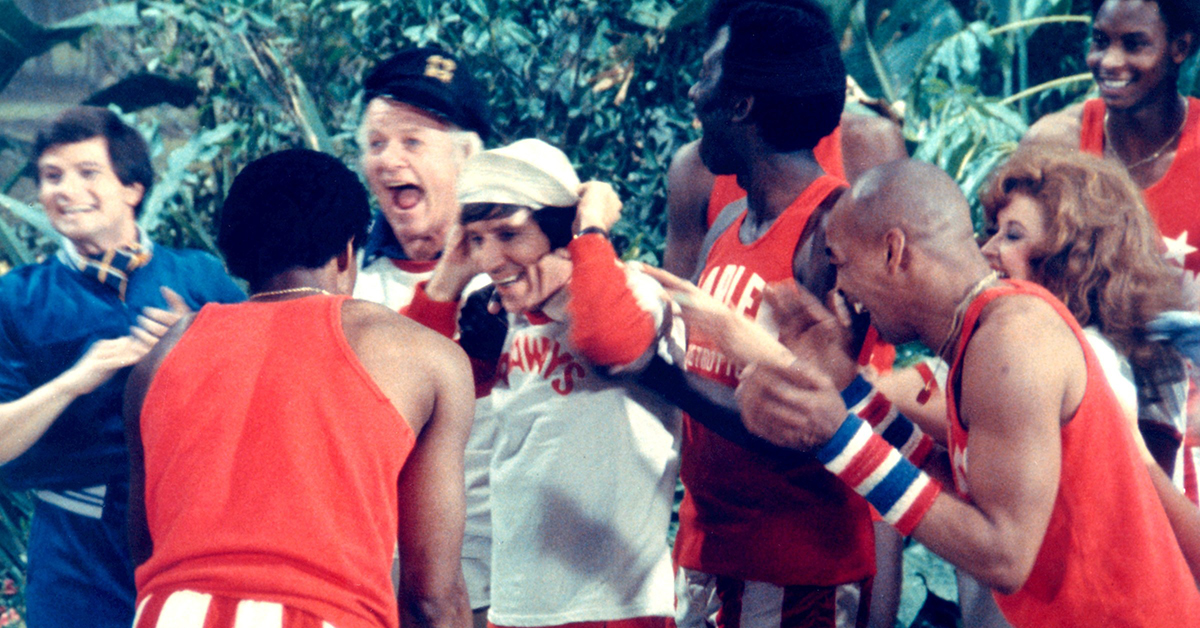
Gilligan’s Island was created by one of my favorite producers, Sherwood Schwartz. It aired from September 1964 till April of 1967, producing 98 episodes and a ton of other versions of the show which aired as new series or television movies, including the hard-to-believe Harlem Globetrotters on Gilligan’s Island.
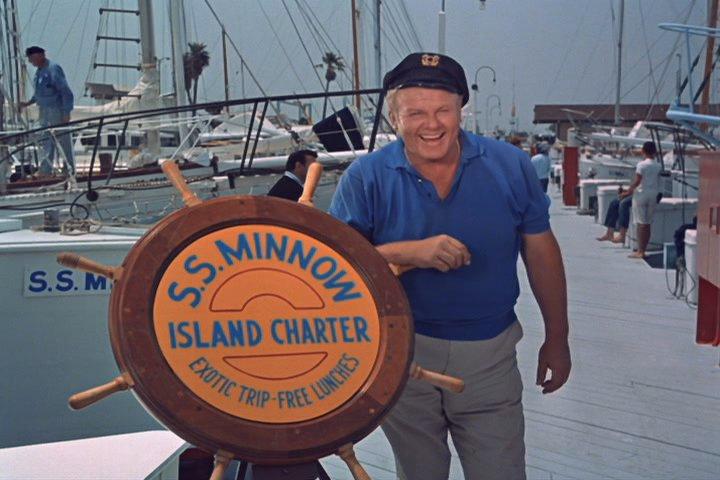
The premise of the show was that on a three-hour tour, the SS Minnow became shipwrecked on a deserted island after a typhoon. Seven castaways now must make the island their home as they wait to be rescued. We have the captain of the ship, the Skipper (Alan Hale), his first-mate Gilligan (Bob Denver), millionaire Thurston Howell III (Jim Backus) and his wife Lovie (Natalie Schafer), movie star Ginger Grant (Tina Louise), the girl next door Mary Ann (Dawn Wells), and the Professor (Russell Johnson). All they have is a transistor radio and whatever they had on the ship.
CBS gave the okay for Schwarz to film the pilot. Schwartz wanted Jerry Van Dyke for Gilligan, but Van Dyke said it was “the worst thing” he ever read. He turned down the script and accepted the role of Dave Crabtree on My Mother the Car.
The pilot was titled “Marooned.” Seven characters were in the pilot, but only the Skipper, Gilligan and the Howells were going to be in the ongoing series. These were the only castaways mentioned in the pilot theme song. The final day of filming for the pilot was November 22, 1963, the day of Kennedy’s assassination. The staff was crowded around a radio between scenes trying to get the updated news. In the opening of the episodes in the first season, as the Minnow leaves the harbor, you can see an American flag flying at half staff as a tribute to Kennedy.
After seeing the pilot, several changes were requested. The first change was to the theme song. Originally it was written by the talented John Williams and sung by Schwartz and was a Calypso-sounding song. The lyrics were quite different from the song we recognize today. The background music and laugh track were the same for both the pilot and the ensuing shows. The three characters who were not part of the series at first were the same characters that later appeared . . . sort of. The Professor was a high school teacher played by John Gabriel, Ginger was an actress but also a secretary played by Kit Smythe, and Mary Ann was Bunny, a dumb blonde stereotype played by Nancy McCarthy.
Because so many changes happened between the pilot and the first episode, the pilot was not aired until 1992 when it was broadcast on TBS.
The first season was filmed in black and white but later colorized for syndication The second and third seasons were filmed in color.
While the pilot had been filmed in Hawaii, the show was taped at a lagoon built at the CBS Radford Studios in Studio City, Los Angeles. The film was supposed to be shot in Malibu, but it was too foggy. The Ventura Freeway was nearby and when traffic was too loud, production had to halt. The lagoon would become a parking lot in 1995.
There were four boats that “played” the part of the SS Minnow. One was used in the opening credits which had been rented in Honolulu for the filming of the pilot. One was used in the opening credits for the final two years. One was shown in beach scenes and the fourth was built at the studio.
The eventual theme song was called “The Ballad of Gilligan’s Isle,” and was written by Schwartz and George Wyle. There were two versions, one for the first season which referred to Mary Ann and the Professor as “the rest,” and another version for the last two seasons which specified “The Professor and Mary Ann.” Dawn Wells credits Bob Denver for going to bat for her and Johnson threatening to take his name out of the song if they were not added.
For the opening credits, the song was:
Just sit right back
And you’ll hear a tale
A tale of a fateful trip
That started from this tropic port
Aboard this tiny ship
The mate was a mighty sailing man
The skipper brave and sure
Five passengers set sail that day
For a 3-hour tour, a 3-hour tour
The weather started getting rough
The tiny ship was tossed
If not for the courage of the fearless crew
The Minnow would be lost, the Minnow would be lost
The ship set ground on the shore of this
Uncharted desert isle
With Gilligaaan
The Skipper too
A millionaire, and his wife
A movie star
The Proffessor and Mary Ann
Here on Gilligan’s Isle
For closing credits, the lyrics were:
So, this is the tale of our castaways
They’re here for a long long time
They’ll have to make the best of things
It’s an uphill climb
The first mate and his skipper too
Will do their very best
To make the others comfortable
In the tropic island nest
No phone, no lights, no motor cars
Not a single luxury
Like Robinson Crusoe
It’s primitive as can be
So, join us here each week my friends
You’ll sure to get a smile
From 7 stranded castaways
Here on Gilligan’s Isle!
Most of the episodes can be categorized into five themes. (1) One of the castaways make some useful object from local material. These could be anything from their bamboo huts to hot water pipes to a stethoscope to a pedal-powered car. They just could not produce anything that could get them off the island! (2) Visitors would often appear on the island. We’ll learn about some of the guest stars on the show in our last monthly blog. None of these visitors ever help the characters get rescued. Unbelievably, Ginger, Gilligan, and Mr. Howell all had look-alikes end up on the island, causing trouble for them. (3) Dreams occur a lot. When we see them, all the characters are part of the dream. Apparently, the hot weather made them sleepy. (4) News from the outside world, usually heard on the radio, caused trouble on the island. (5) Strange objects showed up on the island from time to time like a WWII mine or radioactive vegetable seeds.
Despite many corny scripts and imagination-stretching storylines, the show received solid ratings all three years. When it went into syndication, it grew in popularity. Many of the stars from Gilligan play their characters from the show in other series’ television episodes in the 1970s and 1980s.
The last episode was called “Gilligan the Goddess.” Unfortunately, the castaways were not rescued. A fourth season was expected or perhaps Schwartz would have saved them. In season three, the show was on Monday nights competing with TheMonkees. Schwartz was assured it would be back because it had higher ratings than The Monkees. Gunsmoke, which aired Saturday nights, was given the potential ax. However, CBS president William Paley pressured the executives who then moved Gunsmoke to Monday night and cancelled Gilligan’s Island.
One funny fact I read about was how often the US Coast Guard received telegrams from citizens who were pleading for them to make an effort to rescue the cast from Gilligan’s Island. The Coast Guard sent these telegrams to Schwartz.
I can’t say that after learning more about the show, it made my favorites list, but there are definitely worse shows on television than Gilligan’s Island. If it was one of your favorites, you’ll enjoy hearing about the stars who played the castaways. I certainly learned they were just as interesting a group of people in real life as they were on the isle they called home for three years.















 thewritelife61