How Much Luggage Do You Need for a Three-Hour Trip? The Story of Gilligan’s Island

Today we begin a month-long look at Gilligan’s Island.  I admit I was never a big Gilligan fan, but there are so many dedicated viewers that I decided it was time to take a closer look.  Today we look at the series, and in the following weeks, we’ll look at the actors who appeared in the cast.

Gilligan's Island (US TV Series)

Gilligan’s Island was created by one of my favorite producers, Sherwood Schwartz. It aired from September 1964 till April of 1967, producing 98 episodes and a ton of other versions of the show which aired as new series or television movies, including the hard-to-believe Harlem Globetrotters on Gilligan’s Island.

THE HARLEM GLOBETROTTERS ON GILLIGAN'S ISLAND, Alan Hale, Jr., Bob Denver, Curly Neal, 1981. (c) Uni

The premise of the show was that on a three-hour tour, the SS Minnow became shipwrecked on a deserted island after a typhoon. Seven castaways now must make the island their home as they wait to be rescued. We have the captain of the ship, the Skipper (Alan Hale), his first-mate Gilligan (Bob Denver), millionaire Thurston Howell III (Jim Backus) and his wife Lovie (Natalie Schafer), movie star Ginger Grant (Tina Louise), the girl next door Mary Ann (Dawn Wells), and the Professor (Russell Johnson). All they have is a transistor radio and whatever they had on the ship.

gilligan8

CBS gave the okay for Schwarz to film the pilot. Schwartz wanted Jerry Van Dyke for Gilligan, but Van Dyke said it was “the worst thing” he ever read. He turned down the script and accepted the role of Dave Crabtree on My Mother the Car.

gilligan1

The pilot was titled “Marooned.” Seven characters were in the pilot, but only the Skipper, Gilligan and the Howells were going to be in the ongoing series. These were the only castaways mentioned in the pilot theme song. The final day of filming for the pilot was November 22, 1963, the day of Kennedy’s assassination. The staff was crowded around a radio between scenes trying to get the updated news. In the opening of the episodes in the first season, as the Minnow leaves the harbor, you can see an American flag flying at half staff as a tribute to Kennedy.

After seeing the pilot, several changes were requested. The first change was to the theme song. Originally it was written by the talented John Williams and sung by Schwartz and was a Calypso-sounding song. The lyrics were quite different from the song we recognize today. The background music and laugh track were the same for both the pilot and the ensuing shows. The three characters who were not part of the series at first were the same characters that later appeared . . . sort of. The Professor was a high school teacher played by John Gabriel, Ginger was an actress but also a secretary played by Kit Smythe, and Mary Ann was Bunny, a dumb blonde stereotype played by Nancy McCarthy.

Because so many changes happened between the pilot and the first episode, the pilot was not aired until 1992 when it was broadcast on TBS.

The first season was filmed in black and white but later colorized for syndication The second and third seasons were filmed in color.

While the pilot had been filmed in Hawaii,  the show was taped at a lagoon built at the CBS Radford Studios in Studio City, Los Angeles. The film was supposed to be shot in Malibu, but it was too foggy. The Ventura Freeway was nearby and when traffic was too loud, production had to halt. The lagoon would become a parking lot in 1995.

There were four boats that “played” the part of the SS Minnow. One was used in the opening credits which had been rented in Honolulu for the filming of the pilot. One was used in the opening credits for the final two years. One was shown in beach scenes and the fourth was built at the studio.

giligan5

The eventual theme song was called “The Ballad of Gilligan’s Isle,” and was written by Schwartz and George Wyle. There were two versions, one for the first season which referred to Mary Ann and the Professor as “the rest,” and another version for the last two seasons which specified “The Professor and Mary Ann.” Dawn Wells credits Bob Denver for going to bat for her and Johnson threatening to take his name out of the song if they were not added.

For the opening credits, the song was:

Just sit right back

And you’ll hear a tale

A tale of a fateful trip

That started from this tropic port

Aboard this tiny ship

The mate was a mighty sailing man

The skipper brave and sure

Five passengers set sail that day

For a 3-hour tour, a 3-hour tour

The weather started getting rough

The tiny ship was tossed

If not for the courage of the fearless crew

The Minnow would be lost, the Minnow would be lost

The ship set ground on the shore of this

Uncharted desert isle

With Gilligaaan

The Skipper too

A millionaire, and his wife

A movie star

The Proffessor and Mary Ann

Here on Gilligan’s Isle


For closing credits, the lyrics were:

So, this is the tale of our castaways

They’re here for a long long time

They’ll have to make the best of things

It’s an uphill climb

The first mate and his skipper too

Will do their very best

To make the others comfortable

In the tropic island nest

No phone, no lights, no motor cars

Not a single luxury

Like Robinson Crusoe

It’s primitive as can be

So, join us here each week my friends

You’ll sure to get a smile

From 7 stranded castaways

Here on Gilligan’s Isle!

gilligan9

Most of the episodes can be categorized into five themes. (1) One of the castaways make some useful object from local material. These could be anything from their bamboo huts to hot water pipes to a stethoscope to a pedal-powered car. They just could not produce anything that could get them off the island! (2) Visitors would often appear on the island. We’ll learn about some of the guest stars on the show in our last monthly blog. None of these visitors ever help the characters get rescued. Unbelievably, Ginger, Gilligan, and Mr. Howell all had look-alikes end up on the island, causing trouble for them. (3) Dreams occur a lot. When we see them, all the characters are part of the dream.  Apparently, the hot weather made them sleepy. (4) News from the outside world, usually heard on the radio, caused trouble on the island. (5) Strange objects showed up on the island from time to time like a WWII mine or radioactive vegetable seeds.

Despite many corny scripts and imagination-stretching storylines, the show received solid ratings all three years. When it went into syndication, it grew in popularity. Many of the stars from Gilligan play their characters from the show in other series’ television episodes in the 1970s and 1980s.

gilligan6

The last episode was called “Gilligan the Goddess.” Unfortunately, the castaways were not rescued. A fourth season was expected or perhaps Schwartz would have saved them. In season three, the show was on Monday nights competing with The Monkees.  Schwartz was assured it would be back because it had higher ratings than The Monkees. Gunsmoke, which aired Saturday nights, was given the potential ax. However, CBS president William Paley pressured the executives who then moved Gunsmoke to Monday night and cancelled Gilligan’s Island.

One funny fact I read about was how often the US Coast Guard received telegrams from citizens who were pleading for them to make an effort to rescue the cast from Gilligan’s Island. The Coast Guard sent these telegrams to Schwartz.

gilligan13

I can’t say that after learning more about the show, it made my favorites list, but there are definitely worse shows on television than Gilligan’s Island. If it was one of your favorites, you’ll enjoy hearing about the stars who played the castaways. I certainly learned they were just as interesting a group of people in real life as they were on the isle they called home for three years.

Trick or Treat???

Tomorrow night is Halloween, and many of you will see ghosts flitting around your neighborhood asking for candy.  If you want to watch ghosts flitting around your television screen, I have some shows for you to consider. To save you some time, I’ll let you know which ones are boo-ring and which are hauntingly good.

ghostsimage


Topper (1953)

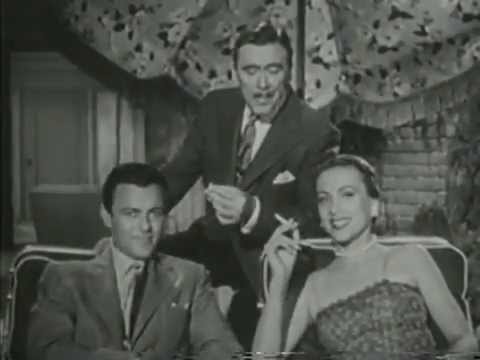
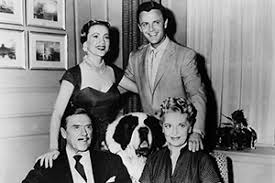
This show was based on several stories by Thorne Smith and a movie starring Cary Grant, Constance Bennett, and Roland Young from 1937. When Cosmo Topper (Leo G. Carroll) and his wife Henrietta (Lee Patrick) move into their house, Topper becomes aware of three more residents, George and Marian Kerby (real husband and wife Robert Sterling and Anne Jeffries) and a St. Bernard named Neil who tried to save them in a skiing accident during an avalanche. One of the ongoing jokes in the show is that Neil is always drinking alcohol left around the house after getting hooked on the brandy he carried around his neck. The complication is that they are all ghosts, and only Topper can see and hear them.

ghosts7topper

Most of the humor comes from their interaction with other people like salesmen or society snobs. Scripts were full of word play and clever dialogue. They would intervene in activities Topper was involved with like his weekly bridge game.  Once he wrote a check for $5 which they changed to $5000. Topper was a bit cheap even though he was VP of the National Security Bank. The ghosts were full of mischief, and we liked them for their fun “spirit.” Being dead, they were fearless.

One of the typical plots happened when Henrietta was in the hospital.  Marion wants to celebrate her birthday with their old friends.  She sends invitations to them from Topper. Topper has no idea people are coming.  The women all make a fuss over him being alone with his wife in the hospital and the party is a bit wild compared to the ones Topper and Henrietta usually host. Of course, Henrietta gets out of the hospital early and arrives with the party in full swing.

Wires, ectoplasm, and the stopping and starting of cameras were used to bring the ghosts to life.

One fact I found surprising was that eleven of the first year’s episodes were written by composer Stephen Sondheim and George Oppenheimer.

ghosts6

The show began in 1953 with R.J. Reynolds as the sponsor for its Camel cigarettes. The cast was required to smoke in every episode.  In 1955 it was picked up by Standard Brands and moved to ABC.  The next year General Foods sponsored it on NBC where it was cancelled in 1957 after a total of 78 episodes. The show hasn’t aged well because the special effects seem unsophisticated and obvious today. Even so, I would list this as a treat. 


The Ghost and Mrs. Muir (1968)

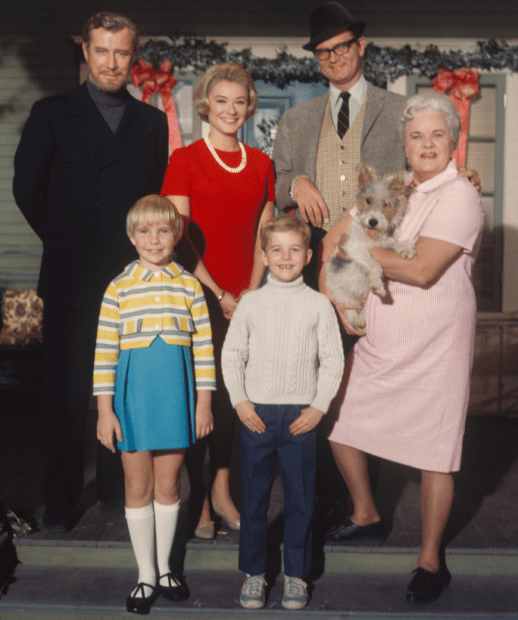
Carolyn Muir (Hope Lange), a widow, decides to move to Schooner Bay where she can focus on her writing career and raising her family, which consists of Jonathan (Harlen Carraher), Candy (Kellie Flanagan), and a dog Scruffy. She rents the house from Claymore Gregg (Charles Nelson Reilly). The house, Gull Cottage, functioned as another character in the show.  Below on the left is how it appeared in the show; on the right is the show today. The house was actually in Santa Barbara, California nowhere near the water.  We also get to know Noorie Coolidge (Dabbs Greer) who owns the local lobster restaurant.

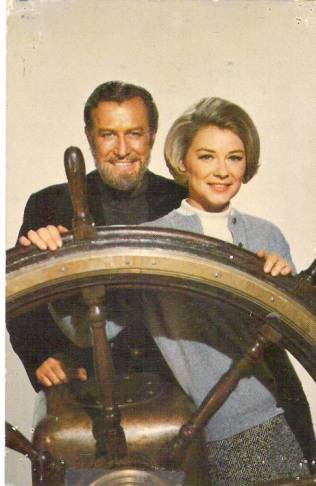
Carolyn plans to bring in a housekeeper Martha (Reta Shaw), but she doesn’t plan on another household guest, Captain Gregg (Edward Mulhare) (Claymore’s uncle), who lived in the house in the 1800s. Captain Gregg falls in love with Carolyn; he also develops a special relationship with the kids.
ghosts5muir

The show was based on a book by R.A. Dick from 1945 and a movie starring Gene Tierney and Rex Harrison from 1947. The special effects were impressive for the 1960s. When Gregg and came and went, the actors all had to freeze.  Strings and wires were everywhere to help with the other magic parts of the film.

In an interview with Flanagan about her time on the show, she said every show took a week to produce.  She enjoyed her experiences with the series saying that the cast had great actors, “Hope Lange was extremely sweet and kind; Reta was a delight, and Charles Nelson Reilly was hilarious” and it was a happy set to work on.

ghosts4captgregg

The show debuted on NBC where it played the first year. The critics liked it, and Hope Lange received two Emmys for lead actress in a comedy. However, the first year it was up against My Three Sons and Lawrence Welk. The show moved to ABC for a second season but lost its ratings battle to Family Affair. Definitely a treat.


The Ghost Busters (1975)

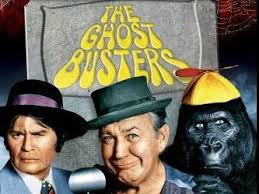
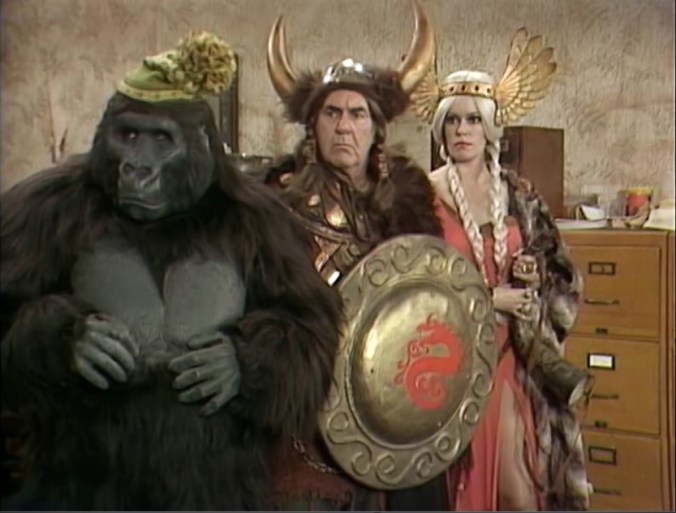
Basically, this was a slap-stick comedy reprising the roles of Corporal Agarn and Sergeant O’Rourke from F-Troop as paranormal detectives.  Larry Storch is Eddie Spencer, Forest Tucker is Kong, and Bob Burns is their assistant and chauffeur Tracy, who just happens to be a gorilla. The team battles ghosts of legendary fiends like Frankenstein’s Monster, Dracula, The Mummy, and The Werewolf.

ghosts1busters

An unseen boss, Zero, would give them their assignment and then the tape would explode.  Their headquarters was a run-down office and they had to use a pay phone nearby. Every week they were taken to the same castle to defeat a new foe. They always used their Dematerializer to send the specters back to the “great beyond.” Somehow, they convinced Jim Backus to guest star in one of the episodes.

ghost2busters

Burns was hired because the producers decided it would be cheaper to hire an actor who already had a gorilla suit. Burns is best known for Bob’s Basement, where he displays his Hollywood science fiction and horror collectibles.  Seen on Saturday mornings, the show produced by Filmation only lasted for 15 episodes.   Definitely a trick. 


Jennifer Slept Here (1983)

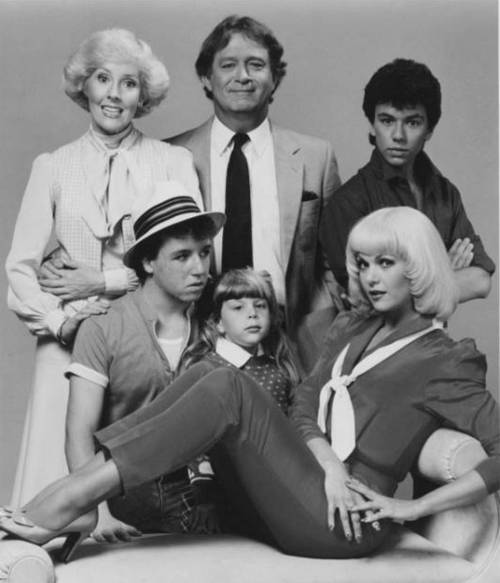
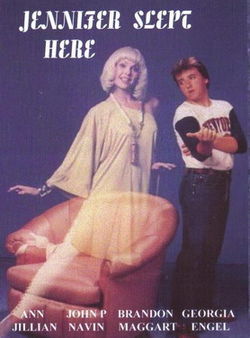
The premise of this show is that famous actress Jennifer Farrell (Ann Jillian) was chasing down an ice cream truck in 1963 when it backed up and accidentally ran her over. George Elliot (Brandon Maggart) was the lawyer who handled her affairs after she died.  He decided to buy her home for his wife (Georgia Engel).

ghosts11jennifer

What the parents don’t realize is that Jennifer still lives here, and only their son Joey (John Navin Jr.) can see and communicate with her. The show was sexy because Jennifer was a Marilyn Monroe type and silly because she acted like a second mother to Joey. The series was told mainly from a 13-year-old’s point of view.

ghosts10jennifer

The show had decent ratings but went up against The Dukes of Hazard and Webster, so it was cancelled after 13 episodes, one for each year of Joey’s life. I’d classify this one as a trick. 


Nearly Departed (1989)

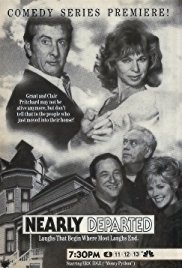
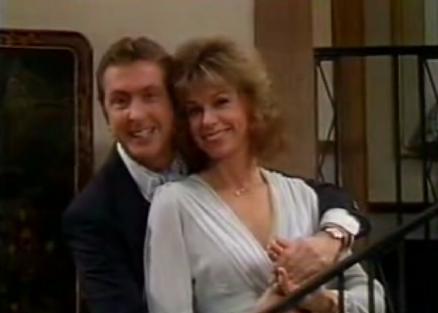
When the Dooleys (Stuart Pankin and Wendy Schaal) purchase a new home, Grant and Claire Pritchard (Eric Idle and Caroline McWilliams) area already living there since they had been the previous owners. However, they are no longer alive. With a bit of a different twist, only Grandpa (Henderson Forsythe) can see and hear them. The Dooleys have a son Derek (Jay Lambert), and the ghosts would try to help him with problems like bullies to repay the Dooleys for giving them a place to live, even though they didn’t know they were doing so.

ghosts12nearly

The critics were all over the place on this one. Joan Hanauer, a UPI feature writer, wrote “Nearly Departed is a fast, pleasant sitcom, and the Pritchards make you believe one thing you can take with you is your sense of humor.” Howard Rosenberg from the LA Times, wrote “ ‘Nearly Departed’ is a zero. A mishmash of ‘Topper’ and ‘Beetlejuice,’ the NBC comedy is worse than bad in its premier at 8:30 . . . making such worthy comic actors as Monty Python’s Eric Idle and Stuart Pankin look worse than bad in the process.”

ghosts13nearly

I guess most viewers agreed with Rosenberg because the show was gone after only six episodes.  I have to give this one a trick. 


The Haunted Hathaways (2013)

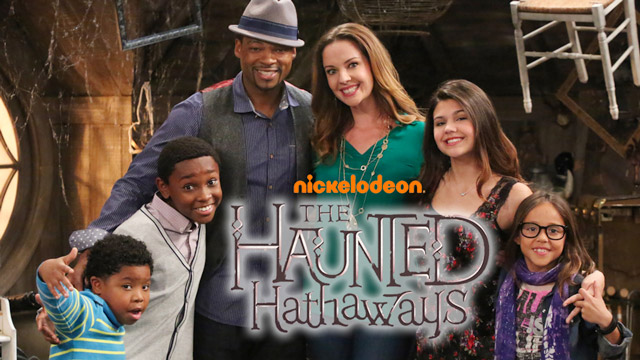
This show is a 21st century Brady Brunch without the best part:  Alice. A single mom Michelle Hathaway (Ginifer King) and her two girls, gymnast Taylor (Amber Montana) and Frankie (Breanna Yde) make the move from New York to New Orleans and open a bakery, Pie Squared.

ghosts9hathaways

However, when they move into their new house, they find three ghosts who had taken up residence:  Ray Preston (Chico Benymon), a saxophone player, and his sons, well-mannered Miles (Curtis Harris) and rude and sarcastic Louie (Benjamin “Lil P-Nut” Flores Jr.). The two families learn to work together using ghostly powers and human intellect to solve problems together. This show lasted two seasons on Nickelodeon.  I would not call this a trick or a treat; it’s like the house that gives out apples, not bad but don’t go out of your way to check it out. 


I would recommend picking up The Ghost and Mrs. Muir or Topper DVDs to watch as you give goodies to the little goblins ringing your doorbell.  Better yet, get the original movies.  It’s always a treat to watch Cary Grant and Rex Harrison. While you are sitting around a bonfire this month, you can also read the original books and decide which version you like best.  Happy Halloween.

Verrry Interrresting!

Occasionally, a show is so entrenched in the time and culture it debuts in, it becomes almost impossible to describe or understand away from its original setting. Dan Rowan and Dick Martin were nightclub comics who co-hosted a special called Laugh-In in 1967.  The name was a play on words based on the love-in’s and sit-in’s happening in the 1960s.  The special was so popular it was turned into a weekly series. I think of Laugh-In as Sesame Street for adults.  Both shows debuted in the late 60s and had a rapid-fire approach, continually moving on to the next segment so the viewer would not get bored. The show captured the counterculture movement and the lime green, turquoise, fuschia, deep orange, bright yellow, and paisley flowers kept our eyes moving as quickly as the jokes did. The show lasted six seasons.

laughin1

Regular cast members who went on to other careers included Ruth Buzzi, Gary Owens, Alan Sues, Arte Johnson, Henry Gibson, Lily Tomlin, Richard Dawson, Jo Anne Worley, Goldie Hawn, Judy Carne, Dave Madden, and Flip Wilson.

Numerous celebrities flocked to the show.  Movie stars that were reeled in included John Wayne, Jack Benny, Peter Lawford, Zsa Zsa Gabor, Charles Nelson Reilly, Debbie Reynolds, Rock Hudson, Jack Lemmon, Edward G. Robinson, Sally Field, Orson Welles, and Rita Hayworth.  Noted musicians included Sammy Davis Jr., Dinah Shore, Johnny Cash, Perry Como, Liberace, Bing Crosby, Cher, Rosemary Clooney, and Liza Minelli. Sports stars tackled the chore including Joe Namath, Wilt Chamberlin, Sugar Ray Robinson, and Howard Cosell.  Comedians who laughed their way on the show included Rich Little, Don Rickles, Bob Hope, Bob Newhart, Paul Lynde, and Carol Burnett. Classic tv stars who accepted starring roles were Tim Conway, Carl Reiner, Steve Allen, Jim Backus, Ernest Borgnine, Eve Arden, Andy Griffith, Desi Arnaz, and Wally Cox.

The format rarely changed from week to week.  Rowan and Martin opened each show with a dialogue; Rowan acted as the straight man, and Martin took on the gullible role. Then the regular cast, along with celebrities, danced against a psychedelic background, firing off one-liners and short gags. Comedy bits, taped segments, and sketches filled in the rest of the hour and always ended with Rowan telling Martin to “Say goodnight, Dick” and Dick replying, “Goodnight Dick.”

Some of the regular features were:

laughinn

The Cocktail Party where the cast stood around spouting politically and sexually suggestive jokes.

Letters to Laugh-In where the cast read letters.

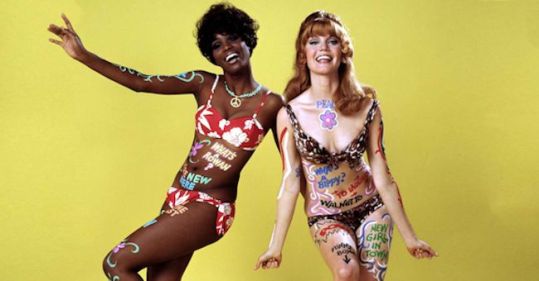
ROWAN AND MARTIN'S LAUGH-IN,  Teresa Graves, Pamela Rodgers, 1969-1970.

It’s a Mod, Mod World where go-go dancers danced in bikinis with puns and word play phrases painted on their bodies.

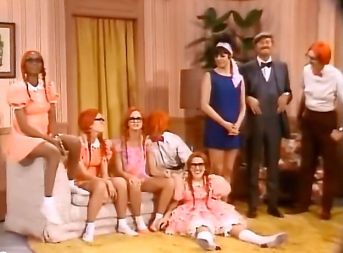
farkel

The Farkel Family about a group of red-headed, freckled family members.

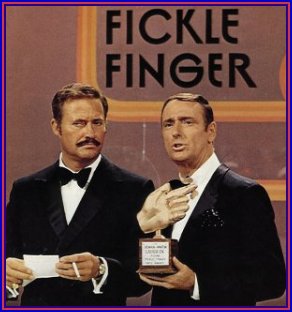
fickle

The Flying Fickel Finger of Fate Award where dubious achievements were celebrated.

Laugh-In Looks as the News was comparable to the Saturday Night Live news sketches of today.

New Talent Time showing various weird skills.

Many of the regular cast members had their own skits that were repeated during the series’ run:

carne

Judy Carne was always tricked into saying “Sock it to Me” which then caused her to get doused with water, fall through a trap door, or endure some other indignity. Sometimes celebrities ended up being the ones to say “Sock it to me,” the most famous being Richard Nixon when he was campaigning for president.

buzzi

Arte Johnson played Tyrone, an inappropriate senior citizen who tries to seduce geriatric Ruth Buzzi as Gladys, forcing her to eventually hit him with her purse.

laughinc

Henry Gibson came on stage holding an oversized paper flower, reciting poetry.

Lily Tomlin performed skits as Ernestine, a telephone operator or Edith Ann, a young girl sitting in a rocking chair. (Personal note:  When I was in 4th grade, I performed an Ernestine and an Edith Ann skit for our talent show.  Why a 9-year-old was watching Laugh-In and the school approved the skits, I can’t say, but I remember getting a lot of compliments.  And Lily Tomlin didn’t sue me for stealing her material!)

sues

Alan Sues portrayed Uncle Al, a children’s show host, who was short tempered and often in bad shape from his late partying nights.

laughinh

Flip Wilson was Geraldine.

laughin6

Jo Anne Worley would say “Bor-ing” in the midst of jokes.

laughing

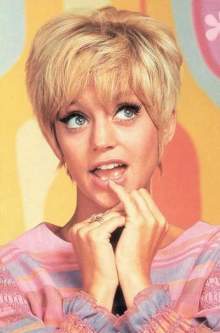
Goldie Hawn as the ditzy blonde.

The series also became known for some of its catch phrases including “Look that up in your Funk & Wagnalls,” “You bet your sweet bippie,” “Beautiful downtown Burbank,” “Is that a chicken joke?,” “Sock it to me,” “Here come de judge,” and “Verrrry Interesting.”

The show was one of the highest rated shows in the late 1960s. It was in the top 4 of the top 40 shows for its entire run. It won Emmy and Golden Globe awards. The Nielsen polling determined it was the most-watched show in seasons 1 and 2.

The show had its own magazine for a year.  Trading cards were sold with catch phrases and images from the show. Several records were produced capturing the humor of the time.  There was even a set of View-master reels made, as well as lunch boxes and other memorabilia.

laughinrev

Laugh-In debuted fifty years ago, but still feels new and edgy. Because the show has not been syndicated in re-runs, it is hard for the current generation to imagine how very different this show was from anything else that appeared on television before it.  The closest show to capturing any of its essence since then is Saturday Night Live.  This was a time when everything was changing: civil rights, Vietnam, women’s lib, the hippie lifestyle, psychoactive drugs, anti-authoritarianism, freedom of speech and assembly, and environmental concerns, especially littering and pollution.

The Generation Gap was a real concept in the 1960s but this show might have come as close as anything else to bridge that gap. Families sat down together to watch the show. Many of the phrases still have a life of their own decades later even thought decades of kids have never seen the show.  Plan your own little sit-in when you check out a couple of the you-tube videos to get a flavor of what the series was like.