Oh Magoo, You’ve Done It Again

Welcome to October, and welcome to our blog series for the month, “Get Animated.” Up first on the schedule is Mister Magoo.

📷imdb.com

This show was originally aired from 1960 to 1962. It was produced by United Productions of America, and each episode was made up of five four-minute cartoons. Jim Backus voiced Mr. Magoo and other famous voice actors on the show included Bea Benadaret, Mel Blanc, Dawes Butler, June Foray, Paul Frees, Jerry Hausner, Frank Nelson, Benny Rubin, and Jean Vander Pyl.

Mr. Magoo’s first appearance was in 1949 in “The Ragtime Bear.” Created by Milard Kaufman and John Hubley, Mr. Magoo was originally a parody of Joseph McCarthy, a mean-spirited, hateful man. It was meant to protest the Hollywood Blacklist. However, Kaufman found himself on one of these lists and passed the character of Mr. Magoo to Pete Burness. Burness depicted Magoo as a senile old man who was too stubborn to admit his eyesight was going. Backus was already voicing Mr. Quincy Magoo in 1949, so he lived with the character for decades.

In 1964, a similar series debuted called The Famous Adventures of Mr. Magoo which was on one season, and What’s New Mr. Magoo popped up in 1977. Backus continued to voice Magoo until the 1997 big-screen movie when Leslie Nielsen took on the role.

The show won two Oscars for Best Short Subject, but these were both in the mid-fifties before the television show debuted.

📷pinterest.com

I remember watching reruns of the shows when I was a kid, and while I thought some of the shows were funny, I wasn’t a huge fan. I was much more into Scooby Doo, Josie and the Pussycats, and The Archies.

Many kids identified Mr. Magoo with a grandparent: an elderly person who wasn’t ready to accept the fact that they were aging and had some limitations. Mr. Magoo got into a lot of complicated situations because he couldn’t see very well and refused to admit it. He would do things like think he was walking into a men’s clothing store when he was in an army recruitment office and try to purchase clothing.

When making the talk show rounds in the sixties, Backus told a story about how he prepared for the series. He put a fake rubber nose that pinched his own nose, giving it a nasal twang. After being Magoo for a bit, he was able to produce the voice without the fake nose. One of Magoo’s taglines was “Oh, Magoo, you’ve done it again.”

One of the tough things about this show was Magoo’s houseboy Cholly, whose real name was Charlie. Cholly was a stereotype of a Chinese man featuring huge buck teeth and fractured English diction. While several shows had Chinese or Black employees during this era, most of them were not so negative. Rochester often got the better of Jack Benny on his show. On Bachelor Father, one of my favorite sitcoms, Bentley lived with his niece and Peter, his houseboy. But Peter was more of a brother and felt free to speak his mind to Bentley; he was not a demeaning caricature.

📷pinterest.com

Backus seemed to vacillate on whether he liked or detested Magoo. In an article from 2023, Jim Korkis talked about Backus’ relationship with the animated character. Backus once admitted that “I’d like to bury the old creep and get some good dramatic roles in movies. He’s a pain in the posterior. Every time I start to be a serious actor I lose out because someone—usually a producer—says I’m Magoo.” However, Jim also drove around in a car with the license plate “Q MAGOO.”

He said Backus saw his father in the Magoo character who was isolated from most of the world. Another influence for determining the voice was a character Backus developed for his nightclub act. Backus described him as “the loud man in the train club car.

In an Ohio State University publication, Backus said his association with Magoo helped him out one night. He was trying to reserve a table at a restaurant with no luck. He called back as Mr. Magoo, and they gave him a table right away.
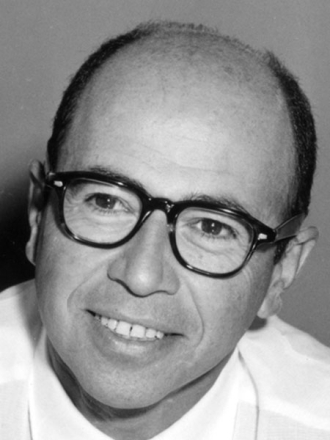
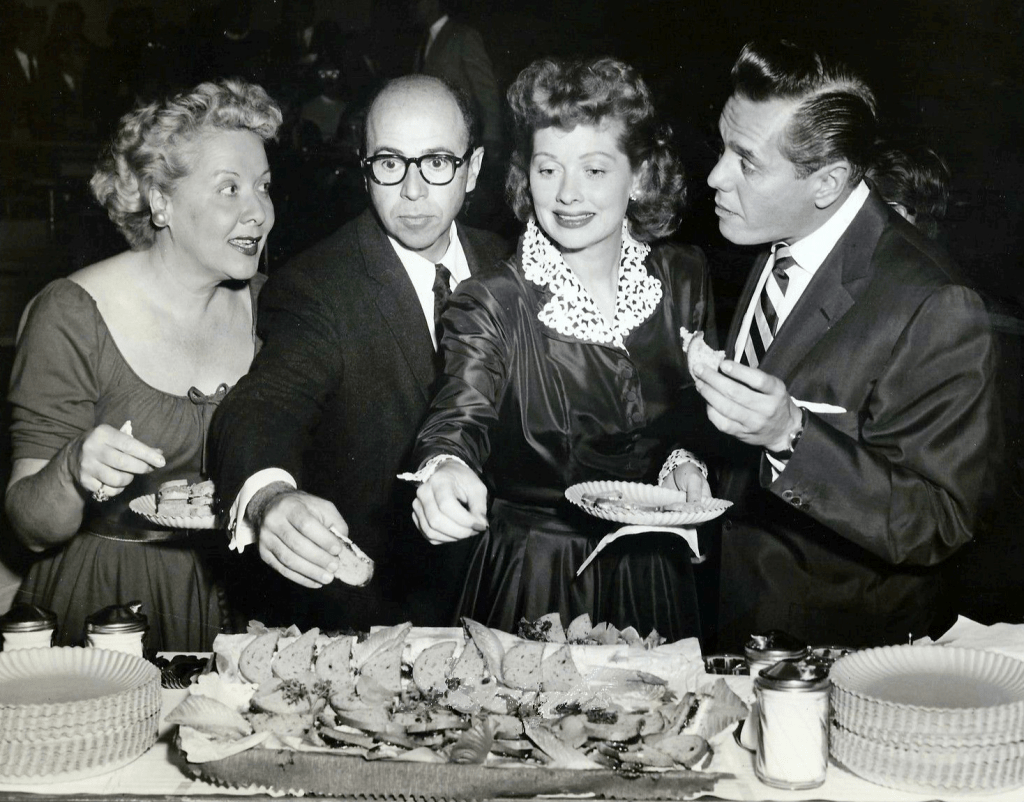
Jess Oppenheimer: The Brains Behind I Love Lucy

As we are learning all about Lucille Ball and her shows this first month of 2025, the month would not be complete without getting to know Jess Oppenheimer, the man Lucy called “the brains” behind I Love Lucy. He was also the producer and head writer of the show. Director William Asher said “he was the field general. Jess presided over all the meetings and ran the whole show. He was very sharp.”

📷televisionacademy.com

Oppenheimer was born in San Francisco in 1913. He took part in a study of gifted children in Stanford Professor Lewis Terman’s project. Ironically, one of Terman’s quotes about Jess was that he “could detect no signs of a sense of humor.” Jess’s father James owned the largest luggage store in San Francisco, but he died in an accident when Jess was 16.

Oppenheimer went on to attend Stanford in the 1930s. He started to spend a lot of his free time at radio station KFRC and performed in a comedy sketch he wrote for the show “Blue Monday Jamboree.”

In 1936 he moved to Hollywood and was hired as a writer on Fred Astaire’s radio show. He later went to work for Jack Benny as well as Edgar Bergen and Charlie McCarthy, George Burns and Gracie Allen, Bing Crosby, Marlene Dietrich, Judy Garland, Bob Hope, and Ginger Rogers.

When World War II began, Oppenheimer joined the US Coast Guard where he met Jack Dempsey and Cesar Romero. While he was there, he was diagnosed with double vision which had bothered him his entire life but had never been addressed.

Agent Ray Stark was Fanny Brice’s son-in-law and later Stark recruited him to write for her Baby Snooks Show based on his reputation in the Coast Guard.

In 1942, Oppenheimer met Estelle Weiss, an employee of Wallichs Music City. They married in 1947 and were together for the rest of his life.

📷wikipedia.com

In 1948, CBS hired Oppenheimer to write a script for a new radio show, “My Favorite Husband.” Several of the scripts portrayed the wife, played by Lucille Ball, as a sophisticated socialite. When Jess added slapstick comedy and transitioned her to a childlike, impulsive, naïve wife, the show was a big success.

In 1950, CBS moved the show to television to star Lucy and her real-life husband Desi Arnaz. Lucy demanded that Oppenheimer stay in charge. Jess suggested doing a show “about a middle-class working stiff who works very hard at his job as a bandleader and likes nothing better than to come home at night and relax with this wife who doesn’t like staying home and is dying to get into show business.” He suggested the title “I Love Lucy.”

For the first five seasons, Oppenheimer was the producer and head writer, with help from Madelyn Pugh and Bob Carroll Jr. as other writers. As part of his contract, Oppenheimer received 20% of the ownership in the show. He gave Pugh and Carroll each 5% of that amount.

A wannabe actor, Oppenheimer appeared on I Love Lucy in two episodes. In #6, “The Audition,” he was one of three TV executives who audition Desi and in #127, “The Tour,” he walks in front of the bus before Ethel and Lucy board it. In one of the more famous episodes, #30, “Lucy Does a TV Commercial,” Jess is the voice that tells Lucy to go ahead and begin her commercial.

📷

In 1956, Oppenheimer moved to NBC where he became a producer of special shows.

During the sixties, Oppenheimer created and produced three other sitcoms. In 1960 he worked with Annie Farge and Marshall Thompson on Angel; in 1963 with Glynis Johns on Glynis, and with Debbie Reynolds on The Debbie Reynolds Show. He also was listed as writer, producer, and director for the 1967 season of Get Smart.

Oppenheimer received two Emmys and seven nominations. His Emmys were for Producer for Best Situation Comedy, I Love Lucy, in 1953 and 1954. He was also nominated for Producer for Best Situation Comedy, I Love Lucy, in 1952 and 1955; for Best Comedy Writer, I Love Lucy, in 1955 and 1956; for Best Single Program of the Year, General Motors 50th Anniversary Show in 1958; Program of the Year, The Danny Kaye Show with Lucille Ball in 1963; and Outstanding Program Achievement in Humor, The Danny Kaye Show with Lucille Ball in 1963.

He was also an inventor with 18 patents. One of his inventions was an in-the-lens teleprompter.

In 1962, Lucille Ball brought a new sitcom to television; however, Oppenheimer sued the show, claiming that Lucy Carmichael was Lucy Ricardo, his character, He received a financial settlement, and the character was changed, but unfortunately, it ruined the friendship between Oppenheimer and Ball.

The Oppenheimer family lived on Burlingame Avenue in Los Angeles. In a funny twist, Jess bought the house from MGM hairstylist Sydney Guilaroff; he was the person who turned Ball into a redhead for the 1943 movie, DuBarry was a Lady.

📷instagram

Jess’s best friends were Mel Blanc, Hans Conried, and Jerry Hausner, who had played Ricky’s agent on I Love Lucy.

In 1988, Oppenheimer had an intestinal surgery; he died shortly after from heart failure. At his death, Lucille Ball said he was “a true genius” and said that “she owed so much to his creativity and his friendship.”

I love hearing stories about people like Jess Oppenheimer and Sheldon Leonard who are creative geniuses and are the influence and inspiration for so many of the classic television shows.