Alice Pearce does not have the number of acting credits that many golden- age character actresses possess because she passed away at an early age. Many of us recognize her as Gladys Kravitz.
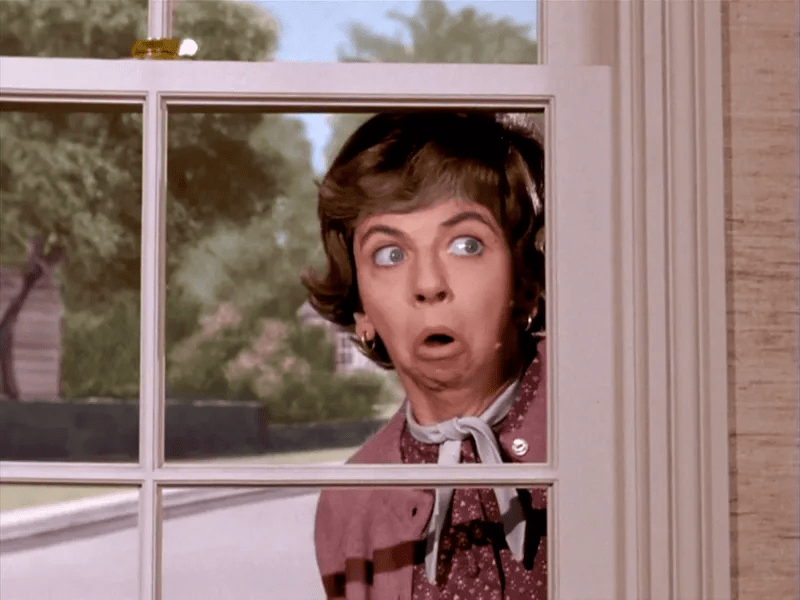
Pearce was born in New York City in 1917. She was an only child. Her father was a foreign banking specialist, and her family moved to Europe when she was a toddler. They had what I would imagine was a magical life, living in Brussels, Antwerp, Rome, and Paris. However, Alice was not a fan of Europe and never went back. In an article in the Buffalo News in July of 1965 she said that she hated living there and just wanted to be an average American kid who was allowed to walk to the movies or the drug store without a chaperone.
While living in Europe, she fell off a swing at age nine after losing her grip on the chain and landed on her chin. From that point on, she had an underdeveloped chin.
Pearce enrolled in Sarah Lawrence College in 1940, graduating with a degree in drama. After graduation, Alice moved to Maine to do summer stock. Leonard Stillman saw her there and cast her in “New Faces of 1943,” where she received great reviews.
Although her parents did not approve, Alice began working as a comedienne in nightclubs, auditioning on Broadway. Her parents didn’t know much about theater at the time, and they didn’t see it as a stable career. She moved to New York and sold underwear at Macy’s to make ends meet.
Alice always had a sense of humor about herself and her looks. She related a story in an interview with the Buffalo News in February of 1965 that during this time she and a few women performed at army camps and hospitals during the war. She said they were at a hospital one day and Imogene Coca was walking down the hall to do the show. One man in a bathrobe saw her and yelled that if they all looked like her, he was going back to bed. A minute later, Alice appeared. The man said they did all look alike and he went back to bed.
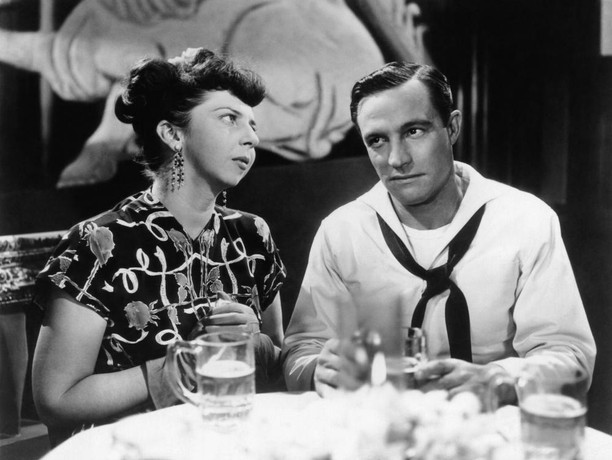
From 1944-46, she was a cast member in the original Broadway production, “On the Town.” Gene Kelly was so impressed with her performance that he brought her to Hollywood as a cast member in the big-screen film of the play in 1949. In both versions, Alice played Lucy Schmeeler, a “unsexy adenoidal” blind date.
Her performance in On the Town was so popular that she was given her own television variety show, The Alice Pearce Show which she described as “fifteen minutes of songs, topical skits, and me.” Pearce co-hosted the show with pianist Mark Lawrence. It was on for fifteen minutes every Friday, but it was cancelled after six episodes.
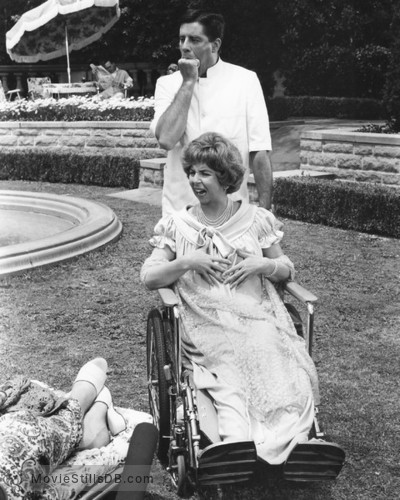
Throughout the fifties, Pearce continued to appear on Broadway and on the big screen. Alice had fourteen film roles. She was spot-on as a hypochondriac in The Disorderly Orderly with Jerry Lewis as she describes her numerous physical ailments and symptoms.
I think Alice was hoping for a more prolific film career. After her death, an AP article that ran in many national papers related a story Pearce had told several times. She said that for one audition she went to, they were looking for an “Alice Pearce type,” so she thought it was a shoe in. About ten women were in the waiting room. Alice did her audition but didn’t get the part!
During the fifties, she appeared on 13 television series, many of them dramatic playhouse shows. In 1953, Alice was cast in two sitcoms, and both would last a year. In Jamie, she appeared in eight episodes as Annie Moakum. The show was about an orphan, Jamie, who lands in one “foster” home after another until he moves in with Aunt Laurie where he meets Grandpa; the two of them become best friends, sharing a variety of adventures.
In The Jean Carroll Show, Alice played their neighbor in six episodes. This show only lasted three months. It was a typical sitcom about Jean, her bumbling husband Herbie and her daughter who doesn’t even have a first name in the credits.
Alice found herself in sixteen series during the sixties including Many Happy Returns. Many Happy Returns was a show that only lasted 26 episodes. It starred John McGiver as Walter Burnley who was a supervisor of the Returns Department at Krockmeyer’s Department Store. A widower, he lives with this daughter played by Elinor Donahue and her husband Bob and daughter Laurie.
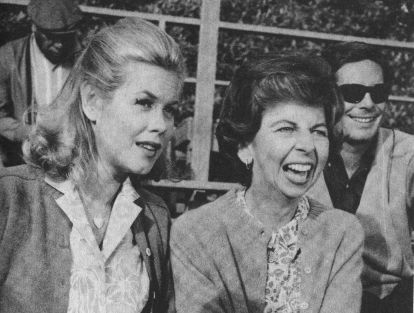
1964 was a great year for Pearce. When she was in the Broadway production of “Bells Are Ringing,” she met director Paul Davis whom she married in 1964. At that time, Davis owned one of the top art galleries in Los Angeles. Alice loved art and did some painting herself.
That same year she was asked to play the role of Grandmama in The Addams Family. She turned down the part which went to Blossom Rock.
It ended up being a good career move to turn down The Addams Family, because later in 1964 she was offered the role of Gladys Kravitz on Bewitched. She was perfect as the nosy neighbor always in the Stephens’ business. After spying on her neighbors and seeing something that could not be explained logically, she would shrilly yell, “Abner, Abner” and relate the newest situation. Of course, witchcraft always took care of the problem before she could prove anything odd had occurred, and she was considered eccentric and high strung by the other neighbors and her husband. Pearce appeared in 27 episodes before passing away from ovarian cancer in 1966 at age 48. She was adored by her Bewitched family.
Alice had been acting for a couple of decades and had become a household name. In the July 1965 Buffalo News interview, Alice mentioned that even though she was 47, her parents had moved to La Jolla, California and still felt acting was a phase she would outgrow.
In 1966, Doris Day’s movie The Glass Bottom Boat was released. Pearce and George Tobias were cast as next-door neighbors in the film. Although they weren’t named Gladys and Abner, the Fenimores were a carbon copy of the Kravitzes.
Alice was diagnosed with terminal cancer before she joined the Bewitched cast. After she died, Elizabeth Montgomery and her husband William Asher offered Davis a job as director on the show. He had stepped away from his career to help care for Alice.
Alice worked until the last two weeks of her life. She commented on how her attitude helped her deal with her diagnosis: “I feel the progress of the disease in my case is unusual because of my mental attitude. I am a supremely happy woman. I have never been beautiful, but I have been blessed with a rich career and the love of two fine men. The strength I have found in the devotion of my dear Paul is beyond measure.”
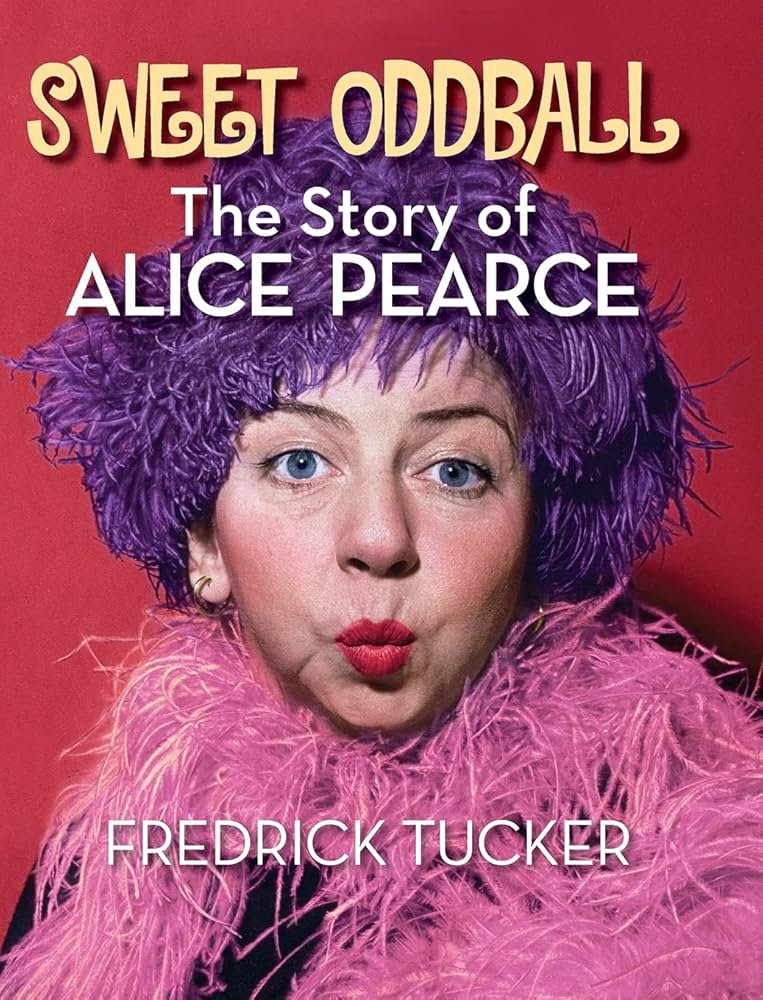
Frederick Turner wrote a book, Sweet Oddball: The Story of Alice Pearce. He recalled a quote that he had heard about Pearce, describing her as “’the adenoidal lass with the most beautiful, homely face on Broadway who carved out a unique career playing wallflowers, nitwits, nags and oddball characters.” I think Alice would be just fine with that description. Although she left us much too soon, she was an amazing comedienne who I’m sure would have had a long and satisfying career, and perhaps her own sitcom, had she lived a few more decades.




 thewritelife61