The Simpsons: No One Grow Up in Springfield Here

This month we are looking at several of our favorite TV families. Last week we talked about the Andersons from Springfield, and I can’t help comparing our show today to that one: The Simpsons are also from Springfield. They both have three children. While you could make some comparisons between Marge and Margaret, Homer and Jim would not have much in common.
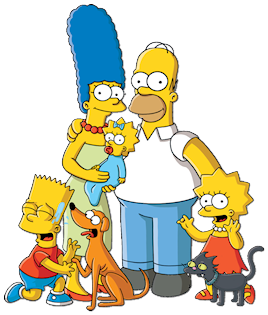
📷wikipedia.com

Right off the bat, I want to admit that if you are looking for a comprehensive reflection on the show, this blog entry will not be that. I could write about this show for volumes and not cover it truly well. That said, I thought it was an important show in television history and family series that we should still talk about it, even if it is briefly. This show has been on the air so long it is hard to imagine: 2024 is the 37th year the show has been on the air. I got married the year it began, and I now have a teenage grandson. We are looking at almost 800 episodes.

So, let’s go back to the beginning. In 1987, Matt Groening developed an American animated series called The Simpsons to air on Fox Broadcasting Co. It was written as a satire of the Simpson family: Homer, Marge, Bart, Lisa, and Maggie. It was set in Springfield and has caricatured any and everything you can possibly think of.
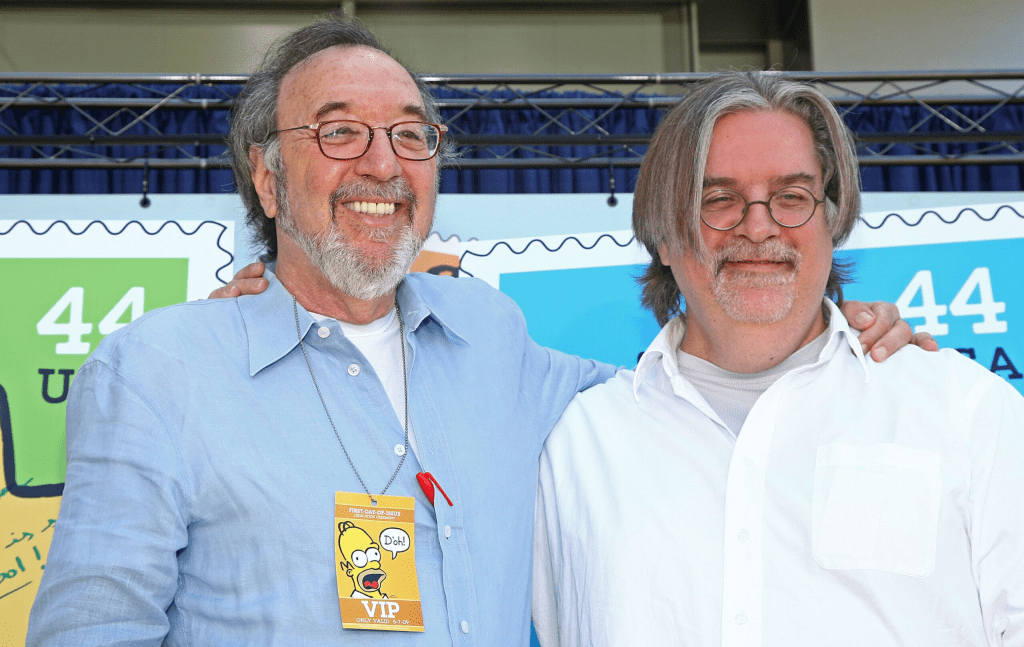
📷thebounce.com James L. Brooks and Matt Groening

James L. Brooks, of The Mary Tyler Moore Show and Taxi fame, was the producer. The first animation shorts appeared on The Tracey Ullman Show and it eventually became its own series. It holds the record for longest-running American animated series and longest-running American sitcom. In 2007 The Simpsons Movie grossed over $527 million dollars. In 2023 it was renewed for its 35th and 36th seasons, ensuring it goes through 2025.

I will say that many fans consider the golden age of the show to be from 1989-1995 and feel that the quality has not held up as well; however, the show has won 35 Emmys.

The show is about the Simpson family. Homer, the father, works at the Springfield Nuclear Power Plant as a safety inspector. Marge, his wife, has beautiful blue hair. (The blue hair was a thing before having blue hair was a thing, and the characters have yellow skin colors, so it would catch the attention of viewers flashing through the channels for something to watch.) They have three children: Bart, a very mischievous ten-year-old; Lisa, a precocious eight-year-old; and baby Maggie. Grandpa Simpson lives nearby in the Springfield Retirement Home. Luckily, they never age, or Bart would be a 47-year-old mischievous son and grandpa would be well over 120. Santa’s Little Helper is their dog and Snowball II (after Snowball I died) is their cat.
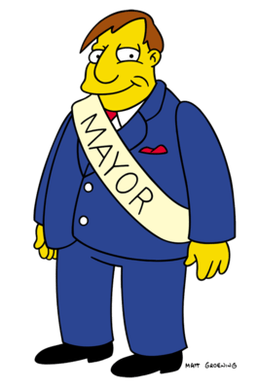
📷wikipedia. Mayor Quimby

In addition to the family, we have met many community members during the three decades plus that the show has been on. Just to name a few, we have Homer’s coworkers Lenny and Carl; Seymour Skinner the school principal; teachers Edna Krabappel and Elizabeth Hoover; neighbor Ed Flanders; Mayor Quimby; reporter Kent Brockman; tycoon Charles Montgomery Burns; Burns’ executive assistant Waylon Smithers; and Krusty the Clown.

Throughout the entire run, Groening and Brooks remained executive producers. There have been oodles of writers on the show. Typically, they are a group of sixteen writers who propose ideas and then turn the best into scripts.

I bet none of the voice actors in the late eighties thought they would still be employed on this show in 2024. Dan Castellaneta is Homer, Grandpa, and Krusty the Clown. Julie Kavner is Marge. Nancy Cartwright is Bart and Maggie. Yeardley Smith is Lisa. It has been a lucrative career. Until 1998, they were paid $30,000 an episode. From 1998 until 2004, they earned $125,000 an episode. A strike ensued in 2004. and after negotiations, we know that they make somewhere between $250,000 to $360,000 an episode. It has been up and down since, but right now hovers around $300,000.

I did not have time to get into all the differences in the animation studios that have been part of the show, but Klasky Csupo, AKOM, Anivision, Rough Draft Studios, and USAnimation, and Toonzone Entertainment have all worked on the show.
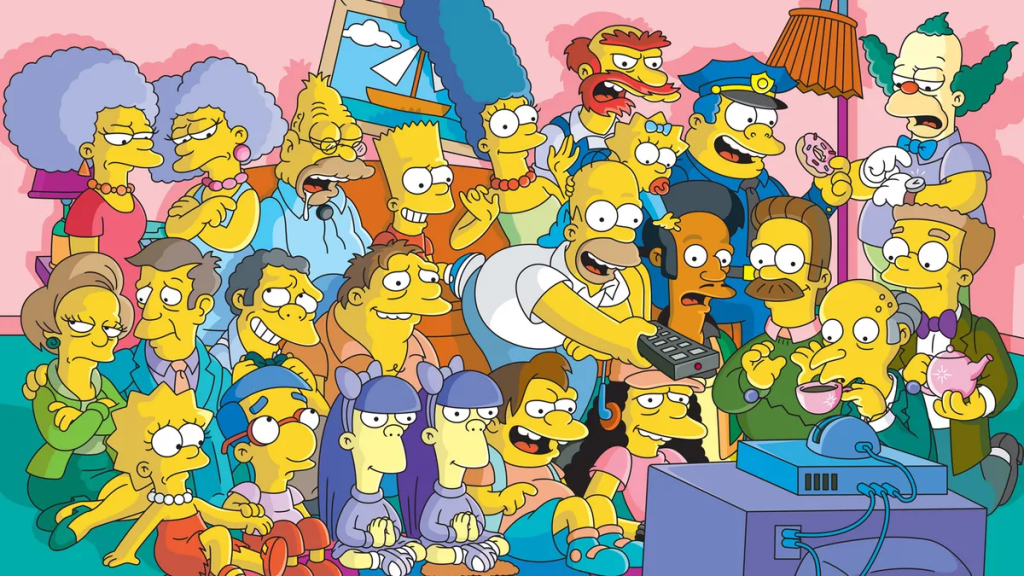
📷cnet.com

As I mentioned, everything and anything is up for being satirized on the show: nuclear power plants, education, middle-class Americans, wealthy Americans, conservatives, liberals, religion, atheists, sexuality, homosexuality. If you can name a theme, you can find an episode to fit it.

The show tries to appeal to a variety of generations. I guess they need to, to keep their original viewers which may have switched from 20 somethings then to retired somethings now.

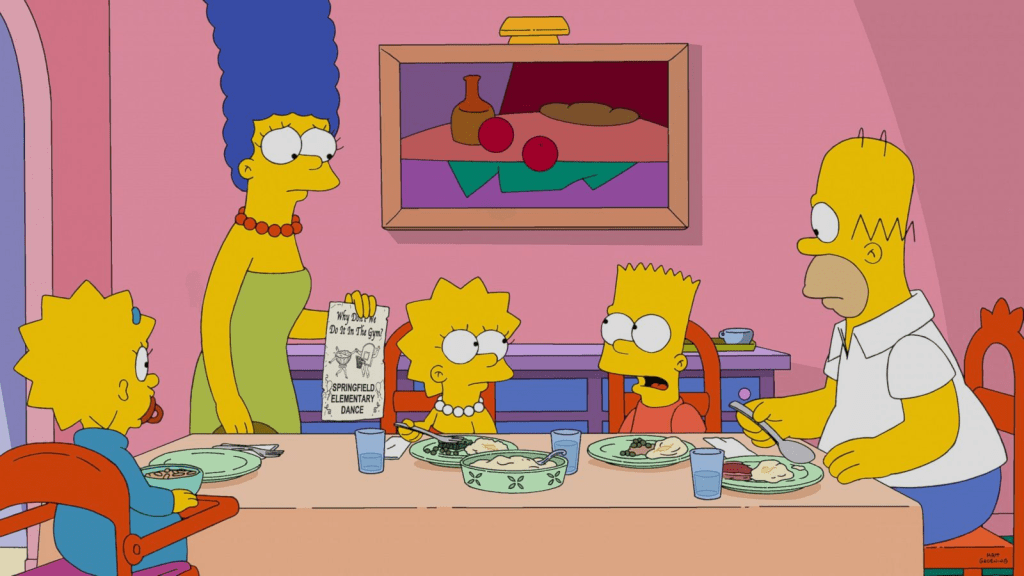
Whether they have ever seen the show or not, many Americans recognize the catchphrases from the show, including Bart’s “Ay caramba!,” “Eat my shorts,” and “Don’t have a cow, man.” Homer’s quip “D’oh” is another as is Mr. Burn’s “Excellent” and Krusty’s “I didn’t do it.”
📷abcnews.com

As you can imagine, critics of the show are legion and from every part of American life. At least they offend everyone. They even make fun of Fox TV.

And with more than three decades of episodes, the merchandising has been over the top; it currently is a billion-dollar industry. There are comic books, board games galore, figurines, t-shirts, etc., etc.

Almost every season is now available on DVD, just in case you have a decade to catch up.

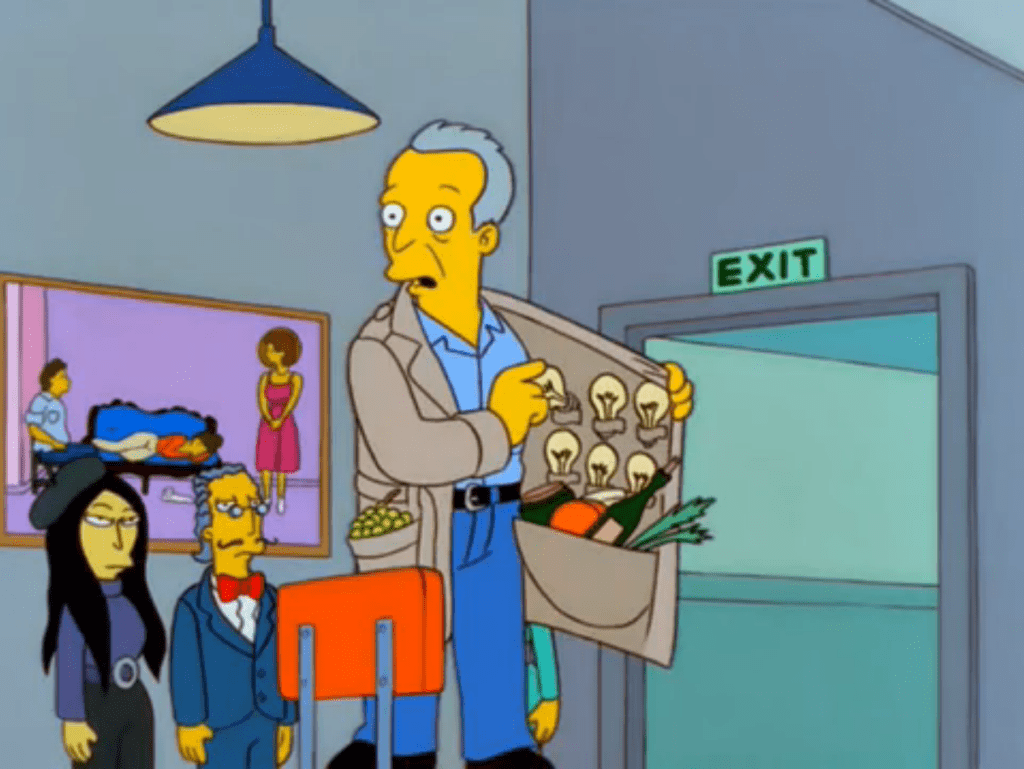
Let’s end with a few fun facts. Several people are banned for life from the comic book store, including Bart, Milhouse Van Houten, Sideshow Bob Terwilliger, Nelson Muntz, George Lucas, and Matt Groening. The most-often parodied films are Citizen Kane, The Godfather, 2001: A Space Odyssey, The Shining, and A Clockwork Orange. Like Batman, celebrities are so eager to make a guest appearance they are willing to be bad guys. Jasper Johns was portrayed as a kleptomaniac, Gary Coleman was a pathetic has-been, and Tom Arnold was an obnoxious nontalent who gets fired for being a bad actor.

📷wikifandom.com george lucas

The fact that so many celebrities are enthusiastic to appear on the show probably sums up how popular and how embedded The Simpsons is in our culture. It’s hard to think of another show with such lasting appeal. There are a few Sunday news shows that might have been on the air as long, but their popularity is not comparable. Actually, because the show has been on the air for so many decades, it may have
📷artinthemovies.com Jasper Johns

curtailed its viewers somewhat. I have never been able to become a dedicated fan because I could not devote the weekly time for so many years to watch the show. I will say that whenever I watch an episode, I always find something valuable in it. Even if the show is not one of their better episodes, and with 800 episodes, you know there are a few “klinkers,” there are always some great one-liners.

If you are one of those people who have lived under a rock or been a hermit without a television for more than 30 years, you might want to watch at least a few episodes to see what all the fuss is about. You won’t be disappointed.

Taxi: The Hip Fleet of Sunshine Cab Co.

Cast Photo: clickamericana.com

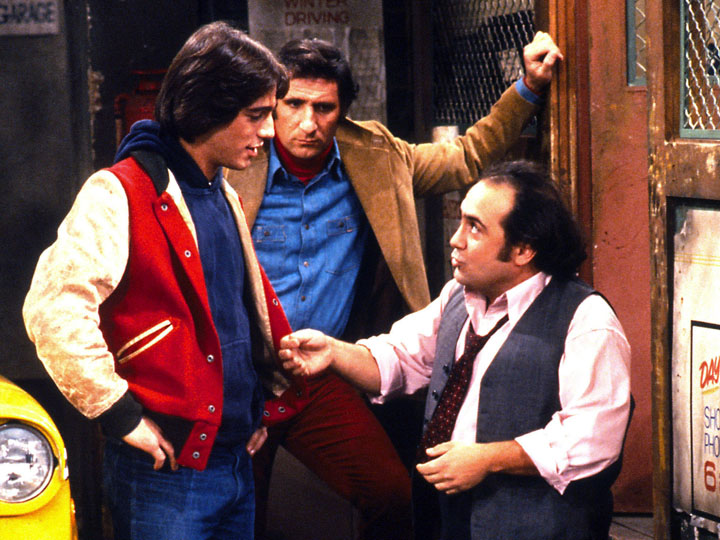
As we continue with our “Work It Out” blog series, today we are taking a long ride with Taxi. This show was created for ABC by James L. Brooks, Stan Daniels, David Davis, and Ed Weinberger and produced by John Charles Walters Co. The show was apparently inspired by an article in The New Yorker, “Night Shifting for the Hip Fleet” by Mark Jacobson in 1975. The article profiled several drivers who worked the night shift for a New York cab company. Taxi was in business from the Fall of 1978 to the Spring of 1982 on ABC and then drove over to NBC for a year.

The show is set primarily at the Sunshine Cab Company in Manhattan. Louie De Palma (Danny DeVito) is the dispatcher that everyone loves to hate. Brooks said that when they went to visit a company as the night drivers were just coming back from their shifts, they saw a dispatcher taking a bribe from a driver for a clean cab. That gave them the idea of Louis. DeVito described Louie as someone who “made life miserable for everyone. The manifestation of what was going on inside of him came out in a mean-spirited way to those around him. Deep down he just wanted people to love him.”

Photo: vodkaster.com

Drivers included Alex Reiger (Judd Hirsch) who considers cab driver his profession as opposed to a temporary get-by job. Elaine Nardo (Marilu Henner) is a single mother who also works at an art gallery. In the first episode when Elaine is hired, Reiger introduces the crew by saying, “You see that guy over there? Now he’s an actor. The guy on the phone? He’s a prize fighter. This lady here: She’s a beautician. The guy behind her? He’s a writer. Me? I’m a cab driver. I’m the only cab driver in this place.”

Tony Banta (Tony Danza) a boxer, and Bobby Wheeler (Jeff Conaway) a struggling actor are other coworkers. We also get to know the Reverend Jim Ignatowski (Christopher Lloyd), an aging hippie who gets a job driving and Latka Gravas (Andy Kaufman), an immigrant mechanic. Latka was a weird character, and I have to say that I did not enjoy him on the show. Andy Kaufman invented the character for a comedy act. During the show, he met and married Simka (Carol Kane).

The person who probably had the easiest audition was Danza. He said that when he went to read for the show, he had broken his third metacarpal on his right hand and had a black eye from knocking out a guy in the ring in Brooklyn. He had never acted before and didn’t really know what he was doing.

Although the show was a sitcom, there were a lot of important issues tackled during the run of the show including addiction, parenthood, obesity, animal abuse, homosexuality, racism, gambling, grief, divorce, and sexual harassment, among others.

Ruth Gordon Photo: ebay.com

This show had more than its share of important guest stars. Ruth Gordon and Eileen Brennan both were nominated for Emmys for their guest appearances, with Gordon winning hers. Other stars who showed up included Marcia Wallace, Penny Marshall, Dr. Joyce Brothers, Edwin Newman, George Wendt, Ted Danson, Tom Selleck, Tom Hanks, and Bubba Smith.

Brooks wrote for The Simpsons and The Mary Tyler Moore Show. Daniels also wrote for The Mary Tyler Moore Show and was best known for The Tonight Show. Davis was one of the writers behind The Bob Newhart Show and Weinberger would go on to write for The Cosby Show. It was no surprise that this show was known for its amazing writing, and the series was nominated for 31 Emmys during its five seasons, it won 18 of them, most impressively it won Outstanding Comedy in 1979, 1980, and 1981. Kane, Hirsch, DeVito, and Lloyd and all won Emmys for acting. James Burrows won two for directing.

Taxi had one of the most-recognized theme songs from the 1980s. “Angela” was written and performed by Bob James.

I did not hear much about conflict on the set, although several performers, including Hirsch, indicated they did not care much for Kaufman. Kaufman had it written in his contract that he only work two days a week, so for most of the filming a guy with a sign around his neck that said “Andy” worked with the cast, so I don’t think there was necessarily a lot of bonding with him anyway.

Conaway was fired after 69 episodes. It was apparently well-known that he had a major addiction problem, and when one of the producers discovered him passed out when he was supposed to be filming, they wrote him out of the episode and then wrote him out of the show.

The cast seemed very happy and like a family. Henner said that they could always express an opinion about their character and thoughts on a scene. Brooks said Burrows was able to bridge the two worlds of writers and actors. He spent time with actors all day and then went to the writers’ room to talk to them and was the liason between the two. Henner agreed and said that Burrows was brilliant at adding memorable moments to a scene. She said in one episode she was losing her mind a bit and someone says the champagne is flat and the producer had her bend over and blow bubbles in the glass. She said it was brilliant.

Photo: rottentomatoes.com

DeVito also mentioned a scene that was special for him. One night when Louie was all alone in the garage, he took out the mic and sang a song. Then he said, “I always wanted to do that.” It was a very heart-warming moment and made Louie more interesting and gave him more depth.

Burrows said that most of the cast was young and they all bonded so well. Sometimes they went roller skating, to dances, and they even had a softball team. Rhea Perlman was on the show off and on and during one of their lunch breaks, she and DeVito got married.

Henner talked about their weekly parties. She said everyone at Paramount wanted to hang out with them including the cast of Happy Days, Mork & Mindy, Laverne & Shirley, and Bosom Buddies. She said that John Travolta and Frances Ford Coppola stopped by. John Belushi hung out with DeVito a lot and was there for one of their get-togethers and he died the next day.

Photo: tvguide.com

Hirsch said the group wanted something to do after the show because they didn’t want to go home; they wanted to hang out together more than anything else.

Brooks probably summed up the show the most eloquently. He said that “there’s a lot of things that take a glow in retrospect. The great thing about Taxi was that there wasn’t a moment on the show they didn’t appreciate how lucky there were to have it. That was the show’s energy. I’ve never seen anything like it. . . People show up at the right time and everyone’s lucky enough to have each other at a certain point. It becomes a beautiful team sport.”

Isn’t that the best tribute anyone could give a show?  I’m glad they all had an appreciation for it, and I’m glad they included us in their family.

I’m a Writer? I’m a Writer!

This month we have been learning about some unique stories about television writing. I thought it would be fun to wind up the series learning a little bit more about what goes on inside the writers’ room and how you might get there.

Review: The Dick Van Dyke Show, “The Curious Thing About Women” | This Was  Television
Dick Van Dyke Show Photo: thiswastelevision.com

Since watching The Dick Van Dyke Show, I have always thought how much fun it would be to be part of a writers’ group for a successful comedy. Nothing I have ever read about the cons of the writing life—late nights, severe writers’ block, procrastination, writers’ arguments–has ever made me question whether this would be an amazing job or not.

So, what exactly is a writers’ room? It’s an office where writers of a television show get together to brainstorm the stories that make it on the air. Depending on the show, you can have two to twenty people in the room. There are other people in addition to writers who pop in and out. A script coordinator, staff writer, story editor, executive story editor, producer, and supervising producer are all positions that might be sitting in on a writing session. Writers’ assistants can take notes, do research, and then there are runners who make copies, get lunch and coffee, and schedule calls.

Just like police officers, doctors, or funeral directors, writers have a lingo all their own. So, let’s take a look at a few of these expressions. A bottle episode takes place in one location and often depends more on dialogue. A Gilligan cut is just what you might guess. It goes back to the show Gilligan’s Island which often showed a contrast in action: one character says Gilligan says nothing in the world will get him to climb that tree and the next scene shows him in the tree. A face heel is where a good guy is now revealed to be a bad guy. A Frankenstein draft is one that is made up of a variety of parts—multiple writers work on the script and then it is unified. A gorilla is a joke or scene that the audience will remember long after the episode is over.

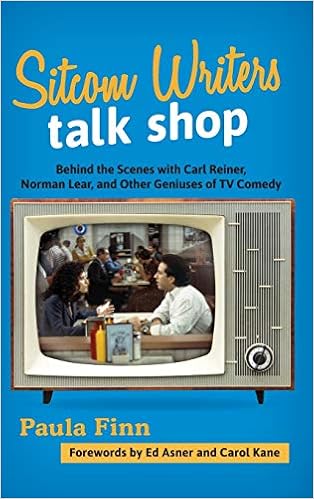
Sitcom Writers Talk Shop: Behind the Scenes with Carl Reiner, Norman Lear,  and Other Geniuses of TV Comedy (9781538109182): Finn, Paula, Asner, Ed,  Kane, Carol: Books - Amazon.com

If you are interested in television writers, there is a great book by Paula Finn called Sitcom Writers Talk Shop. (It’s available on amazon.com and at most of your favorite book stores) Her dad, Herb Finn, was a television writer and, for all of you who think Ralph Kramden and Fred Flintstone seem similar, her dad Herb, wrote for both shows.

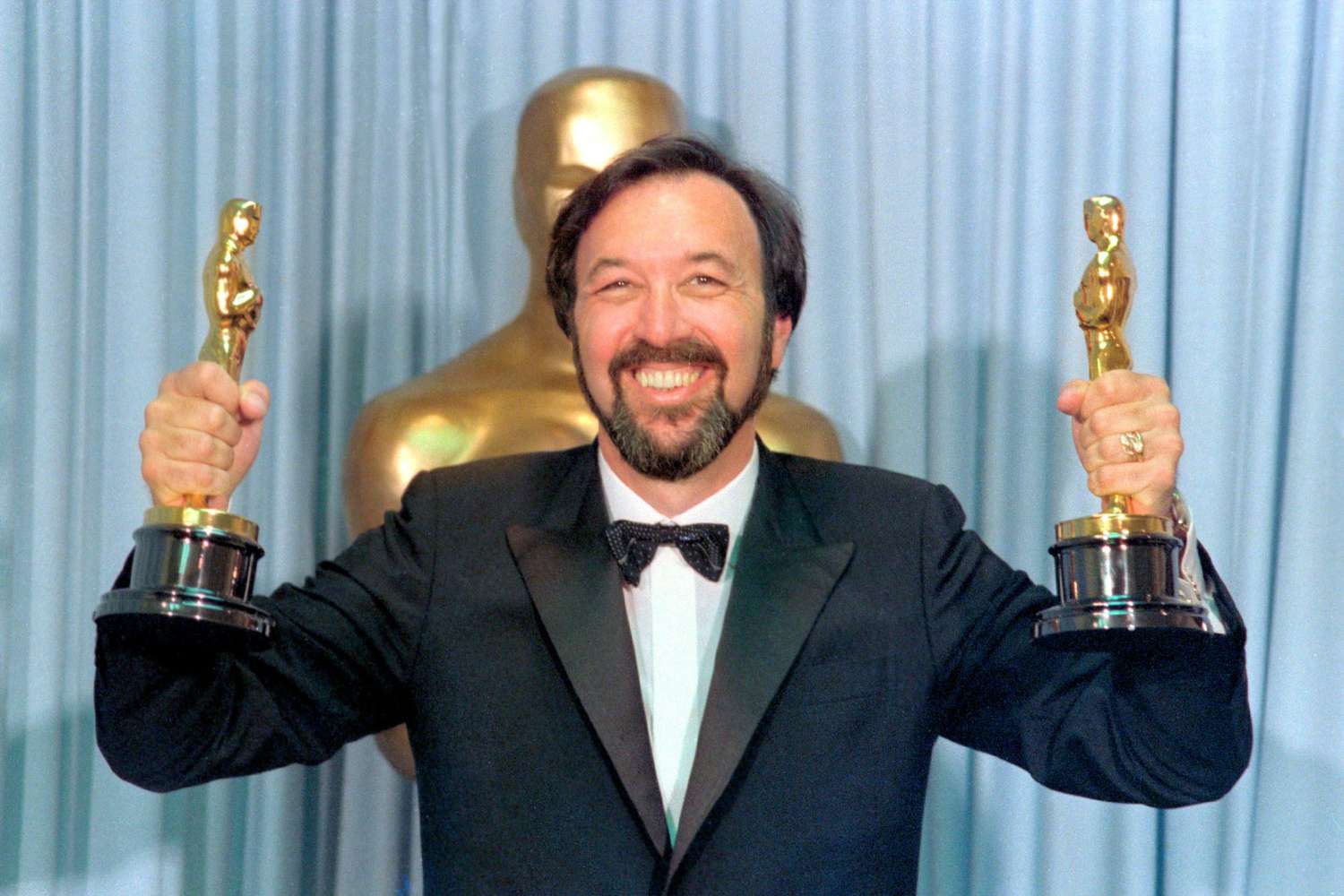
She has some great interviews in the book. If you read the book, you’ll learn a lot about the highs and lows of television writing. James L. Brooks–who wrote for Room 222, The Mary Tyler Moore Show, Taxi, and The Simpsons—had some great insights.

James L. Brooks looks back at the making of his unforgettable films | EW.com
James L. Brooks Photo: ew.com

When asked about how you know you’re in the zone, he responded that “you hear your characters talking to you, and you’re taking dictation.” When asked about how it feels to work with a partner you get paired with, he said that you know you are a good team when “you don’t have an absolute sense of who does what.” When asked what was the best way to learn the craft of comedy, he said, “That’s obvious: It’s just doing it.” My favorite answer to a question of his was when he was asked if he could have found fulfillment doing a different job, he said, “I can’t imagine having done anything else. I never had the ambition to be a writer because it seemed impossible.” He went on to say that it’s a common feeling for writers that you do it for years and years and then suddenly, “somebody asks you what you do for a living, you can say ‘a writer’ without your voice catching or rising. Because it’s just an amazing thing.”

If you are a fan of MasterClass, you know they have a lot of great learning opportunities. One of their courses about writing for television is taught by Shonda Rimes. The MasterClass staff put together five tips for succeeding in a writers’ room. I would take it a step further and say they were five tips for succeeding in life. They are:

  1. Be useful.
  2. Be respectful.
  3. Be brave.
  4. Be collaborative.
  5. Be flexible.

So, if after reading this blog, you too think it would be fun to be part of the writers’ room, what is the best way to do it? Often writers start as assistants. You’re able to make contacts and see how the job is done from the inside. Of course, writing scripts and more scripts and more scripts until someone decides one of them is just what they need is another option. Many aspiring writers find agents who can try to sell the work for them.

Humor (and Hard Work) Inside 'The Big Bang Theory's Writer's Room
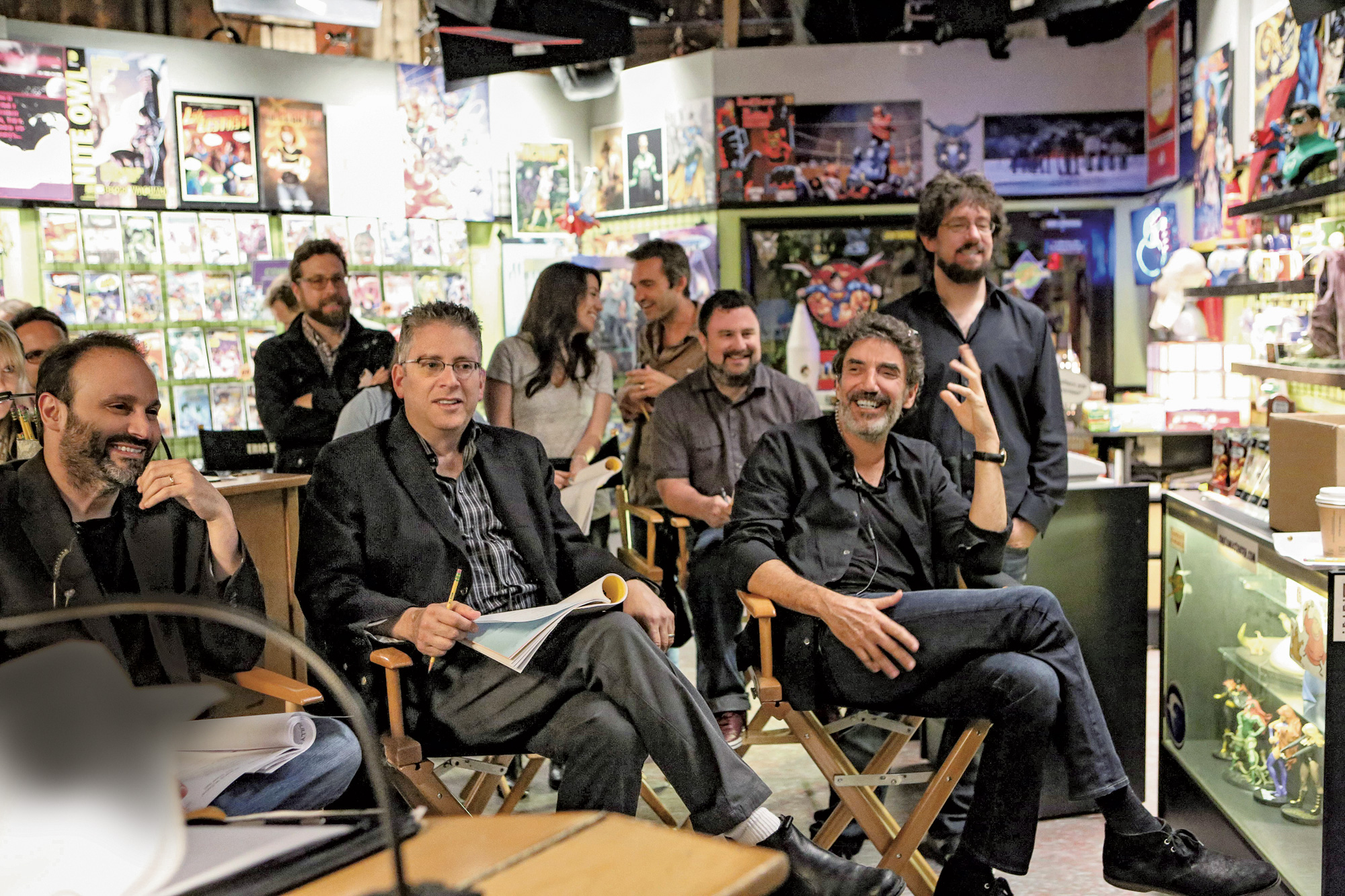
The Writers’ Room – The Big Bang Theory Photo: tvinsider.com

Sharing your work with as many people as possible is always a great way to get your name out there. Writer/Producer Lee Goldberg gave this advice in a post from November 2020: “The first thing you have to do is learn your craft. Take classes, preferably taught by people who have had some success as TV writers. There’s another reason to take a TV writing course besides learning the basics of the craft. If you’re the least bit likable, you’ll make a few friends among the other classmates. This is good, because you’ll have other people you can show your work to. This is also good because somebody in the class may sell his or her first script before you do, and suddenly, you’ll have a friend in the business.”

My best piece of advice if you want to be a comedy writer is to keep a journal. I cannot tell you how many times when I was researching television writers, they said some of their best shows came from real life. And during the years of researching for my blog, I have read quotes by many family members who said they often saw their private family life on the screen. There are some things you just can’t make up. Those situations can often become the basis of a television script. There are as many different paths to becoming a writer as there are writers in the industry.

WHAT IS A WRITERS ROOM?. 5 key points | by Filmarket Hub | Filmarket Hub |  Medium
Photo: medium.com

I wanted to end with a bit of inspiration that I received from James Brooks in Paula Finn’s book that he took from someone else, which is how writers work all the time. Anyway, I always struggle when trying to explain why pop culture is so important and why I choose to write about it. I often feel that I have to over-defend writing about television. His quote: “I forget who said it, but somebody terrific: The purpose of popular culture is to let people know they’re not alone.” Thanks to all of you for being not alone with me!