Phyllis: Relocating Was a Bad Move

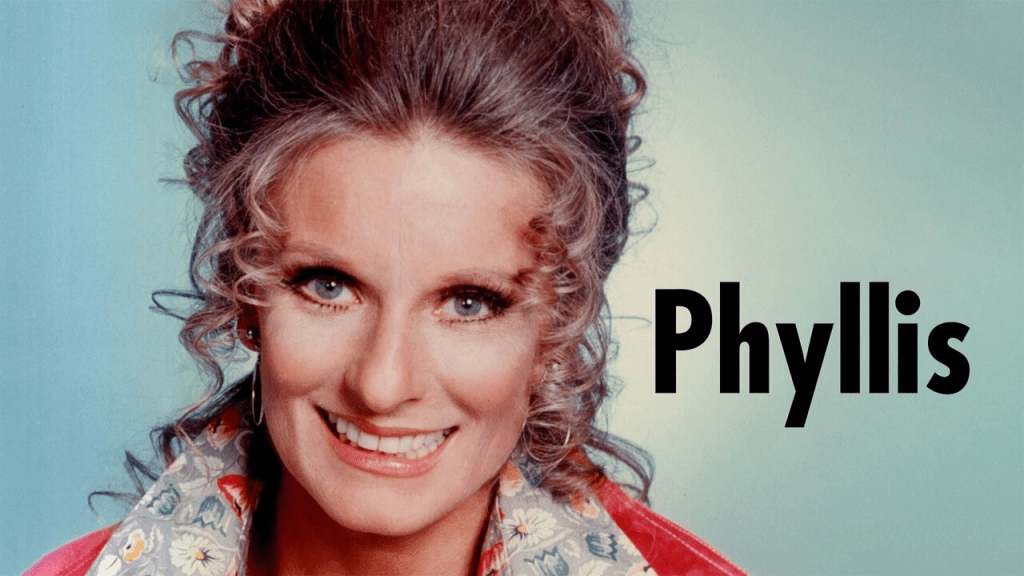
This month we are looking back at one-named sitcoms, and we can’t forget Phyllis. A spinoff from The Mary Tyler Moore Show, it aired in the fall of 1975 and ran for two seasons. James Brooks, The MTM producer, was involved slightly as a consultant but Ed Weinberger and Stan Daniels were in charge.
đź“·TVInsider.com

In this series, Phyllis Lindstrom (Cloris Leachman) and her daughter Bess (Lisa Gerritsen) leave Minneapolis and move to San Francisco after Phyllis’ husband passes away. Her in-laws still live out west in the area where she and Lars lived as newlyweds. Even though Lars was a doctor, his death left his family broke. Life is interesting with three generations under one roof. Lars’ father Judge Jonathan Dexter (Henry Jones), Lars’ mother Audrey (Jane Rose), and Phyllis and her daughter navigate life with their grief, new surroundings, and complicated life situations.

Phyllis applies for an assistant in a photography studio. Her first boss is Julie (Barbara Colby). After Colby was murdered, Liz Torres took on the role and Valerie Harper’s (who played Rhoda on the MTM show) ex-husband Richard Schall plays Leo, a photographer at the studio who doesn’t make life easy for anyone. Phyllis is not only used to being pampered and not working, she also never was shy about sharing her opinions with anyone around her.
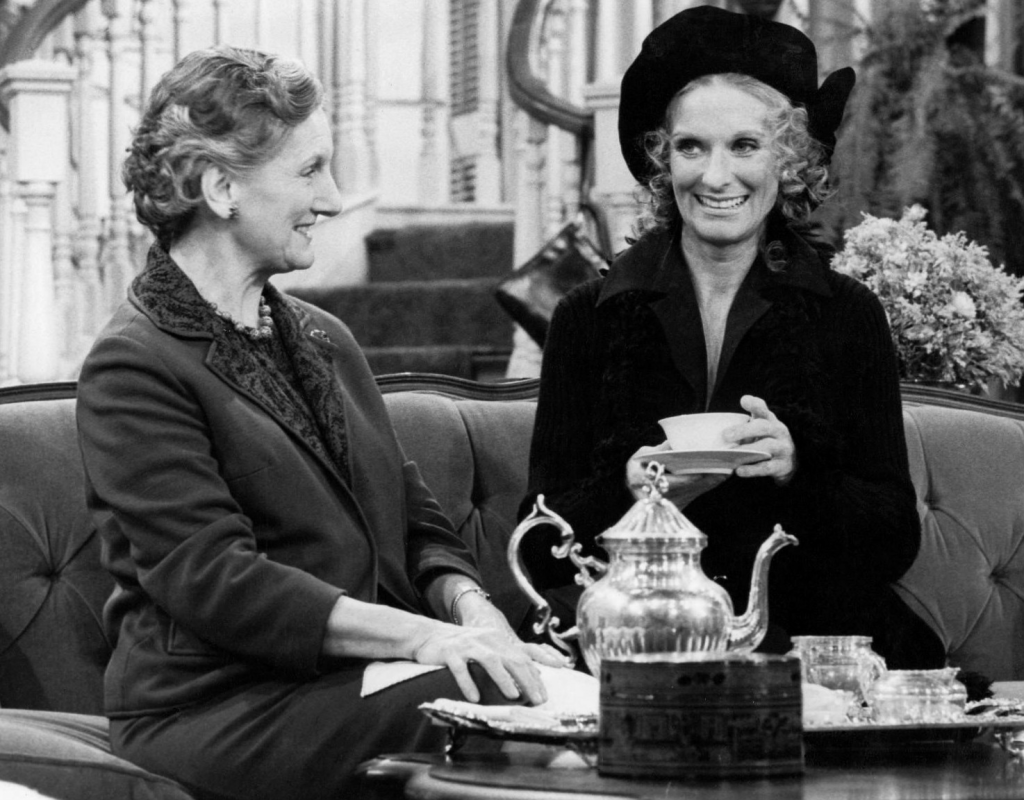
The network scheduled the show on Monday nights after Rhoda and before All in the Family, so it became an instant top ten hit. Leachman was nominated for lead actress in a comedy but lost the Emmy to Mary Tyler Moore. In addition to Moore, Leachman’s competition included her previous coworker Valerie Harper for Rhoda, Lee Grant for Fay, and Bea Arthur for Maude.

Once again, as we’ve seen a few times this month, when ratings began to slip a bit, the network turned the show upside down. For season two, the photography studio was sold, and Phyllis was without a job again. She then goes to work for the San Francisco City Supervisor and is put into the middle of political chaos. Rhoda was also having some trouble with ratings and was rehabbed. Their competition was Little House on the Prairie which continued to rake in lots of viewers.

By 1976, Rhoda had regained many of its viewers, but Phyllis was continuing to decline. It was dropped for the next season. At one point, Mother Dexter (Judith Lowry), the judge’s mother, has a boyfriend Arthur Lanson played by Burt Mustin who later becomes her husband. Henry Jones and Burt Mustin’s scenes are probably the highlights of the shows.
đź“·tvseriesfinale.com

Alan Burns discussed casting the role of Phyllis on The Mary Tyler Moore Show. He said Leachman’s instincts were terrific, and she made the role amazing. James Brook said that Marlin Brando called Leachman the best actor he ever saw come out of The Actor’s Studio. Obviously, the character of Phyllis was a successful and popular one. I think that The Mary Tyler Moore Show was so well loved for the ensemble cast. Pulling Phyllis out of that “family,” and placing her across the country probably wasn’t the formula for a successful spinoff.  They would have been better off to give her a brand new show of her own which could feature her highly rated acting ability.

Gather Round: It’s Time for Tales of Wells Fargo

đź“·pinterest.com

This month we are Riding the Range, exploring some of the westerns from the fifties and sixties. One of those shows that was on the air from 1957-1962 was Tales of Wells Fargo.

The show was produced by Revue Productions and set in the 1870s and 1880s. Gene Reynolds was one of the creators of the show, along with Frank Gruber and James Brooks. Reynolds would go on to great success as a director, producer and writer, and my favorite of his was M*A*S*H. Although this show was set in the same time as Daniel Boone, it was better at getting history correct. The show featured special agent Jim Hardie (Dale Robertson) with his horse Jubilee. It was loosely based on the life of real detective Fred J. Dodge. Sometimes Hardie ran into characters from history including Jesse James and Belle Starr.

đź“·pinterest.com Fred J. Dodge

Fred Dodge was born in California in 1854. He went to work as an undercover agent for Wells Fargo, working in California, Nevada, and Arizona. In 1979 he was in Tombstone and recommended hiring Wyatt Earp as guard for the stage line. He became great friends with Earp. Later Dodge became constable of Tombstone while working undercover. In 1890 he left his undercover work and became a known employee of Wells Fargo in Texas. He purchased a 2,000-acre ranch near Boerne, Texas and when he retired in 1917, he lived there with his family. Dodge was described as an intelligent and successful investigator. He wrote 27 journals during his career, noting his activities and travels in them. Some of these were used for Tales of West Fargo.

I had always assumed this show was about stagecoach travel, but it was not, although stage coaches played a part. In the mid-1800s, the Wells Fargo stage line was the primary connection between the East and West coasts. Wells Fargo did not operate a stage coach line, but they did use that form of transportation for money, gold and other valuables to be delivered. Trains are involved in many of the plots. One of the trains used in the show would eventually travel to Hooterville and be renamed the Cannonball.

đź“·imdb.com

The first five seasons were black and white half-hour shows, while the final season switched to a color, hour-long show. During the last season, Hardie settles on a ranch near San Francisco and several recurring characters (Jack Ging, William Demarest, Virginia Christine, Lory Patrick, and Mary Jayne Saunders) were added to the series. Earle Lyon replaced Nat Holt as producer in 1960.

The theme song was written by Stanley Wilson and Mort Greene. Wilson was a prolific composer, amassing 147 credits for composing and 278 for music department credit on television and in movies. Mort Greene was best known as a writer for The Red Skelton Show and for his musical role for Leave it to Beaver.

The number of well-known actors who appeared on the show was surprising. Here are just a few of the huge number: Claude Akins, Eddie Albert, Hugh Beaumont, Dan Blocker, Charles Bronson, Edgar Buchanan, Harry Carey Jr., Chuck Connors, Buddy Ebsen, Beverly Garland, George Kennedy, Tina Louise, Steve McQueen, Jack Nicholson, Leonard Nimoy, Denver Pyle, Jason Robards, Vito Scotti, Dawn Wells, and Adam West.

đź“·mysteryfile.com

It was an NBC show. The pilot premiered on Schlitz Playhouse of Stars. Its biggest competition was Father Knows Best in seasons two and three. It was very popular with the viewers. The show was in the top ten during seasons one through four. For the sixth season, with an entire new cast, new theme song, and color, it was almost like a new show. NBC moved it to Saturday nights against Perry Mason and ratings declined drastically, costs went up significantly, and it was canceled.

Robertson thought the key to the popularity of the show was because it was not geared specifically to adults or kids. It was a family show. When Robertson first read the script, it was terrible, but he owed Nat Holt a favor, so he accepted the role, assuming that it would never make it. Robertson received a 50% ownership in the show, so he said of course it made him want the show to be better and he convinced them to replace most of the original script. He said that he enjoyed his time on the show a lot and that the crew was close and professional. They never went over schedule or over budget during the entire run.

đź“·thehollywoodreporter.com

The first two seasons were released on DVD in 2011 if you want to check them out. It sounds like this was a solid show. The network supported them, the cast was close, the production team was on top of things, and they all enjoyed their time with the show. That is a rare thing to hear in the television business. They took a gamble in the last season, and it didn’t work out, but perhaps it was for the best. It sounds like the actual show ended the season before because the last season things changed so much it was a completely new production. I would like to read more about Fred Dodge. His life sounds fascinating.