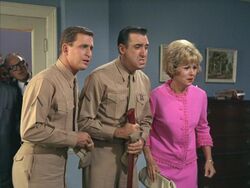
Sandra Gould: What a Character

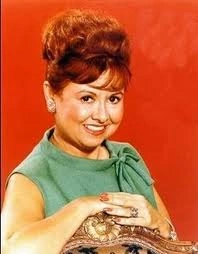
We are winding up our blog series “What a Character” with Sandra Gould. I have to be honest, I had an unfair bias against Sandra Gould.  I didn’t know a lot about her career, I just knew that she replaced Alice Pearce as Gladys Kravitz, and it was a bad replacement. It wasn’t Sandra’s fault—I blame the show’s producers.
📷pinterest.com

Some actors truly are irreplaceable. Eartha Kitt, while a great Cat Woman, just wasn’t Julie Newmar. Imagine trying to replace Henry Winkler as the Fonz halfway into the show. Can you picture tuning into MASH and finding Hawkeye was now played by someone other than Alan Alda?  Pearce was perfect in that role and, despite her being nosy and annoying, she was likable and that is hard to do. Gould’s Gladys was loud and brash, and I felt like I heard fingernails on a chalkboard whenever she was in a scene.

As long as I’m oversharing, I never cared for Dick Sargent either. While he was able to replace Dick York in some ways, York was just Darrin. Okay, I’m done and ready to talk about the good aspects of Sandra Gould and her long career.

Gould was born in Brooklyn in 1916. She entered the entertainment business early becoming a kid dancer in the Cat Skills by age 13.

📷threads.com

Gould found a lot of success on radio, appearing on “My Friend Irma” and “Duffy’s Tavern.” Her first radio job came along when she was only 9 on “The Danny Thomas Show.” Gould was with Jack Benny for almost fifteen years.

In 1938 she married Larry Berns, a broadcasting executive. They were married until his death in 1965. Berns joined CBS in 1942 writing and producing radio and TV series including Our Miss Brooks. He later worked on McHale’s Navy and Broadside.

Sandra’s first role was in the big screen T-Men in 1947. Most of her roles were inept or gabby women, typically a telephone operator, nurse, receptionist, landlady, or saleswoman. Gould once mentioned that she played an operator more than any other actress. I did notice 10-15% of her roles mentioned switchboard operators.
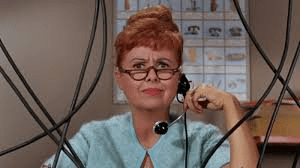
📷facebook.com

While she continued to appear in movies, most of her acting credits came on television. She appeared in Oboler Comedy Theater in 1949. In the early days of television, many of the series were drama or comedy reenactments of movies or plays. Sometimes, new stories were written for these episodes. Gould continued with these roles into the mid-fifties.

From 1952-55 she appeared as Mildred on I Married Joan. This series starred Joan Davis and Jim Backus. He was a judge, and she was another “Lucy Ricardo” always getting into mischief or causing hardships for her husband.

📷tumblr.com

Gould was kept very busy with offers during the end of the fifties and throughout the sixties. She could be seen doing comedy on Our Miss Brooks, I Love Lucy, The Jack Benny Program, My Three Sons, The Brady Bunch, and I Dream of Jeannie among others. She also tried western life on Wagon Train. Her drama performances included Hawaiian Eye and I Spy. She even dipped her toe into animation on The Flintstones.

At the end of the sixties, she was given the Glady Kravitz role. Pearce and Gould split the character’s appearances: Pearce had 27 episodes with Gould having 29.

Gould had stepped away from acting for a time. She published two books for girls: Always Say Maybe and Sexpots and Pans. They both seem quite dated today in their advice to girls to get the right type of husband. At the time she accepted the role of Gladys she said she had gone through a very rough year. Her husband died. Then her writing partner Peter Barry died. Then Alice Pearce, who was a good friend of hers. She had no desire to take over the role, but George Tobias who played Abner and was also a friend, called her to come in for an audition.
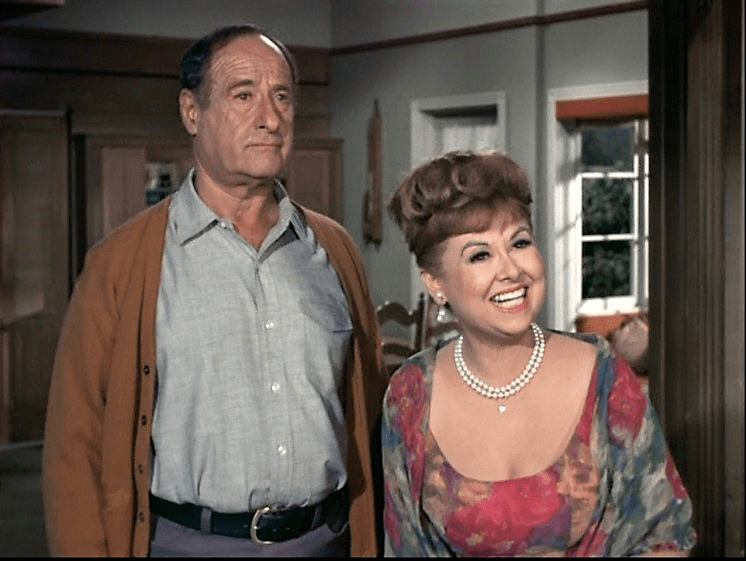
📷imdb.com

I could not find any information about she and Barry collaborating. One article specifically mentioned that they wrote scripts for Honey West, Tammy, and The John Forsythe Show, but I don’t see either of their names as writers for these shows. Barry is listed as a writer for 23 shows in the late fifties and early sixties, and he was a radio scriptwriter. Perhaps they had written some scripts that were never filmed.

I guess I am in the minority on the Bewitched issue because most sites I visited described her role similarly, usually something like Hollywood Spotlight’s description: “her over-the-top performance and shrill voice were popular with viewers, and she succeeded ultimately in making the character her own.” She also reprised her role as Gladys in the sitcom Tabitha in 1977 which was about Darrin and Samantha’s daughter as an adult.

Some time during her stint on Bewitched, she got married again to Hollingsworth Morse, and they were together until his death in 1988. Hollingsworth was a director and assistant director on almost 90 programs and movies including McHale’s Navy, Dukes of Hazzard, and Mork and Mindy.

The seventies and eighties found her primarily in drama roles, although she could be spotted in a handful of sitcoms. You can catch her on Columbo, Marcus Welby MD, Ironside, Crazy Like a Fox, and MacGyver. During the nineties, she took on roles that were described as “old lady” on Friends and on her last appearance which was Boy Meets World in 1999.

📷bewitched wiki.com

Not long after filming this episode, Gould passed away from a stroke following heart surgery.

Gould had a long and successful career and certainly made the nosy, gabby character her own. I’m glad the job on Bewitched helped her get through a very sad and difficult time in her life. However, I still am claiming she was not right for Gladys who should have been written off the show and just replaced with a new neighbor. But I respect Gould and the characters she made her own on the big and little screens.
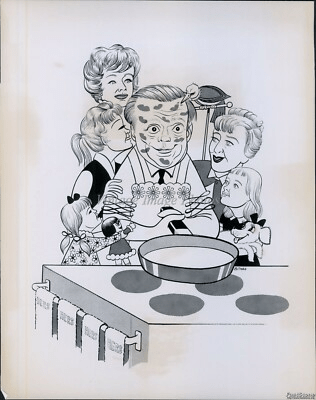
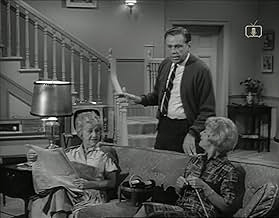
The Tom Ewell Show: Surrounded by Women

Thanks for joining me today. We are having fun with this month’s blog series, “It’s Their Show,” and today we are taking a closer look at The Tom Ewell Show. The shows we are delving into this month were all movie stars jumping from the big screen to the small screen. Some of them landed on their feet and some didn’t.

📷ebay.com

While most of the shows we are covering have a star we all know, Tom Ewell is no longer a household name. His first movie was in 1940, and he’s probably best known for The Seven-Year Itch with Marilyn Monroe. He did become a television fixture, starring in the soap Search for Tomorrow as well as a cast member of Baretta in the seventies and Best of the West in the eighties.

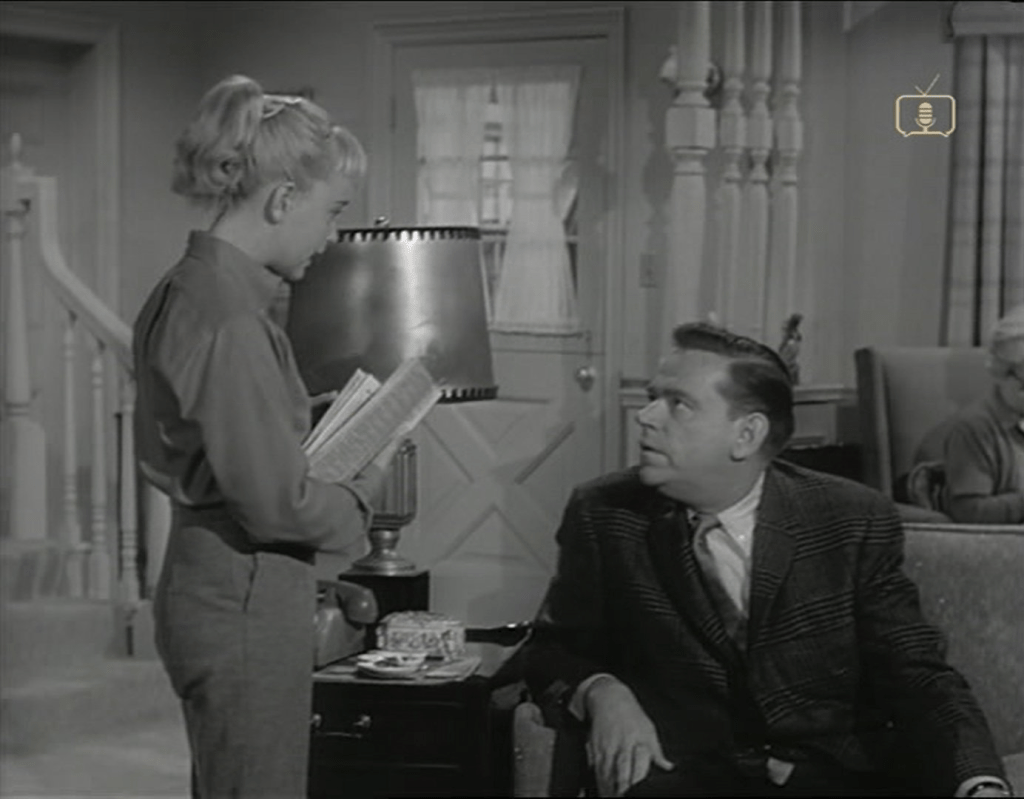
The Tom Ewell Show debuted on CBS in 1960 and was on for one season. The premise is about a guy who has to navigate life with a lot of women: his wife (Marilyn Erskine), daughters (Cynthia Cherault,  Sherry Alberoni and Eileen Chesis), mother-in-law (Mabel Albertson), and a female dog and a parakeet.

Tom Potter is described as a “bumbling” father. I’m not sure why so many shows in the early days featured a wife who caused complications for her husband or a bumbling husband. Potter was a real estate agent. Rounding out the cast are friends pharmacist Howie Fletcher (Norman Fell) and Jim Rafferty (Barry Kelley).

Potter loves sports, but the rest of his household is not too interested. Often, he is watching a sporting event on television while telling his family about the high points when they obviously could care less.

📷imdb.com

The concept of the show was set up in the opening which showed Tom looking around and then being put into a house before seeing the house overrun by women.

The show was created by Madelyn Pugh Davis and Bob Carroll Jr. who wrote for I Love Lucy. Pugh Davis said she based the show on her family. Her family had all girls and a mother-in-law in the house.

Ewell owned the production company in partnership with Davis and Carroll and Four Star Productions. Quaker Oats and Proctor and Gamble alternated sponsorship of the show.

Time reviewed the show after its debut and said “The Tom Ewell Show leads a relentless parade of situation comedies, all designed to show that American family life is as cute as a freckle on a five-year-old. The show, which might also be titled Father Knows Nothing, presents the comic with the excavated face as a bumbler named Potter who is trapped in the customary format: Harassed Man Beaten Down by Wife, Three Daughters, Mother-in-Law. In the opening episode, Ewell could find no better way to outsmart his spendthrift women than closing his bank account and ruining his own credit. For those who may have tuned out early, the women were all set to start spending again.” Not a great review.

📷imdb.com

This makes the female characters sound very unappealing, but on the show, his wife and daughters were delightful. His mother-in-law liked him and they often bantered back and forth; I think it’s worth watching the show just to see Mabel Albertson in action. However, the plots left a bit to be desired: Tom teaching his wife to drive a car, his daughter learning to play the tuba; and the typical sibling issues of everyone wanting to use the phone and the bathroom at the same time.

The show struggled finding viewers. Associated Press television critic Cynthia Lowry interviewed Ewell that fall, and he said that he had read both the positive and negative reviews of the show. He agreed with the critics who felt that Potter was too inept, and the comedy centered more on that and their family life. He said for December episodes, that issue would be addressed in the writing, and the family dog and parakeet were being dropped from the show. Unfortunately, it was not enough to attract viewers, and the show was canceled after one season.

📷youtube.com “Spelling Bee”

In an episode I watched, “The Spelling Bee,” from late November, Tom is trying to interest his family in golf. When he finally got them to watch a golf match, the females were more interested in what the golf spectators were wearing. And then his youngest daughter ran in and turned the station to a kid’s show. One of his girls is practicing her spelling to try to win a trip to Washington DC by winning the all-state spelling bee.

When Tom leaves the house, he continues to run into fathers and sons who are playing baseball, going fishing, working together, or talking about sports. Tom daydreams he has three boys, but we realize that he is holding a skein of yarn for his daughter while he does so. He tries to talk his oldest girl into going into the real estate business. Later he tries to talk his middle daughter Debbie into giving up spelling for golf. He also tries to get his wife to go bowling with him. When Tom realizes that one of his friends has a son trying to win the spelling bee as well, he turns it into a big sports event and is determined to beat them.

He buys a bunch of dictionaries and then gets up early to “train” Debbie. However, she had already left the house and when she returns, he finds out she’s been on the driving range practicing her golf, so they can be in a father and child golf match. He drills her on spelling the rest of the day. That night Debbie comes down with laryngitis.

📷imdb.com

Her grandmother gives her honey and lemon. The following night they attend the spelling bee, and Tom gives Debbie a pep talk, but then he reminds her he loves her no matter what. Of course, the final two contestants are Debbie and the son of Tom’s friend. She wins, and she and her dad get to travel to Washington, DC where they meet the President. The show ends with Tom telling his friend about all the great non-sport talents his girls have. It was a cute show, and the characters were all likable. There were a few great one-liners. It would not make my top 25 shows, but it was much better than many of the sitcoms in the sixties.

The show had a decent time slot. It was on Tuesday nights at nine, competing with Stagecoach West and Thriller. While both of those shows garnered decent ratings, neither of them was in the top thirty. The primary director was Hy Averback, who would later direct twenty episodes of MASH. So, they had the right elements in place, but the show just could never find its fans.

Larry Rhine talked about writing for the show. Rhine said Ewell was a nice man, but he said Ewell didn’t think the kids should be involved in the show much because they didn’t have the caliber of other actors. Rhine told Ewell they could consider them more as props which seems like a strange concept for a family show, considering that the episode I watched revolved around the daughters.

📷imdb.com

Rhine said Ewell found the show was over when he was on the set one day and he was called to the telephone about a trip he was supposed to take with CBS, and he was told that he was no longer part of the group because he had been fired.

I’m guessing part of the problem with this show getting renewed is that it debuted when westerns were still king and many of the television schedule spots were already filled with them. While it was definitely not a terrible show, the sixties were on the cusp of introducing very different sitcoms than the family-based ones that filled the fifties’ slots. By 1965 we would be tuning into Batman, Honey West, Hogan’s Heroes, The Smothers Brothers Show, and I Dream of Jeannie. However, that said, there are worse ways to spend a weekend than viewing a season of The Tom Ewell Show.

Camp Runamuck: Campers Loved It More than Viewers

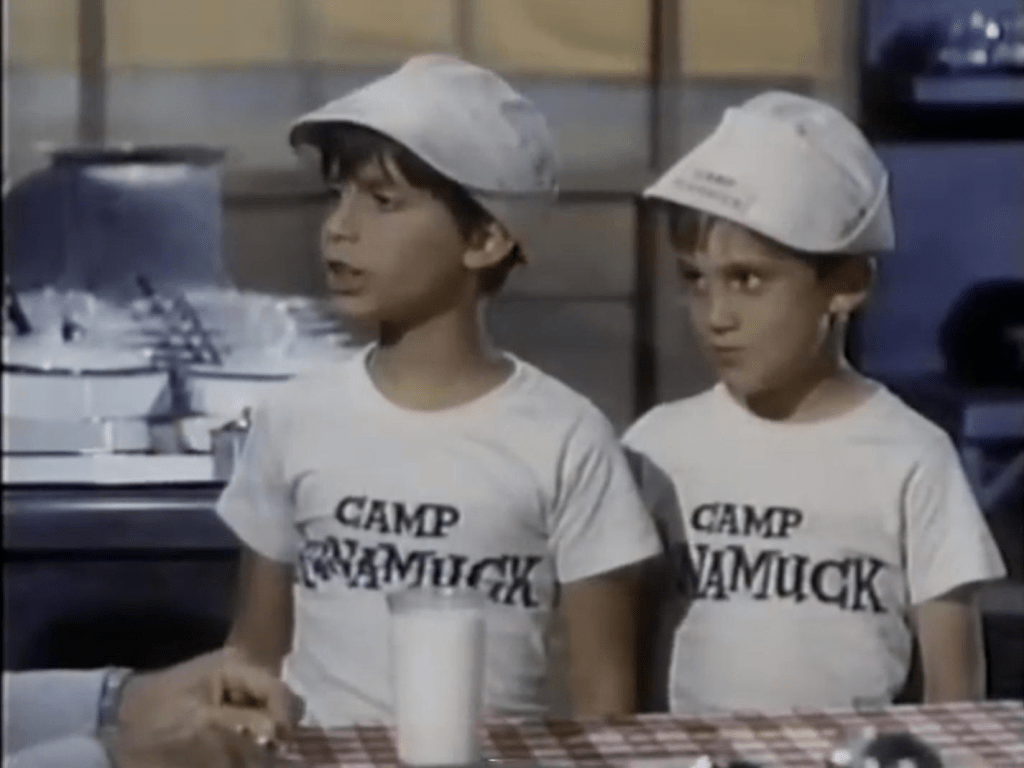
This month we are checking out a few sitcoms that are rarely remembered anymore. Today we are exploring the show Camp Runamuck. It debuted on NBC in 1965 and featured campers for 26 weeks before being cancelled.

📷imdb.com

Dave Madden was counselor Pruett; Commander Wivenhoe was played by Arch Johnson, and senior counselor Spiffy was played by David Ketchum. In the pilot, one of my favorites, Frank DeVol, played Doc Joslyn but illness forced him to hand over the part to Leonard Stone. Bobby Darrin sang the theme song.

If you are a fan of The Partridge Family, you will appreciate that this show was the introduction of actor Dave Madden, later Rueben who would manage the Partridges. Johnson began on television in the fifties, but this was his first cast role. Ketchum started his career a decade after Johnson and this was his second starring role after being in I’m Dickens, He’s Fenster in 1962. One camper who is featured in two of the 26 episodes is Maureen McCormick. This was the year she started her acting career, also appearing in Bewitched, The Farmer’s Daughter, and Honey West. Before becoming Marcia Brady, she would also show up in My Three Sons and I Dream of Jeannie.

Wivenhoe was an interesting camp leader. He didn’t like kids, didn’t like to part with his money, and didn’t appreciate the 6am morning wake-up song sung by the girls across the lake accompanied by a bugle. He did like playing golf and enjoying a quince for breakfast.

Across the lake was Camp Divine owned by Eulalia (Hermione Baddeley) who was helped by counselors Mahalia May (Alice Nunn) and Caprice Yeudleman (Nina Wayne).

The opening featured a peppy tune with fifes and you see the lake and hear the music before you see the camp counselors leading the campers (all in white; the poor laundry crew) marching down the road.

📷youtube.com

Most of the plots featured the counselors as opposed to the campers. Typical plots were the female campers being ordered to steal Wivenhoe’s bathtub so they could take a real bath and the boys getting it back. In another episode, the campers learn a civics lesson. They are given the task of electing a camp commander. However, the candidate who gets in becomes a dictator and tries to put everyone who had been in charge, namely the adults, in jail. This sounds vaguely familiar from the recent news.

In the credits I learned Cal Howard was in charge of visual gags. I never had seen that designation before in a sitcom. Howard, who was born in 1911 and passed away in 1993, had a long career as an actor and writer. He received 178 writing credits, mostly in animation. He worked for Walter Lanz and Walt Disney and wrote a few Bugs Bunny and Alvin and the Chipmunks episodes.

Just to add a sense of weirdness and whimsy to the series, two bears named Irving and Virginia would share their opinions of what was going on around the camp.

The series was up against The Wild Wild West and The Flintstones, pretty tough competition for the time. First of all it was on Friday nights when many viewers might be starting their weekend celebrations. The Flintstones was originally written for adults, but by 1965 families were watching the show together. The Wild Wild West was new, but immediately hit the top 30, and it was followed by another new CBS show, Hogan’s Heroes, and then Gomer Pyle, USMC, so most television fans were glued to that network Friday nights. Other new NBC shows included Get Smart, I Dream of Jeannie, and I Spy so competition was tough to retain a schedule spot. ABC didn’t have a lot of hits that year but they did debut three shows that I liked but all faded away within two seasons: Batman, Honey West, and Gidget.

Camp Runamuck might have gotten a second season if it didn’t have so much competition to deal with. If you loved camp as a kid, or hated camp as a kid, it might be worthwhile to watch a few shows and see what you think.

Honey West: Quality Over Quantity

As we look back at some favorite crime dramas, this week we are traveling back sixty years. From 1965-1966, Honey West appeared in our living rooms. Only thirty episodes were produced, but the show was respected and worth remembering.

Photo: drunktv.com

The show was based on a novel series. Married couple, Gloria and Forrest “Skip” Fickling wrote the books. Skip had been a gunner in the US Army Air Force. According to Skip, they combined Marilyn Monroe and Mike Hammer for the character of Honey West. The novels were published from the late fifties to 1971, with eleven total.

West was one of the first female private eyes on tv. In an episode of Burke’s Law, Ann Francis showed up as Honey West which led to a spin-off. The series was developed by Gwen Bagni and Paul Dubov, writers on Burke’s Law. Aaron Spelling was listed as the producer.

Photo: drunktv.com

West has a partner Sam Bolt (John Ericson). Ericson never received another starring role in a series, but he was a successful actor, amassing 105 acting credits.

Honey is an interesting character. She has a hidden radio in her lipstick case, has a pet ocelot named Bruce, a colorful animal-print wardrobe, and a Cobra convertible. She shares an apartment with her Aunt Meg (Irene Hervey) who shows up in about half of the episodes.

West owns her own investigation firm which she inherited from her father. Her base of operations was behind a fake wall in her living room. She’s very smart and experienced in electronic surveillance. Bolt creates many of the gadgets she uses. They go undercover in a specially equipped van which had a sign “H.W. Bolt & Co., TV Service.” She and Sam could be the inspiration behind Maddie and David from Moonlighting.

Like James Bond, or Max Smart, she uses a number of high-tech instruments: an exploding compact, a garter belt gas mask, tear gas earrings. You don’t have to worry about Honey’s safety. Sam is an ex-Marine, and Honey attained a black belt in judo.

Photo: filmscoremonthly.com

Several of the episodes were written by Richard Levinson and William Link who would go on to write for Columbo and Murder, She Wrote.

The show was canceled after the first year for two primary reasons, one understandable and one which makes me shake my head. I understand that the network determined that it would be cheaper to import The Avengers and show it in the time slot. The second reason is a bit harder to understand: the show was in competition with Gomer Pyle USMC and could not hold its own in the ratings war. I say this with great respect to Jim Nabors whom I love and while Gomer Pyle was an ok show, it’s hard for me to picture it as a show that would draw more viewers than a crime drama.

Francis did receive Golden Globe and Best Actress Emmy nominations that year. She was beat out by Barbara Stanwyck for The Big Valley. The show was described as “sexy, sophisticated and delightfully funny.” According to most of the reviews of the DVDs, it holds up very well after sixty years and is still fun to watch.

Photo: lulu-berlu.com

They had some clever details in the show. There is often at least one instance when the last word of a sentence leads into a funny new scene. The actors often discuss television shows, wondering about their ratings. Honey pulls down an imaginary shade, so viewers won’t watch her sleep. It also had a jazzy theme written by Joseph Mullendore. He had created a lot of the music for Burke’s Law and would go on to provide music for other series, including Land of the Giants and Daniel Boone.

There were several drawbacks mentioned, most notably the lack of color. Not only was color becoming the norm by this time, but Honey West was a show that would have been enhanced by color. It was also criticized for being a 30-minute show. There was not enough time to truly develop both the plot and the characters’ relationships in such a short time.

Photo: pinterest.com

This show reminds me a bit of Barbara Eden’s show How to Marry a Millionaire and Bachelor Father, starring John Forsythe, in that both debuted in 1957; two series that I thought had clever writing, fun characters, witty dialogue, and elegant interiors. On one hand, it is sad it wasn’t given more of a chance to get established with viewers. On the other hand, it sounds like it has thirty mostly great episodes to watch. Maybe an early cancellation allowed the best shows to be saved. I think about I Dream of Jeannie which was released the same year as Honey West. The shows from the first year are fun to watch. Jeanne is witty, clever, mischievous, and smarter than she lets on. During the following years, the episodes were average at best and often sub-par. If I only had the first year’s episodes to watch, I would not feel like I was missing anything.

For less than $20, you can buy the entire DVD season of Honey West. And if it makes you want to go out and get a pet ocelot, who am I to judge?

Surprise, Surprise, Surprise! It’s Gomer Pyle USMC.

Continuing my “We Salute You!” blog series, today we look at one of the most-loved television characters, Gomer Pyle.

Photo: pinterest.com
Danny Thomas in Mayberry

In the late 1950s Make Room for Daddy was one of the most popular sitcoms. On one episode in February of 1960, Danny found himself in Mayberry, picked up for going through a stop sign. Although Sheriff Taylor came off a bit of a country bumpkin, viewers enjoyed the episode and the following fall, The Andy Griffith Show (TAGS) aired on CBS. When the series debuted, Andy was portrayed more of a wise sage and the folks of Mayberry were a quirky but lovable bunch. The show was in the top ten every year it was on the air. In fact, it seemed to get better as it went, making #3 in 1966-1967 and #1 in 1967-68. Andy left the show the following year, and it turned into Mayberry RFD which continued for three more seasons. The first two it was also in the top 10 and the third year it slipped a bit into the top 15. Although it was one of the most successful shows on CBS’s schedule, it was eliminated with a lot of other popular shows in the famous rural purging in the early seventies.

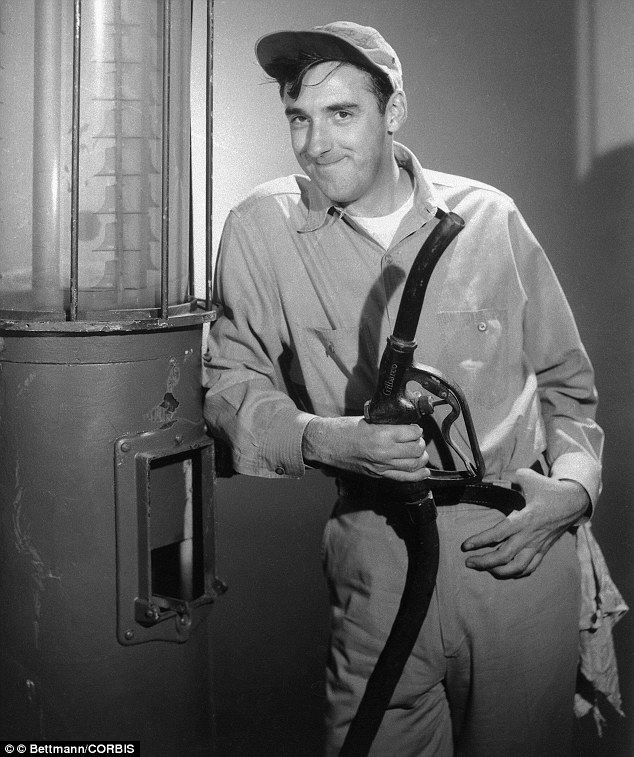
One night, Andy Griffith saw Jim Nabors performing at The Horn in Santa Monica and decided he would be a perfect fit for Mayberry. He offered him a job, and Gomer Pyle began working at Wally’s gas station.

Two writers, Everett Greenbaum and Jim Fritzell were said to have created the character. Greenbaum had dealt with an incompetent gas station attendant. He stopped by a station with motor trouble. The man could not think of any way to fix it except to keep adding gas to the tank, so Greenbaum thought a character based on him should be part of an episode on TAGS. He derived the name from Gomer Cool, a writer and Denver Pyle, the actor. Everett and Greenbaum (along with many TAGS writers) would continue to write for TAGS as well as Pyle episodes.

Gomer was one of the most popular characters on the show. Surprisingly he was only in 23 episodes in the two years he was with the show. Traveling around the country, you would be able to hear people repeating his “gawwwleee,” “surprise, surprise, surprise,”  or “shazzam” which all became part of our language at the time.

Photo: dailymailreporter.com
Gomer at Wally’s Gas Station

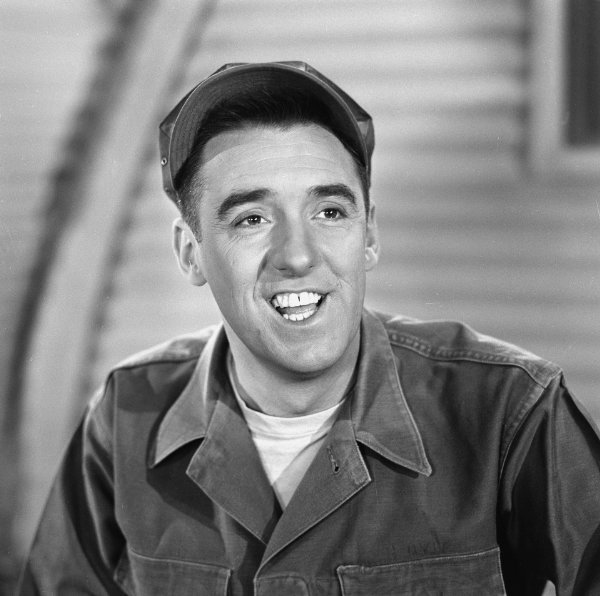
Because Gomer Pyle was so popular, Andy, Aaron Ruben, and Sheldon Leonard decided to give him his own show and Gomer Pyle USMC was created. In this show, Gomer who is naïve, kind-hearted and morally upright has to deal with life in the marine corps and his gruff Sergeant Carter (Frank Sutton). Although Carter gets driven to distraction by Pyle and his “do-gooding,” we all realize he has a soft spot for Pyle and his main concern is protecting him.

Photo: pinterest.com
Carter and Pyle

The show was on the air from 1964-69 and had a solid supporting cast. Like TAGS, Gomer Pyle USMC was in the top ten for its entire run.

Photo: mayberrywikia.com
With Ted Bessell

The show was on Friday nights, except for season three when it moved to Wednesdays. I was a bit surprised it stayed in the top ten, because it had some competition at times. Season one it was opposite Jack Benny and Twelve O’Clock High. Season two it went up against Honey West on one network and a variety of music shows on the other. Season three it was at the same time as Peyton Place and season four it was on opposite Star Trek.

Although the show depicted military life on base, war was never discussed. The series began at Camp Wilson in North Carolina and was moved to the fictional Camp Henderson in California. The actual show was filmed at Camp Pendleton and, along with TAGS, at Desilu’s Cahuenga studio and the RKO Forty Acres backlot. Unlike TAGS, Pyle used a single-camera setup because much of the shooting was outside.

Photo: pinterest.com
Don Rickles, Guest Star

The US Marine Corps worked with Leonard, giving the show unlimited access to their equipment because they felt the series was good for their image. The opening scene of the show was that of marching recruits from the Marine Corps Recruit Depot in San Diego. Nabors commented that it was very difficult for him to see that footage because so many of those service men were killed in Vietnam. In real life, Frank Sutton could not pass the Marine Corps physical for WWII but was able to serve in the US Army, taking part in 14 assault landings including Luzon and Bataan.

Photo: wikipedia.com

I had heard of universities bestowing honorary degrees to actors even if they did not attend the school, but I did not realize the military could do something similar. During the show, Gomer’s highest rank was Private First Class. In 2001, the US Marine Corps gave Nabors an honorary promotion to Lance Corporal, and in 2007 he was raised to Corporal.

Obviously, there were a lot of military vehicles used in the filming of the show. Chrysler Corporation provided them. Jeeps were also prominent in the show, but Jeep did not become part of Chrysler until 1987. As an aside, the vehicles for TAGS were provided by Ford.

Photo: sitcomsonline.com
Gomer and his friend Duke Slater

Pyle’s loyalty and good-natured attitude made him a favorite of both his platoon members and many of the women whom he came in contact with. One of Pyle’s friends was Duke Slater played by Ronnie Schell. Schell was written off after the third season when he left to star in Good Morning World. When that sitcom did not get renewed, he returned to Pyle. Some of the other platoon members included Roy Stuart as Corporal Boyle, Forrest Compton as Colonel Edward Gray, Ted Bessell as Frankie, and William Christopher as Lester.

Gomer gets to meet a lot of people when he goes to town. He especially loves movies and one of his favorite all-time pictures was Godzilla.

Photo: pinterest.com
Sergeant Carter and his girlfriend Bunny

As mentioned, Sergeant Carter eventually becomes a father figure to Gomer. Carter’s girlfriend Bunny (Barbara Stuart) also tried to help Gomer (I could not find anything to indicate that Roy and Barbara Stuart are related). Gomer often causes trouble between Carter and Bunny by trying to “help” Carter. In season three, Gomer also got a girlfriend in Lou-Ann Poovie (Elizabeth MacRae). She is a singer in a local nightclub, but eventually Gomer talks her into returning to Turtle Creek, NC to marry her old beau Monroe. She leaves but returns, informing Gomer she wants him for her boyfriend, and she gets a new job as a clerk at a record store.

Photo: sitcomsonline.com
Gomer and Lou-Ann

Several TAGS alumni made appearances on the show. Allan Melvin was part of the cast as Staff Sergeant Hacker for four years, Carter’s rival on the show. Denver Pyle who was Briscoe Darling on TAGS showed up on Gomer Pyle as a farmer. Andy, Aunt Bee, Goober and Opie all were seen at the base at one time or another, including when Opie ran away from home.

With a show on the air so long, many well-known guest stars showed up at Camp Henderson as well, including Carol Burnett, Ted Knight, Rob Reiner, Don Rickles, and Jerry Van Dyke.

Photo: directexpose.com

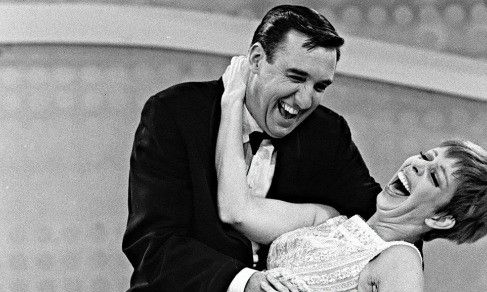
After the fifth season, Nabors expressed an interest to do a variety show, so Gomer Pyle was not renewed. He brought Ronnie Schell and Frank Sutton along for his new show which was on the air for two seasons. Carol Burnett called Nabors her good luck charm. He was one of her best friends and he was always on her season opener each year.

Photo: pinterest.com
Best Friends

In an interview with Jim for American Profile, writer Paulette Cohn (Jim Nabors Lives Happily in Hawaii, January 13, 2008) quoted Carol Burnett’s perspective of Nabors vs Pyle: “ ‘The one thing Jim has in common with Gomer is his kindness,’ says actress and comedienne Carol Burnett, Nabors’ long-time friend, who named him godfather to her daughter Jody. ‘He loves people and is very gregarious. But he is also very smart. Not that Gomer wasn’t, but Jim isn’t naïve. He keeps his eye on things.’ ”

Considering how popular Gomer Pyle USMC has been in reruns, I was surprised to learn it wasn’t until 2006 that CBS Home Entertainment released the show on DVD. By 2008, all the seasons were available.

Photo: blogspot.com

Let’s end with a few quotes that captures the essence of the show’s characters.

Gomer: I’m gonna be a fighting fool, you’ll see.

Sergeant Carter: Well, you’re halfway there.

************************************************************************

Gomer: One of my favorite little sayings is, ‘To avoid criticism, say nothing, do nothing, be nothing.’

************************************************************************

Gomer: A word of kindness is seldom spoken in vain, while witty sayings are as easily lost as the pearls slipping from a broken string.

***********************************************************************

Carter: All I can say is, if the idea of desertion ever crossed your mind, you’ll never find a better time to look into it.

************************************************************************

Carter: I don’t get it Pyle, how come you can knock that Phillips flat, yet you can’t handle that little Lombardi guy?

Gomer: Well sir, you see the big feller needed a lesson, the little feller didn’t.

Photo: abcnews.com

Although Gomer Pyle USMC might not be everyone’s cup of tea, it was a well-done and popular show. I think its success, like TAGS and many of the other shows considered classics, comes from the fact that it’s a character-driven show. We start to consider the characters our friends and enjoy spending time with them. The show can currently be seen on MeTV nightly at 9 pm EST.