We Still Love Lucy

We have been learning a lot about Lucille Ball this month. We delved into I Love Lucy and why it was so important to American culture. We got to know Lucy as a person. And we discussed Jess Oppenheimer and the influence he had on her. Today we are finishing up the month by checking out three shows she starred in after I Love Lucy went off the air: they all debuted in the sixties.

The first show, the Lucy-Desi Comedy Hour, was an extension of I Love Lucy. It spun out thirteen one-hour specials that aired between 1957 and 1960. Five of them debuted during the 1957-58 season of I Love Lucy. The other eight were shown on the Westinghouse Desilu Playhouse and they featured the same cast as I Love Lucy.

Desi tried to talk the network into doing these specials the first year just to keep some freshness in the series, but he was denied the chance. By the last season, they agreed it might work.

During the final season of the series, both the Mertzes and the Ricardos move to the Connecticut suburbs. Apparently, the two couples were running an egg farm to make their living and Fred was Ricky’s manager.

Despite their move out of the City, many of these episodes feature Lucy’s meetings with famous guest stars. For example, in “Lucy Takes a Cruise to Havana,” Lucy meets Hedda Hopper. Production costs were estimated to be $350,000 but with the guest stars, these costs increased and rather than do ten episodes the first year, Arnaz was forced to spread them out over three years.

Ratings were good in the beginning but with the news of Lucy and Desi’s marriage in trouble, both this series and I Love Lucy started to lose viewership. By the time the last episode was filmed, the couple could not even talk without a fight erupting and they communicated by messages. The day after filming, Ball filed for divorce.

The theme song of the series was used with a bit of updating. That symbolizes all ten episodes. It was the same series, but it wasn’t. Had this type of programming happened throughout the original series it might have been more popular but coming on the heels of the ending of the show and the fans being aware that “Ethel and Fred” could barely tolerate each other in real life and then learning “Lucy and Ricky” were ready for divorce took a lot of the fun out of watching the show.

From 1962-68, Lucy attempted another sitcom. While Vivian Vance was no longer Ethel, she was a co-star for the first three seasons of the show. Gale Gordon who had been Lucy’s first choice for Fred Mertz in the early fifties was no longer under contract in 1962 and appeared in this series beginning in season two.

While Arnaz and Ball had divorced two years before this series debuted, they were still in business together. Their company, Desilu Productions, was struggling with the end of I Love Lucy. In 1961 four of their shows were canceled. By spring of 1962, only The Untouchables was still on the air.

Desi approached Lucy about returning to a weekly sitcom. She agreed if it could take the time slot on Mondays that I Love Lucy had, and if Vivian Vance was part of the cast, and the I Love Lucy writers were brought back. The new show, The Lucy Show, debuted Monday, October 1, 1962.

Lucy Carmichael lives with her two kids (Candy Moore and Jimmy Garrett) and Vivian Bagley (Vivian Vance), a divorced friend, and her son (Ralph Hart). Vivian was the first woman to be divorced on television. Her husband had left her a trust fund, so Lucy had to approach the bank often for funding for some of her harebrained projects and purchases. In season two, Gale Gordon took on the role of banker Mr. Mooney. The show had decent ratings and continued in its format until 1965. Lucy moves from New York to Los Angeles when her daughter goes to college in California. Vivian remarries and stays in New York. Lucy meets a new best friend, Mary Jane Lewis (Mary Jane Croft). When Lucy learns that Mr. Mooney is being transferred to the LA bank, their relationship continues, and eventually she works for him.

At the end of the second season, a dispute occurred between Lucy and the writers over a script Ball felt was not up to their standard, and the writers left. In 1964 Desi had resigned as head of Desilu, so Ball took over as president. Most specials, sports shows, and cartoons on CBS were now in color, but they refused to broadcast most of their series in color. Ann Sothern began appearing on the show as a countess to fill in the gaps of Vance being absent.

For the 1966 season, the show dropped all references to Lucy’s children, her trust fund and her life in New York. I don’t know why shows think viewers will just go along with these strange format revamps. Doris Day did the same on her show when her former life and children just disappeared one day and were never mentioned again. Because the show was set in California, a lot of guest stars were featured on the show, many of them bank customers.

During the last season of the show, Gary Morton, Ball’s second husband, was named executive producer of the show. He actually seemed to do well in this role. For this year, Ball was nominated and won an Emmy for the star of the show, the show was nominated for Emmys for best comedy show (but lost to Get Smart) and for the writing and for Gale Gordon as supporting comedy actor (who lost to Werner Klemperer of Hogan’s Heroes). The show was #2 in the ratings.

Surprisingly, this is when Lucy decided to end the show and put it into syndication. Even odder is the fact that she began a new show with a similar plotline that same year. Lucy and her real-life kids, Lucie and Desi Jr. joined the cast which included Croft, and Gordon with Vance making appearances during the run of the show. This show, like the other two, was on the air for six seasons.

Ball as Lucy Hinkley Carter is living in LA, a widow with two children Kim and Craig, played by her own two kids. She works for her brother-in-law Harry Carter, played by Gale Gordon but now they are at an unemployment agency. Vance made six guest appearances on the show.

Again in this show, a number of famous guest stars showed up including Ann-Margret, Milton Berle, Carol Burnett, George Burns, Liberace, Eva Gabor, Helen Hayes, Dean Martin, Vincent Price, Ginger Rogers, Dinah Shore, Danny Thomas, Lawrence Welk, and Flip Wilson.

In 1973 the show fell out of the top ten, the first Lucille Ball show to ever do so. Lucy did a sixth season and then ended the show.

Lucille Ball deserved a break after this show ended. She had been on the air for 23 years. Little Ricky, or little Desi, had been born early in I Love Lucy history and now he was off on his own acting career. After 1974 when this show went off the air until her death in 1989, most of her projects were connected with I Love Lucy, although she was listed as executive producer for several shows including Mission Impossible and Mannix.

None of these post-I Love Lucy shows were much different from each other, but it proved that America still wanted to watch Lucy on the air. Television looked very different in 1974 than it did in 1951, and Lucille Ball influenced and inspired much of that change. I wonder if Lucy would be surprised to learn that fifty years after her final show ended its production, she is just as popular as ever and Lucy merchandise is unending. It says a lot about just how true it was that everyone loves Lucy.

The Amazing, But Much Too Short, Career of Richard Deacon

Richard Deacon, 1960s

Richard Deacon was born in Philadelphia, Pennsylvania in 1921, but most of his adolescence was spent in Binghamton, New York. When he was only 11, he contracted polio. He took up dancing to build up his leg muscles.

Deacon’s first career choice was to become a doctor.  He was working as an orderly at the Binghamton Hospital when World War II began. He tried to join the Navy; they suggested he try the Army.  He did and joined the medical corps.
After the war, he studied medicine at Ithaca College but soon switched to acting. He studied drama for a couple of years and was the actor in residence at Bennington College.  After spending some time in New York, he headed to California to look for work.  After paying his dues as a bartender, he finally got a break and was offered a role in a film, Invaders From Mars.

When he first began his career, Helen Hayes advised him to become a character actor as opposed to a leading man.  It was great advice, and he was one of the most beloved and prolific actors during the golden age of television. During his career, he appeared in 66 movies on the big screen, guest starred on 92 different television shows, and starred in six series.

In the 1950s, he appeared in 48 television shows including Burns and Allen, The Life of Riley, Bachelor Father, and the Gale Storm Show.  He had regular roles in two sitcoms.

The Charles Farrell Show debuted in 1956. Farrell played himself as the manager of the Palm Springs Racquet Club, a resort he actually owned and operated. It was a summer replacement for I Love Lucy and only lasted 12 episodes. Richard played Sherman Hall.

deacon8

In 1957, he got another chance at being a regular in a sitcom, Date with the Angels starring Betty White. Deacon played Roger Finley.  This show lasted one year.

Richard continued his productive acting career, appearing in 43 shows in the 1960s.  He could be seen in a wide range of shows including Bonanza, The Rifleman, My Three Sons, Make Room for Daddy, Perry Mason, The Donna Reed Show, The Twilight Zone, Mr. Ed, I Dream of Jeannie, Get Smart, The Munsters, and The Addams Family. He was also appearing in a number of films during this decade. He appeared in four sitcoms on a regular basis during the ’60s.

Leave It to Beaver aired from 1957-1963. Deacon played Fred Rutherford, father of Clarence, or Lumpy, Rutherford, Wally’s friend. During the 6 seasons it was on the air, Fred was in 63 episodes.

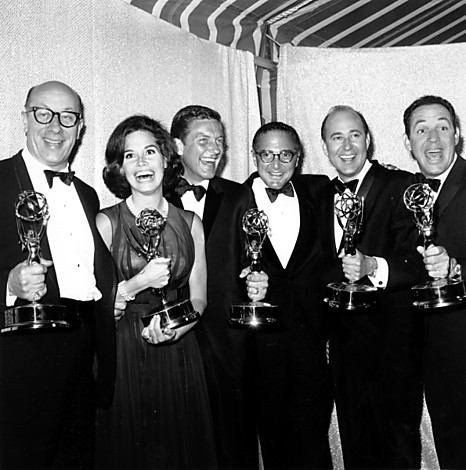
Part way through the series, he was offered another regular role, that of Mel Cooley on The Dick Van Dyke Show.  From 1961-1966, he brightened the screen in 82 shows, putting up with his brother-in-law’s bullying and Buddy Sorrel’s belittling. Deacon had high praise for everyone connected with The Dick Van Dyke Show.

One day Morey Amsterdam was goofing around with Richard and said he didn’t think his hair had fallen out, he thought it had imploded and fallen into his brain, clouding his thinking.  Carl Reiner came running on the set and said to add that dialogue to the show.  From then on, there was an insult fest between Buddy Sorrell and Mel Cooley. When the writers were trying to come up with a comeback from Mel to Buddy, Reiner asked Deacon how he would respond to someone who continued to torment him.  Deacon replied, “Yeecchh!” and his trademark phrase was invented.

deacon9

Bud Molin, Dick Van Dyke Show film editor described Deacon as “the funniest human being on the face of the earth.” Carl Reiner said it was a joy to have him around and everyone on the show loved him.

Deacon, Leonard, Reiner, Paris

The Dick Van Dyke Show was one of the best shows ever written. It won the Outstanding Comedy Emmy in 1963, 1964, and 1966. After the cast of the Dick Van Dyke Show decided to end the show on its own terms, leaving the air with its quality reputation intact, Deacon was offered another sixties role.

Phyllis Diller had a fantastic cast on her show, The Pruitts of South Hampton, or The Phyllis Diller Show as it became known in syndication. This was about a formerly wealthy family who found out they owed $10,000,000 in back taxes.  They try to appear that they still have their wealth, while living in very reduced circumstances.  The cast included Louis Nye, John Astin, Reginald Gardiner, Paul Lynde, Gypsy Rose Lee, Billy De Wolfe, John McGiver, and Marty Ingels in addition to Diller and Deacon.  I don’t know how this show did not succeed, but it was taken off the air after only one year. Diller and Deacon continued to work together both on an episode of Love, American Style and in the production of Hello Dolly in the 1969-1970 season.

deacon14

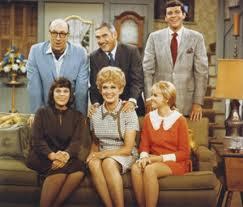
Once the Diller show was canceled, Deacon was offered a role on The Mothers-In-Law starring Kaye Ballard and Eve Arden. Deacon took over the role of Roger Buell mid-way through the series. The concept was two families who didn’t necessarily get along were neighbors whose children  married so they had to find ways to get along and keep the peace.

deacon4

After the show was cancelled, he continued to stay busy with his acting career.  He also appeared in 17 episodes of Match Game and several Family Feud episodes.

deacon7

Deacon was a life-long bachelor.  He was a closeted gay man who had to keep his sexual orientation secret to keep his options open to work for companies like Disney. He was also a gourmet chef.  In the 1980s, he hosted a Canadian cooking show about microwave cooking, writing a book that sold almost two million copies. He spent a lot of his spare time working with SYNANON, an agency that helped teenage drug addicts.

On the night of August 8, 1984, he was suffered a heart attack in his Beverly Hills home. He was rushed to Cedars Sinai Hospital, where he died later that night. He was 63 years old.

deacon15 - Copy

Everything I read about Richard Deacon painted him as a gracious, friendly, very funny man who was caring and kind.  He had an amazing career, with 180 acting credits within a 30-year period.  The legacy he left was a rich and full acting life. Pretty good for a guy who chose to be a character actor and was humble enough to turn down two offers to star in his own show.

The Friendship and Careers of Fred Gwynne and Al Lewis

Fred Gwynne was born in New York in July of 1926 and died in Maryland in 1993.  Al Lewis was born in New York in April of 1923 and passed away in New York in February of 2006. At first glance, they don’t seem to have a lot in common, but a closer look reveals why they enjoyed a long friendship.

Fred Gwynne

Fred Gwynne grew up in New York and had a very wealthy and advantaged upbringing.  He was a radioman in the Navy during World War II.  When the war was over, Gwynne entered Harvard, studying drawing and dramatics. He became a member of their Hasty Pudding Club, being involved with many theatrical productions. Gwynne graduated in 1951 and went on to work for a Shakespeare repertory company. He was a talented man with a variety of interests and earned his living from several careers.  He was a copywriter, a musician, a book illustrator, and a commercial artist.

gwynne2

In 1952, he made his Broadway debut, acting with Helen Hayes in “Mrs. McThing.” The play ran for 320 performances.  In 1953, he performed in his second Broadway play, “The Frogs of Spring” which had a much shorter run.  In 1954, he had a small role in On the Waterfront with Marlon Brando.

He also began appearing on television in the 1950s, and most of his roles were on dramas such as Kraft Theater or DuPont Show of the Week.

The one exception was The Phil Silvers Show where he appeared in 1955 and 1956. The producer of this show, Nat Hiken, went on to create a similar show called Car 54 Where Are You? about New York policemen.  He cast Gwynne as one of the leads, Francis Muldoon. The show ran for two seasons and when it was cancelled, Gwynne went back to his theatrical dramas.

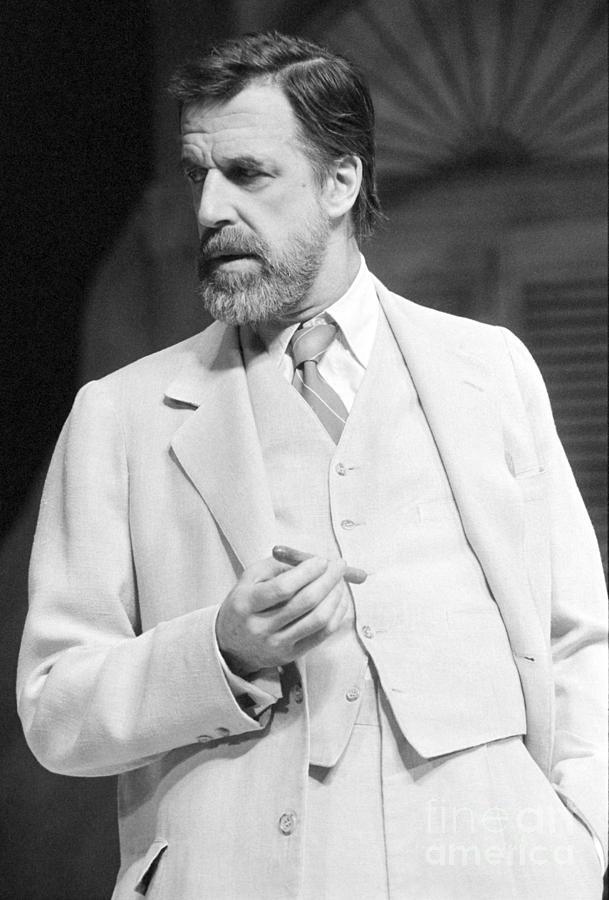
In 1964, the creators of Leave It to Beaver, decided on a different concept for a show called The Munsters.  Fred was cast as the lead role.  While this show also ran two years, the part of Herman Munster was much harder to overcome than Francis Muldoon had been.  Gwynne struggled to find new roles, and when he was unsuccessful, he went back to Broadway.  He did make one pilot during these years for a show called Guess What I Did Today, but no network picked it up. His favorite Broadway performance was Big Daddy in 1974 when he starred in “Cat On a Hot Tin Roof.”

gwynne7bigdaddy

During the 1980s, his cinema career picked up and he ended up with 15 movies to his credit from 1979-1992. Included in this list are The Cotton Club, The Secret of My Success, Fatal Attraction, Ironweed, Pet Sematary, and My Cousin Vinny.

His book writing and illustrating also continued.  His first book, The Best in Show, was published in 1958.  The King Who Rained came out in 1970, and Simon and Schuster published A Chocolate Moose for Dinner in 1976 and A Little Pigeon Toad in 1988.

Throughout most of his career, Gwynne lived a quiet life far from Hollywood. He was married to his first wife Roxy from 1952-1980 and his second wife from 1981 until his death from pancreatic cancer in 1993.

Al Lewis

Al Lewis claimed he was born in 1910 and was a circus performer in the 1920s.  He also said he went to Columbia and graduated with a PhD in child psychology.  After he passed away, his son confirmed that he was born in 1923, and Columbia had no record of him attending school with his given name or his stage name.  His son thought he made himself older to get the role of Grandpa in The Munsters because in real life Yvonne DeCarlo was a year older than he was.

Some of his other jobs included a salesman,  hot dog vendor for the Brooklyn Dodgers, waiter, pool room owner, and store detective.  He was a good basketball player in high school and apparently worked as a basketball scout at some time in his early life. A friend convinced him to join an actor’s workshop in 1949 and that led to a career in vaudeville. In the 1950s and 1960s, he appeared in a variety of TV shows including US Steel Hour, Route 66, Lost in Space, and Gomer Pyle.  He too was cast in the Phil Silvers Show which later resulted in his role of Patrolman Leo Schnauzer in Car 54 Where Are You?

lewis8

In 1964, he too was offered a role in The Munsters. In 1966 when the show went off the air, he continued making television appearances and starred in cinema movies.  During the 1970s and 1980s, he appeared on Night Gallery, Green Acres, Love American Style, Here’s Lucy, Taxi, and Best of the West.  His career featured 22 films including They Shoot Horses Don’t They, Boatniks, Used Cars, Married to the Mob, and a remake of Car 54 Where Are You?

lewis5shoothorses

Like Gwynne, he was married twice:  to Marge from 1956-1977 and to Karen from 1984 until his death from heart complications in 2006. Lewis also published several children’s books during his acting career.

Midway through his career he opened an Italian restaurant, Grandpa’s Bella Gente, which Gwynne designed the logo for. He also got into radio and was featured on Howard Stern’s Show often.

lewis6

It is surprising that both of these stars were in two sitcoms which both lasted only two years. Let’s take a look at the shows that made them household names.

Car 54 Where Are You?

gwynnelewis4

This sitcom, set in the 53rd precinct in Brooklyn was an early Barney Miller. Gwynne played Francis Muldoon.  His partner, Gunther Toody, was his exact opposite.  While Muldoon was a bachelor, an intellectual, calm and quiet, Toody was married, naïve, excitable, and talkative. In one show, when the precinct is debating splitting up the two men, Muldoon says “I guess most of the men are smarter than Gunther and less trouble than Gunther, but  . . . well, I’m so used to Gunther.  When he chatters away, the days just fly by.  I’d just be lost without Gunther.” Gunther concurs, “You mean ride around with someone next to me that’s not Muldoon? Francis is a quiet man. He doesn’t say a word. He just sits there all day thinking. It’s very comforting for a man like me to know there’s someone next to him doing the thinking for both of us.” Of course, they split them up only to partner them up again because no one else could take the silence or constant chatter.

Al Lewis played Officer Leo Schnauzer, appearing in every episode.

Policemen were split on their view of the show.  Some took offense and felt they were portrayed in a negative light, while others enjoyed it and identified with some of the comedic elements. It was filmed in The Bronx at Biograph Studio.  There was a large sign out front identifying it as the 53rd precinct till a woman came in pleading to save her from her abusive husband and the sign was quickly taken down.

Originally titled Snow Whites, the show aired at 8:30 eastern time Sunday nights between The Wide World of Disney and Bonanza.  The only clue I could find for the original name was that the show was sponsored by Proctor and Gamble who made several detergents for clothing. It was filmed in black and white, but the police cars were red and white so they would show up better on black and white film. The show also starred Beatrice Pons, Charlotte Rae, Nipsey Russell, Alice Ghostley, and Larry Storch.

Perhaps what the show is best remembered for was its catchy theme song.  Anyone who viewed an episode or two can probably remember the fun lyrics:

There’s a hold up in the Bronx, Brooklyn’s broken out in fights.

There’s a traffic jam in Harlem that’s backed up to Jackson Heights.

There’s a scout troop short a child; Kruschev’s due at Idlewild . . .

Car 54, where are you?


The Munsters

gwynnelewis1

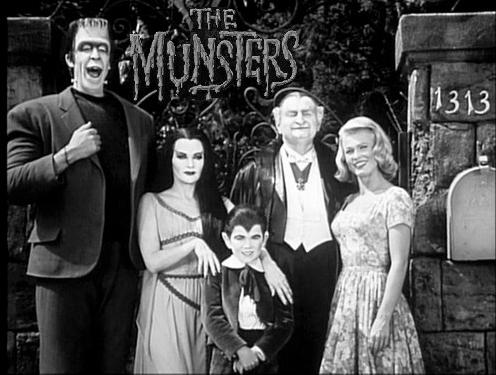
In 1964, the creators of Leave It to Beaver decided to feature another “wholesome” family who just happens to live at 1313 Mockingbird Lane in Mockingbird Heights. The family consists of Grandpa who is always experimenting in his lab; Herman who is the funeral director at Gateman, Goodbury, and Graves; his wife Lilly, a vampire; their son Eddie who is a werewolf; and their beautiful black-sheep Marilyn.  Marilyn was beautiful but they viewed her as odd looking and she seemed to get a lot of dates but when she brings them home, they never ask her out again. The family also owns two pets – Spot, a prehistoric animal Grandpa rescued and Igor, a bat.  They lived a somewhat normal life but drank bat milk and cooked in a cauldron. On the hour, a cuckoo clock chimed and a raven, voiced by Mel Blanc, appeared and said “Nevermore.”

gwynne4

All the actors had to endure a two-hour make-up session, but Gwynne had the worst time because he had to wear 40-50 pounds of padding.  One day he lost 10 pounds filming under the lights.  They gave him gallons of lemonade between takes and later rigged a way to blow cool air on him underneath the material.

The entire family could have been played by different actors.  John Carradine was offered the role of Herman. The pilot featured Joan Marshall as the wife and instead of Lilly, her name was Phoebe. Marilyn was played by Beverly Owens for 13 episodes and then Pat Priest took over for the rest of the show’s run. Eddie was first offered to Bill Mumy, Will Robinson from Lost in Space, and Grandpa to Bert Lahr from The Wizard of Oz.

After the show was cancelled, the Munster mobile often traveled to memorabilia shows.  There was also a Dragula built with purple silk upholstery and chrome pipes for the exhaust. Although the show was only on the air for two years, there were a lot of collectibles such as board games, lunch boxes, paper dolls, and coloring books.

gwynnelewis6

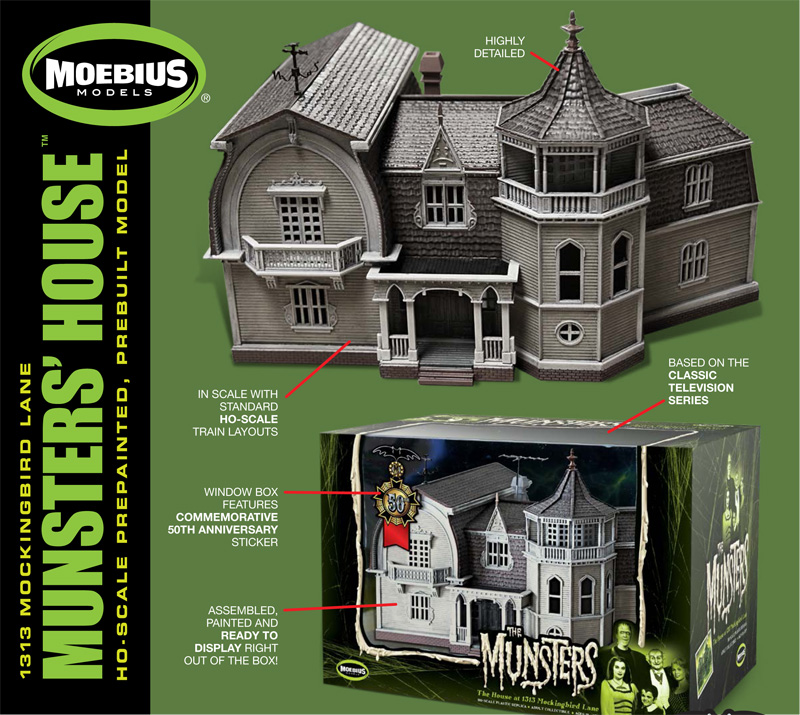
In 2001, the McKee family of Waxahachie, Texas was such a huge fan of the show that the family built their 5000+ square foot house to exactly resemble the Munsters’ home including the crooked weather vane and grand staircase that lifted up to feed Spot.

Both Gwynne and Lewis were born in New York.  They both appeared on the show Brenner early in their careers. Both were tapped from their roles in The Phil Silvers Show to play roles on Car 54 Where Are You? They both went on to star in The Munsters.  Neither of them ever had another series.  They both chose to live on the east coast. They both wrote children’s books.  They were each married twice and married to their second spouse for the rest of their lives. They both had a lot of success in the movies as well as television. They were both men with fascinating careers before they ever entered acting.  I learned a lot about these interesting friends.  Happy Birthday to Fred Gwynne would have been 91.