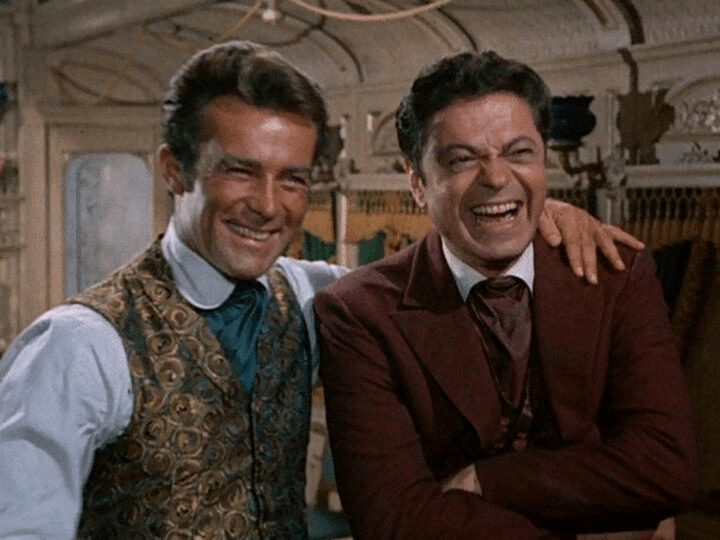
Sandra Gould: What a Character

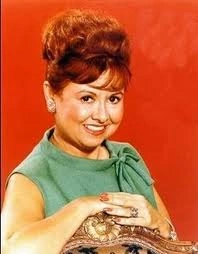
We are winding up our blog series “What a Character” with Sandra Gould. I have to be honest, I had an unfair bias against Sandra Gould.  I didn’t know a lot about her career, I just knew that she replaced Alice Pearce as Gladys Kravitz, and it was a bad replacement. It wasn’t Sandra’s fault—I blame the show’s producers.

📷pinterest.com

Some actors truly are irreplaceable. Eartha Kitt, while a great Cat Woman, just wasn’t Julie Newmar. Imagine trying to replace Henry Winkler as the Fonz halfway into the show. Can you picture tuning into MASH and finding Hawkeye was now played by someone other than Alan Alda?  Pearce was perfect in that role and, despite her being nosy and annoying, she was likable and that is hard to do. Gould’s Gladys was loud and brash, and I felt like I heard fingernails on a chalkboard whenever she was in a scene.

As long as I’m oversharing, I never cared for Dick Sargent either. While he was able to replace Dick York in some ways, York was just Darrin. Okay, I’m done and ready to talk about the good aspects of Sandra Gould and her long career.

Gould was born in Brooklyn in 1916. She entered the entertainment business early becoming a kid dancer in the Cat Skills by age 13.

📷threads.com

Gould found a lot of success on radio, appearing on “My Friend Irma” and “Duffy’s Tavern.” Her first radio job came along when she was only 9 on “The Danny Thomas Show.” Gould was with Jack Benny for almost fifteen years.

In 1938 she married Larry Berns, a broadcasting executive. They were married until his death in 1965. Berns joined CBS in 1942 writing and producing radio and TV series including Our Miss Brooks. He later worked on McHale’s Navy and Broadside.

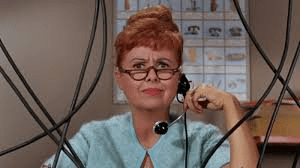
Sandra’s first role was in the big screen T-Men in 1947. Most of her roles were inept or gabby women, typically a telephone operator, nurse, receptionist, landlady, or saleswoman. Gould once mentioned that she played an operator more than any other actress. I did notice 10-15% of her roles mentioned switchboard operators.

📷facebook.com

While she continued to appear in movies, most of her acting credits came on television. She appeared in Oboler Comedy Theater in 1949. In the early days of television, many of the series were drama or comedy reenactments of movies or plays. Sometimes, new stories were written for these episodes. Gould continued with these roles into the mid-fifties.

From 1952-55 she appeared as Mildred on I Married Joan. This series starred Joan Davis and Jim Backus. He was a judge, and she was another “Lucy Ricardo” always getting into mischief or causing hardships for her husband.

📷tumblr.com

Gould was kept very busy with offers during the end of the fifties and throughout the sixties. She could be seen doing comedy on Our Miss Brooks, I Love Lucy, The Jack Benny Program, My Three Sons, The Brady Bunch, and I Dream of Jeannie among others. She also tried western life on Wagon Train. Her drama performances included Hawaiian Eye and I Spy. She even dipped her toe into animation on The Flintstones.

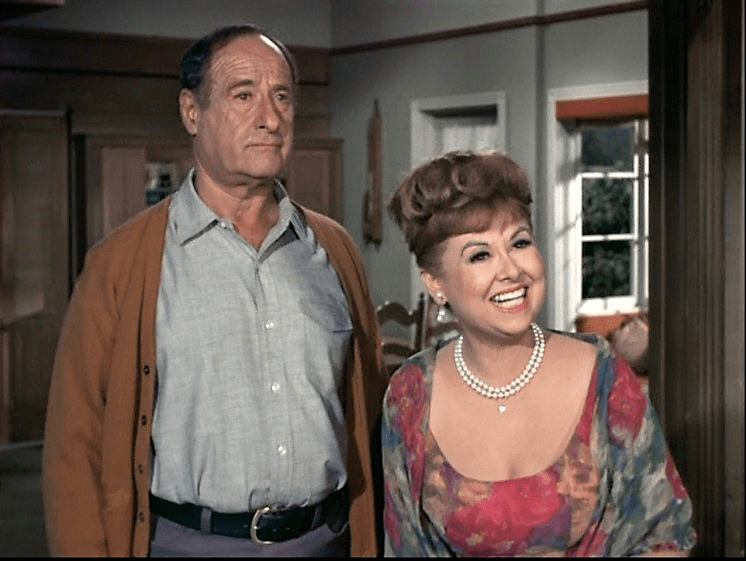
At the end of the sixties, she was given the Glady Kravitz role. Pearce and Gould split the character’s appearances: Pearce had 27 episodes with Gould having 29.

Gould had stepped away from acting for a time. She published two books for girls: Always Say Maybe and Sexpots and Pans. They both seem quite dated today in their advice to girls to get the right type of husband. At the time she accepted the role of Gladys she said she had gone through a very rough year. Her husband died. Then her writing partner Peter Barry died. Then Alice Pearce, who was a good friend of hers. She had no desire to take over the role, but George Tobias who played Abner and was also a friend, called her to come in for an audition.

📷imdb.com

I could not find any information about she and Barry collaborating. One article specifically mentioned that they wrote scripts for Honey West, Tammy, and The John Forsythe Show, but I don’t see either of their names as writers for these shows. Barry is listed as a writer for 23 shows in the late fifties and early sixties, and he was a radio scriptwriter. Perhaps they had written some scripts that were never filmed.

I guess I am in the minority on the Bewitched issue because most sites I visited described her role similarly, usually something like Hollywood Spotlight’s description: “her over-the-top performance and shrill voice were popular with viewers, and she succeeded ultimately in making the character her own.” She also reprised her role as Gladys in the sitcom Tabitha in 1977 which was about Darrin and Samantha’s daughter as an adult.

Some time during her stint on Bewitched, she got married again to Hollingsworth Morse, and they were together until his death in 1988. Hollingsworth was a director and assistant director on almost 90 programs and movies including McHale’s Navy, Dukes of Hazzard, and Mork and Mindy.

The seventies and eighties found her primarily in drama roles, although she could be spotted in a handful of sitcoms. You can catch her on Columbo, Marcus Welby MD, Ironside, Crazy Like a Fox, and MacGyver. During the nineties, she took on roles that were described as “old lady” on Friends and on her last appearance which was Boy Meets World in 1999.

📷bewitched wiki.com

Not long after filming this episode, Gould passed away from a stroke following heart surgery.

Gould had a long and successful career and certainly made the nosy, gabby character her own. I’m glad the job on Bewitched helped her get through a very sad and difficult time in her life. However, I still am claiming she was not right for Gladys who should have been written off the show and just replaced with a new neighbor. But I respect Gould and the characters she made her own on the big and little screens.

77 Sunset Strip: A Bit Kookie

As we continue with our “Favorite Crime Solvers of the Past,” we turn to 77 Sunset Strip. Even if you never watched the show, you might be familiar with the theme song where they snapped and kept repeating “77 Sunset Strip.”

📷facebook.com

Created by Roy Huggins, the show debuted on ABC in 1958 and ran until spring of 1964. This was the third appearance by Detective Stuart Bailey. In 1946, Huggins’ novel, The Double Take, was published. In 1948, Bailey stepped into the big screen, starring in I Love Trouble played by Franchot Tone. A decade later he showed up on television played by Efrem Zimbalist Jr.

Bailey, a former WWII secret agent and foreign languages professor, works with former government agent Jeff Spencer (Roger Smith). Their office is at 77 Sunset Strip, Suites 101 and 102. Suite 103 is occupied by Suzanne Fabry (Jacqueline Beer), a French switchboard operator who handles phones for several clients including Bailey and Spencer. Occasionally she helps them solve a crime.

Other characters come and go from the offices including Roscoe (Louis Quinn), who gives out horse-racing tips when he’s not at the track; he often is an operative for the duo.

📷allposters.com

Gerald “Kookie” Kookson (Ed Byrnes) is a bit of a kook. He loves rock and roll, is witty, appreciates looking good, and works as a valet at the club next door. But he wants to be a private detective and makes full partner during the show. Kookie provides some comedy with his slang like “ginchiest” for coolest or “piling up Zs” for sleeping. During season 2, Byrnes asked for more money with his character expanding his role, but the answer was a firm no, so he left the show. Warner Brothers eventually settled with him, and he returned in May of that year.

Other occasional visitors include Lt. Roy Gilmore (Byron Keith) and the Frank Ortega Trio (played by themselves), a jazz band, who perform next door. They recorded for Warner Brothers who was also behind the television show.

The show had a fun, witty edge to it making it interesting to watch the interactions of the characters in addition to the crime solving. Bailey and Spencer were updated versions of forties’ noir detectives. Some of the shows had very different plots, something like the shows Moonlighting would feature a few decades later. “The Silent Caper” had no dialogue and, in another one, Bailey finds himself in a ghost town and he’s the only main character in the episode. During the last season in “The Target,” roles were played by crew members who were usually behind the camera including director William Conrad, associate producer James Lydon, and writer Tony Barrett.

Guest stars were plentiful and included Robert Conrad, Dyan Cannon, Cloris Leachman, Shirley MacLaine, Elizabeth Montgomery, Mary Tyler Moore, Roger Moore, William Shatner, Marlo Thomas, Robert Vaughn, and Adam West.

📷starstills.com

Mack David and Jerry Livingston wrote the famous theme which became a top 10 hit on the Billboard chart. The duo worked on several other Warner Brothers crime shows including Surfside Six, Bourbon Street Beat, and Hawaiian Eye, all based on the 77 Sunset Strip formula and exotic location.

By 1963, ratings were declining and the show revamped. If you read my blog often, you realize this is one of my pet peeves. If they want to change the casts, I understand that. However, in this one, like so often, Bailey is suddenly working alone and there is no mention made of any of the other characters, just as if they never existed. They did this on Happy Days, The Doris Day Show, and several other popular series.

In addition to booting the cast, Jack Webb was brought in as executive producer and William Conrad as director. And if the name William Conrad sounds familiar, yes, it is the same person as the man who starred on Cannon. During the fifties and sixties, Conrad racked up 32 directing credits.

Bailey is now a solo investigator. The title didn’t change, but the old office is no longer there nor the club nor the theme song. A new one written by Bob Thompson was used, and the show took on a darker, more serious nature. Bailey gets a secretary named Hannah who we rarely see.

📷ebay.com

The show was on Fridays for its entire run, just switching time slots now and then. By season two it was in the top ten. In seasons three through five, it got its biggest competition from Route 66, which it beat in the ratings. The final season, the show got moved to a later slot, going up against The Alfred Hitchcock Hour but, neither of them were in the top thirty.

Big surprise, viewers weren’t fans of the changes or the more serious tone of the show, and they drifted away. The show was cancelled in February. Efrem Zimbalist Jr. moved over to the FBI. Roy Huggins had a hugely successful career. He would write for and create more top shows including Run for Your Life, Maverick, Alias Smith and Jones, The Rockford Files, and The Fugitive. Viewers at least got the satisfaction of knowing that making such drastic changes to the show caused the end of that story. Stream a few of the early seasons on Philo, Roku, or Pluto TV and let me know what you think.

What Do I Spy with my Hawaiian Eye?

Welcome to this month’s blog series, “Crime Solvers of the Past.” Before there was Hawaii Five-0 or Magnum PI, there was Hawaiian Eye.

📷wikipedia.com

Warner Brothers was looking for possible television series to create. They sent one of their story editors, Jack Emanuel, to Hawaii to get some inspiration for a crime series, and Hawaiian Eye was born.

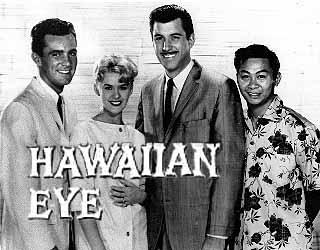
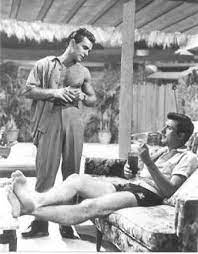
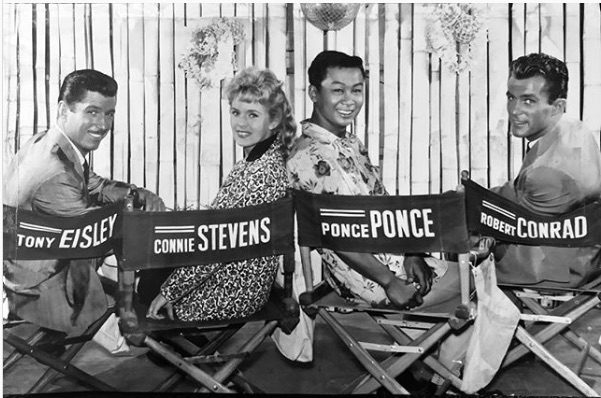
The show debuted on ABC in the fall of 1959 and continued until April 1963. Like the above-mentioned shows, this one also features a partnership. Tom Lopaka (Robert Conrad) and Tracy Steele (Anthony Eisley) own a detective agency that also provides security services, and it’s called Hawaiian Eye. The Hawaiian Village Hotel is one of their biggest clients and they provide an office/living space for the firm. Rounding out the cast was Cricket Blake (Connie Stevens), a local photographer and singer who helps the guys out; Kim Quisado (Poncie Ponce), a cab driver who plays the ukelele; Greg McKenzie (Grant Williams), a former engineer who helps out and later joins the firm, and Philip Barton (Troy Donahue), the hotel social director. Lt. Danny Quon (Mel Prestidge) also shows up off and on when the boys need help from the local police force.

Sprinkled among the 134 episodes, you’ll find lots of great character actors and guest stars popping up.

📷facebook.com

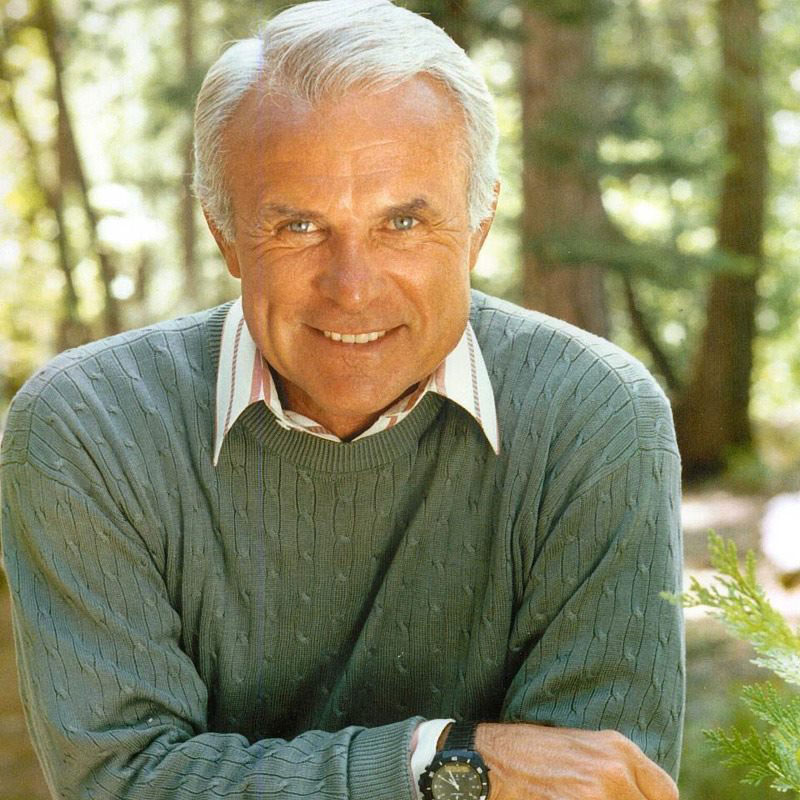
Robert Wagner was originally chosen for Lopaka, but he turned it down to continue his movie work. Warner Brothers produced this one, so there was a bit more feel of a movie set.

Ponce was the only cast member actually born in Hawaii, and when the show aired, his entire hometown shut down in order to watch their local boy. Ponce only ended up with 8 acting credits, one in Speedway with Elvis Presley. Most of his career was spent in the music side of the entertainment business singing and playing. While he played a uke on the show, in his personal life this talented guy also played piano, trumpet, sax, and harmonica. In fact, he was seen by William Orr, head of Warner Brothers as a singing waiter. Orr was so impressed he signed him for the show. However, he was not as impressed with his waiting abilities, so he became a cab driver!

Connie Stevens also started and ended her career in the music business. She was part of a cast for three television shows but garnered 72 acting credits during her career.

📷fanpix.net

The opening of the show was a voiced over with a narrator introducing the cast who is frolicking around in the water and on the beach. In the background a chorus sings “Hawaiian Eye” repeatedly.

The plots seem fun for the time. The duo helped a woman who thinks her husband is trying to kill her, chased down a former spy, investigated hotel crime, and there is a bit of a Love Boat feel to the show where one of the partners falls in love, and lots of women are strolling around the island.

It was not shot in Hawaii but in Burbank, in black and white film; the fact that it often takes place at the hotel, it’s not noticeable we’re not on the Island. It’s just missing the lush scenery the later series feature.

📷tvtime.com

The show aired Wednesday nights with its primary competition The Perry Como Show and I’ve Got a Secret which were top thirty shows the first season but had fallen out of the top thirty by season two, so maybe Hawaiian Eye gained some of their viewers. Season three, in addition to Perry Como, the show was up against The Dick Van Dyke Show. For its final season, it moved to Tuesday nights and was on at the same time as The Red Skelton Show and The Jack Benny Show which were in the top twenty and ten respectively. That seemed to end any hopes the show had to continue, and it was cancelled.

Unfortunately, I can’t find anywhere the DVD set was released but there are streaming services with it and a few private sellers with sketchy quality. If you enjoyed Hawaii Five-0 or Magnum, check out some of the episodes on YouTube. From everything I could find, the show had a great cast with a lot of chemistry, some interesting music performances, comic relief from Ponce, and good writing, everything you want to see in a popular series.

My Sister Eileen: Version Five

As we look at a few little-remembered shows from the past, today we are learning about My Sister Eileen. The series was adapted from short stories by Ruth McKenney published in The New Yorker. The stories became a book in 1938, a play in 1940 and two movies in 1942 and 1955.

📷wikipedia.com

In the 1955 Hollywood movie, two small-town sisters — an aspiring writer, Ruth (Betty Garrett), and a would-be actress, Eileen (Janet Leigh) — move to New York City. They find lodging in a shabby apartment and struggle to locate promising gigs. Ruth eventually meets magazine editor Bob Baker (Jack Lemmon), who tells her to write about her life experiences rather than fiction. As it turns out, Eileen’s life, with her various romantic encounters, is far more interesting, so Ruth steals the stories for herself.

This show joined the television schedule in 1960 and featured Elaine Stritch and Shirley Bonne (Ruth and Eileen Sherwood), who move to New York City. Like the movie, one is a writer and one is an actress. Living in a Greenwich brownstone, they become friends with a reporter Chick Adams (Jack Weston) and Ruth’s coworker Bertha (Rose Marie). Rounding out the cast is Eileen’s agent Marty Scott  (Stubby Kaye), their landlord Mr. Appopoplous (Leon Belasco), Ruth’s boss D.X. Beaumont (Raymond Bailey), and their Aunt Harriet (Agnes Moorehead). The sisters are stereotyped with Ruth being the smart, plain one and Eileen being the beautiful and naïve one.

The pilot was seen on the Alcoa-Goodyear Theater with Anne Helm portraying Eileen.

Earl Hagen who composed “The Fishing Hole” for The Andy Griffith Show composed this theme as well.

📷imdb.com Rose Marie on the show

Rose Marie talked about being on this sitcom for the Television Academy. She said she was friends with the producer Dick Wesson. She said her character Bertha was a wise-cracking one similar to Sally on The Dick Van Dyke Show. Rose Marie didn’t like working with Elaine Stritch. She felt she was not very professional on this show; she said she came to work late and goofed off a lot.

In 1960 it appeared on the schedule on CBS opposite Hawaiian Eye and Perry Como’s Kraft Music Hall. Hawaiian Eye was on the air four years, and this was it’s second season. With Connie Stevens, Robert Conrad and Poncie Ponce, it was about two private investigators in Hawaii, a Korean war vet and a former police detective.

I don’t think the writing helped the show stay on the air too long. During the first season some of the plots included: Ruth’s boss ignores her pleas for a pay increase until he encounters her working as a waitress in a German restaurant — and in a skimpy costume and the Sherwood sisters decide to break their lease with a wild party to which they invite a one-man band, a junior Tarzan, and a fireman with his siren.

📷moviesanywhere.com 1955 film version

I’m guessing part of the problem was that it had appeared in so many versions already. Many people read the book. Lots of people saw one, if not two, of the movies. And the play was being featured around the country. I can see that having a television series which has to expand the hour-and-a-half play and film might not have enough material to draw out the same old plot and keep it interesting for more than a few episodes.

This one is another one that you’re probably better off watching the 1955 silver screen adaptation and skipping the television series.

Robert Conrad: Go West Young Man

We are in the midst of getting up close and personal with some of our favorite television stars. Up today is Robert Conrad. Conrad was born Conrad Robert Falk in 1935 in Chicago. His parents were practically kids themselves when he was born at 17 and 15. His mother, Alice Hartman, was later the first publicity director for Mercury Records when she went by the name Jackie Smith. After divorcing Robert’s father, she later married Eddie Hubbard, a Chicago radio personality in 1948. They gave Robert one sibling before divorcing in 1958.

Photo: people.com

Conrad grew up in Chicago. He dropped out of school at age 15 to work for Consolidated Freightways and later was a milk truck driver for Bowman Dairy.

He studied theater arts at Northwestern University and then decided to pursue an acting career. He also studied singing with Dick Marx.

When he was 25 he met actor Nick Adams while visiting James Dean’s gravesite in Indiana. Adams had been a friend of James, and he talked Robert into moving to California for his acting career. (Adams died from an overdose in 1968.)

Adams was able to secure Bob a small part in the movie Juvenile Jungle which enabled him to join the Screen Actors Guild. Conrad continued to receive movie offers throughout his career, with his last role being in 2002 in Dead Above Ground.

In 1952 he eloped with Joan Kenlay. They had five children.

During the late fifties, Warner Brothers signed Conrad to an acting contract. He also worked in their recording division, releasing several versions including LPS, EPs, 33 1/3, and 45 rpm records. In 1961, he made the Billboard charts with Bye Bye Baby which hit 113.

In 1959, he made his television debut on Bat Masterson. He would appear in nine different series in 1959.

Photo: imdb.com

Warner Brothers created a detective show, 77 Sunset Strip. Conrad appeared on the show as detective Tom Lopaka. After appearing on four episodes, he was offered his own series, Hawaiian Eye which was on the air for four years. Set in Hawaii, this series featured Conrad as Thomas Jefferson Lopaka and his partner Tracy Steele, a Korean war vet and former city police detective played by Anthony Eisley. Their office was located at a swanky hotel where they were also the house detectives. Connie Stevens completed the trio as a scatterbrained nightclub singer and photographer Cricket Blake.

Photo: mortystv.com

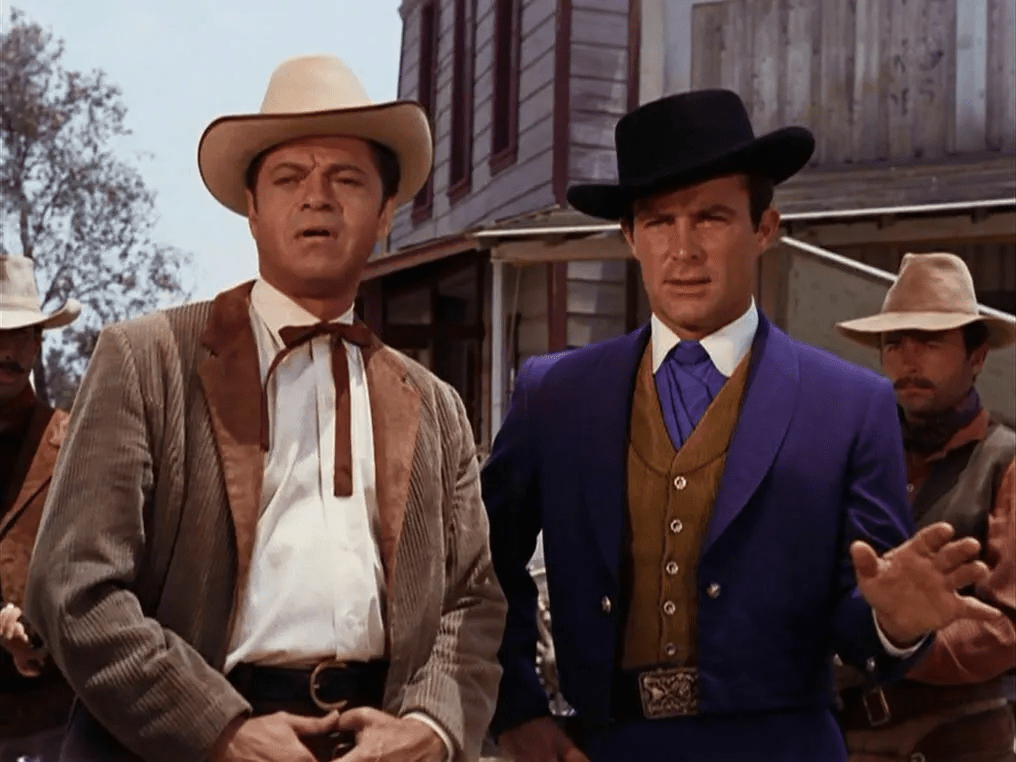
After the show went off the air, Conrad continued with several movies and television appearances until he received word in 1965 that he had been cast as government agent James West on the Wild Wild West with Ross Martin as his partner Artemus Gordon. For five seasons, the two agents worked together to solve cases primarily in the western region of the United States, often reporting to President Ulysses S Grant for their assignments. Conrad made $5000 a week for this show; it doesn’t sound like a lot today, but it was quite an increase from the $300 he made a week on Hawaiian Eye. Robert performed almost all of his own stunts on the show and was inducted into the Stuntman’s Hall of Fame.

Photo: pinterest.com

Later Conrad said he didn’t like that his character didn’t really act; it was just physical confrontation and stunts. He said he and stuntman Whitey Ford choreographed the fights. Although that made him unhappy, he enjoyed his time on the show because he loved working with Martin.

Conrad took on several television and movie roles for two years until he was offered another sitcom offer to star in The DA where he played LA District Attorney Paul Ryan. The show only lasted one season, but then he went directly into Assignment: Vienna where he played a rugged American spy Jake Webster. Unfortunately, this show only lasted eight episodes.

Photo: ebay.com Cast of Baa Baa Black Sheep

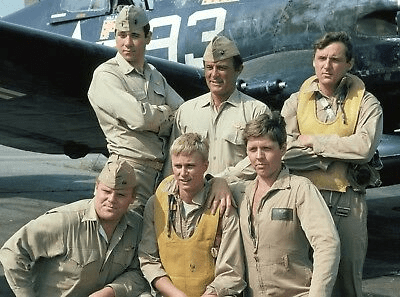
After this short-lived series, Conrad waited four years to try his hand at television again. From 1976-78, he took on the role of tough-guy ace pilot, Pappy Boyington in Baa Baa Black Sheep. Pappy led the US Marine Attack Squadron 214, a group of “black sheep” pilots who were not as committed to the Marines as they were having a good time. However, they were great at their job and desperately needed in World War II. Conrad directed three of the shows.

During the run of this show, Robert and Joan divorced after 25 years of marriage.

For the next fifteen years, Robert bounced back and forth between television appearances and movies. While he showed up on the big screen, television movies were where he earned most of his money between 1979-1995.

He would attempt to star in five additional series, none of which were very successful. In 1979, he was the star of The Duke about an ex-boxer Duke Ramsey who becomes a private investigator in Chicago. After only three episodes, the refs called the match. I’m guessing Conrad did his own boxing in this show because he was a semi-professional boxer and had an undefeated record of 4-0-1.

That same year he went on to star in A Man Called Sloane. Sloane is a freelance spy who often accepts assignments from a secret government agency. He must have had to go into hiding quickly because he was off the air after twelve episodes.

In 1983, Conrad married again. He and LaVelda Fann were married from 1983-2010.

In 1987 he joined High Mountain Rangers as Jesse Hawkes. Hawke led his family on adventures in the wilderness where he was employed in law enforcement and rescue. No one requested a baker’s dozen, so after twelve episodes, he was done again. The following year his series lasted half as long, six episodes only, when he played Jesse Hawkes once again, but on this version, he and his sons fight crime in San Francisco. Sticking with the same theme, in 1995 he became Griffin Campbell on High Sierra Search and Rescue, leading volunteers in a remote mountain town in dangerous rescue missions. Again, after six episodes, he was done.

While none of these shows could find an audience, there was some realism in the roles because Conrad was a deputy sheriff for eight years or so in Bear Valley, California where he lived.

For the last few years of his career, he took on various tv and movie roles. His last television role was in 2000 on Nash Bridges.

Photo: mortystv.com

After 2000, he managed to stay busy with a variety of projects. He ran for President of the Screen Actors Guild in 2005. In 2006 he provided introductory material for the DVD set of The Wild Wild West. He began hosting a weekly national radio show called The PM Show with Robert Conrad on DRN Digital Talk Radio.

In 2020, Conrad died from heart failure. He was 84.

It would have been interesting to see what Conrad’s career would have looked like if he had received some different types of roles. He did test for the role of Anthony Nelson on I Dream of Jeannie and was offered the role of Hannibal Smith on The A-Team but turned it down to pursue his own projects. I would have liked to see him in a comedy role.

The Joey Bishop Show: Versions 1, 2, 3, and 4!

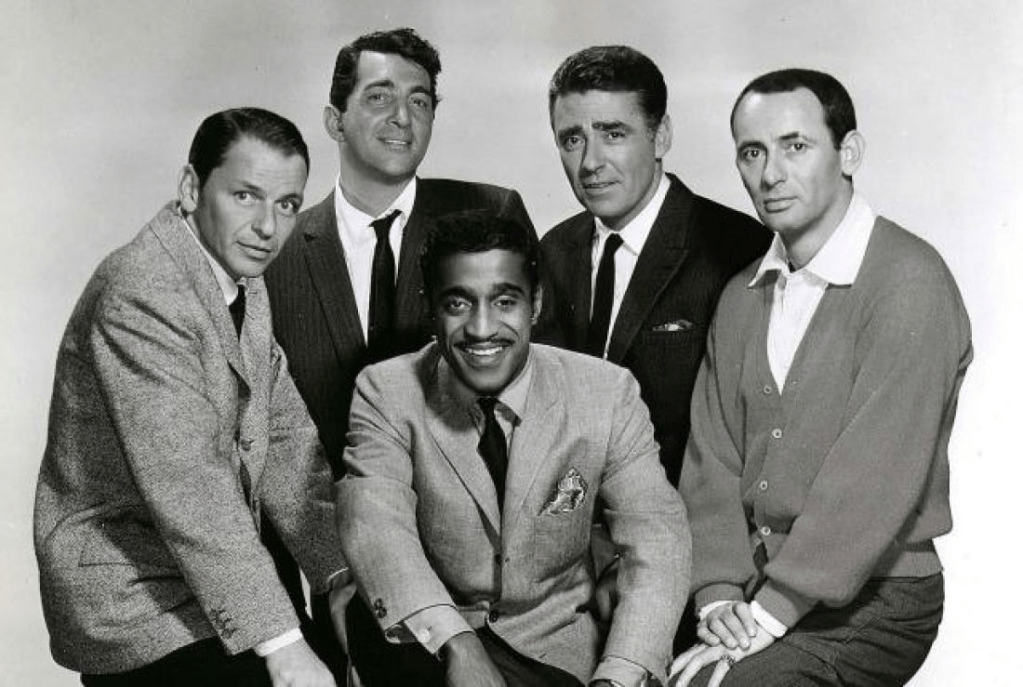
Although the Rat Pack have all passed on, their influence still surrounds us. We can listen to Frank Sinatra’s music channel on Sirius. Jerry Lewis and Dean Martin movies still play late at night. Sammy Davis Jr. and Peter Lawford can both be seen on a variety of sitcom reruns. One member we don’t see as often is Joey Bishop. While he is not as well known as the other friends, he actually was the only one of the group who starred in his own sitcom.

Photo: mentalfloss.com

Two series went by the name “The Joey Bishop Show.” One was a sitcom and aired from 1961-1965, producing 125 episodes. For most of the run, Joey played a talk show host named Joey Barnes. The other show was an actual talk show that he hosted which ran from 1967-1969 and produced 682 episodes.

Photo: amazon.com

This blog looks at the sitcom created by Danny Thomas and Louis F. Edelman specifically for Joey Bishop. Danny served as executive producer, and the show was filmed at Desilu Studios before a live audience. When it debuted in 1961, it was filmed in black and white. One episode was shot in color and then the second and third seasons followed suit. NBC canceled the show after season three and CBS picked it up but filmed that season in black and white again. I imagine fans of the show weren’t happy to go from color to gray tones again; it would be like visiting Oz and then being sent back to Kansas.

Photo: tumblr.com
Version 2

Like The Andy Griffith Show, the pilot was an episode of the Danny Thomas Show. Joey played Joey Mason who was an incompetent public relations staffer. Danny arrives in Los Angeles exhausted but has no place to stay and is forced to sleep at Joey’s house with his parents and his two sisters, the younger one being Stella, an aspiring actress played by Marlo Thomas.

Photo: wikimedia.com

Before airing the next fall, the pilot had some revisions. Now Joey’s last name was Barnes. His father was dropped from the cast but two family members were added:  a younger brother named Larry (Warren Berlinger) and a brother-in-law Frank (Joe Flynn) who was married to Betty (Virginia Vincent), the older sister. His mother continued to be played by Madge Blake who would go on to play Aunt Harriet on Batman.

Joey continued his public relations career and supports his family. The secretary at the PR firm, Barbara (Nancy Hadley) is his girlfriend. A lot of the plots revolve around family members taking advantage of Joey’s influence which they think is significant but is really almost nonexistent.

The show didn’t do well in the ratings, so it was retooled once again. Betty, Frank, and Barbara were all dropped from the show. The series was renewed for a second season, but the show would change its format again.

Photo: newsfromme.com
Newly married

From season two on, Bishop became the host of a New York City talk show. The cast from the first season disappeared altogether in this fourth reincarnation. Abby Dalton plays Joey’s wife Ellie. The couple now live in a posh apartment building and, at the end of the second season, they have a baby boy. Hilda (Mary Treen) is the Barnes’ maid and baby nurse, and she often trades insults with Joey similar to the banter Florence and George had on The Jeffersons a decade later. The Jillsons (Joe Besser and Maxine Semon) are the superintendents of the building. Like Howard’s mother on The Big Bang, Maxine is heard but not seen. Guy Marks played Freddie, Joey’s manager.

Photo: akaguymarks.weebly.com
Version 3

There were some rumors that Joe Flynn had been let go the prior season because he was too popular; this would mean that Bishop was so insecure that he was willing to totally revamp his show to get rid of one character. That doesn’t seem to make sense. However, Cynthia Lowry’s column in The Evening Independent from September of 1963 reported that “Actor’s feuds can be very fierce. Joe Flynn, who now plays the sarcastic Captain Binghamton in McHale’s Navy still is so annoyed with The Joey Bishop Show that he doesn’t even mention it in his list of acting credits – although he included brief appearances on Hawaiian Eye, Ozzie and Harriet, and The Eddie Fisher Show. Flynn played a sharp-tongued ne’er do well brother-in-law during the first year of the Bishop comedy, a role that was swept away with a lot of others when the series was completely revamped.”

One review for the second season by Bob Thomas, AP Movie-TV Writer in the Ocala Star-Banner from August of 1962 stated:

“About the only resemblance between last season’s Joey Bishop show and the coming season’s is the name. It’s still The Joey Bishop Show, NBC having vetoed the comedian’s suggestion to call it The New Joey Bishop Show. Bishop fans may be startled to find their hero is no longer a press agent but a late-night television comic. Furthermore, he has jettisoned his mother, bless her heart, for a curvy wife. And he has acquired a whole new bunch of pals. That Joey was able to make these changes is one the minor miracles of television. Just about everyone, Joey especially, agreed that something was wrong with last season’s shows. When a series pulls a wrongo, it is usually yanked at the first sign of spring. But the series had somehow managed to best its competition on ABC and CBS and rack up an impressive rating. So, when Joey promised a clean sweep in format for the next season, NBC went along. I found Joey in the midst of his fourth show, and absolutely happy – for him. That is, he smiled every 15 minutes. I asked what went wrong the first season. ‘I showed up,’ he replied. But on a more analytical basis, he continued: ‘We did many things wrong. We didn’t have enough time to prepare. We violated a very basic concept in comedy. When you have a clever comedian -and in modesty I think I am-you surround him with funny people. When you have a funny comedian, you surround him with clever people. I made the mistake of working with clever people,’ he said. ‘Now I am working with funny people – Guy Marks, who is a bright young comedian; Joe Besser, who can get laughs just walking on stage; and Abby Dalton from the ‘Hennessy Show, a brilliant talent.’

Photo: sitcomsonline.com

Another review a few weeks later agreed: “Joey Bishop also returned to NBC – on Saturday night. This season he is more poised, more famous, and a successful established night club comedian. He also picked up a wife on the show. The first show involved one of those typical newlywed situations that television situation comedies specialize in. High point of the show, however, was an imitation by Guy Marks, who plays Joeys manager, of a flamingo. Don’t ask how they managed to get that in, but it was very funny! —-”

Photo: youtube.com
Despite the rumors, Bishop proves he’s a team player

Once again there was talk of feuding between the star and a cast member, this time Guy Marks, because he was receiving great reviews. Marks was around for the first 18 episodes and when he left, Corbett Monica came on board as Larry Corbett, Joey’s head writer.

The Montreal Gazette in January of 1963 featured an article by Dorothy Kilgallen that explained, “It’s no secret that the parting between Joey Bishop and Guy Marks was far from friendly, but no one revealed that they were close to the fisticuffs stage.” Some cast members sided with Marks. Other cast members claimed Joey was not egotistical and wanted everyone to succeed. I was not able to determine whose version was closer to the truth, but it is not surprising that the show didn’t last as long as it could have between constant cast changes and in-fighting on the set.

There were also some controversies regarding the writing on the show. In the book Sitcom Writers Talk Shop by Paula Finn, Irma and Austin Kalish who wrote for many great sitcoms in the sixties and seventies were interviewed. She asked the pair if they ever recycled stories for show. They responded no, and continued with this story:

IK: We were once writing The Joey Bishop Show, and we went in to pitch shows to the story editor.

AK: We pitched five shows to him.

IK: And he said, Those sound like good ideas, but you know, I have to pitch them to Joey first. And then our agent called and told us he got word that Joey didnt like any of those ideas. Fine.

AK: Five weeks later–week after week after week after week after week–

IK: Our ideas came on.

AK: Our ideas were stolen. Eventually that guy, the story editor on The Joey Bishop Show, came to us for a job. Needless to say, what goes around comes around.”

Another great writer, Joel Rapp, shared another story about this series. We had a contract for six Joey Bishop Shows and we wrote the first one, and then we went to watch the taping. And there were about three words of our script left in what they finally shot. We asked the producer what happened, and he said Joey got hold of the script, and he changed everything. But we still got the writer credit, which was fine. So then we wrote a second script, and the same thing happened. So for the third script, we turned in thirty-six blank pages, and we were fired. And it was fine with us. We were making plenty of money and had other jobs.”

Of course, many guest stars appeared on the show as themselves being interviewed by Joey, including The Andrews Sisters, Edgar Bergen, Milton Berle, Willie Davis, Don Drysdale, Robert Goulet, Don Knotts, Jerry Lewis, Jack Paar, and Andy Williams.

Photo: sitcomsonline.com

Other guest stars who appeared on the show in roles other than themselves included Jack Albertson, Parley Baer, Frank Cady, Jackie Coogan, Nancy Kulp, Sue Ane Langdon, Howard McNear, Barbara Stanwyck, and Dawn Wells.

The theme song was also axed from the first season. “Sometimes I’m Happy” by Irving Caesar and Vincent Youmans was exchanged for “Joey” by Sammy Cahn and Jimmy Van Huesen.

Photo: allstarpicsfamousfix.com

During the third season, one episode was filmed but never shown. John F. Kennedy was a friend of the Rat Pack. On November 15, 1963 Vaughn Meader, who often impersonated the President, was filmed in an episode as the impersonator of President Kennedy. A week later the assassination in Dallas occurred, and the episode was never seen live or in syndication. Most of the sources I consulted could never determine if the episode had been archived or destroyed.

Following all the changes, the ratings had increased during season two but season three saw lower ratings once again, and NBC decided not to renew the show. At the same time, Danny Thomas decided not to return for a twelfth season in his show, so CBS picked up Joey’s show. However, the show went up against the much-loved Bonanza, and the ratings never recovered, so CBS then canceled the show after the fourth season.

Photo: commons.wikimedia.com

Chuck Rothman, who wrote a blog about the show May 28, 2017 on blogspot.com, described it as “filled with gentle comedy. The jokes may have worn a little thin, but the stories hold up surprisingly well. Barnes is a decent guy with a sense of humor and Bishop’s relaxed and subtle style—he never appeared to work to be funny—was charming to watch.”

Another viewer on imdb wrote that “personally, I failed to see the humor of the situations in this show that centered around a dull, middle-aged man who was still living with his mother . . . who was repeatedly being fired from his job.”

Obviously, they were describing two different versions of the show, but there certainly was a difference of opinion.

If you never had a chance to watch the show, Antenna TV began airing it in 2017; the network even transferred the first season’s 35mm film to a more modern technology so it can also be aired. Currently, you can view the show on Antenna TV at 7-8 am (EST) weekdays and 3-4 am (EST) Saturdays.

Photo: commons.wikimedia.org

I have watched a few of the shows on Antenna TV and enjoyed them. All the episodes I was able to watch were during the final three seasons, but it would be interesting to catch a couple from the first year and compare them.


.

In Memory of Adam West

west1

Adam West was born William West Anderson on September 19, 1928 in Walla Walla, Washington.  He just passed away this summer on June 9. His father farmed and his mother gave up her career as an opera singer and concert pianist.  Like all kids, he had a collection of comic books including Batman. When his parents divorced, he moved to Seattle with his mother. He attended Whitman College in Washington and graduated with a BS in literature. He was drafted into the Army and became an announcer on the American Forces Network television.

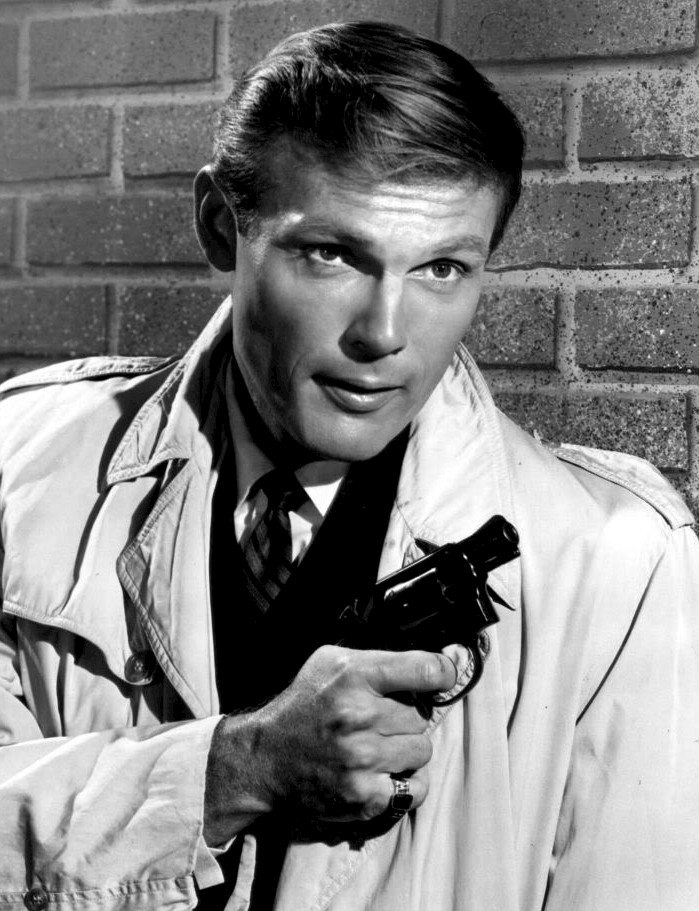
After his service career, he became a milkman until he moved to Hawaii to pursue a career in television. In 1959, he took on his stage name of Adam West and moved to Hollywood with his wife and children. He quickly became an actor and appeared in 33 television shows, including 77 Sunset Strip, Maverick, Hawaiian Eye, Tales of West Fargo, Perry Mason, Gunsmoke, Petticoat Junction, and Bewitched.
west4

In 1966, William Dozier, producer for a new show about Batman decided to cast West over Lyle Waggoner after seeing him as a James Bond-type character in a Nestle Quik commercial. DC Comics described Batman as 6’2” and that was West’s height.
west2

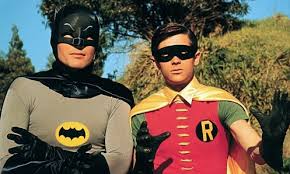
When the series ended, he and Burt Ward found themselves typecast as Batman and Robin.  He did a series of appearances about the Batman character while pursuing a movie career. He ended his career with 49 movies to his credit.

He appeared in 78 television shows after Batman ended including The Big Valley, Emergency, Alice, Police Woman, Laverne and Shirley, The Love Boat, Hart to Hart, Murphy Brown, Diagnosis Murder, News Radio, Drew Carey, King of Queens, and 30 Rock.

After 1990, he apparently embraced his Batman character and appeared on numerous television shows as himself or Batman. When asked about this, he said, “I think it evolved. I learned a long time ago that because people love Batman, I should too. I learned that I shouldn’t resent it even though it prevented me from getting other roles. I really had to become fond of Batman in order to deal with it. I embraced it.”

In 1957, he and his first wife Billie divorced.  He married  dancer Frisbie Dawson in 1957 and divorced in 1962. In 1970, he married Marcelle, and they were together until his death.  He had two children with each of his wives and two stepchildren.

In 1994, he wrote an autobiography Back to the Batcave. In 2012, he received a star on the Hollywood Walk of Fame on Hollywood Boulevard.

west8

West loved outdoor activities and had a lot of hobbies including fishing, sailing, hiking, skiing, golfing, riding motorcycles, swimming, surfing, dancing, traveling, as well as spending time with his family, listening to classic rock, reading, and watching movies.

West died after a short battle with leukemia at age 88. The next week, LA shined the bat signal on city hall to honor him.

While West certainly had a full and varied career despite his typecasting from Batman, I would like to spend some time looking at the series that gave him his fame. Typically, I am not really into super heroes, but I loved this show when I was younger and still get a kick out of watching the campy comedy. I can still hear the narrator saying, “Same bat time, same bat channel.” The show was canceled not only because of low ratings but also because the special effects and lighting had tremendous costs.  When ABC dropped it, they tried to find another network to take it over.  They had no offers, so they dismantled the set. Two weeks later, NBC offered to pick up the show, but decided it was too expensive to start from scratch.
batman4

In the 1960s, Ed Graham Productions received the rights to the comic strip Batman and intended to produce an adventure show similar to Superman or The Lone Ranger. ABC was thinking about a prime time show so DC Comics bought back the rights and sold them to 20th Century Fox. 20th Century gave it to William Dozier to produce.  Dozier had never read comic books and felt that the show should take a campy, pop-art approach. The show was originally an hour-long series, but with only half-hour time slots available, it was changed to a bi-weekly half-hour show.

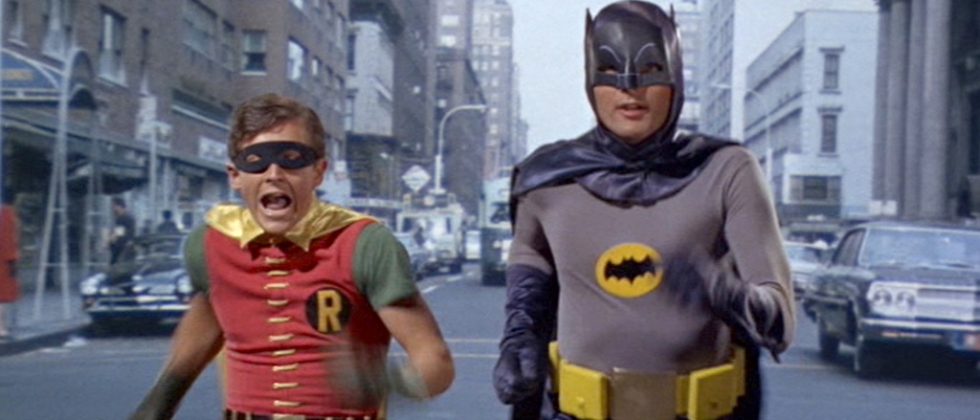
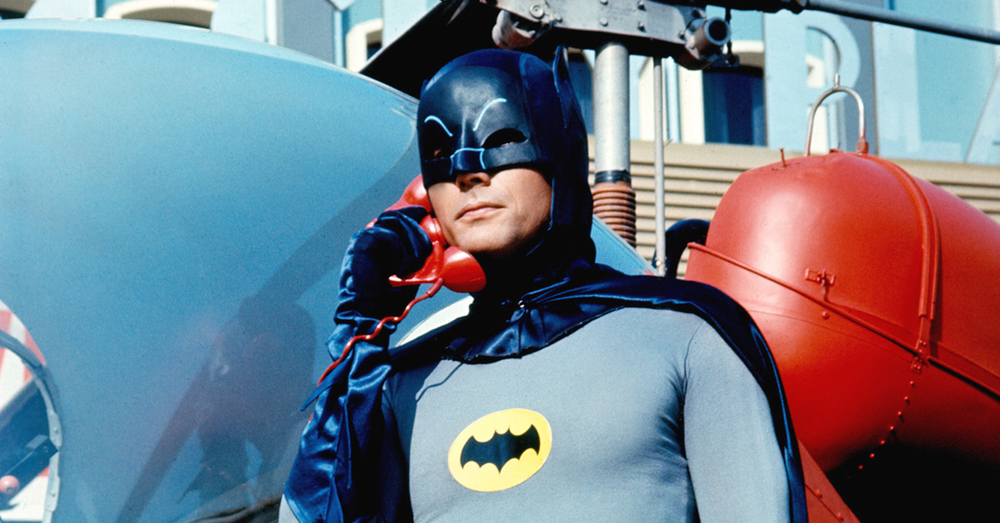
The concept of the show was that millionaire Bruce Wayne and his ward Dick Grayson lead a double life in Gotham City.  When they move a shelf in their library and slide down the bat pole to the bat cave, they become Batman and Robin.  Only their butler Alfred is aware of their real identity. Police Commissioner Gordon calls them on the batphone, often referring to them as the dynamic duo. They usually hop in their bat mobile and speed to city hall to learn what villain is up to no good in their city.
west5

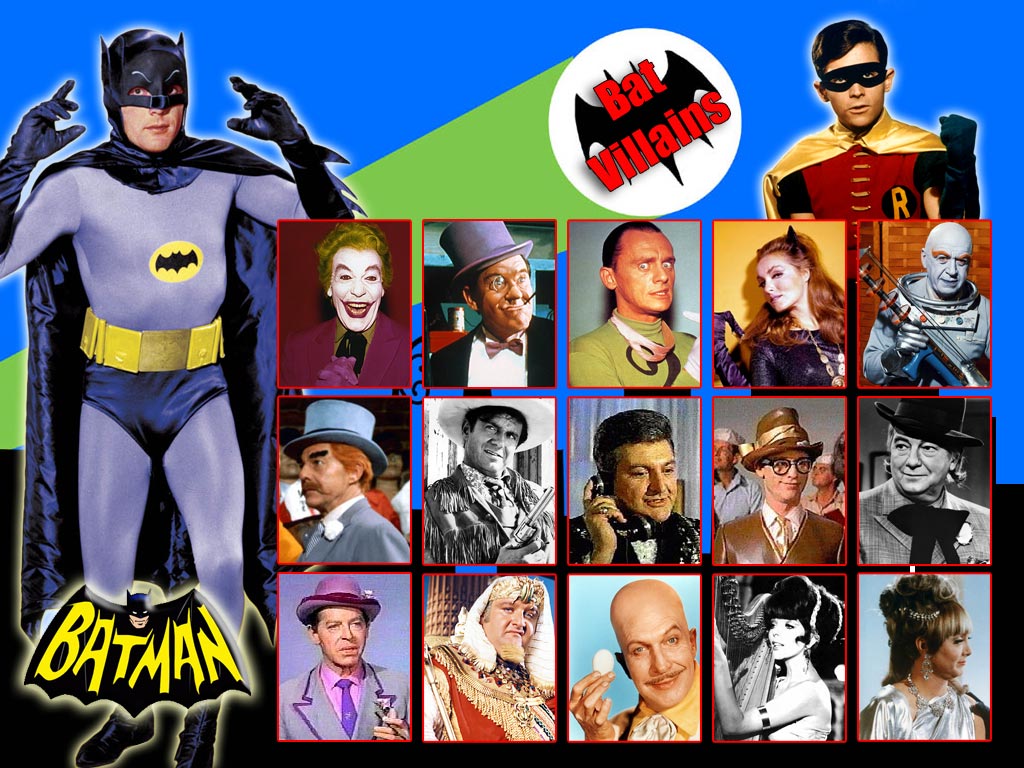
Adam West took the role of Batman/Bruce Wayne and Burt Ward was Robin/Dick Grayson. Other cast members included Alan Napier as Alfred the Butler, Neil Hamilton as Commissioner Gordon, Stafford Repp as Chief O’Hara, Madge Blake as Aunt Harriet, and Yvonne Craig as Batgirl.

My favorite villians included Julie Newmar and Eartha Kitt as Cat Woman, in love with Batman but not willing to give up her criminal life; Burgess Meredith as Penguin always carrying an umbrella; Frank Gorshin as The Riddler leaving riddles for clues; Vincent Price as Egghead a bald-headed genius who loves eggs; Cesar Romero as the Joker who leaves jokes for clues; and Victor Buono as King Tut when evil and Professor William McElroy as his non-evil personality.

The show aired twice a week on back-to-back nights. The first episode would set up the situation and end with the dynamic duo in some dangerous situation. Batman and Robin would get their assignment from the Commissioner and then, using a series of clues, try to figure out who the villain is and then how to defeat them. At some point, there was always a fistfight with the villain’s entourage at which time the villain typically escaped. During the fight, words would pop up on the screen like POW, BAM, ZONK, BOOM. Then the crime fighters would go to look for them at which point the dangerous and perhaps deadly situation occurred and the next episode would summarize what happened on the previous episode before defeating the bad guys for good. They often used inventions like shark repellant bat spray to aid them in their search.

batman5

In Season 3, Bat Girl was added to the cast. The ratings were starting to fall so Dozier wanted to bring in a girl character to attract female viewers. Her real identity was Barbara Gordon, the Commissioner’s daughter.  The Commissioner never seemed to realize she was familiar to him. Because of low ratings, the show also became a once a week series in the third season.  Eartha Kitt took over the Catwoman role since Newmar was filming a movie at the time. Madge Blake’s health was failing, and her role was limited to two appearances during the last season.

The show was cancelled before the next season but it has continued to be popular in reruns. In 1966, an album was released “Batman: The Exclusive Original Soundtrack Album.” It included music by Nelson Riddle, dialogue excerpts from several of the characters in the show, as well as the Batman theme song, Batusi A Go Go, and several other tunes.

A lot of collectibles were produced during the run of the show including trading cards, Batmobile kits, coloring books, lunch boxes, board games, and View-Master reels. In 2013, Mattel designed an action figure line based on the tv characters, and several Hot Wheels/Matchbox cars have been produced. The Batmobile from the show was auctioned in 2013, selling for $4.2 million.  The huge profits from the car as well as the line of action figures prove the continuing interest in and success of this show now 50 years old.

Here are some fun facts I found about the series:

A total of 352 “Holy” words were used by Robin from “Holy Agility” to “Holy Zorro”.

Cesar Romero’s Joker laugh was created almost by accident. Shortly after being cast, Romero met with producers to discuss his role on his series. While waiting to meet with them, Romero happened to see conceptual art of Joker’s costuming. Romero felt the pictures almost looked absurd, and as a result spontaneously broke out into a playfully loud and almost manic laughter. A producer overhearing it responded by telling Romero “That’s it, that’s your Joker’s laugh!”

Burgess Meredith had not smoked in 20 years when he was cast as the Penguin. He came up with the Penguin’s distinctive squawking sound because the cigarettes were irritating his throat. Like his trademark “quack”, the Penguin’s waddling was largely a result of improvisation by Burgess Meredith, as he found it difficult to stand and walk straight while wearing the rubber padded fat suit that was part of his costuming.

Before going on the air, this show received the worst audience test scores in the history of ABC. It only went on the air because so much money had already been invested in it.

This was one of the “in” shows to appear on if you were a big name in Hollywood during the 1960s, and many top names guested on the show, including many who didn’t do much TV otherwise. Those performers who weren’t cast as guest villains could frequently be seen popping their heads out of windows to exchange a few words with Batman and Robin when the latter would be climbing up a building wall. Frank Sinatra, Natalie Wood, and Cary Grant were all fans of the show, and wanted to be on it, but the producers were never able to come up with the right roles for any of them. During the run of the series, this show crossed over with The Green Hornet (1966).

The “Giant Lighted Lucite Map of Gotham City” is a reverse image of St. Louis, right down to Forest Park, Fairground Park, Tower Grove Park, Lafayette Park, and Horseshoe Lake on the Illinois side, as well as the other river and road networks.

Each main villain had their own theme music.

In the first season, Burt Ward (Robin) was paid $350 per week.

Yvonne Craig has stated that she briefly did have a stunt double, but did most of her stunts herself. She actually operated the Batgirl Cycle herself as well. She was an accomplished biker at the time, and actually owned a bike.

Adam West (Bruce Wayne / Batman), Burt Ward (Dick Grayson / Robin) and  Neil Hamilton (Commissioner Gordon) are the only actors to appear in all 120 episodes of the series.

Suzanne Pleshette was one of the original choices to play Catwoman before Julie Newmar landed the role.

The show aired from January 12, 1966 to March 14, 1968 on ABC for 120 episodes. It was one of few TV series to be seen on 2 different nights a week: 7:30 Wednesdays and Thursdays. It remained there for a season and a half (Jan. 1966-Aug. 1967) until it was moved back once a week (Thursdays 7:30) for its final season. The episodes were generally two-parters: Wednesday’s episode was a cliffhanger, resolved in Thursday’s episode. The 1966-1967 season had 2 3-parter episodes (“The Zodiac Crimes/The Joker’s Hard Times/The Penguin Declines”[ep. #2.37-9, 1/11-12 & 18/1967] and “Penguin is a Girl’s Best Friend/Penguin Sets a Trend/Penguin’s Disastrous End”[ep. #2.42-4, 1/26/, 2/1 & 2/1967]) which left cliffhangers that would be solved the following week. When the series was reduced to (mostly) one part episodes during season three, the cliffhanger death traps and threats were still used, but greatly scaled back and occurring at the middle commercial break.

The three primary cast members of The Addams Family each made appearances on Batman. Carolyn Jones played the villainess Marsha, Queen of Diamonds, and John Astin played the Riddler during the second season. Additionally, Ted Cassidy had a window cameo, appearing in his part as Lurch from The Addams Family. Interestingly, Cassidy’s cameo took place in a story involving the Penguin, with whom Jones’ character Marsha teamed up in one of the three-part stories.

In episode 7, Alfred refers to Robin as Mr. Ward, and not Mr. Grayson.

While Superheroes and the movies and television shows they appear in seem to cycle up and down throughout the decades, the popularity of the Batman television show has never wavered.  The fact that Mattel would create action figures based on the original stars almost 50 years after the show debuted says a lot about the fans and the place the show holds in their hearts.

Thank you Adam West for creating such a memorable and well-loved character.  Rest in peace.
batman2