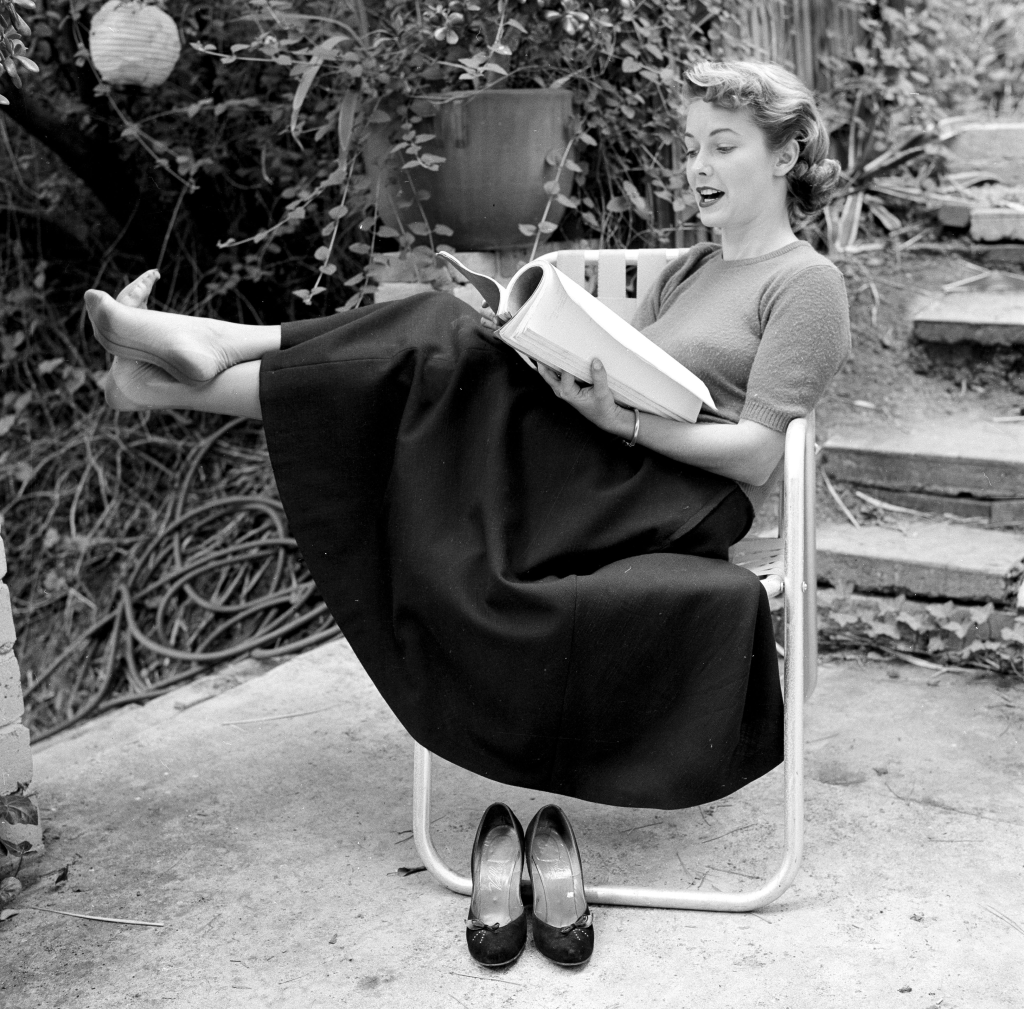
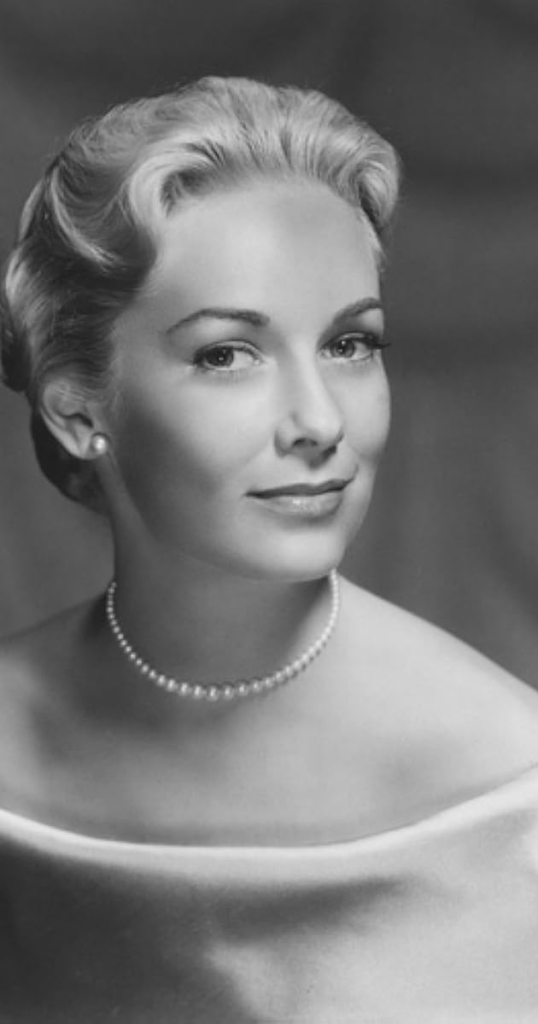
During this month of Supportive Women, I am excited to learn more about Vera Miles. For four decades, Miles appeared in our homes as well as on the big screen. With 162 credits, she may have visited your living room more than most of your family members.
📷facts.net
Vera Ralston was born in Boise City, Oklahoma in 1929. She grew up in Pratt, Kansas, and later she moved to Wichita where she graduated from high school and worked nights as a Western Union operator-typist. In 1948 she won the Miss Kansas pageant and was third runner-up in the Miss America contest that year. Miss Minnesota won the crown.
A year later she moved to Los Angeles to pursue a career in television and movies. Not long after arriving in Hollywood, Vera married photographer and stuntman Bob Miles. One source said that she enrolled at UCLA, hoping to become a teacher.
Bob Miles has 13 acting credits and 14 stuntman credits. The cast of Bonanza must have liked him because he appeared as a stuntman 99 times and as an actor on the show 76 times.
📷photos.com
After the birth of her children, she began doing some modeling and taking on a few roles to help provide income. Vera used her husband’s last name because there was already a Vera Ralston in the industry.
She appeared as a contestant in a 1951 episode of You Bet Your Life with Groucho Marx. Along with her partner, she won $8 in the quiz portion of the show but gave the wrong response to the De Soto-Plymouth question which was “Who was the first Chief Justice of the Supreme Court?” When Groucho asked her what titles she had held as a beauty contestant, in addition to Miss Kansas, she mentioned that she was Miss Chamber of Commerce, Miss Wichita, Miss Texas Grapefruit, and Miss New Maid Margarine.
She received her first movie role in 1950 and her first credit in 1952. In The Rose Bowl Story, a romantic comedy, she played a Tournament of Roses Queen. She would appear in about 40 additional movies during her career and quite a few made-for-television movies as well. She often worked with Alfred Hitchcock and was cast in Psycho.
In 1951 she appeared on Fireside Theater, her first television role. While she had more than 100 credits performing on television, surprisingly she never starred in a series. The only recurring character she had was Ernestine Coulter on My Three Sons.
📷fotogrammas.com
In 1956 she married Gordon Scott after divorcing Miles in 1954. They also divorced in 1960. Scott appeared to only work in Hollywood for a five-year period according to imdb.com. From 1960-1971 she tried marriage again with Keith Larsen, but their marriage also ended in divorce. Since the third time was not the charm, for two years in the mid-seventies, she wed Robert Jones but that ended in divorce as well.
During the fifties, she fit roles around her movie appearances, and you can see her in episodes of dramatic theater shows. In the sixties, she had no trouble finding work and she showed up on The Twilight Zone, Route 66, Wagon Train, I Spy, The Man from UNCLE, The FBI, and Mannix. Work did not slow down in the seventies, and you can spot her in a variety of shows including Gunsmoke, Hawaii 5-O, Bonanza, Cannon, Columbo, and Barnaby Jones. She might have taken thing a bit easier in the eighties, but she still worked on four or five shows a year, including Magnum, PI; Little House on the Prairie; TheLove Boat; Hotel; and Murder She Wrote. Her last credit was for a movie titled Separate Lives in 1995.
📷imdb.com
Miles was a member of the Church of Jesus Christ of Latter-Day Saints and visited Salt Lake City quite often.
Early in her career, Miles appeared to be almost a clone of Grace Kelly but that never materialized into a movie star career. Hitchcock hired her for Vertigo with Jimmy Stewart, but her pregnancy caused her to back out of the movie, and Kim Novak received the starring role. Perhaps, that movie would have changed the trajectory of her film career. I’m surprised that she was never given an opportunity to star in a television show. With 162 credits, she had a prolific and busy career. I will definitely try to spot her when I watch some of my favorite classic shows.
This month we are talking about classic television shows. Because it was early in the history of television, many of these shows began on the radio. Our series today was no different. It had a lot of lives. Like Ozzie and Harriet Nelson or Our Miss Brooks, it went from radio to television to film. However, in addition to those different genres, this show probably has the record for the first reboot. Today we learn all about The Life of Riley.
📷wikipedia.com
The Life of Riley began on the radio. Throughout the forties, you could tune in to hear Chester Riley, voiced by William Bendix, getting into a lot of different trouble while his long-suffering wife Peg (Paula Winslow), tried to help him. He had two kids, Babs (Barbara Eller) and Junior (Tommy Cook, Bobby Ellis, Scotty Beckett). His best friend Jim Gillis was often in the middle of the screw-ups with him. Another recurring character favorite was Riley’s friend Digby O’Dell, local undertaker, played by John Brown.
The family lived in California, and Riley was a blue-collar worker; he was a riveter at the Cunningham Aircraft plant. Riley is stubborn and opinionated, and knows his way is the right way. His family and neighbors think otherwise.
The original radio concept was created to star Groucho Marx, but the sponsor could not see Marx in a sitcom role. Gummo Marx who had become an agent, worked with the original sponsors, The American Meat Institute, to develop the show. Later the show was sponsored by Proctor and Gamble and then by Pabst Blue Ribbon Beer.
In 1949 in a weird twist, there was a film version coming out as well as an ABC Blue Network television sitcom. Bendix had signed on for the film, so that prevented him from playing Riley on television. The film did well, earning $1.6 million.
📷iamachildoftelevision.com The Jackie Gleason Riley
Jackie Gleason took on that role with Rosemary DeCamp as Peg. Gloria Winters was Babs, Larru Reese was Junior, Sid Tomack was Gillis, and Brown continued to play O’Dell. It only was on the air from October 1949 to March 1950. I’m not sure why it disappeared from the schedule so quickly. Producer Irving Brecher and Pabst Brewing Co. could not agree on extending the series to a 39-episode season. Apparently, the ratings were not high enough for the sponsor to want to continue with the series. It competition was a Feature Theater on Dumont and Suspense on CBS. Suspense also began in 1949 and began as a radio show. It was an anthology series that often featured literature adapted for television. It was on the air until 1954, although the radio show was on the air from 1942-1962. However, it won the first Emmy Award for Best Film Made For and Shown on Television. Six shows were nominated, but the only other show remembered today was The Lone Ranger.
📷imdb.com
In 1953, a reboot was made for NBC. William Bendix was back as Riley and this series continued on the air for six seasons. In this second, better-known series, Marjorie Reynolds was Peg, Lugene Sanders was Babs, and Wesley Morgan was Junior. Gillis was played by Tom D’Andrea and his wife Honeybee was played by Gloria Blondell. Digger O’Dell was not mentioned. John Brown had been named on the Hollywood Blacklist during the McCarthy debacle years, so he was prevented from taking the role. Many people use Riley’s catch phrase, even if they are not sure where it was originally from: “What a revoltin’ development this is.” Riley made $59 a week, and money was often one of his concerns.
Four of the six seasons found the show in the top 30, and 217 episodes were produced. Oddly, season five was filmed and broadcast in color, while season six was back to black and white. The show was on Friday nights for its entire run. The first three seasons it faced its biggest competition against Topper for two years and Our Miss Brooks for season three.
Dell Comics featured the show in one of its comic books in 1958. It was included in the Four Color series. It has held its value with most editions going for about $200-$300 online.
While I have watched a fair number of episodes of The Life of Riley, I have to admit it was never one of my favorites. Shows from this era are very hit or miss with me. I do like all the versions of Our Miss Brooks, and I love Burns and Allen and Jack Benny, but I got quickly got tired of the circumstances Riley continually found himself in and his mispronunciation of words and his lack of knowledge which he never realized. I am also in the small, small minority of people who felt the same way about I Love Lucy. I can watch one or two episodes here and there but not on a regular basis, although the scripts and acting on I Love Lucy carried it much further than Life of Riley.
However, Life of Riley was popular in the fifties and is still well-known today, so it found its audience of fans. If you want to try it out, there are limited opportunities. Interestingly, there is a DVD of the Gleason episodes and there are several recordings available of the radio show. However, for the Bendix television series, I could only find one option and half the shows are Our Miss Brooks so it is not even an entire season, just two episodes. I could not find any networks currently streaming the show either.
This month we continue with our “Kinda Creepy” blog series. Last week we talked about a show that debuted in fall of 1964 and was canceled in the spring of 1966, The Munsters. You can use the exact dates for our show today, The Addams Family.
ABC aired The Addams Family for two years, ending up with 64 episodes. Like The Munsters, this show was filmed in black and white. The Munsters was based on the typical suburban family while this series was created by David Levy and was based on Charles Addams’ New Yorker cartoons.
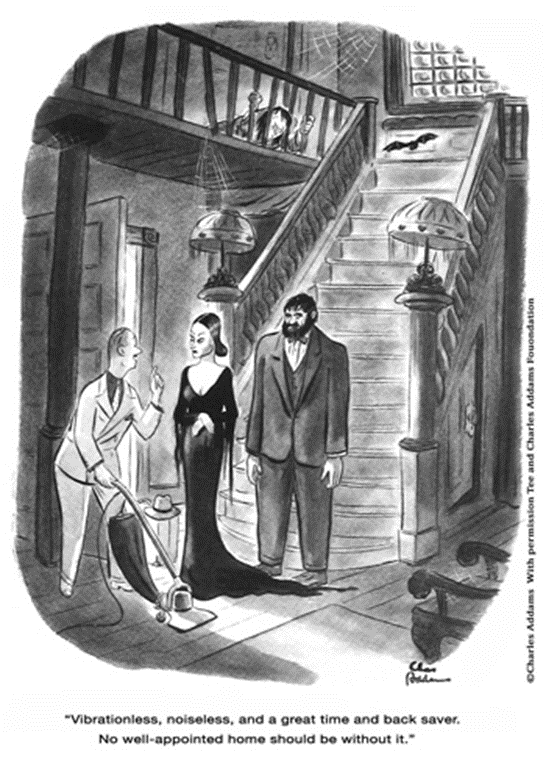
The first Addams Family cartoon was published in The New Yorker in 1938. The first illustration was titled “Vacuum Cleaner,” and it shows a salesman convincing “Morticia” to buy an appliance. The joke was that this was a house full of dirt and cobwebs, probably haunted. Addams was paid $85 for it. Addams did not intend for it to be a series, but New Yorker editor Harold Ross asked for more of them. Later, Gomez and the children were added. During the forties and fifties, 58 cartoons appeared in the publication.
In an interview before the show’s debut, Levy said that Addams was “a social commentator and a great wit.” It was produced by head writer Nat Perrin for Filmways, Inc. Perrin was a friend of Groucho Marx and had written for the Marx Brothers movies.
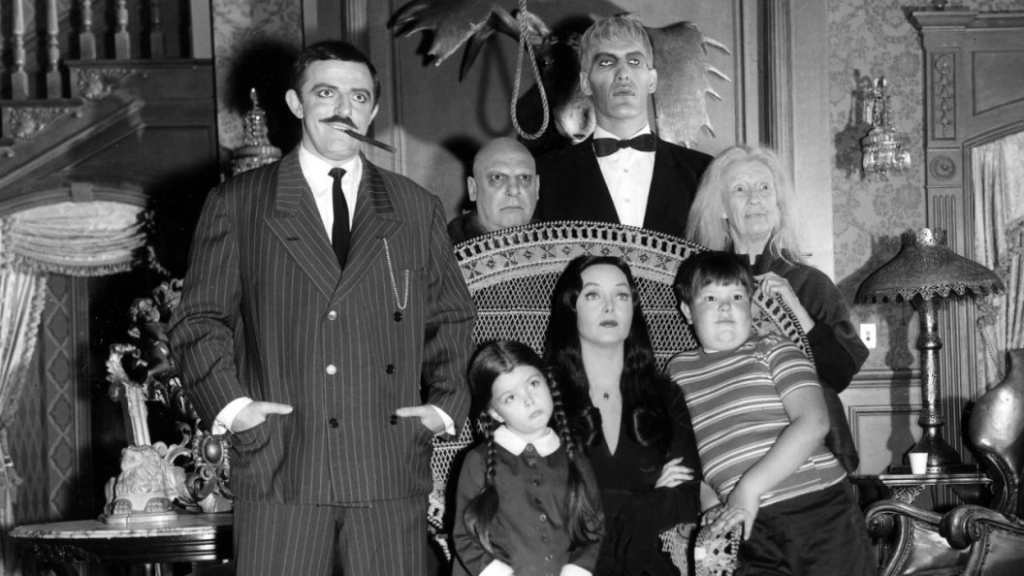
Like the Munsters family members, everyone in the Addams family is a bit off in some way. Wealthy former attorney Gomez Addams (John Astin) still is in love with his wife Morticia (Carolyn Jones) whom he often speaks to in French and refers to her as Cara Mia at times. Originally Carolyn turned down the offer to play Morticia because she was focusing on her movie career. She was persuaded to accept the role by her then-husband Aaron Spelling; the couple divorced not long after. Carolyn Jones had to endure sitting in the makeup chair for two hours every day. She worked with Nolan Miller to create a unique costume. Miller said that Morticia’s outfit was the most difficult one he had ever designed. The dress was very tight, especially around her feet. Gomez’s hobby is crashing model railroad trains. The prop department had to line Gomez’s pockets with asbestos because he put his lit cigars into his pockets.
The couple has two children: daughter Wednesday (Lisa Loring) and son Pugsley (Ken Weatherwax). They are polite children but Wednesday has a pet black widow spider and a headless doll named Marie Antoinette while Pugsley has a pet Octopus named Aristotle. Wednesday is named for the poem, which included “Wednesday’s child is full of woe.”
Photo: pinterest.com
In addition, Uncles Fester (Jackie Coogan), Grandmama (Blossom Rock), and the butler Lurch (Ted Cassidy) all live in the house. Fester enjoys playing with dynamite, Grandmama is always experimenting with potions and has a crystal ball, and Lurch always replies to his summons with “You rang?” Coogan was rejected for Uncle Fester. He went back home, shaved his head, and did his own makeup and costuming. Then he went back and got the part. Ted Cassidy got a lot of fan mail from teenage girls who thought he was so cute.
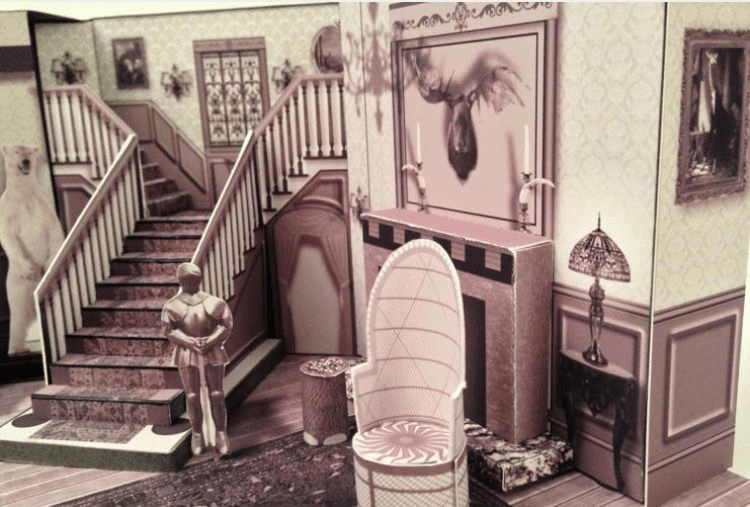
Their house décor is rather dark including a Venus flytrap, an art piece where a human leg protrudes from a swordfish’s mouth, and a taxidermied two-headed tortoise. The interior of the house was inspired by the apartment in Manhattan where Charles Addams lived. It contained suits of armor, an antique crossbow collection, and other oddities.
Cousin Itt Photo: costumerealm.com
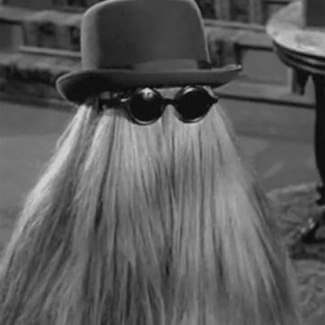
Thing is a gloved hand which shows up in places around the house. Cousin Itt (Felix Silla), who is all hair except for a hat and sunglasses, visits from time to time as does Ophelia, Morticia’s sister. Gomez was supposed to marry Ophelia in an arranged marriage but when he saw Morticia, he could not go through with it. Ophelia is an expert in judo.
The family considers itself quite sophisticated and cultured and they don’t understand the general public’s reaction to their home and actions.
The theme was composed and sung by Vic Mizzy. He also snaps his fingers through the song. You could hear Ted Cassidy say “neat,” “sweet,” and “petite” during the lyrics. Mizzy would also write the memorable theme for Green Acres.
In the early seventies, there was a Saturday morning cartoon with the actors voicing their characters. In 1977, a reunion made-for-television film, Halloween with the New Addams Family, was filmed with all the original actors except Rock who was quite ill at the time.
Like so many shows of the sixties, a lot of memorabilia was released for this series. You can choose from trading cards, comic books, board games, lunch boxes, and a ton of action figures.
Photo: strongmuseumofplay.com
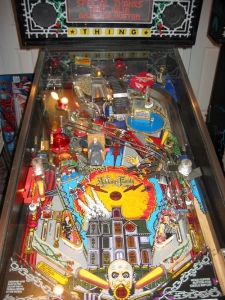
A major film, The Addams Family, was released in 1991 starring Raul Julia as Gomez, Angelica Huston as Morticia, and Christopher Lloyd as Uncle Fester. A sequel aired in 1993, Addams Family Values. In 1998 a reboot, The New Addams Family debuted on Fox and ran for two years just like the original. I honestly never saw either of the big-screen movies or any of the television reboots, so I cannot speak to whether they did the original show justice or not. The movie also spawned a popular pinball machine, which became the biggest-selling pinball machine of all time with more than 20,000 units sold since 1992.
Considering that both The Munsters and The Addams Family were only on the air for two years, and did not even rack up the typical number of shows needed for syndication, it is truly amazing that more than fifty years after the original shows aired, they are still very popular. I think like the Bewitched vs Jeannie debate, there are arguments for which family was more fun; my vote would have to go to The Addams Family, but if you have never watched either of the series, you should at least check a couple of episodes out. They probably would not work out so well to binge watch, because I think they would get boring quickly, but that is only one humble opinion.
Dick Cavett made a career of being a talk show host. He began on ABC in March of 1968 and ended on TCM in 2007. In between, he showed up during the day, in prime time, late at night, on PBS, in syndication, and on CNBC. The Dick Cavett Show seems to refer to all the shows as a collected whole, so that’s how I will present it in my blog.
Photo: chicagotribune.com
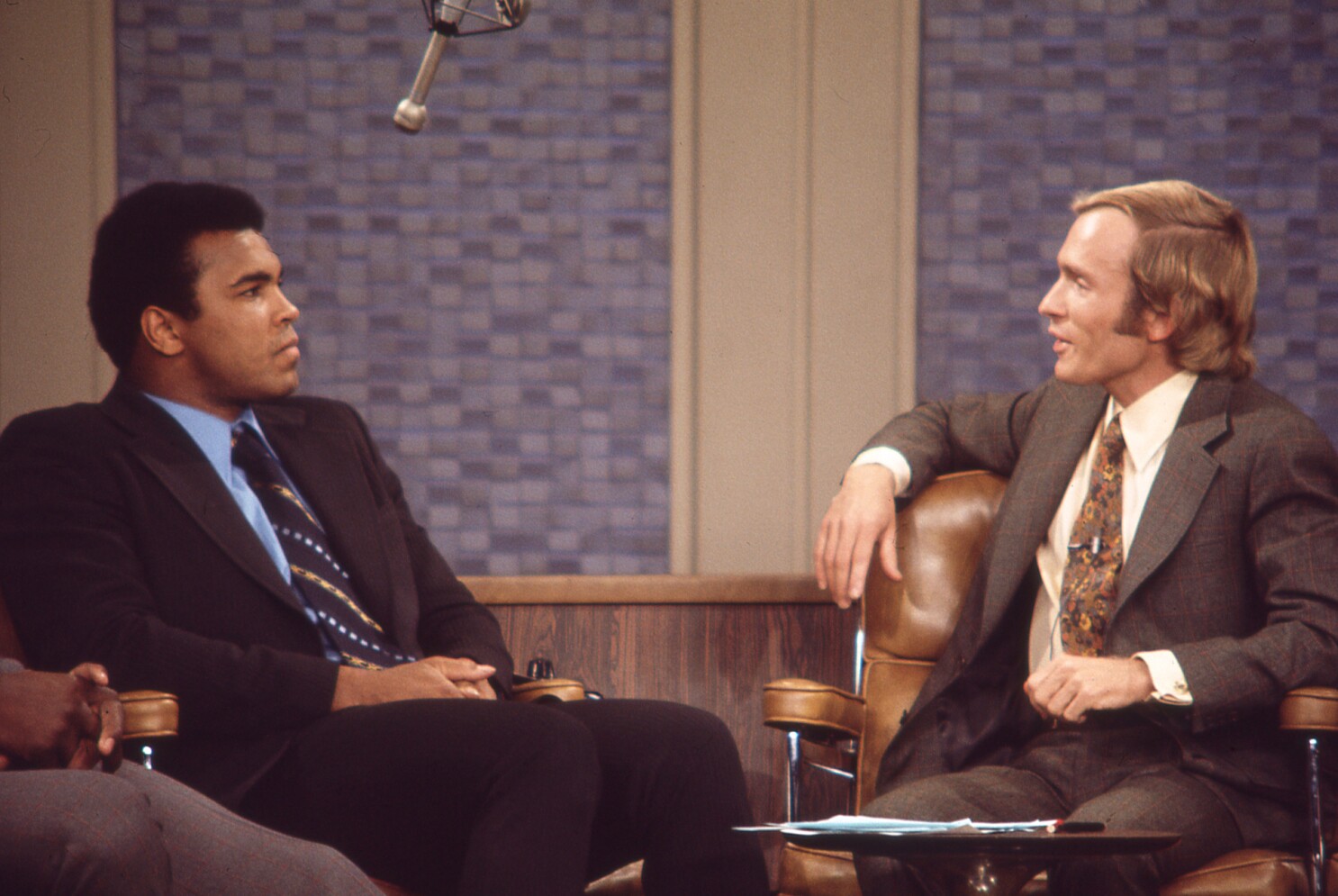
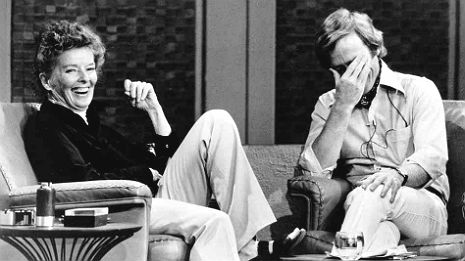
If you have ever seen Cavett in action, he has such a smooth, polite manner that sometimes you forget he may be asking an invasive question. Some of the most memorable shows were conversations with Christine Jorgenson (who walked off the show in 1968); Groucho Marx (1969); Jimi Hendrix (1969); The Woodstock Show (1969); Eric Clapton (1970); Alfred Lunt, Lynn Fontanne and Noel Coward (1970); Orson Welles (1970); Salvador Dali (1971); John Kerry debating on Vietnam (1971); Watergate and Beyond (1974); Angela Davis (1972); Jackie Robinson (1972); Marlon Brando (1973); Katharine Hepburn (1973); Carol Burnett (1974); and Mohammad Ali (several shows). As you can see, in addition to entertainers, Cavett interviewed influential authors, politicians, athletes, and newsmakers.
Talking to the Great One: Ali Photo: latimes.com
Cavett often had several guests on each show, but sometimes he devoted the entire night to one person such as Laurence Olivier, Judy Garland, Bette Davis, Janis Joplin, Alfred Hitchcock, Fred Astaire, Gloria Swanson, Lucille Ball, Bob Hope, and David Bowie.
Politics were often covered by Cavett, and over the years, he interviewed many including political guests including Carl Bernstein and Bob Woodward, Walter Cronkite, John Ehrlichman, John Dean, Gerald Ford, Barry Goldwater, Henry Kissinger, and G. Gordon Liddy.
In various interviews of his own, Cavett mentioned different shows that were memorable or brought in a lot of mail. Early in the show’s history, Cavett was interviewing Peter Falk, Ben Gazzara, and John Cassavetes about a movie they were in. Cassavetes was so drunk and incoherent, Cavett walked off the stage.
Laughing with Katharine Hepburn Photo: dangerousminds.com
Georgia governor Lester Maddox appeared in a panel with Truman Capote and Jim Brown about segregation. Cavett made a reference to “bigots” who supported Maddox. When Maddox demanded an apology, Cavett apologized to Georgians who supported him without being a bigot. Maddox left the studio. However, later Maddox relented and made another appearance, and Cavett walked off the set as a joke.
One memorable episode was something no host wants to encounter. Publisher J. I. Rodale was on the show. Cavett was talking to another guest when Rodale seemed to be snoring, but everyone soon realized something was wrong. He actually died there on the set. The audience didn’t even realize it until Cavett called for a doctor. The program was taped but not aired.
Director Ingmar Bergman did few television interviews and no US interviews, but he made an exception for Dick Cavett.
With David Bowie Photo: nostalgiacentral.com
So, what types of things might you have learned from Cavett’s show? Well, Hitchcock explained how some of his most ingenious special effects worked. Gale Sayers talked about the movie Brian’s Song (maybe he could have given me a hint how not to cry every single time I see the movie.). BB King revealed what his name stands for. Jack Benny demonstrated how to play the violin. Melba Moore told what it was like to open at the Apollo Theater. James Garner explained how he accidentally broke co-star Doris Day’s ribs, and Jacques Cousteau discussed the mystery of manatees.
And finally, I had to find out who was Cavett’s favorite interview, and who were the ones that got away? The two he never got to interview but always wished he had was an easier answer to find: Cary Grant and Frank Sinatra.
Photo: WBUR
It was a lot harder to answer the first question. If you read the other three blogs in this series, you know the other talk show hosts (Mike Douglas, Phil Donahue, and Tom Snyder) began careers in Ohio. I was hoping to find an Ohio link for Dick, and that’s when I found the answer to my question of his favorite interviewee. Cavett landed in Cleveland at the end of his career, which seems fitting since he is ending this series.
He was talking about an upcoming show at The Nightclub in Cleveland and mentioned Jack Paar was his mentor. (Cavett wrote for The Tonight Show when Paar hosted it, and Paar began his career in Canton, Ohio; I know it’s one coincidence after another.) Jack told him he didn’t need humor, singing, or anything except a desire to have a conversation. Then Cavett said, “I watch clips from the shows when I’m invited to give a talk and they show them, and I’m always surprised by the number of little delightful moments I’ve forgotten. I watched a moment the other night when Groucho was on the show with [zoologist] Jim Fowler. And Fowler brought a sloth on the stage, and Groucho said, ‘That’s the lousiest-looking dog I’ve ever seen.’ I’d forgotten that. That was the same night Groucho proposed marriage to Truman Capote. . . .’I love to do Q&A with the audience, but there’s only one forbidden question, and it doesn’t have anything to do with sex or politics,’ he said. ‘The forbidden question is, Who has been your most interesting guest?’ . . . But then he went on to say that ‘If pushed to the wall, I have to admit that Groucho was the guest who meant the most to me.’ Cavett said that ‘In a letter from Miriam, Groucho’s daughter, she wrote, ‘My father thought the world of you.’ It gets me even now when I say that out loud.’”
The unique Groucho Marx Photo: pinterest.com
In 2005 several box sets were released of some of Cavett’s shows. They are collected by theme of the interviewee such as The Rock Icons, etc. The network Decades, which recently went off the air, broadcast these shows also. Before the network was disbanded, I was able to watch about ten of these episodes, and they were as good as I had hoped for.
I have really enjoyed reviewing these talk show hosts and their guest interviews this month. It makes me want to invite a bunch of friends over, one at a time, for coffee and conversation. Just be forewarned, if I invite you over, I may have a list of questions I’ll want to be asking you.
I am cheating just a bit with this post. During this Oddly Wonderful series, I think I can push the envelope enough. You Bet Your Life was a very different type of game show. If ever there was a person who personifies oddly wonderful it was Groucho. But I really wanted an excuse to write about George Fenneman.
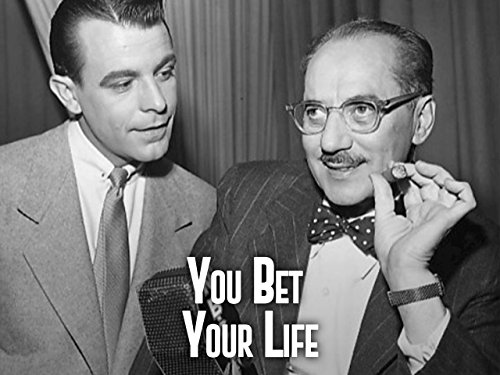
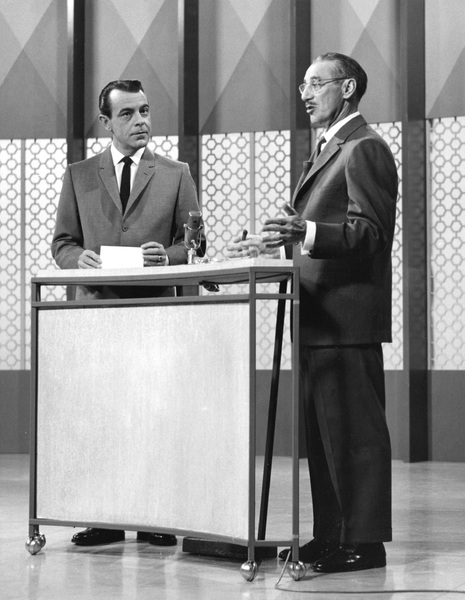
George Fenneman is best remembered for his role on Groucho Marx’s quiz show, You Bet Your Life which began on radio in 1947 and transitioned to television in 1950. The show went off the air in 1961, the year I was born. Obviously, I don’t remember the original show, but I saw it in reruns and always had a crush on George; I think it was his smile that always got me.
Photo: imdb.com
George was born in Beijing (then Peking), China in 1919. His father was in the importing/exporting business. When he was not quite one, his parents moved to San Francisco where he grew up. After high school, he attended San Francisco State College. He graduated in 1942 with a degree in speech and drama. He took a job with a local radio station KGO for a short time. He married his college sweetheart Peggy Clifford in 1943 and they would stay married until George died. The couple had two daughters and a son.
Photo: collectors.com
Poor eyesight
and asthma prevented Fenneman from military action in World War II, but he was
able to become a broadcast correspondent for the War of Information. In 1946 he
was back in California, in the radio industry again. One of the shows he announced
for was Gunsmoke. After the episode concluded,
he would introduce Matt Dillon (William Conrad) to discuss the sponsor’s
products which often was cigarettes such as L&M or Chesterfield.
Some of the other radio shows he announced for included The Orson Welles Show, The Eddie Albert Show, and the Hedda Hopper Show.
Photo: aveleyman.com
He and Peggy
were neighbors of Christian Nyby. In 1951, Nyby was hired as director for the
film, The Thing from Another World. George
joined the cast as in the minor role of Dr. Redding who has an important scene
at the end of the film. It took 27 takes for him to get the speech right, and
he realized he was better suited for radio. However, he would appear in two
additional films, the little-known Mystery
Lake in 1953 and How to Succeed in
Business Without Really Trying in 1967. While his voice was part of several
other films, most notably in the original Ocean’s
11 as the man talking on the phone to Sheriff Wimmer.
Jack Webb had worked on broadcasts with George during the war. He hired Fenneman as announcer for his radio show, Pat Novak, For Hire. When Dragnet aired the same year, Jack took George with him. George, along with Hal Gibney took on the role of narrator for the show. They both continued with the show in 1951 when it moved to television. Dragnet was off the air for a number of years and returned to television in 1967. Fenneman was again hired as narrator with John Stephenson for that version. George was the one who was heard saying, “The story you are about to see is true. The names have been changed to protect the innocent.” Stephenson handled the closing narration. Fenneman was also cast as a news reporter in a variety of shows including Please Don’t Eat the Daisies, The Man from U.N.C.L.E., The Name of the Game, and on Batman in 1966 in the episode, “The Yegg Foes in Gotham.”
Photo: pinterest.at On Batman
In addition
to appearing on Groucho’s show on television, Fenneman was the host or
announcer for several other shows. He emceed two games shows during his time
with Groucho: Anybody Can Play in 1958
and Your Surprise Package in 1961. In
1963, He hosted a show on ABC titled Your
Funny, Funny Films which was a cousin to the later Candid Camera and America’s
Funniest Home Videos.
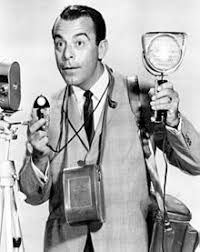
He was usually an unseen announcer on The Ed Sullivan Show, but in 1964, the night the Beatles were on the show for the second time, he did a spot on the air for Lipton Tea. From 1978-1982 he hosted a show on PBS, Talk About Pictures. In this show, Life magazine photographer Leigh Weiner and George interviewed respected photographers and looked at their best photos.
Photo: pinterest.com With Leigh Weiner on PBS
He also was the voice for Home Savings & Loan commercials from the late 1960s until his death from emphysema in 1997. He also acted as announcer for shows such as Dean Martin and Jerry Lewis, Donny and Marie, The Jim Nabors Show, and The Life of Riley.
Photo: hollywoodphotographs.com With Martin and Lewis
In 1993, The Simpsons aired an episode that
spoofed Dragnet, and Fenneman can be
heard on the show delivering his famous line about names being changed to
protect the innocent.
Despite his large cannon of work as an announcer and emcee, Fenneman became a household celebrity when he went to work for Groucho on You Bet Your Life. One day George was standing on the corner of Hollywood and Vine. Robert Dwan, who had hired him at KGO Radio, came up and told him he was holding an audition for a new show for Groucho. Fenneman went up against thirty other announcers and won the job which paid $55 a week. He was hired just to do commercials. At some point, Groucho decided he should also be scorekeeper, as well as his straight man.
Photo: usawoopro.blogspot.com
When
discussing Groucho, George said, “I have to say he was unique, and he was
fearless. It was a great privilege to work with him for 15 years and to be his
friend for 30.” After Fenneman’s death, Peggy did an interview for an article
by Lawrence Van Gelder for the NY Times
in June of 1997. She said that George was always a fan of Groucho and the Marx
Brothers. She remembered them often going to the Golden Gate Theater when they
were in college. They went to watch the Marx Brothers rehearse future movie
scenes for comic timing. She remembered watching scenes from A Night at the Opera and A Day at the Races.
Groucho, known for his quick wit and acid tongue, found an agreeable and attractive man in Fenneman. When viewers queried George whether the show was scripted or ad-libbed, he always said yes. Actually, it was about 50/50. Groucho was fed some lines from the interviews with the contestants, but he never met them ahead of time and was given the freedom to interject whatever comments he chose.
Photo: mptvimages.com
George often took the brunt of Groucho’s humor. One time he had to inhale helium, one day he came down from the ceiling when the secret word was said in place of the usual duck, or he would be questioned about something on the show. For example, one evening each of the contestants was a very attractive woman and Groucho made it seem that Fenneman had set that up on purpose. One contestant mistakenly referred to George as Mr. Fidderman, and Groucho called him out to discuss his double life.
Photo: popflock.com
George never
knew what Groucho had in store for him. Often Marx would summon George from
behind the curtain, and he always looked uncomfortable which was quite genuine.
But Groucho had great affection and appreciation for him, calling him the
perfect straight man.
At times on
the show, George could also be quite funny, but he knew his main role was
straight man, and he usually toed that line carefully.
George and Groucho remained friends long after the show was cancelled. They often got together before Groucho’s death in 1977 at age 87. Groucho never lost his sense of humor. At one of their last visits, Groucho was in very frail health. Helping Groucho get across the room, George lifted him out of his wheelchair and carried him. He had his arms around his torso and began to shimmy him across the floor. Groucho’s rasping voice said, “Fenneman, you always were a lousy dancer.”
Photo: en.wikipedia.org
Although the shows have never been released in a chronological DVD collection, they are available. The programs were recorded in full and then edited to the desired length. On MP3 discs, some of the unedited tapes are available which provide a very different perspective than the aired show.
There are a few announcers still well known in the business. I think of Rod Roddy, Johnny Gilbert or Johnny Olson who have game show fame, but it is a career that is being phased out. There is something charming about watching the former announcers for shows promoting products and interacting with the stars. Harry Von Zell from the Gracie Allen and George Burns Show comes to mind or Don Wilson from the Jack Benny Show. Like rotary phones, transistor radios, and Polaroid cameras, they are fondly remembered from a slower and less technological period in history.
With this series being Oddly Wonderful, I am stretching it a bit by focusing on George. In our definition of oddly wonderful, he was definitely the wonderful.













 thewritelife61