Jess Oppenheimer: The Brains Behind I Love Lucy

As we are learning all about Lucille Ball and her shows this first month of 2025, the month would not be complete without getting to know Jess Oppenheimer, the man Lucy called “the brains” behind I Love Lucy. He was also the producer and head writer of the show. Director William Asher said “he was the field general. Jess presided over all the meetings and ran the whole show. He was very sharp.”
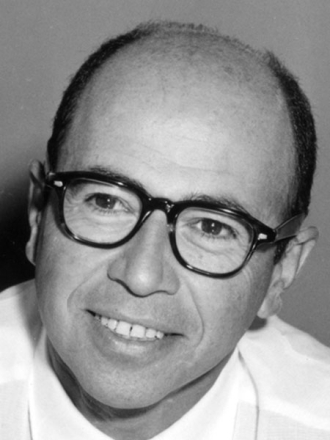
📷televisionacademy.com

Oppenheimer was born in San Francisco in 1913. He took part in a study of gifted children in Stanford Professor Lewis Terman’s project. Ironically, one of Terman’s quotes about Jess was that he “could detect no signs of a sense of humor.” Jess’s father James owned the largest luggage store in San Francisco, but he died in an accident when Jess was 16.

Oppenheimer went on to attend Stanford in the 1930s. He started to spend a lot of his free time at radio station KFRC and performed in a comedy sketch he wrote for the show “Blue Monday Jamboree.”

In 1936 he moved to Hollywood and was hired as a writer on Fred Astaire’s radio show. He later went to work for Jack Benny as well as Edgar Bergen and Charlie McCarthy, George Burns and Gracie Allen, Bing Crosby, Marlene Dietrich, Judy Garland, Bob Hope, and Ginger Rogers.

When World War II began, Oppenheimer joined the US Coast Guard where he met Jack Dempsey and Cesar Romero. While he was there, he was diagnosed with double vision which had bothered him his entire life but had never been addressed.

Agent Ray Stark was Fanny Brice’s son-in-law and later Stark recruited him to write for her Baby Snooks Show based on his reputation in the Coast Guard.

In 1942, Oppenheimer met Estelle Weiss, an employee of Wallichs Music City. They married in 1947 and were together for the rest of his life.
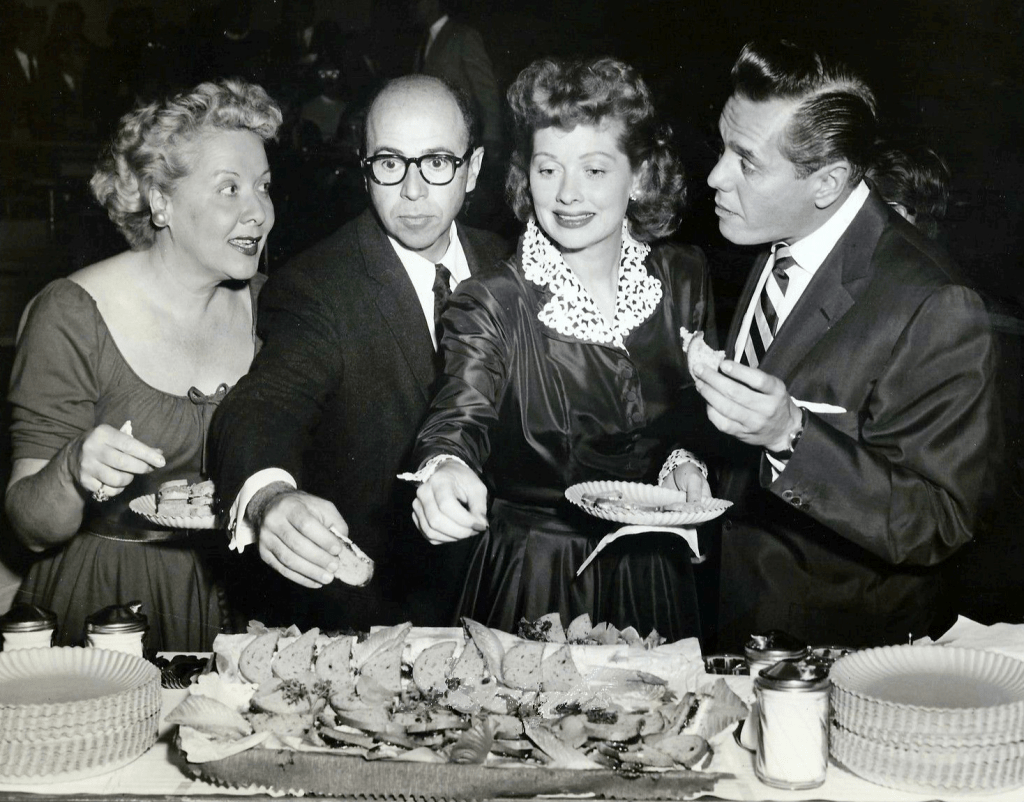
📷wikipedia.com

In 1948, CBS hired Oppenheimer to write a script for a new radio show, “My Favorite Husband.” Several of the scripts portrayed the wife, played by Lucille Ball, as a sophisticated socialite. When Jess added slapstick comedy and transitioned her to a childlike, impulsive, naïve wife, the show was a big success.

In 1950, CBS moved the show to television to star Lucy and her real-life husband Desi Arnaz. Lucy demanded that Oppenheimer stay in charge. Jess suggested doing a show “about a middle-class working stiff who works very hard at his job as a bandleader and likes nothing better than to come home at night and relax with this wife who doesn’t like staying home and is dying to get into show business.” He suggested the title “I Love Lucy.”

For the first five seasons, Oppenheimer was the producer and head writer, with help from Madelyn Pugh and Bob Carroll Jr. as other writers. As part of his contract, Oppenheimer received 20% of the ownership in the show. He gave Pugh and Carroll each 5% of that amount.

A wannabe actor, Oppenheimer appeared on I Love Lucy in two episodes. In #6, “The Audition,” he was one of three TV executives who audition Desi and in #127, “The Tour,” he walks in front of the bus before Ethel and Lucy board it. In one of the more famous episodes, #30, “Lucy Does a TV Commercial,” Jess is the voice that tells Lucy to go ahead and begin her commercial.

📷

In 1956, Oppenheimer moved to NBC where he became a producer of special shows.

During the sixties, Oppenheimer created and produced three other sitcoms. In 1960 he worked with Annie Farge and Marshall Thompson on Angel; in 1963 with Glynis Johns on Glynis, and with Debbie Reynolds on The Debbie Reynolds Show. He also was listed as writer, producer, and director for the 1967 season of Get Smart.

Oppenheimer received two Emmys and seven nominations. His Emmys were for Producer for Best Situation Comedy, I Love Lucy, in 1953 and 1954. He was also nominated for Producer for Best Situation Comedy, I Love Lucy, in 1952 and 1955; for Best Comedy Writer, I Love Lucy, in 1955 and 1956; for Best Single Program of the Year, General Motors 50th Anniversary Show in 1958; Program of the Year, The Danny Kaye Show with Lucille Ball in 1963; and Outstanding Program Achievement in Humor, The Danny Kaye Show with Lucille Ball in 1963.

He was also an inventor with 18 patents. One of his inventions was an in-the-lens teleprompter.

In 1962, Lucille Ball brought a new sitcom to television; however, Oppenheimer sued the show, claiming that Lucy Carmichael was Lucy Ricardo, his character, He received a financial settlement, and the character was changed, but unfortunately, it ruined the friendship between Oppenheimer and Ball.

The Oppenheimer family lived on Burlingame Avenue in Los Angeles. In a funny twist, Jess bought the house from MGM hairstylist Sydney Guilaroff; he was the person who turned Ball into a redhead for the 1943 movie, DuBarry was a Lady.

📷instagram

Jess’s best friends were Mel Blanc, Hans Conried, and Jerry Hausner, who had played Ricky’s agent on I Love Lucy.

In 1988, Oppenheimer had an intestinal surgery; he died shortly after from heart failure. At his death, Lucille Ball said he was “a true genius” and said that “she owed so much to his creativity and his friendship.”

I love hearing stories about people like Jess Oppenheimer and Sheldon Leonard who are creative geniuses and are the influence and inspiration for so many of the classic television shows.

Write On!

Happy Monday.  It’s National Encourage a Young Writer Day.  I love to encourage writers of all ages.  If you’re a writer, you know the two golden rules of writing.  (1) Write what you know and (2) Be original.  With those two qualifiers, one would think there would be a myriad of great shows out there about writers.  Not so.  It took a lot of exploring on my part to come up with 12 shows about writers in the past 70 years!

If writers are writing what they know, it seems writers know much more about incompetent parents, complex medical surgeries, and dating bachelors than they do about writing and writers.

Don’t get me started on being original. Unfortunately, any viewer knows that when one genre show succeeds, the next year will feature ten more just like it;  hence, the number of medical and police dramas currently on the schedule.  This doesn’t hold true anywhere else in life.  No grocer says avocados are so popular, let’s replace the oranges and apples with them.  No radio station decides to play the top five songs to the exclusion of the other songs.  That being said, I’ll jump off my soapbox before ranting about how the shows on today’s schedule are either amazingly written or not worth the time it takes to turn on the television. So, let’s look at shows about writers.

Apartment 3-C. In 1949 John and Barbara Gay played themselves.  Living in New York City, he was a writer.  The 15-minute show went off the air after one season. They moved to California where they raised their family and spent 66 years together. As far as I can tell, neither of them acted again, but John went on to be a prolific scriptwriter.

bethel leslie

Young and Gay/The Girls. Debuting in 1950 as Young and Gay, this series was based on an autobiographical novel written by Cornelia Otis Skinner and Emily Kimbrough. CBS bought the rights. After the first two episodes, the name was changed to The Girls.  The premise of the show was that two Bryn Mawr graduates come to Greenwich Village after spending time in Europe, trying to develop careers as an actress and a writer.  After a few more episodes, their acting career ended when the show was cancelled.

Dear Phoebe. In 1954, ex-college professor Bill Hastings, played by Peter Lawford, decided he wanted to try his hand at journalism.  The option he receives is becoming Phoebe Goodman, providing advice to the lovelorn. Ironically, his girlfriend, Mickey (Marcia Henderson), is the paper’s sports writer. After one season, they both received advice to seek new work when the show was cancelled.

mysistereileen1

My Sister Eileen. It would take half a decade before another show about a writer was produced. In 1960, My Sister Eileen aired.  The concept will sound vaguely familiar.  It’s based on a book and two movies about two sisters from Ohio who move to Greenwich Village wanting to be an actress and a writer. The sisters were played by Elaine Stritch and Shirley Boone. The only memorable thing about the show was the pairing of Rose Marie and Richard Deacon who went on to try their hand at another show a year later called The Dick Van Dyke Show.

The Dick Van Dyke Show. Hands down, this was the best comedy to debut about a writer.  It was also the longest running show, going off the air five years because the cast wanted to quit while the show was still successful. Rob Petrie (Dick Van Dyke) is the head writer of the Alan Brady Show, creating scripts with Sally (Rose Marie) and Buddy (Morey Amsterdam). Mel (Richard Deacon) is the long-suffering producer. This is one of the first shows to concentrate on work life. We get to see what goes on behind the scenes of a comedy/variety show. While Rob, Sally, and Buddy have lives outside the office, they are somewhat married to their work. Sally is always hunting for Mr. Right.  Buddy deals with more comedy at home because of his not-so-bright wife Pickles, although it’s obvious he is in love with Sally. Rob and Laura (Mary Tyler Moore) are both confident and intelligent adults and insecure parents, raising their son Richie (Larry Mathews) in New Rochelle. The show won an Emmy its first year and never left the top 20, producing 157 of the best-written sitcom episodes ever created.

Window on Main Street. Mention the name Robert Young, and most viewers fondly recall Father Knows Best or Marcus Welby.  In this 1961 show, Robert Young plays Cameron Garrett Brooks, an author.  After his son and wife pass away, he returns to his small home town of Millsburg to write about the town’s citizens. It must have been a very small town with few people to write about, because the series was cancelled after one year.

The New Loretta Young Show. Loretta Young starred in several shows using her name so it gets a bit confusing, but in this 1962 version, she plays Christine Massey, a children’s author and widow with 7 children. Living in Connecticut, she decides to get a job with Manhattan Magazine.  However, after meeting the editor she falls in love and marries him. Perhaps the network had a policy banning inter-company marriages, because the show was cancelled after six months.

writersblog2

Glynis. In 1963 Glynis Granville (played by Glynis Johns) moved to town. She is an amateur sleuth who solves crimes to have something to write about. Her husband Keith (Keith Andes) is an attorney.  She consults with a former policeman Chick Rogers (George Mathews). The show only lasted three months.  Jess Oppenheimer, the producer of I Love Lucy, apparently forgot this was a different show, airing episodes that were very Lucy-esque.

Please Don’t Eat the Daisies. In 1968, Please Don’t Eat the Daisies came to the small screen.  Based on Jean Kerr’s book, it was also a movie starring Doris Day about the Nash family.  James (Mark Miller) is a college professor and his wife Joan (Patricia Crowley) is a free-lance writer. The show featured their four sons, two of whom were twins, their large dog, and their housekeeper Martha (Ellen Corby). Faring better than most of our shows, this one lasted two years.

The Ghost and Mrs. Muir. This show about a writer, a widow Carolyn Muir (Hope Lange) who moves into an old house in Schooner Bay in New England, appeared in 1968. The house turns out to be haunted by Captain Daniel Gregg (Edward Mulhaney), a captain who built the house in the 1800s. This show was also based on a movie. Captain Gregg is annoyed with the interruption and noise of the new family, but ultimately falls in love with Carolyn. Charles Nelson Reilly plays the Captain’s nephew Claymore Gregg. Dabbs Greer is Noorie Coolidge, the owner of a local lobster restaurant, and Reta Shaw is their housekeeper Martha. The show was on NBC for one year then moved to ABC for one year.  Apparently, CBS declined its turn, so the show was cancelled.

The Debbie Reynolds Show. In 1969, another show produced by Jess Oppenheimer eerily reminiscent of I Love Lucy was on the fall schedule. Jim Thompson (Don Chastain) is a sports writer. His wife Debbie (Debbie Reynolds) is a stay-at-home wife who wants to be a feature writer. Jim discourages her, wanting her to stay home.  Instead of Ethel and Fred, we have her sister Charlotte (Patricia Smith) and her brother-in-law Bob (Tom Bosley).  After one season, the network decided they did not care if  Debbie worked or stayed home and sent the crew packing.

Suddenly Susan. Jump almost thirty years to 1996 and we have another show about a writer, Suddenly Susan, starring Brooke Shields. Susan leaves her husband-to-be at the altar and is forced to ask her ex brother-in-law (Judd Nelson) to hire her back at his magazine.  Most of the show is set in the workplace.  Luis Rivera (Nestor Carbonell), Vicki Groener (Kathy Griffith), and Nana (Barbara Barrie) round out the cast and appear on all the episodes.  (The photo above also includes Andrea Bendewald [the blonde] and David Strickland [laying down] who were in about half the episodes.) The show continued until 2000.

I should mention that because I focused on comedies I did not include Murder She Wrote or Castle, both having long runs of 12 and 8 years respectively. I did not include Everybody Loves Raymond because that show concentrated on his family life, and rarely revealed his writing profession.

I wish I had more encouraging words for writers who wanted to get involved in television.  About the only thing I can tell you, is if you want to develop a successful show around a writer, make it a drama for job security.