Gather Round: It’s Time for Tales of Wells Fargo

đź“·pinterest.com

This month we are Riding the Range, exploring some of the westerns from the fifties and sixties. One of those shows that was on the air from 1957-1962 was Tales of Wells Fargo.

The show was produced by Revue Productions and set in the 1870s and 1880s. Gene Reynolds was one of the creators of the show, along with Frank Gruber and James Brooks. Reynolds would go on to great success as a director, producer and writer, and my favorite of his was M*A*S*H. Although this show was set in the same time as Daniel Boone, it was better at getting history correct. The show featured special agent Jim Hardie (Dale Robertson) with his horse Jubilee. It was loosely based on the life of real detective Fred J. Dodge. Sometimes Hardie ran into characters from history including Jesse James and Belle Starr.

đź“·pinterest.com Fred J. Dodge

Fred Dodge was born in California in 1854. He went to work as an undercover agent for Wells Fargo, working in California, Nevada, and Arizona. In 1979 he was in Tombstone and recommended hiring Wyatt Earp as guard for the stage line. He became great friends with Earp. Later Dodge became constable of Tombstone while working undercover. In 1890 he left his undercover work and became a known employee of Wells Fargo in Texas. He purchased a 2,000-acre ranch near Boerne, Texas and when he retired in 1917, he lived there with his family. Dodge was described as an intelligent and successful investigator. He wrote 27 journals during his career, noting his activities and travels in them. Some of these were used for Tales of West Fargo.

I had always assumed this show was about stagecoach travel, but it was not, although stage coaches played a part. In the mid-1800s, the Wells Fargo stage line was the primary connection between the East and West coasts. Wells Fargo did not operate a stage coach line, but they did use that form of transportation for money, gold and other valuables to be delivered. Trains are involved in many of the plots. One of the trains used in the show would eventually travel to Hooterville and be renamed the Cannonball.
đź“·imdb.com

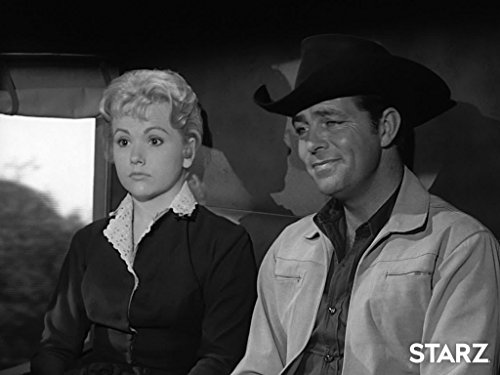
The first five seasons were black and white half-hour shows, while the final season switched to a color, hour-long show. During the last season, Hardie settles on a ranch near San Francisco and several recurring characters (Jack Ging, William Demarest, Virginia Christine, Lory Patrick, and Mary Jayne Saunders) were added to the series. Earle Lyon replaced Nat Holt as producer in 1960.

The theme song was written by Stanley Wilson and Mort Greene. Wilson was a prolific composer, amassing 147 credits for composing and 278 for music department credit on television and in movies. Mort Greene was best known as a writer for The Red Skelton Show and for his musical role for Leave it to Beaver.

The number of well-known actors who appeared on the show was surprising. Here are just a few of the huge number: Claude Akins, Eddie Albert, Hugh Beaumont, Dan Blocker, Charles Bronson, Edgar Buchanan, Harry Carey Jr., Chuck Connors, Buddy Ebsen, Beverly Garland, George Kennedy, Tina Louise, Steve McQueen, Jack Nicholson, Leonard Nimoy, Denver Pyle, Jason Robards, Vito Scotti, Dawn Wells, and Adam West.

đź“·mysteryfile.com

It was an NBC show. The pilot premiered on Schlitz Playhouse of Stars. Its biggest competition was Father Knows Best in seasons two and three. It was very popular with the viewers. The show was in the top ten during seasons one through four. For the sixth season, with an entire new cast, new theme song, and color, it was almost like a new show. NBC moved it to Saturday nights against Perry Mason and ratings declined drastically, costs went up significantly, and it was canceled.

Robertson thought the key to the popularity of the show was because it was not geared specifically to adults or kids. It was a family show. When Robertson first read the script, it was terrible, but he owed Nat Holt a favor, so he accepted the role, assuming that it would never make it. Robertson received a 50% ownership in the show, so he said of course it made him want the show to be better and he convinced them to replace most of the original script. He said that he enjoyed his time on the show a lot and that the crew was close and professional. They never went over schedule or over budget during the entire run.

đź“·thehollywoodreporter.com

The first two seasons were released on DVD in 2011 if you want to check them out. It sounds like this was a solid show. The network supported them, the cast was close, the production team was on top of things, and they all enjoyed their time with the show. That is a rare thing to hear in the television business. They took a gamble in the last season, and it didn’t work out, but perhaps it was for the best. It sounds like the actual show ended the season before because the last season things changed so much it was a completely new production. I would like to read more about Fred Dodge. His life sounds fascinating.

McHale’s Navy: Set Adrift in a Sea of Comedy

Ahoy matey. We are currently in the middle of the “We Salute You!” blog series. Today we go behind the scenes of one of the most popular military sitcoms: McHale’s Navy.

Photo: blogspot.com

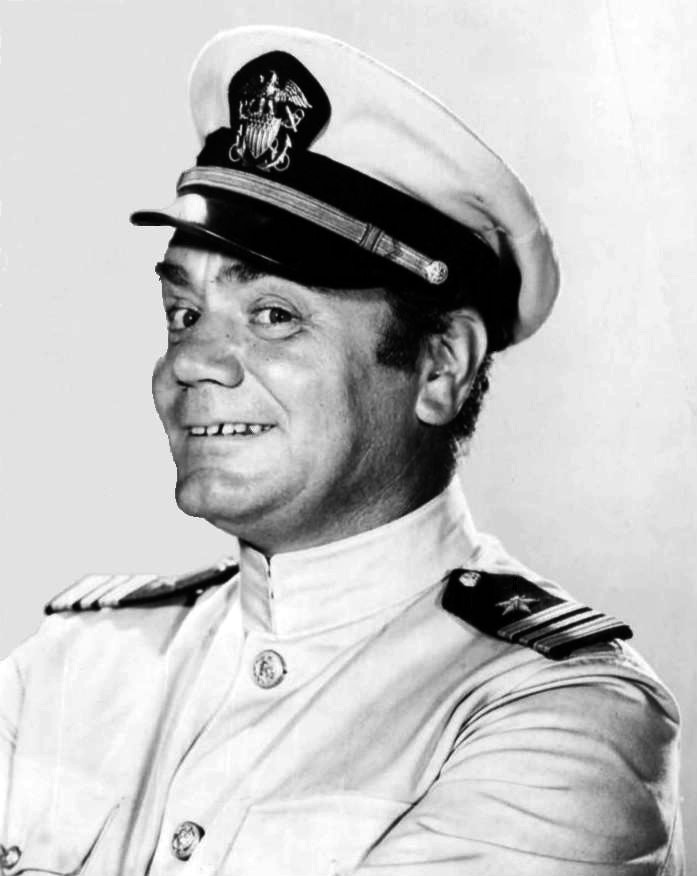
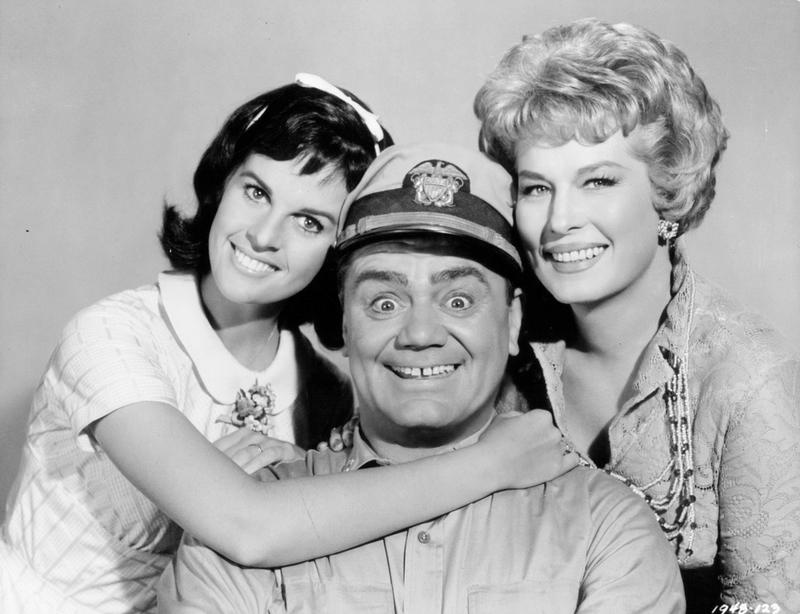
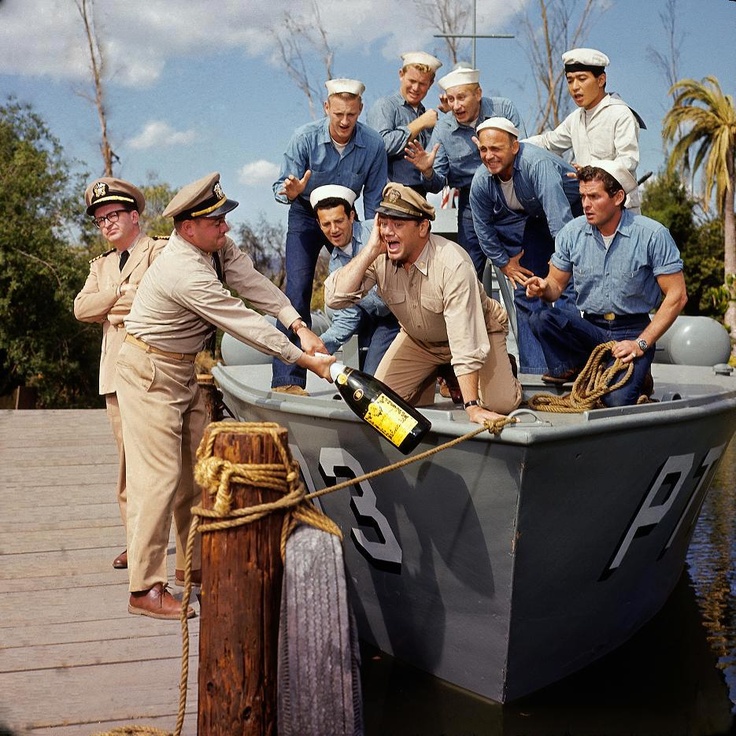
The series is centered around the adventures of a US Navy crew aboard the PT boat PT-73 during WWII. One of the best crews in the Navy, they often try to outwit Captain Binghamton (Joe Flynn) and his aide Lt. Carpenter (Bob Hastings). Stationed in the South Pacific, the crew often is involved in antics to make life more enjoyable during wartime. Quinton McHale (Ernest Borgnine) is fun-loving but sometimes has to reign his crew in when they go too far.

Debuting on ABC in 1962, the show sailed on for four seasons, producing 138 episodes. In April of 1962, a drama on Alcoa Premiere a/k/a Fred Astaire’s Premier Theatre aired that was titled Seven Against the Sea with Borgnine as the lead. It became the pilot for what would become McHale’s Navy.

Photo: thehollywoodreporter.com

Edward Montagne who was the producer of the new show had worked on The Phil Silvers Show. Montagne decided to turn the dramatic Seven Against the Sea into a “Bilko in the Navy” type of show. He recruited some of the actors and writers who had appeared on the prior series.

The basic plot of the show is that while these are respected, hard-working men when necessary, they have a lot of wacky schemes involving women, making money, and having fun. Captain Binghamton’s goal is to get rid of the entire bunch. The crew is said to live on an island across the bay from Taratupa, the fictional base. The geographic distance gives them extra time and more freedom to get into and out of their complicated situations.

Similar to The Phil Silvers Show, this sitcom also had a very large cast compared to most other shows.

Photo: wikiwand.com

McHale is a strong, competent leader and goes to great pains to protect his crew. He likes to wear Hawaiian type clothing when off duty. Sometimes the crew uses the PT boat to go deep-sea fishing or water skiing. When the crew has laundry, they put the clothes into a barrel with holes, add soap and drag it behind the boat. McHale speaks Japanese, Italian, and some of the local island dialects.

Photo: pauldavisoncrime.com

Ensign Charles Parker (Tim Conway) is McHale’s goofy second-in command. McHale calls him “Chuck.” Conway captured the lovable, naïve, bungler perfectly. He often refers to his home town Chagrin Falls, Ohio which was Conway’s hometown. Parker says he worked for the Chagrin Falls Gazette. Parker is too dizzy to get much respect, and his resume is full of errors and ineptitude. For example, it’s mentioned that he crashed a destroyer escort into a dock, and he called a naval airstrike on a gasoline dump. He has all the naval regulations memorized but can’t remember his serial number. From time to time, Parker is asked by the crew to impersonate President Roosevelt when calling Binghamton.

In the first episode, Parker is assigned to the crew. We learn that they have gone through several men already who could not put up with their insubordinate behavior and one of them even had a nervous breakdown. The men like Parker and treat him better than their previous ensigns.

Conway later stated that he and Ernest Borgnine had a wonderful working relationship both on and off the set. In the late 1990s, they would voice Mermaid Man and Barnacle Boy on  SpongeBob SquarePants.

Photo: pinterest.com

Captain Wallace Binghamton, who the crew calls “Old Leadbottom” because he once took a bullet in the butt, previously managed a yacht club, although at times it’s mentioned he was the editor of a yachting magazine. He is gruff and grumpy and dreams about being promoted. He spends much of his time trying to catch McHale and the boys in one of their schemes. He is blind without his glasses, so sometimes the crew knocks them off to prevent him from seeing something incriminating. One of his most-uttered lines is “Why me? Why is it always me?”

Photo: pinterest.com

A typical interaction between Binghamton and McHale follows:

Binghamton: Commander, how would you and your men like two weeks with nothing to do but play gin rummy, go surfing, have luaus with steel drum bands, dancing girls, hmm?

McHale: Two whole weeks? Woo hoo, oh that’d be a wonderful change sir. Yes sir.

Binghamton: Knock it off McHale. That’s what you do every week.

Photo: thewrap.com

Binghamton’s aide is Lt. Elroy Carpenter who is also inept. He talks too much and is clumsy. He often gets the brunt of Binghamton’s tirades.

Photo: pinterest.com

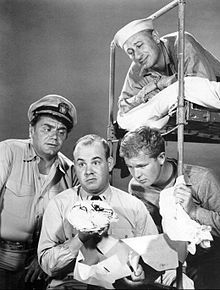
McHale’s crew is composed of Quartermaster George Christopher (Gary Vinson), Radioman Willy Moss (John Wright), Torpedoman’s Mate Lester Gruber (Carl Ballantine), Motor Machinist Mate Harrison Bell (Billy Sands), Gunner’s Mate Virgil Edwards (Edson Stroll), and Seaman Joseph Haines (Gavin MacLeod). Houseboy Fuji (Yoshido Yoda) was often found cavorting with the crew. He is boyish, fun loving, and loyal to McHale. Fuji was a deserter from the Japanese Navy, but the captain knows nothing about his existence. In exchange for not living in a POW section, he acts as houseboy for the crew.

Photo: groovyhistory.com

Although the crew is always chasing women and trying to throw parties that they can invite them to, McHale has several romantic relationships during the show. Nurse Molly Turner (Jane Dulo) from New Jersey is always trying to trap him in a serious relationship. Two other love interests are Kate O’Hara (Joyce Jameson) and Maggie Monohan (Jean Willes).

Photo: tumblr.com
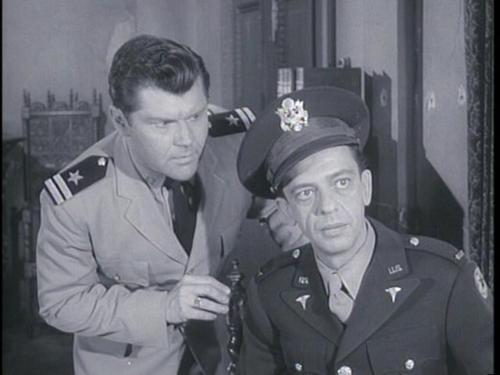
The great Don Knotts

A lot of guest stars dropped anchor on the show including Jerry Colonna, Bernard Fox, Pat Harrington Jr., Arte Johnson, Ted Knight, George Kennedy, Don Knotts, Bernie Kopell, Sue Ane Langdon, Marlo Thomas, and Raquel Welch.

Photo: lingerandlook.com

The PT-73 is almost like a character on the show. It was a 72-foot type II Vosper motor torpedo boat. The war ended before the boat (PT-694) could be sent to Russia, and it was then purchased by Howard Hughes. He loaned or sold it to Universal Pictures.

Photo: Wikipedia.com

The set of the Pacific Ocean naval base was built on the back lot of Universal Studios.  After the show went off the air, it became an attraction on the studio tour.

In one episode, McHale replaces Binghamton temporarily during an inspection and learns what a hard job he actually has. While that gives him some respect for the captain, they still don’t see eye to eye. Sometimes Binghamton tries to get them legitimately transferred for a scheme and other times he is not above inventing a story such as the time he tried to get them sent away by telling a psychiatrist that they are suffering from combat fatigue.

Photo: pinterest.com

For the final season, the crew, including Fuji, is transferred to Italy to the coastal town of Voltafiore. Many plot twists come about from the crooked Mayor Lugatto and the quirky residents. The move probably came about to be able to add some additional plot lines but it was perhaps too far-fetched for viewers, and the show was cancelled.

The show had a consistent schedule for most of its run. The first season it was on Thursday night up against The Twilight Zone and Hazel. The second and remaining seasons it was on Tuesday nights against Red Skelton on CBS and a variety of shows on NBC, including the forgettable Redigo and You Don’t Say, as well as The Man from UNCLE, Hullabaloo, and Dr. Kildare.

Photo: moviepostershop.com

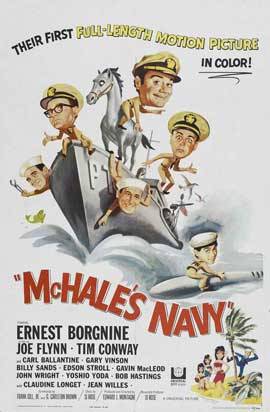
During the run of the show, two big-screen movies were made based on the series: McHale’s Navy in 1964 and McHale’s Navy Joins the Air Force in 1965. Borgnine was unavailable for the second film due to a schedule conflict. The first film brought in a respectable $2,250,000 and the second netted $1,500,000.

Photo: ebay.com

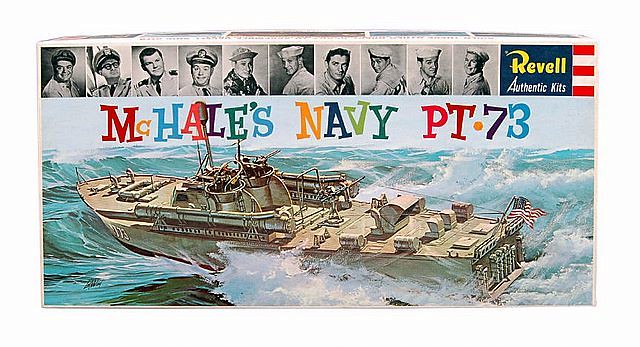
McHale’s Navy was a popular show both in the 1960s and in syndication. It may have been one of the first shows to produce related merchandise. Trading cards, comic books, a board game, 3-ring binders, and a model of the PT-73 were some of the items available to its fans. The show was well-written and the characters were fun and quirky. Unfortunately, a show like this can only sustain so many similar plots before it begins to feel like you’re watching repeats.

Photo: flickr.com
Revell :: McHale’s Navy :: PT 73 Boat

The show is currently on Antenna TV Saturdays from 7-8 pm eastern time. It is also available on DVD. Take some time and enjoy getting to know McHale and his PT-73 crew.