The Elegance of What’s My Line

This month, we are looking at popular fifties stars and shows. While the show we are talking about today outlasted the fifties by almost another decade, it gained its popularity during the 1950s. Today we are learning about What’s My Line.
📷wikipedia.com

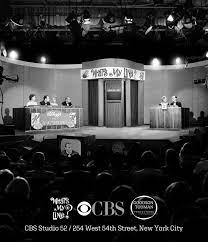
This panel game show was on CBS. It debuted in 1950 and ran until 1967. The show was produced by Mark Goodson and Bill Todman, and the working title was Occupation Unknown. Perhaps the title should have been What’s My Schedule. The show began on Thursday nights as a live show. Later in season one, it switched to every other Wednesday and then moved to every other Thursday. In October of 1950, it landed on Sunday nights where it would remain throughout the rest of its life.

The original series, which was usually broadcast live, debuted on Thursday, February 2, 1950, at 8:00 p.m. ET. After airing alternate Wednesdays, then alternate Thursdays, finally on October 1, 1950, it had settled into its weekly Sunday 10:30 p.m. ET slot where it would remain until the end of its network run on September 3, 1967.
📷imdb.com

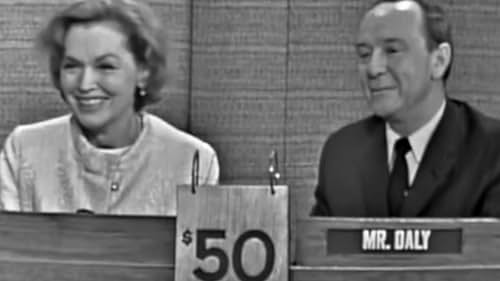
Celebrity panelists ask contestants questions to figure out their occupation. While most of the contestants were not famous, there was a “mystery guest” segment. The panelists were blindfolded for this segment and asked questions to determine the celebrity. People enjoyed watching the panelists banter with each other and the sophisticated humor they shared with us.

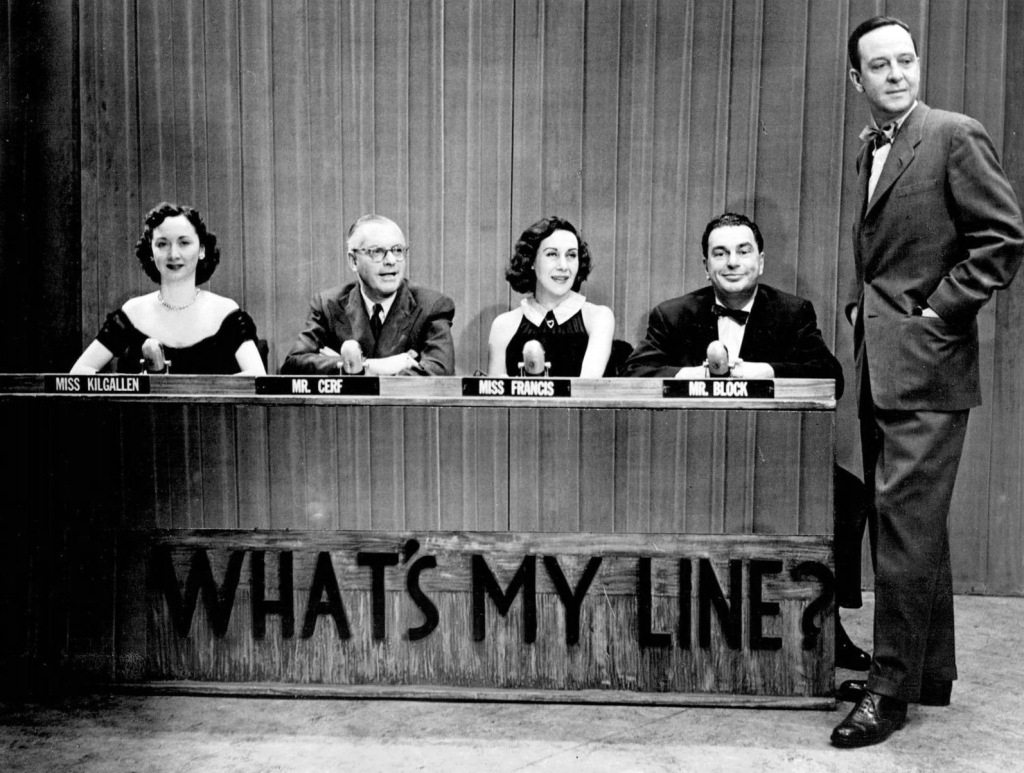
Each episode had four panelists. The most famous panelists were Dorothy Kilgallen, Arlene Francis, and Bennett Cerf. John Daly was the moderator. The first show in the series featured New Jersey governor Harold Hoffman, Kilgallen, poet Louis Untermeyer, and psychiatrist Richard Hoffman. Later in season one, Arlene Francis came  on board with Kilgallen, Untermeyer and writer Hal Block. In season two, Cerf replaced Untermeyer and Steve Allen took over for Block in season three. When Steve Allen left to host The Tonight Show, comedian Fred Allen was part of the panel from 1954 until his death in 1956. Kilgallen was killed in 1965 and her replacement varied for two years. Her death is a mystery itself and well worth reading about. Many people think she was killed because of her investigation into JF Kennedy’s assassination.

📷facebook.com

The panelists started the series wearing business clothing, but by 1953 they shifted to formal attire with the men showing up in suits and ties and women in formal gowns and gloves. Unfortunately, we never got to see the beautiful colors of these clothes. Until 1966 everything was filmed in black and white. In the final season, the show was broadcast in color, but the kinescopes were saved in black and white.

Both critics and television viewers liked the show, and it won an Emmy for Best Quiz or Audience Participation Show in 1952, 1953, and 1958.

Because it was a game show, most of the 700 episodes were on kinescope, 16 mm filming. Because many original shows in that era were recorded via kinescope onto silver nitrate film, many networks destroyed recordings to recover the silver. After learning that the network was not keeping the recordings, Goodson and Todman offered to pay for the broadcast and retained the recordings from season three on, however many of those were also lost along the way. A variety of the episodes are stored at different archive centers around the country. My home state houses one from 1951 at the University of Wisconsin Center for Film and Theater Research in Madison.
📷facebook.com

The remaining kinescopes which have been digitized have been seen on television on the Game Show Network and 757 of them exist on YouTube.

Many of us remember the reruns and seeing the contestant come on stage and write their name on a chalkboard as Daily said “Will you enter and sign in please.” The very first contestant was Pat Finch who was a hat check girl at the Stork Club.

The first mystery guest was New York Yankees shortstop Phil Ruzzuto. Many of these guests used fake voices to answer questions. Some of the mystery guests who appeared on the show included Julie Andrews, Louis Armstrong, Lucille Ball, Jack Benny, James Cagney, Gary Cooper, Joan Crawford, Salvador Dali, Sammy Davis Jr., Doris Day, Aretha Franklin, Ava Gardner, Judy Garland, Jackie Gleason, Alfred Hitchcock, Bob Hope, Ginger Rogers, Roy Rogers, Eleanor Roosevelt, James Stewart, Elizabeth Taylor, and John Wayne.
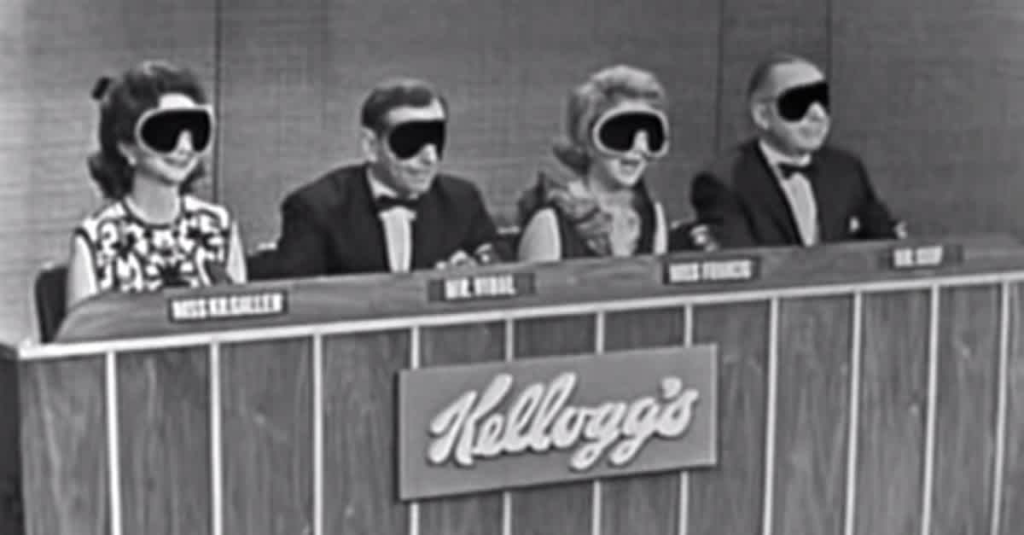
📷littlethings.com Blindfolds come out for a mystery guest

The emcee would choose a panelist who could ask yes or no questions. If the answer was yes, they could continue until they got a no response and then the next panelist would be able to pose questions. If the contestants answered no, Daily flipped a card; when the contestant had ten cards, they won $50.

If you have heard of or even used the term “Is it bigger than a breadbox?,” you might want to know that it came from the show. Steve Allen asked the question in 1953, and it became a standard question after that night. In fact, on one episode, the guest was a breadbox maker, and when Daly could not help laughing at the question, Allen figured it out.
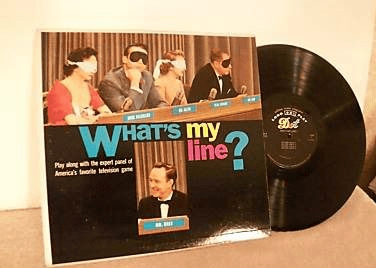
In 1967 The New York Times broke a story that CBS was canceling many of their game shows. None of the panelists had been told that the show was not renewed. Despite the fact that the low costs of the game shows made them profitable, the low ratings led the network to conclude that game shows were no longer suitable for prime-time schedules.

After the show was canceled in 1967, it did go into syndication five days a week. Soupy Sales joined Francis and Cerf on the panel of the reboot. A variety of other panelists took the fourth seat including Joyce Brothers, Jack Cassidy, Bert Convy, Joel Grey, Meredith MacRae, Henry Morgan, Gene Rayburn, and Nipsey Russell. The show ended in 1974. Cerf died during the run of the syndicated series.

It’s hard to believe, but Colonel Harland Sanders was on the show as founder of Kentucky Fried Chicken, although he was not easily recognized at the time, so he was not a mystery guest. While no president ever appeared while in office, Ford, Carter, and Reagan all appeared on the show.

📷youtube.com We switched to a first-name basis in the 70s

It would be fun to see this show on television today, but I’m afraid it would not be the same. In the way that Dick Cavett had a manner of interacting with guests to ask amazing questions with his humor and intelligence, this game show had that same atmosphere. Today, I think the banter would border more on crudeness than wit. There is something charming about a panel of very intelligent people talking with each other, trying to determine the identities of the people they were interviewing while being dressed to the nines that was fun to sit in on and be a part of. I guess that’s why this show is in our series where we are saluting the fifties because that was the era where it could shine.
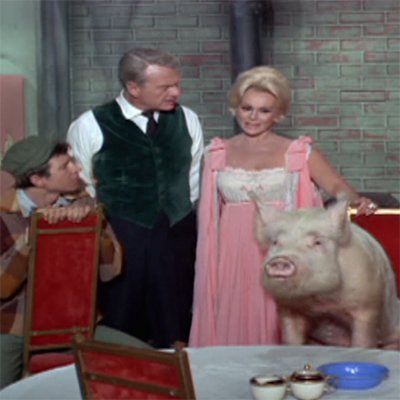
What do You Wear to Eat Beans and Franks with Arnold Ziffel?

There is a lot that happens behind the scenes to help make a show a hit. In previous blogs (see the December 2018 blogs about Earl Hagen and Jay Livingston), we learned about composers. This month we’ll take a look at the costumers and the set designers. The wardrobe department has the responsibility to make sure the characters are wearing the appropriate clothing for their character.

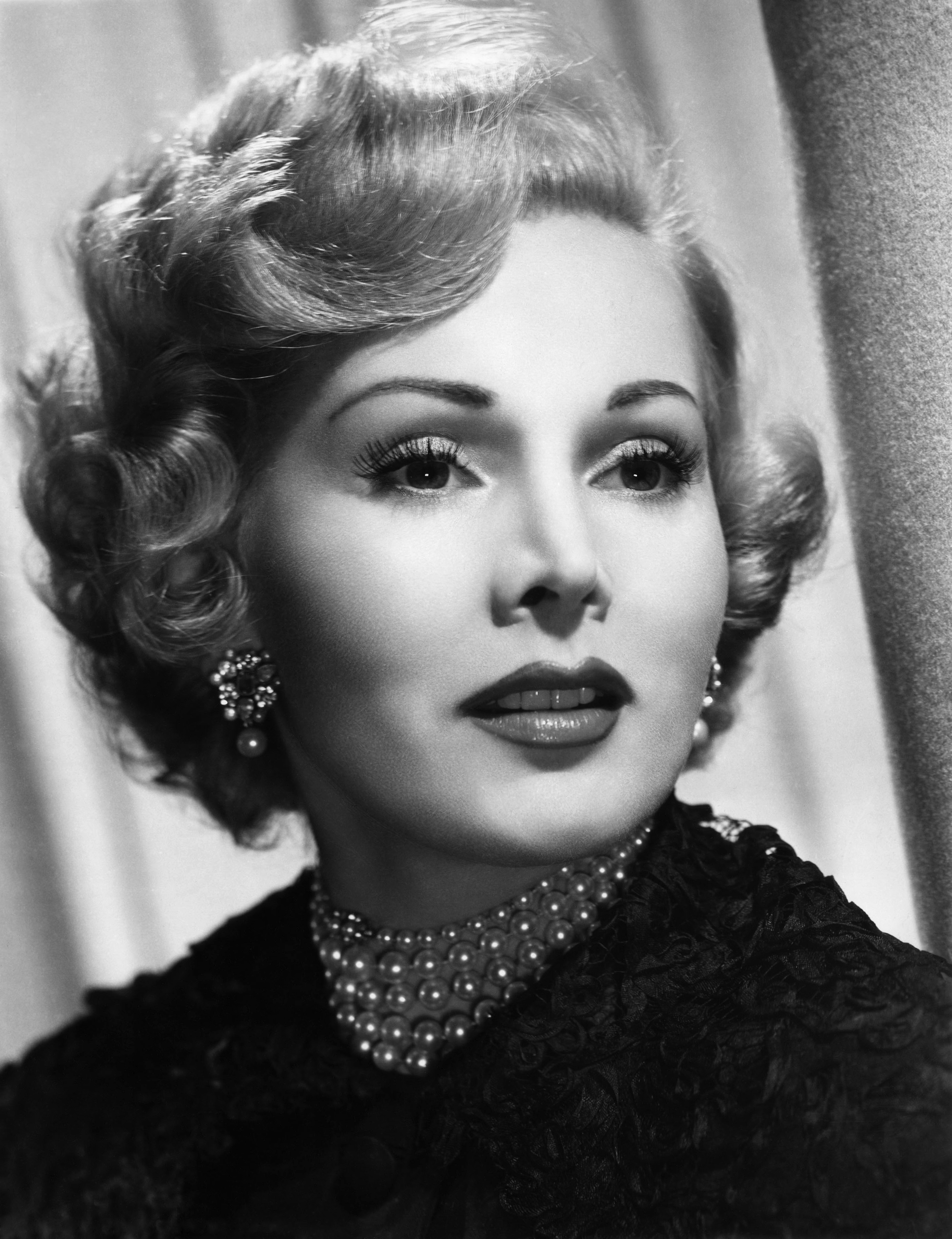
Zsa Zsa Gabor, ca. 1952
Photo: quotesgram.com

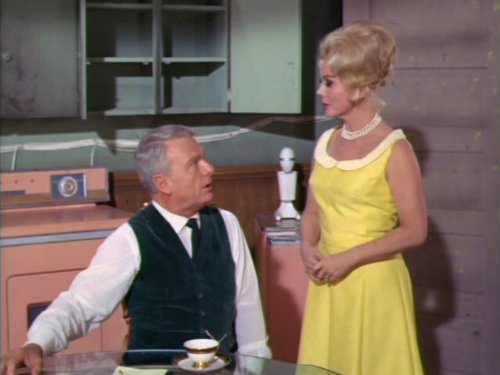
Green Acres presented a challenge for the wardrobe department. Most of the citizens were farmers, so overalls and house dresses fit the bill. Sam Drucker was the grocer, postman, and newspaperman for Hooterville, among other jobs. He always wore a blue shirt with a tie and had his postman vest or grocery apron on. Lisa and Oliver Douglas played an attorney and his wife who relocated from New York City and the social scene to rural Hooterville to run a farm. Oliver often wore suits on his tractor, looking somewhat silly and questioned by the locals. Lisa also continued to wear her glamorous outfits, but somehow, she was accepted by everyone and fit in wherever she went.

Photo: metv.com

Lisa Douglas could wear anything and look good. She often wore her negligees around the house without being thought a hussy. She could show up in a sequined gown for a local band performance and was just one of the crowd. She wore gowns of boldly colored prints, but she was just as likely to show up in a single-colored sheath dress with a simple strand of pearls.

Photo: imdb.com

With her lavish updo hairstyle and her extensive collection of jewelry, Lisa was fun to outfit. Three designers were responsible for the majority of Lisa’s wardrobe: Jean Louis, Lucie Ann Claire Sandra, and Nolan Miller.

Jean Louis

Born Jean Louis Berthault in 1907 in Paris, France, he was an Academy Award winner for The Solid Gold Cadillac in 1956 starring Judy Holliday. (Jean was nominated for 13 Academy awards.)

Photo: pinterest.com

He attended the School of Decorative Arts and then went to work for Agnes Drecoll, courtier. In 1935, he moved to New York city where he worked for Hattie Carnegie before going to Hollywood. While working there he began gathering a large clientele, including Wallis Simpson and Irene Dunne.

Photo:
Black gown -1960s Jean Louis Silk Tiered Gown

From 1944-1958, he was head designer for Columbia Pictures. Some of his most creative designs included Rita Hayworth’s black satin dress from Gilda, the beaded gowns worn by Marlene Dietrich, and the sheer, sparkling dress Marilyn Monroe displayed when she sang “Happy Birthday” to John F. Kennedy. He also was the primary designer for Kim Novack.

Photo:
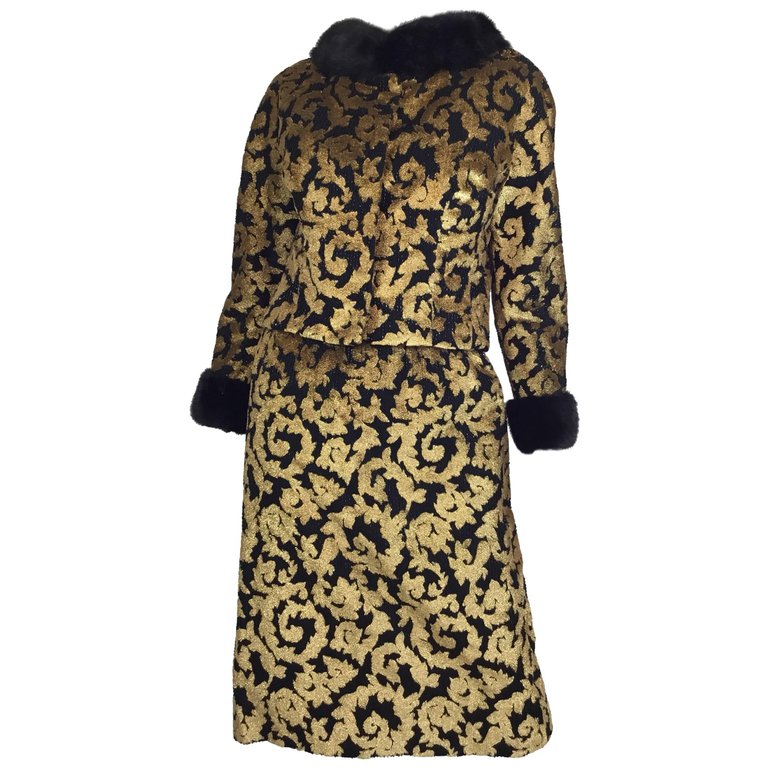
Gold and black lame dress

In 1958 he moved over to Universal. There he began a working relationship with Doris Day, with Pillow Talk, their first collaboration. Journalist Tom Vallance described his work:- “He created a sophisticated allure for Doris that launched a new phase of her career.” James Garner, who also starred with Doris in several films said she “exuded sex appeal while still maintaining her All-American Girl next door image.” Jean Louis also worked with Lana Turner during this era, putting together her colorful wardrobe in Imitation of Life. Jean’s daughter said her father “had the most amazing discerning eye for color. It was a sixth sense for him.”

Jean Louis had designed the clothing for The Loretta Young Show from 1953-1961. She was a close friend of Jean and his wife Maggie. After Maggie passed away, he and Young married in 1993. She was considered one of, if not the best, well-dressed stars. He also designed clothing for Ginger Rogers, Vivian Leigh, Julie Andrews, Katherine Hepburn, and Judy Garland.

Jean began to freelance in 1960. He opened a boutique in Beverly Hills and sold his label, “Jean Louis, Inc.” at better department stores all over the country. During this time, he also updated the United Airlines stewardess uniforms.

Photo: metv.com

From 1965-1967 he designed Lisa Douglas’s dresses on Green Acres. He was the perfect designer for her. Gifted with a great sense of humor, he could undoubtedly relate to the humor on the show.

Photo: thewritelife61.com

As he said during a Vogue interview, “You can use marvelous fabrics, have wonderful, impossible embroidery—in fact, be superluxe and superluxe is what the couture is all about.”

Photo: tumblr.com

In the 1970s, he opened a boutique in France and launched his first fragrance. His career was still flourishing with clients like Jacqueline Kennedy, Sophia Loren, and Bianca Jagger.

Jean Louis passed away in 1997. His influence continues to be felt among designers today. Some of the fashion icons who admit being influenced by him include Michael Kors, Vera Wang, Giorgio Armani, and Zac Posen.

Photo: imdb.com

Lucie Ann-Claire Sandra

Lucie Ann vintage nightgowns are among the most glamorous and desirable negligees ever made. Lucie Onderwyzer founded the fashion company in 1947 in Beverly Hills. Known for bold color and exuberant details like pompoms, bows, rosettes, and rhinestones, she designed for many stars including Elizabeth Taylor.

Photo: pinterest.com
A few of Lisa’s gowns in the background

She designed all the peignoir sets worn by Eva Gabor in Green Acres. Her designs were also featured in other television shows and movies. In one episode of Bewitched, Darrin goes to the store to purchase a Lucie Ann for Samantha.

Photo: pinterest.com
Darrin shopping for Samantha

Lucie passed away in 1988 and her company was bought by Deena Lingerie Co and later Lady Ester Lingerie Company which is still making them today.

Norman Miller

Norman Miller was a wardrobe consultant for Eva on Green Acres.

At www.emmytvlegends.org/interviews/people/nolan-miller, Miller described his relationship with Eva.

 “I adored Eva. We worked together for many years. Later on, our working relationship became a friendship that I really valued. She wasn’t silly. She was a very smart lady. Not so smart with the men of her life. Her home was incredibly elegant. Anything that she needed I would do.” Miller shares about the time when Eva discovered a store called Loehmann’s; the store would buy designer samples and pack them up in huge boxes for stars to pick from. “Eva was a size 8 and the sample sizes were 2, and she’d simply ask me to do my magic and tailor them to her size. I smile at that as Eva could get anyone to change things around for her. I sometimes wonder whether she did understand fully well what was entailed in changing a size 2 into an 8 just like what was entailed in coming up with an animation idea tailor-made for her. She’d bat her eyelashes and sprinkle in a few ‘darlings’ and you find yourself doing what she wanted.”

Photo: pinterest.com
A pink chiffon sleeveless floor-length Nolan Miller dress with accompanying chiffon and ostrich feather wrap worn by Eva Gabor on the television series Green Acres.

Miscellaneous

These three designers were the major forces behind Lisa Douglas’s beautiful fashion style on Green Acres. Gabor had an amazing fashion sense and was well known for her private wardrobe. She also was a successful business woman, owning a multi-million-dollar wig company.

Photo: newyorksocialdiary.com

Eddie Albert tells a great story about Gabor and her fashion. At her funeral, he said he probably saw more of Gabor than any of her five real-life husbands did. And, like any couple, married or not, they had their differences. She, for example, never quite understood his passion for wildlife conservation. “Every time you hear about a sick fish, you make a speech. Vy?,” Albert recalled his co-star saying. “And I would tell her, ‘I think we ought to preserve nature, save wild animals,’ and so on. Well, one day she showed up in a gown made of feathers, and I asked her not to wear it. ‘But so chic!’ she said. And I said, ‘Yes, and ladies will see it and want one, and thousands of birds will die.’ And she said, ‘But, Eddie, feathers don’t come from birds.’ ‘Well,’ I asked, ‘where do they come from?’ And she said, ‘Dahlink. Pillows! Feathers come from pee-lowz!’ ”

Perhaps there was more of Eva Gabor in Lisa Douglas than we realized.

Photo: sitcomsonline.com