Bracken’s World: Ahead of Its Time

As we wind up our What in the World? blog series this month, we end with Bracken’s World. Just like the other shows we covered, this one began in the sixties, 1969, and just like the others, it was on for less than two seasons.

Dorothy Kingsley created the series for NBC. This was her only foray into television; she was a screenplay writer for most of her career. Kingsley wanted to concentrate on the “little people” who work at the studio, rather than the executives. In one blog I read that props from Twentieth Century Fox where the show was filmed were often carted around in the background for authenticity. It would be fun to go back and make a list of the props that were shown around the set; specifically mentioned were props from Planet of the Apes and Land of the Giants.

Watch.plex.tv.com captures the essence of the show in its description “In the glitzy realm of Century Studios, powerful executive John Bracken shapes Hollywood’s fate, navigating ambition, romance, and betrayal through the eyes of his astute secretary Sylvia, who holds the key to both secrets and success.”

Century Studios was a movie studio. John Bracken owned the company, and he was never seen during the first season. Similarly to the way Charlie interacted with Charlie’s Angels, we only heard Bracken on the telephone, voiced by Warren Stevens. Sylvia Caldwell (Eleanor Parker) was his secretary. There were some impressive cast members in this show including stunt man Dennis Cole, Jeanne Cooper, Madlyn Rhue, Linda Harrison, Elizabeth Allen, Karen Jensen, and Laraine Stephens. Most of them played starlets waiting for their big break. Peter Haskell as producer Kevin Grant seemed to be responsible for a lot of the success of the show. Tom Selleck had a recurring role of Roger Haines during the first season. The characters dealt with the problems of the movie industry—drugs, sex, alcohol, and amoral executives.

Being a Hollywood studio, there were also a lot of great guest stars including Anne Baxter, Shelley Fabares, Sally Field, Lee Grant, Carolyn Jones, Ricardo Montalban, Edward G. Robinson, Martin Sheen, Richard Thomas, Forrest Tucker and Raquel Welch.

The series was on Friday nights in the hole filled when Star Trek was canceled. It was referred to as the “Friday night death slot.” The show’s competition was Love American Style and CBS Friday Night at the Movies, which started an hour before Bracken’s World did. I’m not sure when this death slot switched because at that same time, I recall loving Friday nights in the early seventies featuring The Brady Bunch, The Partridge Family, Room 222, The Odd Couple, and Love American Style.

The show’s ratings were not good, so for the second season, things were changed a bit. Parker left part way through season one because she didn’t like the scripts. We now got to see John Bracken in person, but he sounded like Leslie Nielsen who played him instead of John Warren. Dennis Cole was also shown out the door.

Jeanne Cooper had a very different view of the show than Parker. Cooper played one of the starlet’s mom who was also her agent. She said that it allowed viewers to go behind the scenes of a movie studio to get a realistic depiction of what happened when the cameras were off. She said that the cast can take much more time filming movies to discuss the script, but that is not the way television works, and Parker never understood the difference between the two mediums. Cooper felt the writing was much more sophisticated than shows had produced before and that it led the way for shows like LA Law and Boston Legal.

According to Cooper, there were two reasons for the demise of the show. One was that she said Bracken should never have been exposed. He should have stayed a voice who ran a studio like a Louis B. Mayer type. She also said the show was very expensive to produce. Often shows were ordered six at a time back then which gave the crew some wiggle room to have a few expensive shows and then cut back when it got viewers locked in to average out the cost. NBC would only buy two or three at a time. Finally, Stan Rubin, the executive producer, said NBC had to agree to a minimum of four-episode commitments at a time and they refused, so the show was canceled.

The show did seem to be a bit ahead of its time. Perhaps if it had debuted a few years later, it would have found more viewers.

Verrry Interrresting!

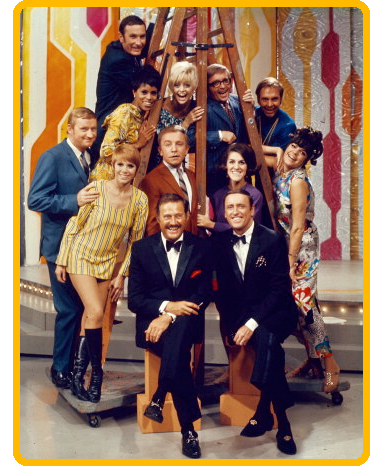
Occasionally, a show is so entrenched in the time and culture it debuts in, it becomes almost impossible to describe or understand away from its original setting. Dan Rowan and Dick Martin were nightclub comics who co-hosted a special called Laugh-In in 1967.  The name was a play on words based on the love-in’s and sit-in’s happening in the 1960s.  The special was so popular it was turned into a weekly series. I think of Laugh-In as Sesame Street for adults.  Both shows debuted in the late 60s and had a rapid-fire approach, continually moving on to the next segment so the viewer would not get bored. The show captured the counterculture movement and the lime green, turquoise, fuschia, deep orange, bright yellow, and paisley flowers kept our eyes moving as quickly as the jokes did. The show lasted six seasons.

laughin1

Regular cast members who went on to other careers included Ruth Buzzi, Gary Owens, Alan Sues, Arte Johnson, Henry Gibson, Lily Tomlin, Richard Dawson, Jo Anne Worley, Goldie Hawn, Judy Carne, Dave Madden, and Flip Wilson.

Numerous celebrities flocked to the show.  Movie stars that were reeled in included John Wayne, Jack Benny, Peter Lawford, Zsa Zsa Gabor, Charles Nelson Reilly, Debbie Reynolds, Rock Hudson, Jack Lemmon, Edward G. Robinson, Sally Field, Orson Welles, and Rita Hayworth.  Noted musicians included Sammy Davis Jr., Dinah Shore, Johnny Cash, Perry Como, Liberace, Bing Crosby, Cher, Rosemary Clooney, and Liza Minelli. Sports stars tackled the chore including Joe Namath, Wilt Chamberlin, Sugar Ray Robinson, and Howard Cosell.  Comedians who laughed their way on the show included Rich Little, Don Rickles, Bob Hope, Bob Newhart, Paul Lynde, and Carol Burnett. Classic tv stars who accepted starring roles were Tim Conway, Carl Reiner, Steve Allen, Jim Backus, Ernest Borgnine, Eve Arden, Andy Griffith, Desi Arnaz, and Wally Cox.

The format rarely changed from week to week.  Rowan and Martin opened each show with a dialogue; Rowan acted as the straight man, and Martin took on the gullible role. Then the regular cast, along with celebrities, danced against a psychedelic background, firing off one-liners and short gags. Comedy bits, taped segments, and sketches filled in the rest of the hour and always ended with Rowan telling Martin to “Say goodnight, Dick” and Dick replying, “Goodnight Dick.”

Some of the regular features were:

laughinn

The Cocktail Party where the cast stood around spouting politically and sexually suggestive jokes.

Letters to Laugh-In where the cast read letters.

ROWAN AND MARTIN'S LAUGH-IN,  Teresa Graves, Pamela Rodgers, 1969-1970.

It’s a Mod, Mod World where go-go dancers danced in bikinis with puns and word play phrases painted on their bodies.

farkel

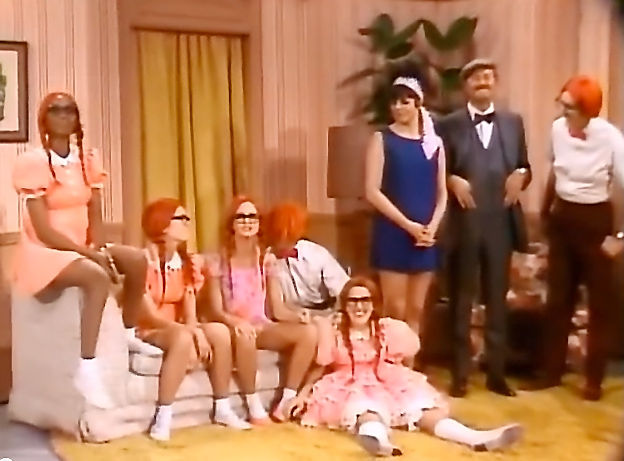
The Farkel Family about a group of red-headed, freckled family members.

fickle

The Flying Fickel Finger of Fate Award where dubious achievements were celebrated.

Laugh-In Looks as the News was comparable to the Saturday Night Live news sketches of today.

New Talent Time showing various weird skills.

Many of the regular cast members had their own skits that were repeated during the series’ run:

carne

Judy Carne was always tricked into saying “Sock it to Me” which then caused her to get doused with water, fall through a trap door, or endure some other indignity. Sometimes celebrities ended up being the ones to say “Sock it to me,” the most famous being Richard Nixon when he was campaigning for president.

buzzi

Arte Johnson played Tyrone, an inappropriate senior citizen who tries to seduce geriatric Ruth Buzzi as Gladys, forcing her to eventually hit him with her purse.

laughinc

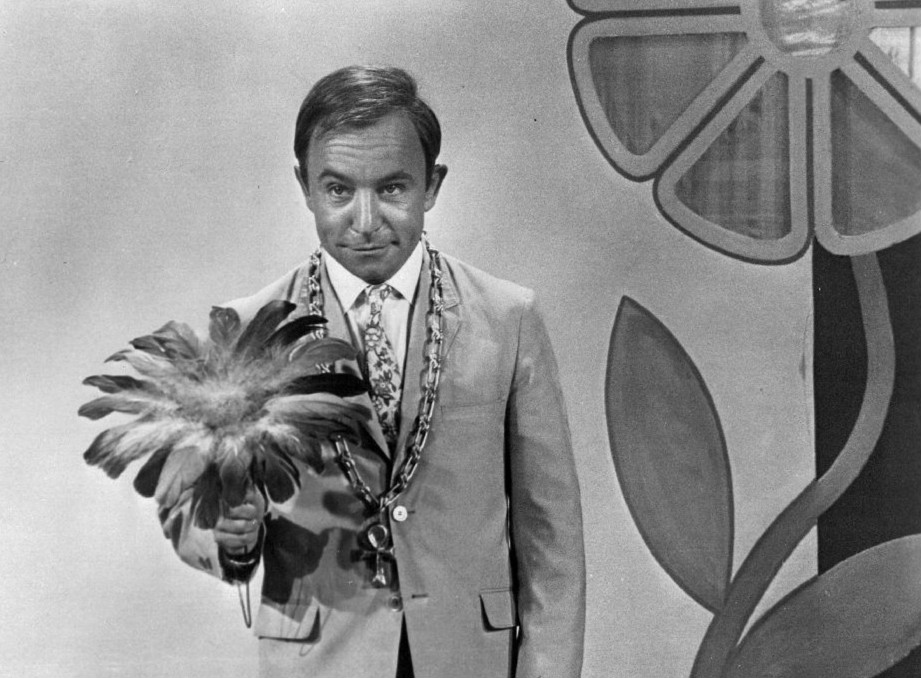
Henry Gibson came on stage holding an oversized paper flower, reciting poetry.

Lily Tomlin performed skits as Ernestine, a telephone operator or Edith Ann, a young girl sitting in a rocking chair. (Personal note:  When I was in 4th grade, I performed an Ernestine and an Edith Ann skit for our talent show.  Why a 9-year-old was watching Laugh-In and the school approved the skits, I can’t say, but I remember getting a lot of compliments.  And Lily Tomlin didn’t sue me for stealing her material!)

sues

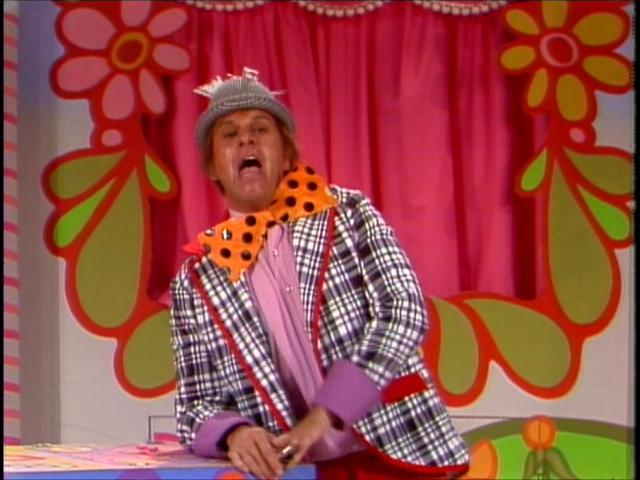
Alan Sues portrayed Uncle Al, a children’s show host, who was short tempered and often in bad shape from his late partying nights.

laughinh

Flip Wilson was Geraldine.

laughin6

Jo Anne Worley would say “Bor-ing” in the midst of jokes.

laughing

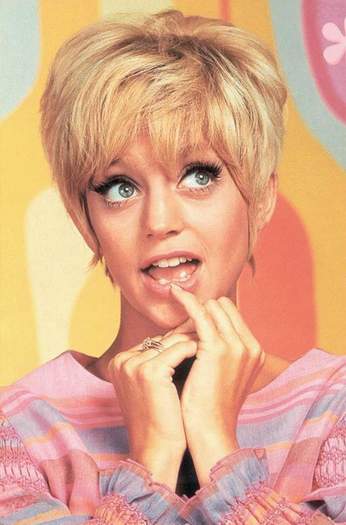
Goldie Hawn as the ditzy blonde.

The series also became known for some of its catch phrases including “Look that up in your Funk & Wagnalls,” “You bet your sweet bippie,” “Beautiful downtown Burbank,” “Is that a chicken joke?,” “Sock it to me,” “Here come de judge,” and “Verrrry Interesting.”

The show was one of the highest rated shows in the late 1960s. It was in the top 4 of the top 40 shows for its entire run. It won Emmy and Golden Globe awards. The Nielsen polling determined it was the most-watched show in seasons 1 and 2.

The show had its own magazine for a year.  Trading cards were sold with catch phrases and images from the show. Several records were produced capturing the humor of the time.  There was even a set of View-master reels made, as well as lunch boxes and other memorabilia.

laughinrev

Laugh-In debuted fifty years ago, but still feels new and edgy. Because the show has not been syndicated in re-runs, it is hard for the current generation to imagine how very different this show was from anything else that appeared on television before it.  The closest show to capturing any of its essence since then is Saturday Night Live.  This was a time when everything was changing: civil rights, Vietnam, women’s lib, the hippie lifestyle, psychoactive drugs, anti-authoritarianism, freedom of speech and assembly, and environmental concerns, especially littering and pollution.

The Generation Gap was a real concept in the 1960s but this show might have come as close as anything else to bridge that gap. Families sat down together to watch the show. Many of the phrases still have a life of their own decades later even thought decades of kids have never seen the show.  Plan your own little sit-in when you check out a couple of the you-tube videos to get a flavor of what the series was like.