It’s 2026! And it’s January, so we are starting the year off with “Worth a Million.” This month we are learning about the careers of several of the cast members from How to Marry a Millionaire. This show debuted in 1957 and aired for two years.
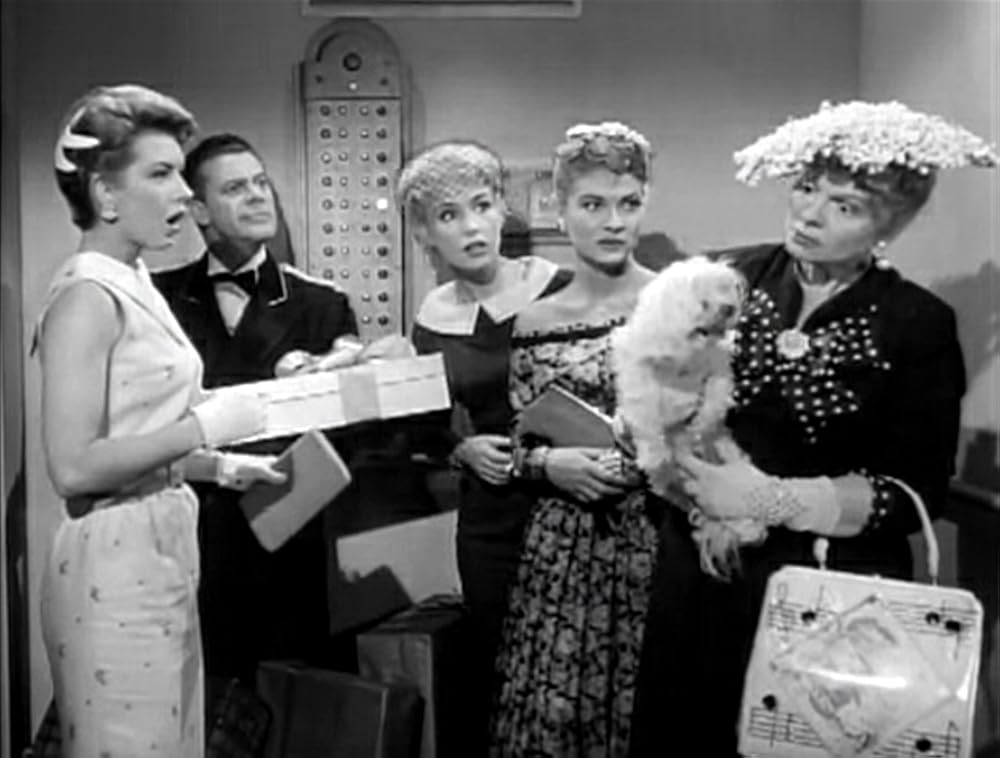
📷tmdb.com The first year cast of women
According to imdb.com, the plot is “Motherly Mike, ditzy but sexy Loco, and sensible Greta move to the big city to find themselves wealthy men to turn into husbands. After the first year Greta gets married with Gwen moving in as the new roommate in this syndicated series.”
The six members of the cast included Merry Anders (Mike), Lori Nelson (Greta), Barbara Eden (Loco), Jimmy Cross (Jesse), Lisa Gaye (Gwen), and Joseph Kearns (Mr. Tobey). During the past decade, we have learned a lot about Barbara Eden, best known as Jeannie in I Dream of Jeannie and Kearns who we remember as Mr. Wilson in Dennis the Menace. So, this month we are learning about the four remaining stars, and we begin today with Jimmy Cross.
📷imdb.com Cross as elevator attendant
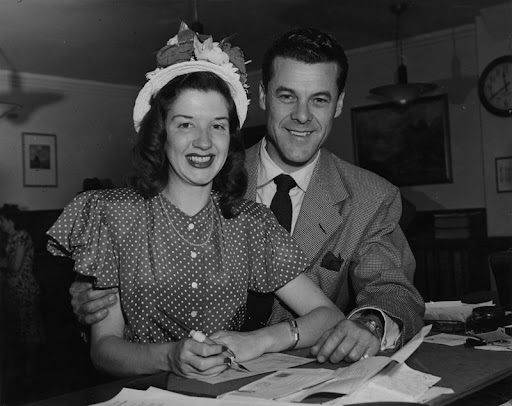
Cross was born in 1907 in New York. At age 40, he married actress Peggy Ryan, but they divorced after the seven-year itch. Ryan was a popular face for a while. She and Donald O’Connor were supposed to be the next Judy Garland/Mickey Rooney couple. Ryan’s parents were Vaudeville dancers, and she was on stage by age two. She was an amazing dancer and singer. After she and Cross divorced, she tried another short-term marriage to Ray McDonald before meeting Eddie Sherman whom she was with for almost fifty years. You might remember her as Jenny, Steve McGarrett’s secretary on the original Hawaii Five-0.
On How to Marry a Millionaire, Cross played the elevator man, at age 50, who worked in the apartment building where the girls lived. He sometimes helps and sometimes hinders the trio with their get-rich-husband schemes.
This was the only series he costarred in, but he did show up on The Red Skelton Show 46 times.
Cross typically played a background role, often a bartender, drunk, or photographer. However, he was busy and appeared on almost every popular show during the sixties and seventies, garnering almost 100 credits during those decades. His last role was in BJ and the Bear in 1979, two years before his death.
📷thevalleytimes.com With Wife Peggy Ryan
Cross also had a decent movie career. Again, he was not front and center but had some fun parts and if you look quickly, you will see him in several popular movies including North by Northwest, Bells Are Ringing, Hello Dolly, and The Poseidon Adventure.
I wish I knew more about Cross. There just isn’t much information out there considering how long he worked in the entertainment industry. This is one of those cases where his work might have to speak for itself. That said, this show got a lot of good reviews when it came out and Cross, while not being a star, added a fun element to the episodes he was in.
We are in the middle of our blog series for November, “What a Character!” Today we get to meet the delightful Sylvia Field.
Born Harriet Louisa Johnson in 1901 in Allston, Massachusetts, Field always knew she wanted to act. When she was ten, she saw Maude Adams in “Peter Pan,” and she decided that would be her career as well. After being diagnosed with diphtheria, she was not allowed to attend school for a while. So, when she was feeling better, she ventured down the street to a motion picture company that was filming movies. She was allowed to join the cast and became the “leading lady of the extras.”
📷facebook.com
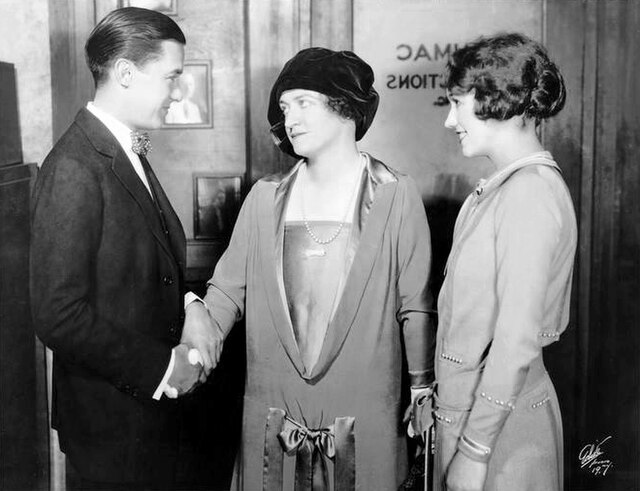
Eventually she decided to move to New York. At only 17, she made her Broadway debut in “The Betrothal.” She never did go back to school.
📷wikipedia.com 1927 Broadway shot
A decade later she got her first shot at the big screen in The Home Girl. She was signed by Fox Studios in 1939. Her last acting credit was also for a film, The Cruz Brothers and Miss Malloy in 1980. While she fit a few movies in her career, most of her appearances were on television.
After she began her film career, she married Robert Frowhlich in 1924; they were only married five years. In 1930 she tried marriage again with Harold Moffat; he passed away eight years later. In 1941 she married Ernest Truex, and they remained together until his death in 1973.
Truex had an interesting background. He was born in Kansas where his father was a doctor. In exchange for medical services, one of his father’s patients gave Ernest acting lessons. Ernest performed Shakespeare as a five-year-old child, and was given the nickname, “The Youngest Hamlet.” As a nine-year-old, he and his mother toured the country while he performed. Before he was a decade old, he was in his first Broadway show with Lillian Russell.
📷wikipedia. The Butter and Egg Man by George Kaufman
In the movies he played the quiet, ineffectual boss. Like Field, he was also a regular cast member in three shows. His were Jamie, Mister Peeper, and The Ann Sothern Show.
Field and Truex traveled around the country in plays together before starring in a local New York series featuring members of their family. The couple had a blended family with Field’s daughter Sally Moffat and Truex’s three sons. All four of the kids became actors. I’m guessing it was like The Adventures ofOzzie and Harriet. The show was on the air for three years before Truex and Field decided to move to California.
Sylvia’s first television appearance was on the Chevrolet Tele-Theater in 1948. She continued accepting roles on many of the drama shows through the mid-fifties. In 1952 she got her first cast role as Mrs. Remington on Mister Peepers. Ernest Truex was also part of the cast, playing Mr. Remington. They played the parents of Nancy, the school nurse, Mister Peepers’ fiancé. (Field and Truex would work together again on a 1966 episode of Petticoat Junction, “Young Love,” as well as in The Ann Sothern Show.)
📷who’sdatedwho.com Field and Truex
After Mister Peepers was canceled, she accepted a few spots on current shows including The Ann Sothern Show, Father Knows Best, Perry Mason, and The Thin Man.
In 1958 Sylvia received another cast offer to become Aunt Lila on both Annette and The Mickey Mouse Club. These shows shared cast members, so if you were cast on one of them, it was a buy one, get one deal.
Aunt Lila only lasted a year, which was a good thing, because Field was free to accept the role of Martha Wilson on Dennis the Menace, beginning in 1959. She defended Dennis to her husband George for almost four seasons.
Before the 1962 season, her tv husband Joseph Kearns passed away. For the season, Gale Gordon was brought in as George’s brother John, who was staying with Martha while George was away on personal business. However, the next year, Field was written out of the show, and John’s wife Eloise took her place, played by Sara Seegar. John and his wife bought the house from George and Martha, and no explanation was given to why they moved away. Sylvia and Jay North, who played Dennis, remained friends for the rest of her life.
📷WPRI.com Field, North, and Kearns
For the rest of her career, she would show up on television shows including Hazel, Occasional Wife, and Lassie. After Truex’s death, Sylvia accepted a couple of roles but spent much of her time fishing, golfing, watching baseball, and taking care of her avocado orchard. Eventually she had to move to a nursing home where she passed away in 1998.
I always enjoyed Martha Wilson. She and George took on the role of Dennis’s pseudo grandparents. While George was gruff, everyone knew he loved Dennis. Martha was more affectionate and always waiting with cookies, ready to hear about his latest exploits. Field seemed to have a great life. She had a prolific career and then was able to enjoy retirement which so many actors find impossible to do.
Our last two shows are both set in Springfield, and we might do a bit of comparison and contrast next week. This week we are checking out the Anderson family on Father Knows Best.
📷wikimedia.com
The show debuted on NBC radio in 1949. For five years it was sponsored primarily by General Foods. None of the television cast members were part of the radio show, but you would recognize the voice of Jean Vander Pyl from The Flintstones.
A couple of months before the show ended on radio, it made its move to television. This was not all that unusual in the early days of television, but the show began on CBS for a year, then it was picked up by NBC for three years, and then it returned to CBS for two years.
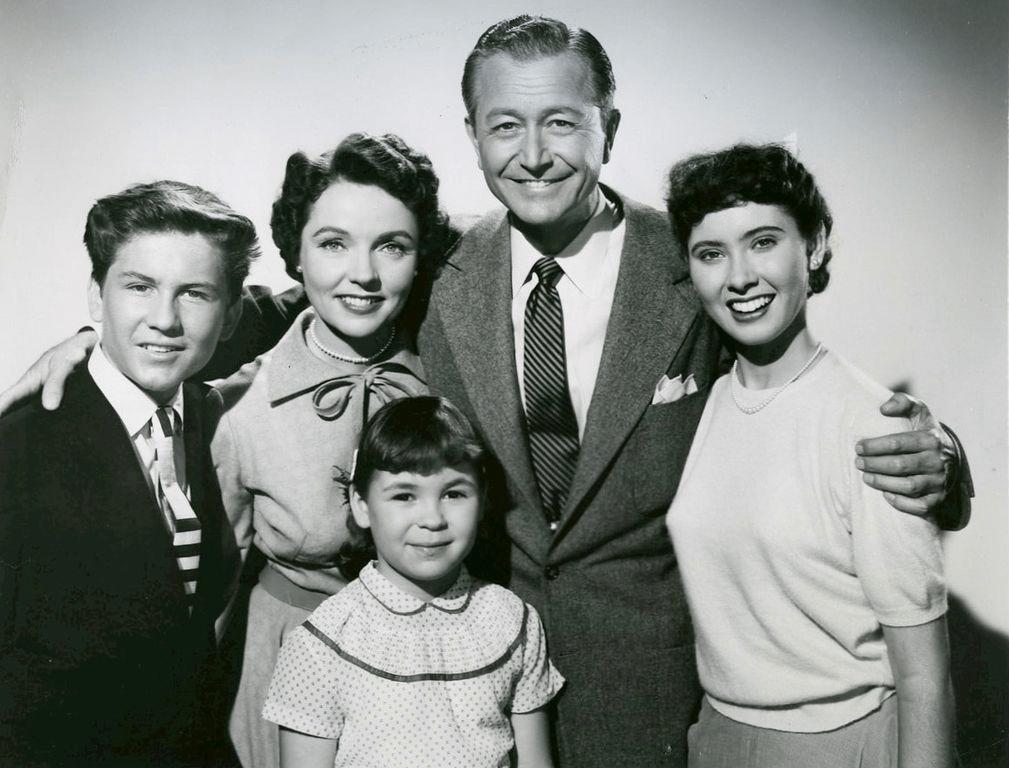
The pilot aired on an episode of The Ford Television Theatre and was called “Keep It in the Family.” While the show was picked up, only Robert Young was retained from the original cast. Joining him were Jane Wyatt as Margaret, Elinor Donahue as Betty, Bill Gray as Bud, and Lauren Chapin as Kathy.
📷evergreenarchives.com
I think we all have this stereotyped vision of the Anderson family in our memories. In fact, the US Department of the Treasury requested a 30-minute episode of the show that was never aired on television. It was distributed to schools, churches, and civic groups to promote the sale of savings bonds. However, when I watch the show today, I think it got some unfair criticism. There are several episodes when Margaret has just had it with cleaning and cooking for an ungrateful family. The kids are sometimes portrayed as thoughtless and self-absorbed. The three children often disappoint their parents and sometimes the parents are not good role models. I don’t say that in a negative way—it’s a realistic description of a lot of us as teenagers and parents at times.
📷imdb.com
Robert Young and his business partner Eugene B. Rodney developed the show with Screen Gems. Casting was not an easy task. One of the things they were trying to avoid was stereotyping. They wanted Bud to be absorbed but not flip. Young and Rodney mentioned that it was not easy to do the gags in the right tone, but they knew they had their Bud in Gray in a scene where Jim is worried about Betty getting too serious. Rodney relayed the following story: “As an example”, said Mr. Rodney, “when Jim, worried about Betty’s going steady, reads aloud a newspaper story about a girl eloping and taking $200 with which her aunt was to buy a TV set, our Bud had to be able to look up and ask seriously, ‘What size screen, dad?’ Billy Gray was the only actor that could do it the way we wanted.”
Kathy was a bit harder to cast for; seventy-eight girls auditioned for the role. Chapin had no acting experience before the show, but she seemed more like a regular kid. They wanted Betty to be attractive but not sophisticated. Donahue talked about her auditions in a Television Academy interview. She auditioned once and had to hop out of the tub and run to the audition with her hair a bit of a mess, and they told her she was too young for the part. Her agent got her hair cut, dressed her in a suit with heels and got another tryout for her, but they said she was too old. Her agent kept pestering them to give her one more shot and they did not want to, but finally Rodney agreed if her agent would quit calling him, so they brought her in again. She was all nerves and very anxious and Young tried to calm her down and she auditioned again and felt that she had embarrassed herself and that she had made a terrible impression. However, they called a month later to say that she had been hired.
📷wikimediacommons.com
Jane Wyatt was offered the role of Margaret and rejected it. She wanted to do a show in New York, but when they sent her the script and she read it, she loved it and agreed to the part.
The show began on Sunday nights. It seems a bit odd today that this wholesome family show on Sunday nights was sponsored by Lorillard’s Kent cigarettes. The show became popular with America, but the ratings were not high enough for Kent Cigarettes, and they decided not to extend the 26-episode contract. Fans sent letters, and television columnists got in on the action, encouraging fans to write the president of the CBS network. Kent canceled and Scott Paper then picked it up. Scott moved the show to NBC. By the second season, more than 19 million households watched the show on Wednesday evenings. In 1958 NBC decided to cancel the show, but CBS took it up again for two more years. In 1960 there was a writers’ strike and it lasted long enough that Robert Young decided he was ready to move on in his career. Jane Wyatt was also ready to retire and enjoy her family. The sad thing was that they were never able to say goodbye to each other or wind up the show.
📷imdb.com
Good scripts were critical for both Rodney and Young. They wanted character motivation. Roswell Rogers and Paul West, the primary writers for the show, took a lot of their material from their own lives. The two writers had seven children between them and included moral lessons built in.
The two major directors were Peter Tewksbury and William D. Russell. As co-owner of the show, Rodney served as producer. He knew everything about the characters. Jane Wyatt related an incident when she asked Rodney what she could do to improve her characterization of Margaret. Rodney told her to love her children as much as her husband. Wyatt realized at that moment that she had been concentrating on the relationship between Jim and Margaret more than her motherly feelings.
📷pinterest.com
If you are a pop culture fan, you will recognize the house as the home of Mr. Wilson on Dennis the Menace and Major Nelson on I Dream of Jeannie. If you pay close attention, sometimes you can see the house in episodes of Bewitched, Hazel, The Monkees, and The Partridge Family. Gracie Allen would have approved of the show’s interior. She liked to do the activity that she was supposed to be doing on the show, and the Andersons had working appliances in their kitchen. While the bedrooms were interchangeable so they could film any of the characters’ rooms, the kitchen had red wallpaper, white cabinets, and blue countertops. Every morning, coffee and sweet rolls were served, and lunches were kept in the refrigerator.
The theme song was titled “Waiting.” It had lyrics but they were never used on the show. It was written by Don A. Ferris and Irving Friedman.
The show was nominated for an Emmy 20 times with 6 wins: Robert Young won for Best Actor in 1957 and 1958, Jane Wyatt won for Best Actress in 1958, 1959 and 1960, and the show received Best Direction for A Single Episode in 1959.
📷closerweekly.com
The Andersons had a special place in the heart of many kids growing up during the fifties and in 1977, two reunion movies were made: Father Knows Best Reunion in May and Father Knows Best: Home for Christmas in December. We learn that Betty is a widow with two daughters, Bud is married with one son, and Kathy is recently engaged to a doctor.
Despite the abrupt ending of the show, the cast kept in touch. Donahue said that she really loved Robert Young and considered him her father figure. She, Chapin, and Gray all were in families without a father, although Gray saw his occasionally, so Robert did become a father for them. She said he never had a cross word for any of them and if they were behaving unprofessionally or causing trouble, he would take off his glasses and look down and that was their cue to do better. Perhaps that is why the show rings true for so many people. On the set, their “father” truly did know best.
As we look at some of our favorite character actors, today we learn more about Hazel’s friend Rosie: Maudie Prickett. Prickett had a prolific career with more than 300 credits between the stage, film, and television.
Photo: bewitchedwikifandom.com
Maudie was born in 1914 in Oregon. Her birth name was Maudie Marie Doyle; she married Charles Fillmore Prickett II in 1941 and used her married name for her career. Charles was the co-founder and manager of the Pasadena Playhouse and later became an orthopedic surgeon. They remained married until his death in 1954 and had two children.
Prickett would amass 64 movie credits, with her first being Gold Mine in the Sky in 1938. Her last three movies were made in 1969: The Maltese Bippy, Rascal, and Sweet Charity. She typically played maids, secretaries, spinsters, or nosy neighbors. One of her most recognized movie roles was as Elsie the Plaza Hotel maid in North by Northwest.
In 1952 she received her first television roles, appearing on This is the Life, Hopalong Cassidy, The Doctor, and The Adventures of Superman. While most people are familiar with Hopalong Cassidy and Superman, they may not recognize the other shows. This is the Life was a religious show that began in 1952 and ended in 1988; each episode was a mini-drama that ends with someone becoming a Christian. The Doctor was a medical show where Warner Anderson as the doctor presented a story and then provided comments after the episode. Most of the series dealt with some type of emotional problem.
The look we were used to with Maudie Photo: imdb.com
For the next two decades, Maudie was quite busy with her television career. She often made multiple appearances on a show as different characters. She had a nice blend of both dramas and comedies on her resume.
In 1961 she married Dr. Eakle Cartwright who died in 1962. In 1966 she would try marriage one more time when she wed the mayor of Pasadena, Cyril Cooper who lived five more years.
While watching your favorite classic television shows, you will see her on westerns including Wagon Train, Bonanza, and Gunsmoke. She made her mark on medical series including Ben Casey and Marcus Welby MD. She also appeared in quite a few dramas including The Millionaire, The Untouchables, Lassie, Daniel Boone, The Mod Squad, and McMillan and Wife.
However, it was the sitcom genre that kept her busiest. During the fifties, she could be seen on Topper, Father Knows Best, Leave It to Beaver, and The Donna Reed Show. The sixties found her on Dennis the Menace, Bachelor Father, The Danny Thomas Show, Mister Ed, My Three Sons, Petticoat Junction, The Andy Griffith Show, The Doris Day Show, Gomer Pyle USMC, and Get Smart. During the seventies, she took roles on Mayberry RFD, Bewitched, Love American Style, and Room 222.
Best Friends – with Shirley Booth on Hazel Photo: pinterest.com
All of her recurring roles were on sitcoms: Date with the Angels, The Jack Benny Show, and Hazel. Date with the Angels was Betty White’s second sitcom, and Maudie played Cassie Murphy, a neighbor of the newlyweds. On The Jack Benny Show, she played Mrs. Gordon, the secretary of the Jack Benny Fan Club. Many people remember Prickett from Hazel where she played Rosie. Hazel and Rosie were best friends and always came through for each other but were also very competitive, especially when an eligible bachelor was involved.
In 1976, Maudie passed away from uremic poisoning at the young age of 61. Uremia occurs when there is an increase of toxins in the blood and usually occurs when the kidneys no longer filter them out. It can be treated with medication, dialysis, and transplant surgery, but for some reason, hers must have been untreated which lead to her death.
On Bewitched Photo: sitcomsonline.com
Maudie was a very busy lady, accumulating 164 acting credits between 1938 and 1974. I’m not sure if she was okay with being typecast or if she would have liked some other types of roles, but she certainly made the roles her own. You have to wonder how much more she would have accomplished if she had lived another twenty or thirty years. Her personal life was sad, having three husbands die before her and then she herself dying as middle age was beginning.
I know you read this comment a lot if you follow my blog, but we have another one of those character actors I wish we knew more about. The Television Academy rarely interviews them, and it is tough to find much information beyond their professional resume. One day I will make good on my promise and write a book about these wonderful people who made classic television so fun and believable.
I thought it might be fun to look at some unique aspects of writing for sitcoms in this blog series. This month we’ll take a look at a variety of writing subjects.
To begin this series, I wanted to learn a bit about a classic sitcom writer, and Jay Sommers came to mind immediately. He wrote more than 400 scripts.
Sommers was born in 1917 in New York City. Before veering into comedy, he attended the City College of New York and studied the not-so-funny topic of chemistry. Apparently, he had good chemistry with his girlfriend’s father who thought he was pretty funny. The dad was an executive with Bristol Myers and the company sponsored many radio shows.
Photo: rusc.com
In 1940 his relationship with his then girlfriend’s dad led to Sommers receiving an offer to write for Milton Berle’s radio show. Jay did not keep the girl, but he kept the career. He would go on to write for a variety of radio shows including The Alan Young Show, Eddie Cantor, Spike Jones, Lum and Abner, and Red Skelton.
In 1950 he became the producer, director, and writer for a show called Granby’s Green Acres. It only ran for two months, but it would inspire him to create Green Acres for television a decade later. The show was based on a book by S.J. Perelman titled Acres and Pains. The premise of the show was that a wealthy banker wants to become a farmer, so he and his wife move to the country. The banker was played by Gale Gordon and his wife was Bea Benardaret.
Gordon and Benardaret Photo: wikiwand.com
Sommers’ first job as a writer on television was for The Peter Lind Hayes Show in 1950; the episode starred Gloria Swanson. In 1951 he wrote for the Colgate Comedy Hour, along with an episode of the Buster Keaton Show.
1953 brought him recognition for an episode of Our Miss Brooks (“Clay City Chaperone”). He became busier in 1954 writing for My Friend Irma, The Red Skelton Hour, and The Great Gildersleeve.
In the late fifties, he contributed to Blondie, Bachelor Father, and The Donna Reed Show.
Sommers really came into his own as a writer in the sixties. Along with a few screenplays, he wrote for The Adventures of Ozzie and Harriet, The Jim Backus Show, Dennis the Menace, The Beverly Hillbillies, and Grindl.
Sommers enjoyed the most lucrative part of his career from 1964 to 1970, working on Petticoat Junction and Green Acres. Paul Henning had created The Beverly Hillbillies and Petticoat Junction for CBS. In 1965, the network asked Henning to come up with a new sitcom and said he did not have to film a pilot or give a pitch; they trusted him to develop whatever he wanted. Sommers suggested a television version of his old radio show, Granby’s Green Acres. With Gale Gordon and Bea Benardaret already committed to other shows, the hunt began for two new stars for Green Acres.
Photo: globalnews.com Cast of Green Acres
In the television show starring Eva Gabor and Eddie Albert, the banker is replaced by an attorney. Oliver Wendell Douglas and his wife Lisa leave glamorous Manhattan and move to a run-down farm in Hooterville. Lisa considers their handyman Eb their son and they bond with all the neighbors including Fred and Doris Ziffel and their pet pig Arnold, general store owner and postmaster Sam Drucker, and the folks from Petticoat Junction.
During an interview with the Television Academy, Paul Henning said his contribution was casting, and he let Jay do most of the writing and producing. The show resulted in 170 episodes and was canceled in 1971 when CBS decided to do a “rural purge” and get rid of any shows that fit that theme.
In another Television Academy interview with Richard L. Bare, who directed Green Acres, he said that he was the only director, Jay was the only producer, and that Jay and Dick Chevillat did all the writing. He said that the only other person on staff was a secretary. And, he said things worked out great. He said today there are way too many people on the set and it gets confusing.
More Hooterville favorites Photo: sitcomsonline.com
Jay continued writing in the seventies, but he did not write a lot. His shows that decade included Hot L Baltimore, Good Times, Ball Four, Alice, and Hello Larry.
Jay passed away in 1985 in Los Angeles from a heart ailment. It was very hard to find much personal information about Jay and no photos. I do know that at some point he married Barbara and they had several children. So sad that we don’t know a lot about some of the people who contributed so much to the golden age of television.
Jay Sommers left us much too early. He came out of a chemistry background, proving you don’t have to teach someone to be funny. He wrote for some of my favorite shows including The Adventures of Ozzie and Harriet, The Donna Reed Show, and Bachelor Father.
Photo: findagrave.com
Sommers worked on three of the most iconic television sitcoms in the 1960s: The Beverly Hillbillies, Petticoat Junction, and Green Acres. If you have been with me for a while, you know I never really cared for The Beverly Hillbillies. I really enjoy Petticoat Junction and I think it’s well written, but I think Green Acres was one of the best-written sitcoms on television. It’s not easy to write about quirky characters without them seeming unbelievable, but Jay did it. He created characters we fell in love with and truly liked. He produced and wrote brilliant scripts week after week for more than five years. They were clever, witty, and sophisticated without being over the top. His grave marker sums it up, “WRITER.” Thank you, Jay Sommers for introducing us to the good folks in Hooterville.
We are winding up our blogs for May, and I have a confession to make. For some reason, I failed to notice that there were five Mondays in May, so when I published my blog last week, I realized that I was short one blog. While scrambling to find a topic that still fit in with the other shows we learned about this month, it occurred to me that this week’s actress appeared on The Ann Sothern Show and I Love Lucy. She was also part of the cast of December Bride and Pete and Gladys. So, today we will learn about the woman behind Hilda Crocker: Verna Felton.
Photo: imdb.com
Verna Felton was born in Salinas, California in 1890. Verna entered show business at the young age of nine. Her father died just before her ninth birthday. He was a doctor, but he kept no records of payments due, and there was little cash in his account. Verna had performed at a local benefit for flood victims, where she caught the attention of a road show manager. He offered Verna a job, and after the death of her father, her mother accepted the job on her behalf. Verna grew up involved in theater community.
Photo: agecalculator.com
She was called “Little Verna Felton, the Child Wonder. By age 13 she was performing with the Allen Stock Company that toured the western United States and British Columbia in Canada. By age 20, she had a play written specifically for her by Herbert Bashford called “The Defiance of Doris.”
Photo: wix.com
She continued building her stage resume, acting in a variety of plays.
In 1923 Verna married Lee Millar who conducted the band in the acting troop. He was also a movie actor in the thirties and forties. Verna and Lee were married until his death in 1941. Their son Lee Carson Millar was born in 1924 and would also go on to become an actor who appeared on many of the most popular shows in the fifties and sixties.
From about 1930-1950, Verna could be heard on the radio. Her voice could be detected on a variety of shows including Red Skelton, Hattie Hirsch on Point Sublime, Dennis Day’s mother on his show, and a regular on both The Abbott and Costello Show and The Great Gildersleeve.
Photo: wiki.com
After transitioning from stage to radio, it was no surprise that Verna’s career in the forties and early fifties was spent on the big screen.
Television was a natural progression, and, in 1951, Verna had her first tv roles: as a nurse on Amos and Andy and as Mrs. Day on the Enzio Pinza Show. She continued her radio role as Dennis Day’s mother on his television show in 1952.
With Lucille Ball
During the early fifties, you could catch her on many of the most popular shows: The Adventures of Ozzie and Harriet, I Love Lucy, Burns and Allen, The Bob Hope Show, The Halls of Ivy, I Married Joan, and Where’s Raymond?
Verna would become best known as Hilda Crocker. She played that character on December Bride from 1954-1959 and again on Pete and Gladys during the 1960-61 season, a total of 182 episodes. She was nominated for an Emmy for Best Supporting Actress in 1958 and 1959. In both years, she lost to Ann B. Davis for Love That Bob.
With Spring Byington on December Bride Photo: pinterest.com
Between the two series, she made appearances on The Many Loves of Dobie Gillis, The Real McCoys, The Ann Sothern Show, Miami Undercover, and The Jack Benny Show. She also accepted roles on a handful of shows after her life as Hilda, including My Three Sons, Wagon Train, and Dennis the Menace.
Felton had voiced several animation characters for Disney including the fairy godmother in Cinderella, the Queen of Hearts in Alice in Wonderland, Aunt Sarah in Lady and the Tramp, and Winifred the Elephant in The Jungle Book.
After voicing these fun characters, it was only natural for her to find a television animation character to play, and she found the perfect one in Pearl Slaghoople, Wilma’s mother on The Flintstones. Pearl looked a lot like Wilma but not as young or slim. She originally had red hair like her daughter which later became gray. She did not care for Fred and didn’t think he was good enough for Wilma and often nagged him to do better.
In 1966 Verna passed away from a stroke. Walt Disney would die a few hours later. About 25% of the movies Verna made were for Walt. Jungle Book, the last movie she made for him would debut a year after the two stars died.
Although Verna’s television career only spanned fourteen years, she appeared in many of the era’s best shows. She did Broadway, radio, cinema, and animation as well and had a very full and successful career. It was fun getting to know Verna Felton a bit better.
We are in the third blog of our series “The Men of November.” Born Charles Thomas Aldrich Jr. in 1906, Gale Gordon is remembered fondly for being Lucille Ball’s nemesis on several of her television sitcoms.
Photo: oldtimeradio.com
Both his parents were entertainers, and they traveled to England to perform when he was only one. For eight years, he lived in England. After returning to the United States for a few years, Gordon returned to London to complete his education at the Woodbridge School in Suffolk.
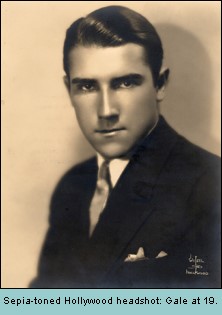
Gale at 19 Photo: lucyfan.com
Gale followed in his parents’ footsteps, and his first theatrical job was as an extra in “The Dancers” in 1923. Richard Bennett (father of Constance and Joan Bennett) starred in the stage production. Gordon worked as Bennett’s dresser, and Bennett taught him all about make-up, mentored him as an actor, and helped him to develop his voice.
By 1925, Gordon traveled to Hollywood, tackling roles in stage, film, and radio. Gordon talked about his first radio performance: “They asked me to come to a Hollywood studio in 1926 and try this new thing called ‘radio.’ They didn’t pay me, of course. They just wanted to fill up some time. So, I sang, ‘It Ain’t Gonna Rain No More, No More’ and accompanied myself on the ukulele. You might say I almost killed radio before it was born. I haven’t played an instrument on the air since.”
Photo: radiospirits.com
In seven short years, Gordon became the highest-paid actor in radio in Hollywood. He was the male lead for Mary Pickford in her serial. He was on almost every popular show on the air. It wasn’t unusual for him to appear on three or more programs in a week. Gordon was the first actor to play Flash Gordon in 1935.
His radio work also provided some other benefits. While appearing on an episode of Death Valley Days in New York, he met Virginia Curley. They married in 1937.
Gale and Virginia Photo: lucyfan.com
In 1941, after playing primarily dramatic roles, Gordon became a regular on Fibber McGee and Molly. Playing Mayor LaTrivia, Gale was on the show for a dozen years. There was a brief interruption in 1942 when he left the show and enlisted in the US Coast Guard for three years. He rose to the rank of Petty Officer First Class, and his service took him around the world to many dangerous places.
One of the roles he is best known for was Principal Osgood Conklin on Our Miss Brooks. Gordon described Conklin in a TV Guide interview: “There was nothing subtle about Osgood. No nuances. Just a lot of very satisfying acid, bluster, and bellowing, with an occasional weak moment of cordiality thrown in for leavening. It was practically impossible to overplay him. Even when he was being cordial, he was like an elephant trying to waltz.”
In 1950, he could be heard as John Granby on Granby’s Green Acres which later became the sitcom Green Acres.
With Bea Benederet Photo: wikipedia.com
While trying to reign in the chaos at Madison High School as Osgood Conklin, Gale was also the refined banker, Rudolph Atterbury, on My Favorite Husband, Lucille Ball’s radio comedy. Atterbury’s wife was played by Bea Benederet.
As television gained popularity, it was inevitable that some of radio’s favorite shows would make the transition to the small screen. While it was entirely possible to play several different characters on the radio, television production didn’t offer the same flexibility. When My Favorite Husband was retooled for television as I Love Lucy, Ball planned on bringing Gordon and Benederet along with her. However, Gale was committed to Our Miss Brooks, and Bea was playing a major role on Burns and Allen on television.
Asked about those days, Gale described himself as “a quiet, reserved, pipe-smoking homebody.” He said he always had a good balance of professional and personal interests. In addition to acting, he wrote books (Nursery Rhymes for Hollywood Babies and Leaves from the Story Trees), painted, and maintained a ranch. He and Virginia bought a 150-acre property about three hours away from Hollywood. They grew carob trees. Gordon was not a rancher in name only; he raised the trees, built the house, installed the plumbing, completed carpentry and handiwork, put in a swimming pool, and built a two-story building that served as garage and studio.
Our Miss Brooks Photo: amazon.com
In 1952, Eve Arden decided to take Our Miss Brooks to television. While Gale continued his role as Conklin on the show, he also guest starred on a couple of I Love Lucy episodes. Our Miss Brooks had a successful run for four years.
When the show ended in 1956, CBS was quick to sign Gordon on for another show. They paired him with Bob Sweeney in The Box Brothers (sometimes called The Brothers). Unfortunately, the series only lasted for 26 weeks.
The Box Brothers Photo: imdb.com
In 1958, Gordon was a regular on Sally where he played department store owner Bascomb Bleacher. He also appeared with Walter Brennan on The Real McCoys.
In 1959, December Bride which aired from 1954-1959, went off the air, spinning off a new show Pete and Gladys starring Harry Morgan and Cara Williams. Morgan appeared as Pete Porter on December Bride. On the new show, Gale played Pete’s Uncle Paul.
Dennis the Menace Photo: pinterest.com
In 1962 he was cast as Mr. Wilson on Dennis the Menace. At the same time, Lucille Ball was creating a new show, The Lucy Show. She wanted Gordon to appear as Mr. Barnsdahl, a banker. When he was not available, Lucille turned to Charles Lane. She said she loved working with Lane, but always wanted to work with Gale again, so when Dennis the Menace was cancelled, she quickly signed Gordon; Lane moved over to Bea Benederet’s new sitcom, Petticoat Junction, as the despicable Homer Bedloe. And thus Theodore J. Mooney was born.
Photo: welovelucy.com
For the next eleven years, through several different series titles, Lucy and Gale worked together. They would both retire in 1974. When describing his time on Lucy’s shows, Gale related in a Good Morning America interview in 1982 that “I always had a wonderful feeling of anticipation going to work every week, which is very, very rare. I don’t care what business you are in. But to really look forward to getting into the nitty gritty and working hard for four days—which is all the time we had to do the show—is really unique. To look forward to it for eleven years, that’s doubly unique.” He went on to praise Lucy for her work ethic: “Her attitude has never changed. Every show she ever did was always the most important show of her life. And I think that is the secret of her success.”
Photo: oldtimeradio.com
One surprising thing I learned was that Gordon was known for his ability to do cartwheels. He can be seen doing them on several episodes of Here’s Lucy. At the time, he was earning $25,000 an episode. Compare that to today when the stars of The Big Bang Theory received a million dollars an episode.
Gale and Virginia enjoyed twenty years of retirement. Virginia would pass away in 1995 at Red Terrace Health Center in Escondido, California. One month later, Gordon died from lung cancer at the same facility.
In 1999, Gale was inducted into the Radio Hall of Fame. Known for playing a variety of gruff, formal professionals, everyone knew that the bellow and bluster his characters spewed was great acting. In real life, Gale was one of the sweetest, kindest men around. He once said, “I am never nasty—unless I get paid for it.”
Photo: wikipedia.com
It’s hard to describe the influence Gale Gordon has had on generations of actors and the number of hours of entertainment he has provided to generations of television and radio fans. It’s always fun to listen or watch Connie Brooks trying to pull a fast one over on Osgood Conklin or Lucy Carmichael trying Mr. Mooney’s patience with her latest scatter-brained plan. Thank you Gale Gordon!
My blog theme for this month is “What a Character!” I am looking at the careers of four successful and hard-working actors. With 372 acting credits, perhaps there was no more prolific character actor than the beloved Charles Lane. He perfected the grumpy sourpuss always ready and gleeful to make life more complicated for others. His bio on imdb.com captures his type perfectly as the “scrawny, scowling, beady-eyed, beak-nosed killjoy who usually could be found peering disdainfully over a pair of specs, brought out many a comic moment simply by dampening the spirit of his nemesis.”
Photo: pinterest.com
However, despite that, we always knew there was more to him, and that his real persona was being covered up by his crotchety outward characteristics. His character Herman Bedloe on Petticoat Junction portrayed this dual-personality perfectly. Bedloe was always trying to shut down the train, but we knew he actually liked the Bradley family, and occasionally you would get a glimpse of the lonely and soft-hearted side of him.
He was born Charles Gerstle Levison in San Francisco in 1905. His family survived the 1906 earthquake. His father was an insurance executive, and Charles would follow in his footsteps for his first career.
Photo: newsfromme.com The Music Man
A friend, actor Irving Pichel, convinced Lane to try his hand at acting, and Lane joined the Pasadena Playhouse in the late 1920s. His first movie was City Girl in 1930, and his last was Acting on Impulse in 1993. During those six decades he had a successful career in both television and Hollywood. In 1933, Lane became one of the founding members of the Screen Actors Guild (SAG). In that year alone he made 23 films. There was an anecdote told about Lane that it was not uncommon for him to go to a movie, see himself on screen, and be surprised because he completely forgot he had been in the film. Starting out at $35 a day, by 1947 he was earning $750 a week.
His longest-running role was husband. In 1931 he married Ruth Covell; the couple had two children and were married until her death in 2002.
Photo: pinterest.com It’s a Wonderful Life
Perhaps most people recognize Lane from his role of rent collector for Henry Potter in It’s a Wonderful Life. Capra signed Lane to roles in ten of his movies. Lane was a corrupt attorney in Mr. Deeds Goes to Town (1936), an IRS agent in You Can’t Take It with You (1938), a newsman in Mr. Smith Goes to Washington (1939), a reporter in Arsenic and Old Lace (1944), and Blink Moran in State of the Union (1948). Among his most-cherished possessions was a letter from Capra where he wrote “Well, Charlie, you’ve been my No. 1 crutch.” Other popular films he was in include The Ghost and Mr. Chicken; It’s a Mad, Mad, Mad, Mad World; and The Music Man.
Photo: blogspot.com You Can’t Take It with You
During World War II, Lane joined the Coast Guard. When he returned to civilian life, his television career took off. His first role was on Burns and Allen in 1951. During the 1950s, he appeared in more than 30 shows including Topper, The Thin Man, Perry Mason, and The Ann Sothern Show. He was often seen on Lucille Ball shows. He and Lucy had become friends when they both worked for RKO, and he had a great respect for Desi Arnaz’s acting ability.
Photo: imdb2freeforums.net I Love Lucy
During this decade he was cast on the show Dear Phoebe in 1954. Peter Lawford starred in the show as a former college professor who writes an advice column under the name Miss Phoebe Goodheart. Meanwhile, his romantic interest is Mickey Riley portrayed by Marcia Henderson, the paper’s sports writer. Lane took on the role of Mr. Fosdick, their boss.
Photo: blogspot.com The Andy Griffith Show
The 1960s found him on almost every popular show of that decade. Tuning in to your favorite series, you would spy Lane on Bachelor Father, Pete and Gladys, Mister Ed, The Andy Griffith Show, The Joey Bishop Show, Get Smart, The Bing Crosby Show, The Man from UNCLE, The Donna Reed Show, Green Acres, Bewitched, and The Wild, Wild West, among many others.
Photo: sitcomsonline.com Gomer Pyle USMC
Lane had recurring roles on five shows during the 1960s. On Dennis the Menace, he was the pharmacist Mr. Finch. He also could be seen on his friend’s series, The Lucy Show as Mr. Barnsdahl, a local banker. The Phyllis Diller Show had a cast that should have made it a hit and from 1966-67, Lane played Maxwell. Although many characters appeared on both The Beverly Hillbillies and Petticoat Junction, Lane had two different roles on the two series. He appeared in 24 episodes of Petticoat Junction between 1963-1968 as Homer Bedloe, a railroad executive who is always trying to find a reason to shut down the Cannonball. On the Beverly Hillbillies, he portrayed Foster Phinney.
Photo: filmstarfacts.com Petticoat Junction
Lane continued with both his movie and television appearances throughout the 1970s, taking roles on The Doris Day Show, The Odd Couple, Family, Rhoda, Chicoand the Man, and he continued his television appearances into the 1980s and 1990s with shows that included Mork and Mindy, St. Elsewhere, LALaw, and Dark Shadows.
Photo: pinterest.com Bewitched
The decade of the seventies would find him cast in two additional series, Karen and Soap. Karen debuted in 1975, starring Karen Valentine as Karen Angelo. Karen works for an advocate group for the common American citizen, Open America, founded by Dale Busch, who was played by Lane. On Soap, Charles took on the role of Judge Petrillo who presided over Jessica Tate’s murder trial; however, because of Jessica’s husband, the judge lost $40,000 in a bad investment.
Photo: sitcomsonline.com Soap
Charles Lane was honored in 2005 when he turned 100. SAG proclaimed January 30 “Charles Lane Day,” and TV Land honored him in March for his long career. After receiving his award, he let it be known “in case anyone’s interested, I’m still available!”
Photo: allmovie.com TV Lands Award March 2005
Despite his being typecast in cranky roles, friends and family described him as funny, kind, and warm-hearted. Lane’s one vice was smoking. In 1990 he was rushed to the hospital when he was having problems breathing. When the doctor asked if he smoked, Lane informed him he had kicked the habit . . . 45 minutes earlier. He never smoked again and he lived another 12 years, dying peacefully in 2007.
Photo: blogspot.com Homer Bedloe
Although it’s tough on actors to be typecast so early in their career, it’s a double-edged sword, because it also provides a lot of opportunities for roles. Lane was an enigma; while he always convinced us that he was just as mean as could be, we also knew if someone would give him a chance, he could be reformed like Scrooge; he just needed the opportunity. It always makes me smile to come across Charles Lane in a move or television episode. It’s like seeing an old friend, or perhaps the neighbor who yelled at you to get off his yard. However, if you looked closely, you would see him watching and wanting to be part of the action. As you watch your favorite older classic shows, keep an eye open for him.
As we proceed
with our Behind the Scenes series this month, today we are thinking about set
designers. Before the interior designs are done, the production team needs to
find the perfect home for our television friends.
Did you ever daydream about places you might want to live in, even if you never would actually consider leaving your home? Perhaps it’s a small rose-covered cottage in the English countryside, maybe a ski chalet in the Swiss alps, or a house on the Maine coast with green shutters and a widow’s walk. I’ve thought about all of these places, but now I have another one to consider. It’s an historic neighborhood where some of my favorite television friends lived. Today we learn a bit about the Columbia Ranch.
Photo: columbiaranch.net
Now called
Warner Brothers Ranch, the former Columbia Ranch was in Burbank, CA. In
addition to dozens of television shows, it was the setting for many movies as
well such as Mr. Deeds Goes to Town,High Noon, and Lost Horizon. The neighborhood interiors were typically shot at other
studio locations.
In 1934, Harry Cohn, head of Columbia Pictures, purchased 40 acres in Burbank. In 1948, Columbia got into the television business under Screen Gems.
Photo: pinterest.com
During the
1950s, Captain Midnight, Father Knows Best, The Donna Reed Show, and Dennis
the Menace were filmed here. By the 1960s, the ranch was used continuously
for television and movies. The set was about six blocks but looked much larger
on camera shots. Shows during the 1960s included My Sister Eileen, Hazel, Our Man Higgins, The Farmer’s Daughter, Bewitched,
Gidget, I Dream of Jeannie, The
Monkees, and The Flying Nun.
In 1970, a
fire destroyed a quarter of the neighborhood, including many buildings on
Blondie Street. After rebuilding, taping continued on the set. During the next
three decades, shows included The
Partridge Family, Bridget Loves
Bernie, Apples Way, The Scarecrow and Mrs. King, and Life Goes On.
In 1971, Columbia and Warner Brothers combined their companies and merged into The Burbank Studios. The Ranch then was relegated to a back backlot.
Photo: columbiaranch.net
When Columbia Pictures moved its production facilities to Culver City in 1990, Warner Brothers gained ownership of the Ranch.
Photo: pinterest
Photo: pinterest
It’s continued to be a busy spot for filming. The fountain in the park was the one shown in the opening credits in Friends.
Nearby is also a swimming pool used on a variety of shows, including The Partridge Family.
The most famous street in the Ranch was Blondie Street. Blondie Street was named for Blondie Bumstead because the Blondie movies of the 1940s were filmed here. Walking down Blondie Street reveals homes that we were all familiar with growing up in the sixties and seventies.
Photo: columbiaranch.net
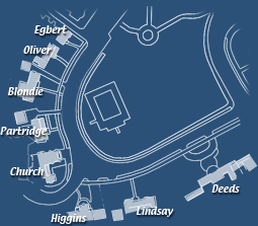
It’s a curved
residential street with twelve different houses, surrounding a large, central
park. There is also a brick church and paved sidewalks. Three of the buildings—the
Lindsay House, the Little Egbert House, and the Oliver House—were original to
the 1935 set production.
The Blondie House
Photo: columbiaranch.net
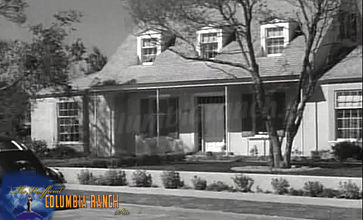
This set, constructed in 1941, was the home for Major Nelson on I Dream of Jeannie, Mr. Wilson on Dennis the Menace, and the Andersons on Father Knows Best, in addition to the Blondie movies. Later it housed the operations office for the Warner Ranch. Of course, Jeannie’s house was not here, it was a Jim Beam decanter that was sold during Christmas of 1964.
The Corner Church
Photo: columbiaranch.net
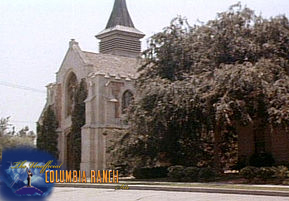
When thePartridge Family drives off for a show in their bus, you can often spot the
church which is just down the road from their home, across from The Stephens’
home on Bewitched. It was moved here
in 1953. When any of the series needed a church, this was the one. It can be
seen on an episode of Hazel when the
family attends church.
The Deeds Home
Photo: columbiaranch.net
Originally built for Frank Capra’s movie, Mr. Deeds Goes to Town in 1936, the house is only seen briefly in the movie. The Three Stooges filmed there in the thirties and forties. In the sixties it was seen in Batman. Both Gidget and The Partridge Family used the house as the high school and Bewitched used it as a civic building. In 1989, the original house was demolished. In its place, The Chester House and the Griswold House were built. The Griswold House was built for National Lampoon’s Christmas Vacation.
The Lindsay House
Photo: columbiaranch.net
Constructed in 1936, this house was best
known as the Baxter home on Hazel. It
also served as the Lawrence home on Gidget.
The Higgins House
Photo: columbiaranch.net
This structure was constructed for the show Our Man Higgins in 1962. It was later the home of Darrin and Samantha Stephens on Bewitched from 1964-1972. On I Dream of Jeannie, it was the home of Alfred and Amanda Bellows.
Photo: pinterest.com
For Bewitched, the interior and backyard scenes were filmed on a sound stage. The stairs ended in a hallway, but the doors only led to small closets, not the master bedroom. A modular first floor served as a setting for all the rooms. The den doubled as the nursery. A fake wall was put up to hide the view to the kitchen. When the den was needed, brown paneling was put over the nursery walls and the window was covered with a wall near the fireplace.
Photo: darkershadows.com
If you look closely, you’ll notice the avocado and gold flowered sofa in the Stephens’ living room was the same one used by Alfred and Amanda Bellows in their living room. But the shows shared well. On one episode of Bewitched, Louise and Larry Tate are seen at their kitchen table, but the kitchen looks identical to Major Nelsons’s. Roger Healey’s bedroom eerily resembled Darrin and Samantha’s.
Photo: youtube.com
Photo: pinterest.com
I guess I was too busy crying to notice that this house was also Brian Piccolo’s home in Brian’s Song.
The Partridge Family House
Photo: pinterest.com
The house across the street from the
Stephens’ house was home to Abner and Gladys Kravitz. During the filming of Dennis the Menace, it was Mrs. Elkins’
house. It was also the home of The Partridge
Family. In 1989 it became the Thatcher home on Life Goes On.
The home was built in 1953, modeled after a Sears, Roebuck & Co. plan. The modest two-story home was a perfect fit for the Partridges with its white, picket fence. The interiors were filmed at the Ranch as well. Located next door to the Blondie House, there were shrubs between the homes that were featured several times on the Partridge Family. In an episode where Keith shoots a movie, Shirley is clipping the hedges and begins dancing for the film, not realizing her neighbor is watching her. We see the hedges again when Keith moves into the room above the garage next door and gets free rent in return for yard work.
Photo: flickr.com
Photo: flickr.com
Because they were filming the show when the infamous fire broke out, some of the structure had to be rebuilt for the remainder of the series. From season 1 to 2, Danny and Keith’s bedrooms switch back and forth a couple times, and I wonder if this is the reason.
The Oliver House
Photo: columbiaranch.net
Constructed in 1935 for a movie, the Oliver house was moved to Blondie Street for the home of the Stone family in The Donna Reed Show. It was also the Mitchell home where Dennis resided with his parents.
The Little Egbert House
Photo: columbiaranch.net
Technically, Little Egbert is not on Blondie Street but on its own, Little Egbert Street, basically an alley. Fortunately, the 1970 fire did not damage any of the original structure. The house was also used in Minding the Mint and as The Shaggy Dog, the hangout for Gidget and her friends.
Photo: retrospace.org
For sentimental reasons, I would choose the Partridge Family home to live in. However, I would have to remodel the kitchen. I could live with the red breakfast table set. The avocado and gold flowered wall paper may have been very chic in its day, but even I am not that sentimental!
We wrap up
our series Just a Couple of Characters this week with Mary Wickes and Susan
Oliver. Mary and Susan are very different character actors, but you will
immediately recognize them. Let’s learn a bit more.
Mary Wickes
Photo: imdb.com
It’s not surprising that Mary shortened her last name to “Wickes” after being born Mary Wickenhauser in 1910 in St. Louis. Her father was a banker, and the family had plenty of money. After high school, Mary attended Washington University in St. Louis, majoring in political science, planning a career in law. One of her professors suggested she try theater, and she dipped her toe into it doing summer theater in Stockbridge, Massachusetts.
Photo: flickr.com
After deciding a career in acting was for her, she moved to New York. She quickly found a role in “The Farmer Takes a Wife” on Broadway in 1934. In this show, which starred Henry Fonda, Mary was Margaret Hamilton’s understudy. Mary had a chance to perform during the run and received excellent reviews.
Photo: tcm.com The Man Who Came to Dinner
Mary understood that comedy was the field she needed to pursue. She was lucky enough to continue getting roles on Broadway, appearing in several shows throughout the 1930s, including “Stage Door” in 1936 and “Hitch Your Wagon” in 1937. She also was cast in “The Man Who Came to Dinner” as Nurse Preen with Monty Woolley. She continued to receive encouraging reviews. When Warner Brothers decide to turn the play into a movie, both Mary and Woolley were part of the cast. Mary became known for being a bit sarcastic and witty. She was given roles in the film, Now Voyager with Bette Davis, again playing a nurse.
Photo: viennasclassichollywood.com By the Light of the Silvery Moon
Mary flip flopped from Broadway to Hollywood, taking roles that interested her. She would appear in both Moonlight Bay (1951) and By the Light of the Silvery Moon (1953) with Doris Day; White Christmas (1954), and The Music Man (1962).
Mary had cornered the market in roles of smart-alecky teachers, nurses, and housekeepers in film. When she transitioned to television, she often continued in these roles. Her first two recurring roles were housekeepers named Alice on Halls of Ivy from 1954-55 and Katie on Annette in 1958. From 1956-1958, she played Liz O’Neill, Danny Thomas’s press agent on Make Room for Daddy. Throughout the 1950s she also appeared on numerous shows including Zorro.
Photo: pinterest.com
One of my favorite episodes with Mary was the 1952 episode “The Ballet” on I Love Lucy where Wickes played Madame Lamond, a formidable ballet teacher who taught Lucy. Wickes and Lucy would remain life-long friends. After Mary’s death, Lucie Arnez talked about her relationship with their family: “For my brother and me, Mary was just like one of the family. If any of us were sick or even in bed with a cold, Mary would show up at the backdoor with a kettle of chicken soup. She could be loud and boisterous and as demanding as any of the characters she played, but she was also very loving and giving. What a lady.” Mary would appear on numerous episodes of Lucille Ball’s other shows in the 1960s and 1970s.
Photo: aurorasginjoint.com
In the 1960s, Mary continued to show up on a variety of shows. We see her on My Three Sons, Bonanza, F-Troop, The Doris Day Show, The Donna ReedShow, and I Spy. She also had recurring roles on three shows during the decade: TheGertrude Berg Show, Dennis the Menace, and Temple Houston. In the Gertrude Berg Show, Mary was landlady, Winona Maxfield. She was hilarious on Dennis the Menace, playing Miss Cathcart, an older neighbor looking for a man. On Temple Houston, she played Ida Goff. Temple was Sam Houston’s real son who was a circuit-riding lawyer.
Photo: en.wikipedia.org The cast of Doc
As Mary aged, she progressed to the cranky relative or nosy neighbor type of character. In the 1970s she was a regular on Julia, Doc, and The Jimmy Stewart Show. On Julia, she was Dr. Chegley’s wife, Melba. She went back to her role as a nurse on Doc. On the Jimmy Stewart Show, she is Mrs. Bullard. Two of my favorite episodes of her from the 1970s were her roles on Columbo and M*A*S*H. On Columbo, Mary plays a landlady of a victim who’s been murdered. She and Columbo have a priceless conversation during the show, “Suitable for Framing” in 1971. On M*A*S*H, Mary played Colonel Reese who is observing Margaret and the nurses.
Photo: aurorasginjoint.com
In the 1980s, Mary’s schedule slowed down a bit. She did revive her role as a maid on The Love Boat in 1981. From 1989-1991, she took another regular role as housekeeper Marie Murkin on Father Dowling Mysteries.
Photo: hometheaterforum.com
In the 1990s, Mary was doing more voice overs. She taped five episodes of Life with Louie which aired from 1995-1997 and was Laverne in The Hunchback of Notre Dame in 1996. Unfortunately, she would not live to see them on the big screen. In 1995, she passed away after having respiratory problems. While a patient in the hospital, she fell and broke her hip. She died of complications caused by the surgery.
Mary never married or had children and as part of her legacy, she left a $2 million donation in memory of her parents to the Television, Film and Theater Arts at Washington University.
Susan Oliver
Photo: amazon.com
More than twenty years younger than Wickes, Susan Oliver was born in 1932 in New York City. Her real name as Charlotte Gercke. Her father was a political reporter for the New York World. Her parents divorced when she was quite young, and she grew up in boarding schools. She traveled with her father to Japan when he took a post there. She studied at the Tokyo International College, studying American pop culture. While Wickes was the wise-cracking comedic foil, Oliver was often the leading lady character with blue eyes, blonde hair and heart-shaped face.
Photo: trekdivos79.blogspot.com on The Wild Wild West
In 1949, she
traveled to LA to see her mother who had found her niche as “astrologer to the
stars.” Susan then enrolled at Swarthmore College. After graduation, she
continued acting courses at New York City’s Neighborhood Playhouse.
Her first Broadway part came in 1957 as the daughter or a Revolutionary veteran, “Small War on Murray Hill.”
Photo: manfuncle2014.blogspot.com The Man from U.N.C.L.E.
Returning to LA, she started a film career. Though she would appear in 15 big-screen movies, television is where she spent most of her time. She put in her due diligence in the 1950s and 1960s. Her first job was on The Goodyear Playhouse in 1955. She continued with a lot of drama and theater for the first few years of her career. She took roles in a variety of shows including: Father Knows Best, Suspicion, The David Niven Show, Bonanza, The Twilight Zone, The Adventures of Ozzie and Harriet, The Alfred Hitchcock Hour, Wagon Train, Route 66, The Fugitive, The Andy Griffith Show, Ben Casey, Mannix, Dr. Kildare, The Man from UNCLE, I Spy, Gomer Pyle, My Three Sons, and the Wild, Wild West.
Photo: imdb.com
I read several times that she turned down lead roles in series to retain her independence, but I never read any specific roles she turned down. In 1966 she accepted a recurring role of Ann Howard in Peyton Place. She had signed a contract for a year, but after five months, her character was killed on the show. She made a pilot for a show titled, “Apartment in Rome” that did not sell.
Photo: en.wikipedia.com on Peyton Place
Oliver never did get another show of her own, but she continued to guest on shows throughout the 1970s and 1980s, including Love American Style, Gunsmoke, The FBI, Streets of San Francisco, The Love Boat, Magnum PI, Murder She Wrote, and Simon and Simon.
Photo: flickr.com on Murder She Wrote
One of the reasons, she didn’t want to be tied down was her interest in flying. In 1959, a Boeing 707 she was a passenger on plummeted 30,000 feet for the Atlantic Ocean before leveling out. After that scare, she decided to learn to become a pilot. In 1964, she started flying single-engine planes. Bill Lear brought her on board to become the first woman to train on his new Lear Jet. She would star in a movie about Amelia Earhart. She also later wrote about her flying experiences in an autobiography, Odyssey: A Daring Transatlantic Journey in 1983.
Photo: imdb.com
In the mid-1970s, she stopped accepting most acting roles and quit flying. She enrolled at the 1974 AFI Directing Workshop for Women with peers Lily Tomlin, Margot Kidder, Kathleen Nolan, and Maya Angelou. During the final season of M*A*S*H she directed an episode of the show. She would later direct an episode of Trapper John, MD.
At age 58, Oliver was diagnosed with colorectal, and eventually lung, cancer. She died in 1990.
Oliver was an
interesting actress. Apparently, she loved acting, but never wanted to be tied
down. She not only was a aviator and director but a writer. She was a practicing
Buddhist and a baseball expert as well.
Wickes and Oliver were very different women with very different interests and acting roles. They both remained single and devoted themselves to their careers. But they were both women who were always in demand for their acting ability.



























 thewritelife61