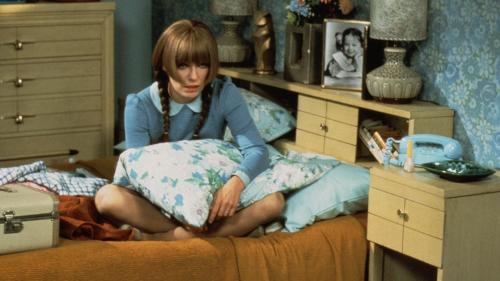
Angie: Always on the Move

This month we are learning about sitcoms with one name, and today is Angie. Angie had a short run from February 1979 until September of 1980, producing 36 episodes. It was one of the few Garry Marshall shows not to be a long-running hit. He created it with Dale McRaven. We all know Marshall’s amazing career with Happy Days, Laverne and Shirley, The Odd Couple, not to mention all of his great movies. McRaven also had a prolific career as a producer and writer. He’s listed as producer for The Partridge Family, The Betty White Show, Mork and Mindy, and Perfect Strangers. His writing credits includes all of these shows, as well as The Dick Van Dyke Show, That Girl, Get Smart, The Odd Couple, and Room 222 among others.
📷ihearthollywood.com

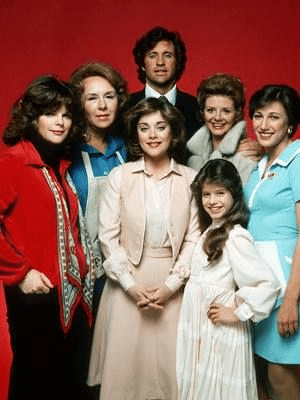
The cast was quite talented: Donna Pescow played Angie, Robert Hays was her boyfriend-later-husband, the amazing Doris Roberts was her mother Theresa before Raymond came along, and Debralee Scott played her sister Marie.

Bradley Benson is a young pediatrician who comes from a wealthy family comprised of his stuffy father Randall (John Randolph), his overbearing sister Joyce (Sharon Spelman), and her daughter Hillary (Tammy Lauren). The show is set in Philadelphia.

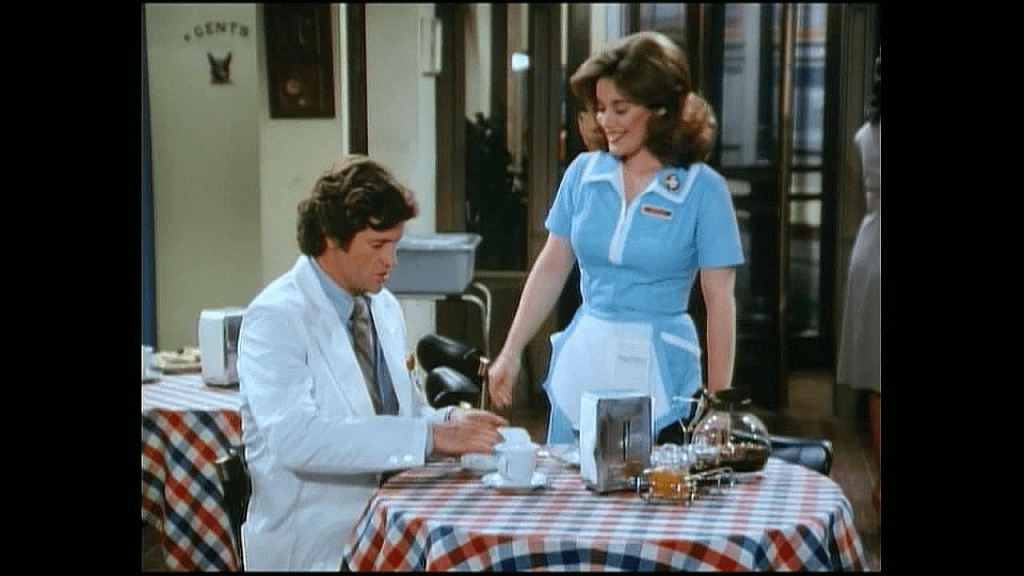
Angie is a coffee-shop waitress who falls in love with Brad. Many scenes are set in the diner with Angie’s friend and co-waitress Didi (Diane Robin). When their families argue about wedding plans, Brad and Angie elope. Later Angie’s mother plans a small family wedding for the two families to get to know each other, and Brad buys the coffee shop for Angie.

At the beginning of the second season, Angie sells the coffee shop to buy a salon with her mother.

📷imdb.com

The theme song was “Different Worlds,” written by Norman Gimbel and Charles Fox. Gimbel is still hard at work and has amassed 494 credits so far while Fox has 131 credits for many impressive television series and big-screen films. Maureen McGovern sang it; she’s best known for her top-forty hit “The Morning After.”

The show was sandwiched between Happy Days and Three’s Company on Tuesday nights, which ensured great ratings. This one was fifth its first week. The show just could not find its fan base. By the end of the season, the Nielsen ratings had fallen drastically, and the show had moved to Monday nights following Monday Night Football. Angie wasn’t the only show to struggle in this time slot. Once it was moved, three other shows—One in a Million, Goodtime Girls, and Laverne and Shirley—all tried this scheduling spot. I’m not sure if the shows were just not very good in 1979, if people were too busy to watch television, or the network heads were inexperienced, but when you look at the schedule from 1979 most prime times had a different show in the slot every season of the year. When it’s not only one show on a network moving, but many shows on a network moving and then all networks having a bunch of shows moving, how are viewers supposed to figure out where anything was? Out of the 54 new shows debuting in 1979, by the next season every network basically had one hit show out of the bunch: ABC-Hart to Hart, CBS-Trapper John MD, and NBC-The Facts of Life. While these are all decent shows, none of them were classics in my opinion. In 1980 another 30 shows were brand new.

📷rewatchclassictv.com

The show was put on hiatus. It did return in April on Saturday nights, but it was officially canceled in May.

When you look at this show on paper, it had all the right elements. First of all, we have Garry Marshall and Dale McRaven, very successful creators and writers. The cast was amazing. Even the theme song was composed and sung by extremely talented people. Then you have the fact that there were not a lot of great shows debuting this year; a decent show should have crushed it. So, what happened here?

I think I’m putting the blame for this one on the network. I watched the pilot and while pilots are meant to pull you back for the next one, most pilots aren’t the best of the series. Some of the pilots for shows I love are almost dreadful. This pilot was not dreadful. The characters were likable, the writing was funny, and the theme was not overdone over the years. It was similar to The Mothers-In-Law from a decade earlier but more of a Dharma and Greg (which came two decades later) where they fall in love despite their economic differences.
📷youtube.com

This series was better than a lot of shows that are currently on the air. I did watch another later episode where the couple elopes. Once again, the writing was good and the characters were a bit eccentric, but the writers knew how far to go to keep them likable and charming rather than odd. If ABC had kept it in a time slot for more than a month or two and given it a bit of time, it might have been a big hit.

If you want to check it out, let me know what you think. For a late seventies/early eighties show, it’s aged very well.

Life in Fernwood: Mary Hartman, Mary Hartman and Fernwood 2-Night

As we wind up our series of “oddly wonderful” shows, we take a look at two shows that were set in the same community and may be two of the most unusual shows to ever air on television—Mary Hartman, Mary Hartman and Fernwood 2-Night.

If you read my blog often, you know I am not usually a fan of Norman Lear shows, and while these two series are very different from a typical Norman Lear show, unfortunately, I only enjoyed one of them. Lear’s shows were filmed at Metromedia Square in Hollywood. When he got ready to tackle these shows, there was no room left there. He arranged to rent space from KTLA which was across Fernwood Street. The staff started calling KTLA “Fernwood” which became the name of the town in Ohio where Mary lives.

Photo: next-episode.net

Lear said he created the show to deal with consumerism.

The original show was was a campy show but had likable and thoughtful characters. Like Soap, this show had a brilliant cast and satirized soap series. It was called Mary Hartman, Mary Hartman, because the writers said dialogue on a soap opera was often said twice. Lear filmed the pilot and offered it to the three major networks who all passed. The show began as a syndicated show (it began on 50 stations) and was only on from January 1976 till May 1977. Unlike Soap, this show produced a huge number of episodes, 325 to be exact. It aired daily on weekdays.

Like the Tates and Campbells, Mary suffered through bizarre plots and unbelievable story lines, including adultery, mass murder, disease, homosexuality, religious cults, UFO sightings, and a nervous breakdown.

Photo: imdb.com
Dodie Goodman as Martha

Louise Lasser (who had been married to Woody Allen) portrayed Mary. She was married to Tom (Greg Mullavey). Tom worked at an auto assembly plant. Dody Goodman played Mary’s mother Martha. Debralee Scott played her sister Lorraine. The cast was rounded out by amazing supporting characters including Mary Kay Place as Mary’s best friend Loretta; Graham Jarvis as Charlie, Loretta’s husband and Tom’s best friend; Claudia Lamb as Heather, Mary and Tom’s daughter; Martin Mull as Garth Gimble who killed his wife; Dabney Coleman, Fernwood’s mayor; Gloria DeHaven who had an affair with Tom; Orson Bean as Rev. Brim, Shelley Fabares as Eleanor Major, a woman Tom falls in love with after Mary leaves him; Ed Begley Jr. as Steve; and Doris Roberts as Dorelda Doremus, a faith healer.

Photo: tumblr.com
Mary Kay Place as Loretta

Mary wore her hair in braids like Pippi Longstocking. One article described her as a life-size Raggedy Ann. She was indecisive and switched her emotions quickly and without reason. Mary went through one crisis after another until she couldn’t function anymore. One of the things that led to Mary’s breakdown was that she believed everything she saw on television and it made her crazy that she could not see the waxy yellow build up the commercials claimed was on her floor. She was also dealing with marital problems and boredom.

Photo: moviestillsdb.com

Right from the beginning, the show displayed its weird story lines. In the first episode, the Lombardi family of five is murdered and the neighborhood tries to catch the Fernwood Flasher, who later turned out to be Mary’s grandfather. There were a lot of strange deaths in this show. Jimmy Joe Jeeter was electrocuted in the tub, Coach Leroy drowned in chicken noodle soup, and Garth Gimble impaled his wife on a bottle brush Christmas tree.

In 1977, Lasser decided to leave the show. The rest of the cast continued on and accounted for her disappearance by announcing that she had run off with Sgt Dennis Foley. The show then became Forever Fernwood.

Photo: tumblr.com

Later that year, Fernwood 2-Night was spun off. Martin Mull was now Garth’s twin brother Barth and was the host of a late-night talk show with Jerry Hubbard (Fred Willard) as his “Ed McMahon”.

One of my favorite things about this show was Frank DeVol, the composer, who played Happy Kyne with his band the Mirth Makers (Eddie Robertson, Tommy Tedesco, Frank Marocco, and Colin Bailey) on the show. Happy never looked happy; he had a side business, a fast-food restaurant called Bun ‘n Run.

Photo: sonypicturesmuseum.com

Alan Thicke was the head writer on the show. Lear thought it should all be improvised, but Thicke said it needed a balance of scripting with ad-lib.

In the same way Mary Hartman satirized soap operas, this show satirized late-night talk shows. The guests were a mix of real and fictional people. For example, Tom Waits appeared on the show when his bus broke down in Fernwood. I don’t remember a lot about this show specifically, but I remember thinking it was very funny.

Photo: sonypicturesmuseum.com

After the first season, the show was moved to California where celebrities would be more likely to appear on the show.

Photo: nostalgiacentral.com

I have never seen either of these shows in reruns and like most of the shows we learned about this month, I think they are better left as a remnant of the era they debuted in. Although few people seem to remember Mary Hartman, Mary Hartman, it was listed #21 on TV Guide’s list of best one-hundred shows in 2003. When thinking about the classic shows that had been on the air by 2003, that says a lot about what TV Guide thought about the quality of this show.

Lear had to tow a fine line on this show. With the types of crises Mary encountered and the bleak life that was portrayed of a housewife in Fernwood, Ohio, it was close to tragic. The exaggerated number of catastrophes and despairing situations kept it slightly in the humor genre. The demise of the show is often blamed on Lasser’s leaving, but in my opinion, it could not have continued to sustain viewers much longer than it was on the air. How many crises can be cooked up that hadn’t happened, and when did the tragic overtake the comedy for most viewers? Again, it’s a show best viewed in its decade.

In my rating of odd, wonderful, or oddly wonderful, I give Fernwood 2-night wonderful, and I’m afraid I have to give Mary Hartman an odd rating. It was a hard show to watch. If you wanted drama, there was too much humor in it, but if you wanted comedy, it was way too dark. I’d love to hear from you on your ratings for these two little-remembered shows.