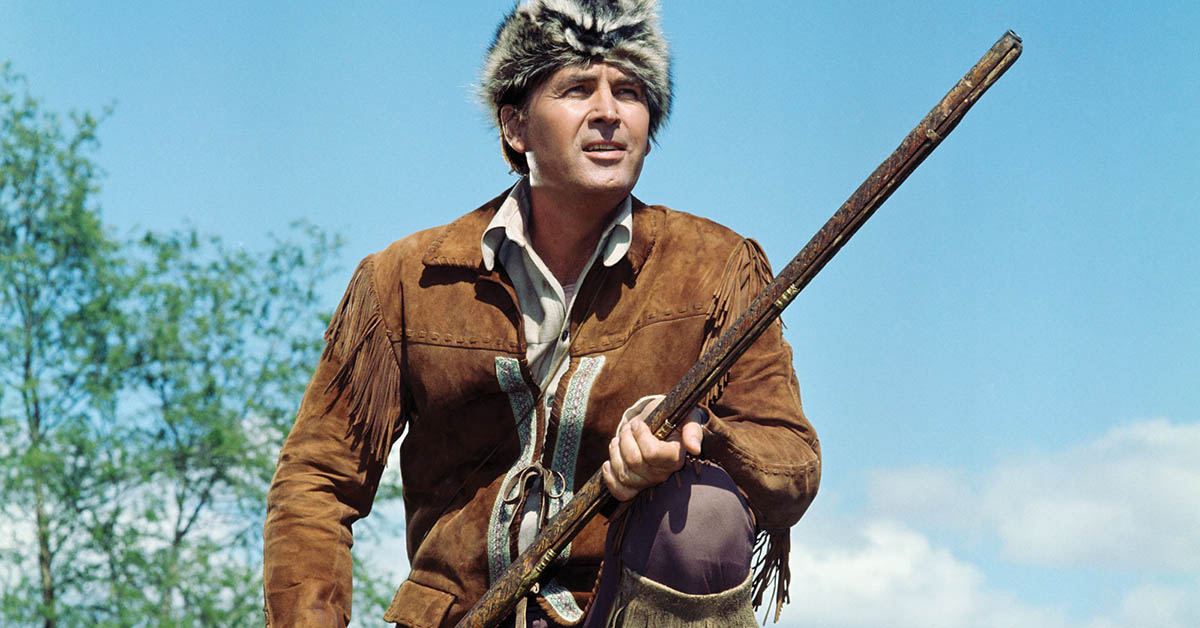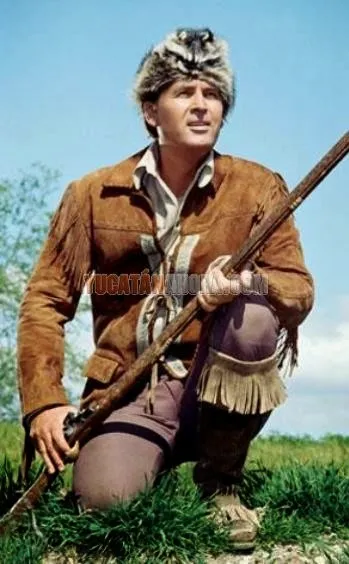
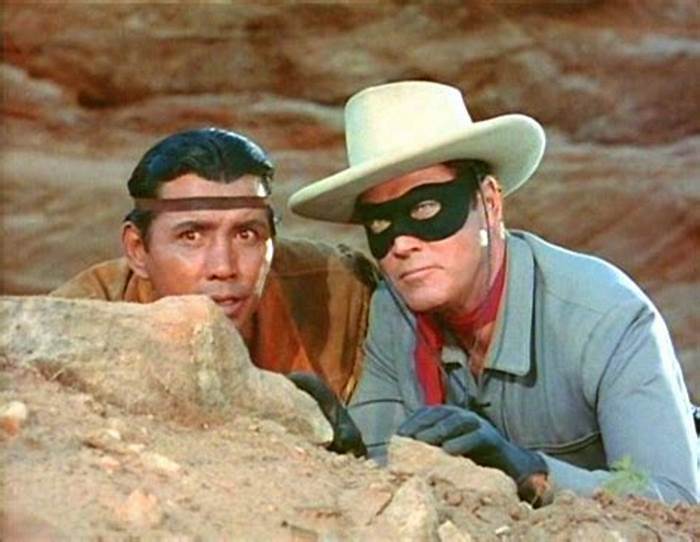
This month we are Riding the Range. Up first is Daniel Boone. I remember watching this series with my son when he was in second and third grade and loved everything western. He bought vintage western board games and read western stories. He wore a cowboy hat around the house with a pair of boots. Email was somewhat new then, but he was able to contact Fess Parker and Clayton Moore. They both sent him back nice emails, and Clayton Moore sent him an autographed biography.
When I decided to do a series about westerns and include Daniel Boone, I was surprised to learn that it was on the air from 1964-1970. That means it went off the air when I was in fourth grade—I always assumed it was produced in the fifties.
The series was on NBC during those years. It starred Fess Parker as Daniel Boone and Ed Ames as Mingo, his Cherokee friend. Boone’s wife Rebecca was portrayed by Patricia Blair and his son Israel was played by Darby Hinton. Dallas McKennon played store owner Cincinnatus. For the first two seasons before just vanishing, his daughter Jemima (Veronica Cartwright) was on and for the final two seasons, Rosy Grier, former NFL player, was Gabe Cooper.
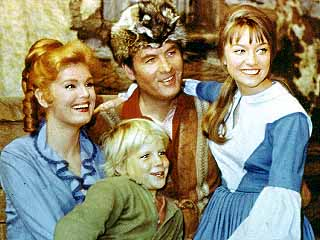
From Cartwright’s complaints, it seems that Blair complained about having an older daughter and felt it made her seem older than she wanted to appear, so the show just got rid of a kid. If you have read my former blogs about disappearing characters, you realize that this is just one of many shows that insult viewers’ intelligence enough to just remove a character without an explanation, assuming everyone will just accept it.
Unfortunately for kids who tuned in to learn about their hero, the show did not contain a lot of historical accuracy. The show is set in the 1770s and 1780s in the town of Boonesborough, Kentucky. Daniel Boone had ten children, but only two in this show. In real life, Boone was an explorer, but on the series, he was much more of a family man. One episode was centered around Aaron Burr, but it was about an event that happened in 1806?!?!
The inconsistencies were so bad that at one point, the Kentucky legislature condemned the show. A coalition of activists asked the local television station to not air 37 different episodes in reruns because they were offensive to the local Native Americans.
Oddly, one area they did try to stay true to was the construction of the fort. They used authentic wooden pegs to build it like it would have been at the time, and it collapsed, having to be replaced by modern construction. Why the fort was the only authentic fact they worried about is beyond me.

Ed Ames did not love playing Mingo on the show. He admitted that he signed on for a regular paycheck, assuming the show would not last long. In 1968, he told TV Guide “Work is tight and if you get a decent part on Broadway every three years, you’re lucky. Whereas you can just keep hackin’ ‘em out week after week on TV. And then, of course, you have to eat.” He ended up getting more fan mail than Parker, and it caused some bad blood between them.
There were three versions of the theme song used during the show’s run. It was written by Vera Matson and Lionel Newman. Fess Parker originally sang the song for the show, but later seasons used a version by the Imperials. The song played up Boone as a larger-than-life hero:
“Daniel Boone was a man. Yes, a big man.
With an eye like an eagle and as tall as a mountain was he.
Daniel Boone was a man. Yes, a big man.
He was brave, he was fearless, and as tough as a mighty oak tree.
From the coonskin cap on the top of ol’ Dan to the heel of his rawhide shoe,
The rippin’est, roarin’est, fightin’est man the frontier ever knew.”
Parker not only sang for the show, but he directed five of the episodes.

Although the history was embarrassing on the show, the series is often celebrated for the attitude Daniel Boone displayed that every man was to be treated with respect and as an equal. That is not to say that it was ever politically correct, as we think of that term today, but for the era it debuted, it was a refreshing, perspective. One episode that demonstrates this is season 2, episode 4. Rafer Johnson (an Olympian and civil rights activist) plays a former enslaved person who is stealing trappers’ furs to sell to earn money to return to Africa. Boone tells him he can’t condone the stealing and “arrests” him for that crime. However, he takes him into his custody to protect him and raises enough money for him to travel to Africa, refusing to return him to the former slave owner.

Before the show ended, Parker wanted to open a Daniel Boone amusement park in Kentucky. He bought some land near the junction of I-71 and I-75, but before he could build Frontier World, another park opened nearby in Ohio and Boone’s never happened. He did later buy a ranch in California and started the Fess Parker Winery.
I guess Fess Parker enjoyed making people dizzy whether it was riding a roller coaster, drinking wine, or trying to figure out if the television Boone was a good or bad influence on the fans who watched the show.





 thewritelife61