Thanks for joining me this month in our blog series, “It’s Their Show.” As it became obvious that television wasn’t going away and movie stars were only hurting themselves shunning the industry, several celebrities decided to make the jump and star in their own show on the small screen. Ray Milland was one of the first stars to tackle the task. Milland had been known for many great movies including The Lost Weekend, for which he won an Oscar, and Dial M for Murder.
📷raredvds.com
His show was originally titled “Meet Mr. McNutley,” but it became The Ray Milland Show. This is one of those shows that fans remember fondly as very funny and well written.
The show debuted in 1953 and ran for two seasons, two very different seasons. In the first season, McNutley is an English professor at Lynn Haven College for Women. Although all the students find him attractive his wife (Phyllis Avery) understood that this was not affecting her marriage. Rounding out the cast were their neighbors Pete and Ruth Thompson (Gordon Jones and Jacqueline DeWit) and the college dean (Minerva Urecal) who was not swooning over McNutley.
📷wikimediacommons.com
When the show returned for its second season, his name is now Mr. McNulty and he is a drama professor, moving from New England to Comstock University in California, a coed college. Dean Dodsworth (Lloyd Corrigan) and his wife (Madge Blake) take the place of their neighbors in this version.
The first season, CBS put the show on Thursday nights where it was up against Groucho Marx’s You Bet Your Life, a top ten program. Although many things changed from season one to season two, what stayed the same was that the show was still up against You Bet Your Life and Groucho’s show was still in the top ten. Ray’s show was cancelled at the end of the second season.
The producers of the show were Joe Connolly and Bob Mosher. The partnership would have some minor success in the early sixties after this show went off the air (Bringing Up Buddy, Ichabod and Me, Calvin and the Colonel) before hitting it big as the writers and producers for Leave It to Beaver and The Munsters. They were also behind The New Leave It to Beaver Show in 1997.
📷idahoseniorindependent.com “The Christmas Story”
I watched the Christmas episode from the second season for this blog. Peg gets involved with the local orphanage and agrees to host a child for Christmas. She is a difficult child and makes life and the holidays very unpleasant for the couple. However, as viewers, we are in on a scene where Susie (Beverly Washburn) reveals why she is so mean. She decides to become the perfect child so the couple will take her to the orphanage Christmas party, but her goal is to expose Santa as a fake to the other kids, and the show ends with an unexpected twist. It was a heart-warming story, and the humor was a bit subdued, but I enjoyed the episode. I was impressed by Washburn’s portrayal of a bad, good little girl. By the way, Washburn is still acting; she’s probably best remembered for her role in Old Yeller.
Milland would attempt another television series in 1959, and that show also ran for two seasons. As Markham, he portrayed a former attorney turned private detective who solved crimes around the world.
It’s too bad that the network never gave this show a chance to move to a spot in the schedule where it didn’t have so much competition. I thought it was more sophisticated than some of the sitcoms during the fifties. I’m guessing that it might have been a big hit.
This month we are taking a look at some classic sitcoms that many people don’t remember anymore.
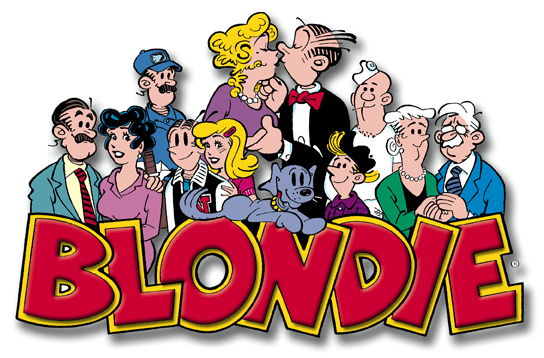
Blondie is one of those shows. It was based on the Chic Young comic strip and debuted on NBC in 1957, lasting one year. The series was resurrected in 1968 and the reboot also lasted a season.
📷wikipedia.com The 1957 version
Blondie had become very popular with fans. Beginning in 1938, 28 movies were made starring Penny Singleton and Arthur Lake. Blondie also showed up on the radio from 1939 to 1950. Many products had been based on the characters including comic books, coloring books, lunch boxes, and board games.
The 1957 series starred half the movie duo. Lake took on his role of Dagwood Bumstead, but Pamela Britton was offered the role of Blondie Bumstead. Their kids, Cookie and Alexander, were played by Ann Barnes and Stuffy Singer. Florenz Ames was boss J.C. Dithers with Elvia Allmana as his wife Cora. Rounding out the cast was Harold Peary as neighbor Herb Woodley.
📷imdb.com The 1968 version
A decade later Will Hutchins and Patricia Harty play Dagwood and Blondie, Jim and Henny Backus play the Dithers, and Pamelyn Ferdin and Peter Robbins are their kids. The only advantage this series had over the original was color.
The comic strip, movies, radio show and both sitcoms all encompassed the familiar Bumstead elements: Dagwood being physically and socially awkward; their dog Daisy, and Dagwood’s love of napping and huge sandwiches.
The reboot was produced by Joe Connelly and Bob Mosher, the faces behind Leave It to Beaver and The Munsters. There was room in the schedule after the network cancelled He and She, a sitcom starring real life spouses Paula Prentiss and Richard Benjamin. The show is described on imdb.com as “Dick and Paula Hollister are a couple living in New York. Dick is a comic-book artist who has become famous for creating a superhero called Jetman, which has been turned into a TV show starring egocentric actor Oscar North.” During its one season of 26 episodes, the show received seven Emmy nominations, including a win for writing. It’s too bad that show was given the axe and Blondie moved in because the Prentiss-Benjamin show was much more creative and felt new, while Blondie felt extremely old.
No surprise, the ratings were not great. This is even worse when you see what the show was in competition with: The Ugliest Girl in Town, which would also be gone by 1969, and Daniel Boone. The one new 1968 show to return on CBS was Hawaii Five-0 which seems so much more sophisticated than Blondie; it’s hard to believe they both debuted the same year.
📷yahoo.com Hawaii Five-0
Perhaps the fans didn’t tune in because the critics panned the show before it aired. The Milwaukee Journal’s Wade Mosby said it was “a horrendously contrived piece of fluff that should have never been snatched from the comic pages.” Don Page of the Los Angeles Times called it “an unmitigated disaster,” and Cynthia Lowry of the Associated Press described it as “dismal.”
By November, rumors were that the show was already cancelled, and its last episode aired in January. The show probably relied too much on slapstick and unsophisticated humor; things that might have been fine in the 1930s but were passe by the 1960s. Sometimes a show is cancelled just because it’s a badly written and executed show. It seems Blondie fell into this category not once but twice.
Off the top of my head, I can only recall two comic strips becoming popular television shows: The Archies and The Addams Family. Because the Blondie characters were not very dimensional and got into the same situations over and over, they just never were able to translate into sustainable television characters. I think there’s a good reason that many people don’t remember this show and perhaps it’s better that way.
This month we are learning about America’s favorite families. Today we are spending some time with the Cleaver family. In the past we have talked quite a bit about The Brady Bunch, and in some ways, Leave It to Beaver is like that show. The Brady Bunch portrayed the 1970s and although they have been on the air since that first episode debuted, the show never cracked the top twenty. The Cleavers taught us about the 1950s. That show also never got into the top thirty during its six-season run but has been on the air most of the past 65 years.
📷thetodayshow.com
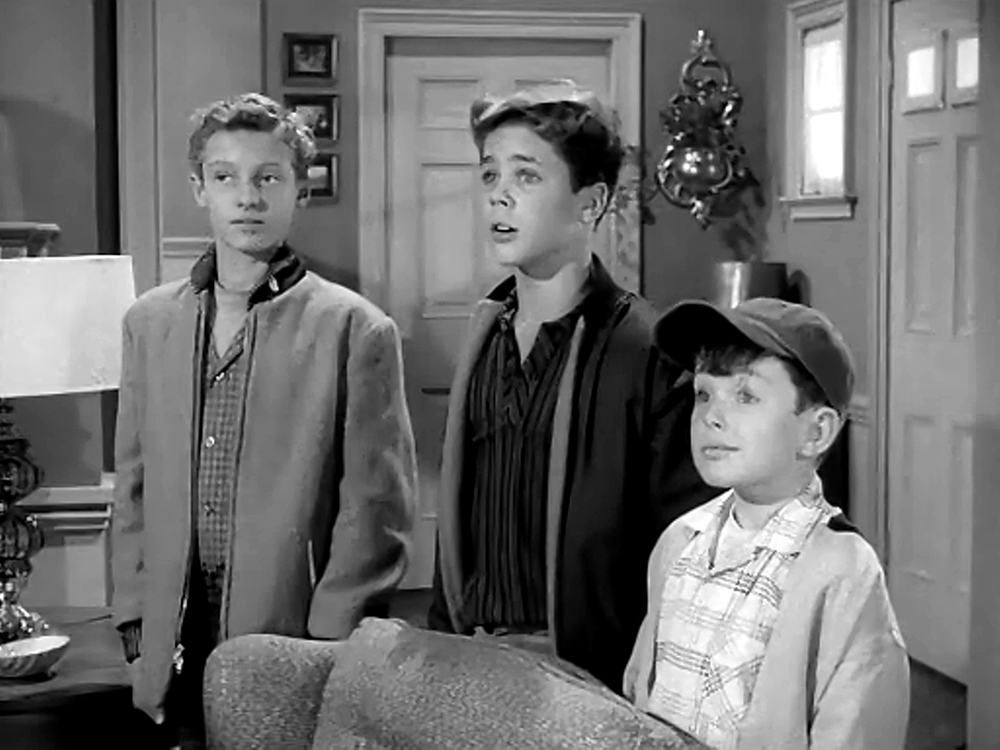
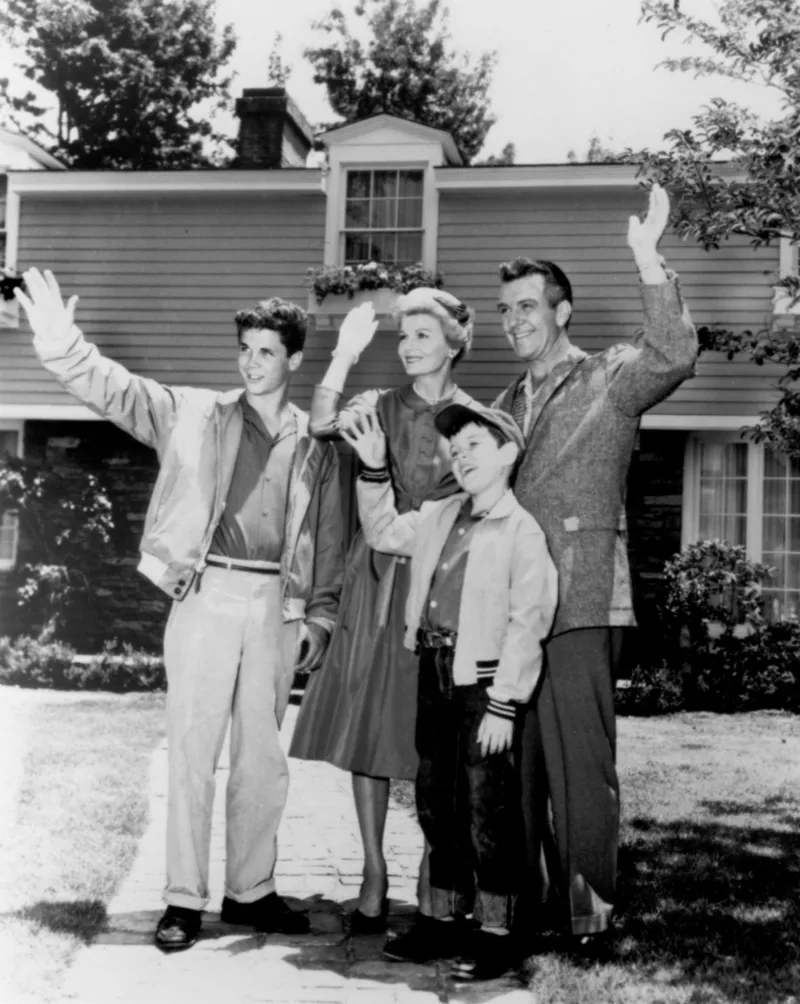
The show was originally written to feature Theodore or Beaver played by Jerry Mathers. Beaver gets into a lot of mischief, but he is a good kid and always means well. He has an older brother Wally, played by Tony Dow. His parents are Ward (Hugh Beaumont) and June (Barbara Billingsley). I thought it was interesting that all four of the stars appeared in every single episode of the show, 234 of them.
We also got to know some of the boys’ best friends as well. Beaver hangs out with Larry Mondello (Rusty Stevens) and Gilbert Bates (Stephen Talbot). He also spends time with Gus an old fireman played by Burt Mustin who seemed old even then. Wally is often with Clarence “Lumpy” Rutherford (Frank Bank) whose father is friends with Ward and Eddie Haskell (Ken Osmond). Eddie is overly polite to Ward and June who are never fooled by his manners; he often picks on Beaver.
Mathers said that when he went to the audition, he went in his Cub Scout uniform because he didn’t want to be late for the den meeting. He was so honest and innocent about wanting to get to his Scout meeting that the producers hired him.
📷imdb.com With Eddy Haskell
Tony Dow never planned on getting a part. He had been in one commercial but no television series. He was an athlete and a diving champion and great swimmer. He had been working out at the Hollywood athletic club and a lifeguard there asked Dow’s mom if Tony could go with him to the audition. Dow ended up getting the part. Mathers later corroborated the story in his blog, saying that the actor who was in the pilot grew five inches the following year and was as tall as Beaumont, so they decided to hire another kid for the role. They wanted someone who looked like an athlete, so they chose Dow.
Beaumont took some inspiration from his studies to be a wise and caring father. He held a Master of Theology degree from USC and was an ordained minister. In addition to acting, Beaumont wrote one entire episode, contributed to several others, and directed 23 episodes.
While Beaumont contributed to the scripts, the show was primarily created by Joe Connelly and Bob Mosher, and many of the plots were based on their children.
📷metacritic.com
CBS put Leave It to Beaver on the air Wednesday nights in 1957. I can see where the ratings might suffer because the show was on during the last half of both Wagon Train and Disneyland, so a lot of viewers were watching another show at the time.
The network decided to drop the show at the end of the year, but ABC picked it up and extended its run for five more years. The new network aired it Thursday nights up against repeats of I Love Lucy and a show I know nothing about called JeffersonDrum. The description is that a widowed father starts a newspaper in a western town. The next season the show appeared on Friday nights with another move the following year to Saturday nights. In its fifth season it stayed on Saturday nights but switched times and the sixth season found it on Thursday nights against PerryMason and Dr. Kildare. At that point, Jerry Mathers wanted to have a normal high school life, and the show ended.
The theme of the show is probably one of the best-known television themes. It was “The Toy Parade” composed by David Kahn, Melvyn Leonard, and Mort Greene.
📷dvnet.com Still the Beaver
In 1983, “Still the Beaver” aired to catch us up on the Cleaver family. Beaumont had passed away, but the rest of the cast showed up for the reunion. It led to a reboot that ran for four years from 1985-89 called The New Leave It to Beaver. Beaver and Lumpy run Ward’s business. Beaver lives in their family home. June is still living there, taking care of Beaver’s two boys. Eddie Haskell is still in Mayfield with his son Freddie. Wally is now a lawyer living in town, married and expecting his first child.
Ward and June took a lot of heat for being stereotypical parents in the show. While there was definitely some unrealistic behavior, fans continued to flock to the show for decades and now, almost 70 years after the first airing, it is still on the air and gaining new generations of viewers. June gets made fun of for wearing pearls and high heels, but when she was asked about that, she admitted that she wore the pearls because she had an indentation on her neck that she thought did not look good on film and the pearls covered it up. She said she wore heels because she had to be taller than the boys.
📷latimes.com
Mathers is the only remaining primary cast member; the rest of the crew has passed away. He has admitted that the family on television was also close off the air. Mathers became good friends with Ken Osmond. When Dow passed away, Matters wrote, “It is with the utmost sadness I learned this morning of my costar and lifelong friend Tony Dow’s passing. He was not only my brother on tv but in many ways in life as well. Tony leaves an empty place in my heart that won’t be filled. He was always the kindest, most generous, gentle, loving, sincere, and humble man, that it was my honor and privilege to know. Of Beaumont, he said, “we had a good chemistry and . . . I was very glad that he was picked for the role and we had a wonderful friendship for his entire life until he passed away from a heart attack. Hugh and my dad had become friends and he occasionally came to our house to play cards with my father and his friends.” He also had fond words for Billingsley, that she was “a good friend and an even better mentor. . . I was lucky enough to work with her for six years and have a life-long relationship with her. She was a very kind woman and a generous philanthropist who supported many charities.”
Like some of the Brady kids, Mathers thought once he left the show, he left show business behind him. He attended Notre Dame High School in Sherman Oaks, California and had a typical teenage life. He enlisted in the US Air Force Reserves, attaining the rank of sergeant. He also was in a band called Beaver and the Trappers. After graduation, he worked as a loan officer at a bank and got involved in real estate. At the end of the 1970s, he decided to star with Dow in a stage production of “Boeing, Boeing” in Kansas City and afterward, the two of them toured in “So Long, Stanley” for 18 months. In 1981, Mathers began working as a DJ and, not long after, the reunion movie and reboot of the tv show was offered to him.
📷heraldweekly.com
I will admit that I have never been a huge fan of Leave It to Beaver. I never thought of it as a bad show, but I was just interested in other shows more. It is pretty incredible that it has been on the air for so many decades and still finds new viewers. I think I gravitate more to The Brady Bunch because it reflects the decade that I grew up in. It must be very strange for a person to live a role for six years, walk away at age 15 or so and then come back to it two decades later. From everything I read, both Mathers and Dow came away from their acting careers unscathed from so much of what you read other child actors had to endure. Along with Ron Howard, they seem to have been able to have a fairly normal life off the set. I think it’s great that Hugh Beaumont became friends with Mather’s father. They seem to have experienced the same great relationships with their tv parents that Patty Duke, Shelley Fabares, and Paul Petersen did. It’s always nice to hear that a show about a favorite American family in pop culture is also a great family away from the set.
This month’s blog “theme is “Kinda Creepy.” These are not shows that will give you nightmares or have you sleeping with the nightlight on. But they did have a touch of ghoul or terror. First up is one of our All-American families, The Munsters.
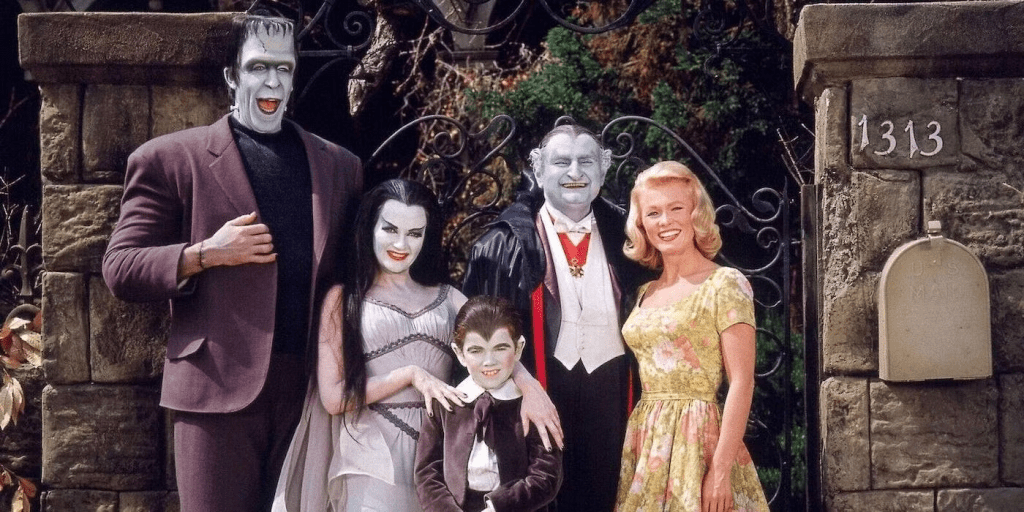
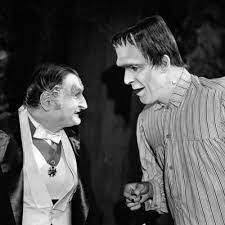
The creators of Leave It to Beaver, developed this series to be a satire of suburban life. The opening credit shows Lily handing her family their lunches as they run out the door just like Donna Reed did in The Donna Reed Show in the fifties. The Munsters are a perfectly normal family except for a few eccentric and trivial things like Herman (Fred Gwynne) being a Frankenstein, Lily (Yvonne De Carlo) being a vampire, Grandpa (Al Lewis) who can turn into a bat, and werewolf son Eddie (Butch Patrick). In real life, Lewis was a year younger than De Carlo who played his daughter and Gwynne was four years younger than De Carlo.
Photo: ebay.com
Living with the family is Lily’s niece Marilyn (Beverly Owen/Pat Priest), who seems a little abnormal to the family but looks like any high school girl of the time, except a little bit prettier. Owen was engaged when she got the part and did not think the show would be picked up. When it became popular, the cast convinced the network to release her from her contract, and Priest, who looked very similar, took over. Gwynne and Lewis had previously been part of the cast of Car 54, Where Are You? and were good friends. (To learn more about their friendship and their individual careers, see my blog from July 10, 2017.)
This series aired on CBS, and ABC featured The Addams Family whom we’ll meet next week. Both shows debuted in 1965 and were off the air after two seasons.
There were a few recurring characters including Paul Lynde as Dr. Edward Dudley (Dom DeLuise also played Dr. Dudley in one episode), Herman’s boss Mr. Gateman (John Carradine), and Clyde (Chet Stratton), a colleague of Herman’s.
Paul Lynde Photo: pinterest.com
The family lives at 1313 Mockingbird Lane. Herman works for Gateman, Goodbury and Graves, a funeral parlor, as a grave digger. In an interview with Daily Variety, Al Lewis, explained that with the unusual family, “they could do a lot of satirical pointed things on society that you couldn’t do on an ordinary show.”
The show actually had four pilots which I don’t think I have ever seen before. The first one was filmed in 1964 with Gwynne, Lewis, and Owen. Joan Marshall was Phoebe, Herman’s wife and Nate Derman was Eddie. For the second pilot, De Carlo replaced Marshall and changed her name to Lily. In the third edition, Patrick was brought on board to replace Derman. The cast stayed intact for the fourth pilot, but Eddie’s character was changed a bit. He was a bit of a brat and they toned it down.
The family had a pet dragon named Spot that lived under the stairs. When the staircase opened up, you could see the fire he was breathing and sometimes you would see his tail only.
Photo: hagerty.com
Makeup for the show was credited to Bud Westmore who had worked for Universal during their monster movie phase. However, the actual work was done by several people. Perc Westmore worked with Grandpa. Abe Haberman applied Lily’s new face, while Michael Westmore worked with Patrick and Priest. Bill Mumy was the original choice for Eddie, but his parents said “No” when they learned about how much makeup would be used for each episode.
Patrick was asked about the cast and how they got along in an interview with Fox News. He said it was a good relationship. If he had to pick another actor whom he bonded with more than another it would probably be Lewis. He discussed the amazing comedic timing that Gwynne and Lewis shared. He said that the person he enjoyed working with the most was his makeup man, Westmore. He said he was the first person he saw every morning. He also mentioned Westmore was a very handsome guy who owned a Jaguar and was a bachelor, so he looked up to him as a role model also.
Photo: vintageeveryday.com
Karl Silvera did Herman’s makeup. Gwynne had the toughest time of all the characters. He had to spend two hours in the makeup chair first thing in the morning. He wore forty pounds of foam rubber padding and drank copious amounts of lemonade. Despite that, he lost a lot of weight doing the show. In one month, he lost ten pounds. They also put a piece of foam latex on his head to flatten the top. His shoes were asphalt paver’s boots with four-inch soles. The producers rented a compressed air tank and would poke the nozzle inside his collar to blow cool air on him.
The show aired on Thursday nights at 7:30. Many shows began filming in color in the mid-sixties, but the studio did not want to pay the extra $10,000 per episode, so it was shot in black and white. For its debut year, it was number 18, tied with Gilligan’s Island, but it took a drastic drop for season two and landed at number 61. The show competed with The Flintstones and Daniel Boone in year one In year two, Batman debuted in color and The Munsters’ viewers switched networks in droves. The show was canceled with 70 episodes for syndication. From the comments that I read, I’m not sure Lewis and Gwynne would have continued another season anyway. They wanted a different type of humor and, of course, Gwynne had to endure so much with his costume.
If you were looking at the merchandising that accompanied the show, you would never guess it was only on for two seasons. Between 1965-68, 16 Gold Key Comics were produced. The show rolled out Colorforms, car model kits, both a Herman Munster doll and a puppet, and View Masters. You could also purchase several different action figure sets, a board game, and a lunch box, among other items.
Although the show, not surprisingly, never received an Emmy nomination, it was up for Best Television Series for a Golden Globe in 1965 which did surprise me.
The theme song was an instrumental, simply titled “The Munsters’ Theme.” It was composed by Jack Marshall. It was nominated for a Grammy in 1965. There are lyrics for the song, written by Bob Mosher, but they were never used on the air.
For a show that was only on the air for two seasons, it has had a lot of staying power. I think that it was so different and the fact that The Addams Family was also on two seasons and very similar just provided it with that perfect fan base. I do remember watching the show and buying The Munsters coloring books and paper dolls, but I don’t remember it being a “must see” for me. Of course, I was only five when it was canceled, so I primarily saw it in reruns. Sadly, I would also choose Batman over The Munsters, so I understand why the viewers drifted. However, it is never a waste of time to watch Fred Gwynne and Al Lewis in action. If you never watched the show or want to binge watch it, seventy episodes is an easy one to get through.







 thewritelife61