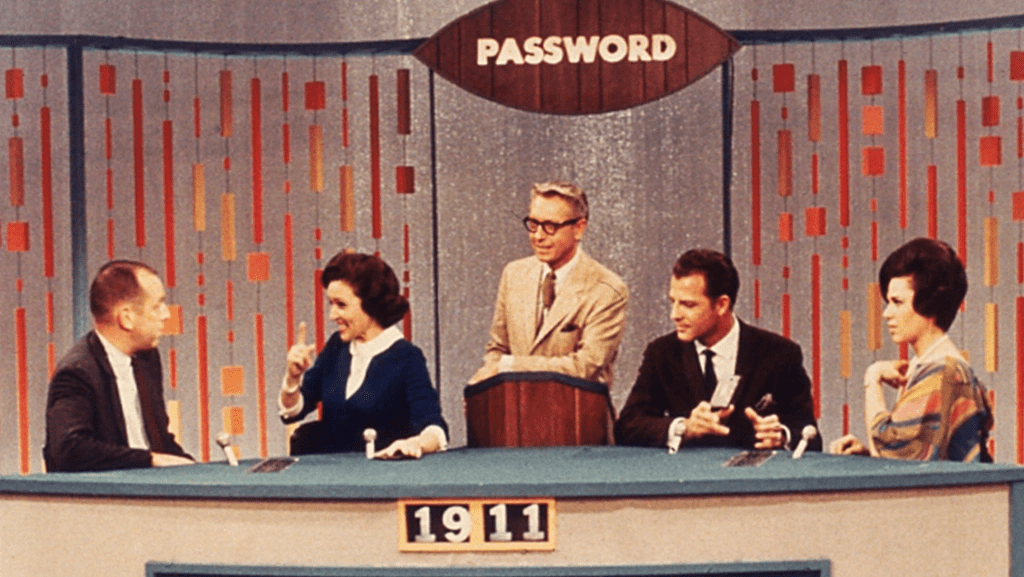
This month our blog series is “Life is Just a Game,” and we are looking back at some of the game shows that debuted in the fifties and sixties. Today we are taking a peek back at Password. A funny moment occurred that first year when one of the celebrities was Jack Benny. The word he had to describe was “miser,” and he said, “Me” which got a lot of laughs.
📷boomerjourney.com
The Goodson Todman partnership created many game shows over the years. One of their first was Password. It debuted in 1961 on CBS at 2pm ET. Allen Ludden, a former G.E. College Bowl host was chosen as the emcee. Ludden is also known as the husband of Betty White whom he met on the game show.
Ludden was born in Mineral Point, Wisconsin. After his father passed away from Spanish flu, his mother later remarried, and the family ended up in Texas. Ludden graduated from the University of Texas with honors in 1940, later returning for his Masters in English. He served in the US Army in charge of the Pacific theater entertainment district. In 1948, he became the program director for New York radio station WCBS and in 1959 was program coordinator for all CBS owned-and-operated stations. Ludden began hosting shows for teens and then College Bowl. His opening catch phrase while hosting Password became “Hi Doll” which he said was meant for his mother-in-law Tess White.
📷instagram.com Carol Burnett and Elizabeth Montgomery
The rules of the game were that teams were formed with one contestant and one celebrity. The word was given to one player on the team and the other player had to guess what the word was based on one-word clues. If the player failed to guess the word within the five-second time period, play passed to the opposing team. This continued until the word was guessed. The quicker the word was guessed, the more points a team received.
The first team to reach 25 points won $100 for the contestant. That partnership got to play the Lightning Round where the celebrity gave the clues, and the contestant got five passwords within a minute. They received $50 for each right answer.
On July 11, of 1966 Secretary of Defense Robert McNamara updated the country on the progress of the Vietnam War one afternoon. CBS went with the coverage of the live news while NBC aired its soap opera Days of Our Lives and ABC aired its new show which began the same day, The Newlywed Game. Quite a few people turned off CBS that day and during the next few months, Password continued to lose viewers to these two shows. The next spring, Password was cancelled.
After the show was canceled, reruns were sold to CBS which it placed in syndication in the late 1960s. It became so popular that the show began to be filmed again in Hollywood. In 1971, it was placed on the network schedule when Dark Shadows ended. It held its own until 1973 when The Young and the Restless took a huge share of the market, and both Password and Jeopardy saw deep declines in ratings. In 1973 Password won the first Daytime Emmy Award for Outstanding Game Show.
In 1974 the show became Password All-Stars; in 1978 it became Password Plus; and in 1984 it became Super Password. CBS revived the show in 2008 as Million DollarPassword, but it ended by 2010. Jimmy Fallon produced a new version beginning in 2022 with Keke Palmer as host.
📷people.com
Sadly, the episodes from the first version no longer exist. There were rumors that the videotapes were recycled and used for Family Feud.
The Milton Bradley Company introduced a home version of the game in 1962, releasing 24 editions from then until 1986 which they also did with Concentration.
I always enjoyed watching this game. One of my favorite portrayals of the show was when Oscar Madison and Felix Unger go on Password during an episode of The OddCouple. Since you can’t watch the original shows, check out the Odd Couple episode (season 3, episode 11) for some fun.
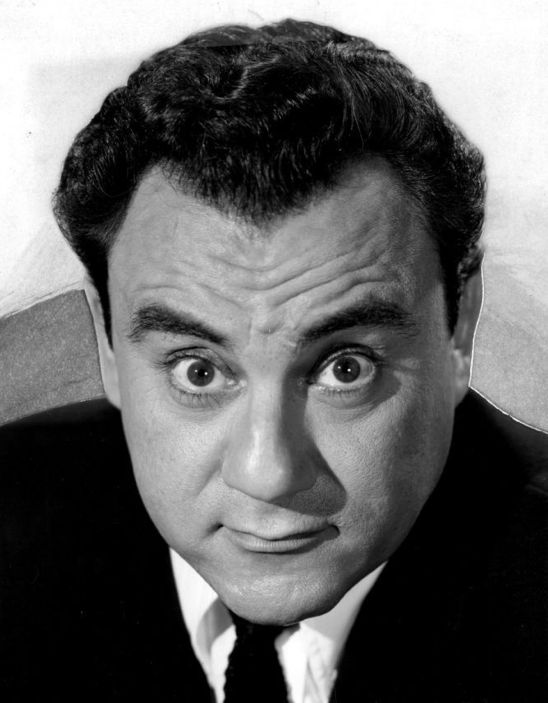
This month we are exploring The Bill Dana Show for our blog series. Last week we talked a bit about the show itself, and for the rest of the weeks, we are looking at some of the other cast members’ careers. Today we begin with Bill Dana himself.
📷findagrave.com
Dana was born William Szathmary in Quincy, Massachusetts in 1924. He was the youngest of six children. His older brother Arthur was fluent in several languages and inspired Bill to learn different accents.
Dana served with the US Army during WWII as a machine gunner and was awarded the Bronze Star Medal.
After the war, Bill enrolled at Emerson College. After graduation, he was hired as a page at NBC’s Studio 6B, or 30 Rock. He was also trying to break into comedy performing around New York. During the fifties he appeared on The Imogene Coca Show. He also did some writing and producing for The Spike Jones Show.
He met Don Adams and began writing routines for him in the fifties. He and Don would be part of each other’s lives for a bit. Don would be one of the cast members on The Bill Dana Show. Dana would appear on Adams’ show Get Smart, and Dana’s older brother Irving was the composer of the Get Smart theme song. Bill would also cowrite the script for the Get Smart film The Nude Bomb.
📷thenewyorktimes.com
In the late fifties, Steve Allen hired Dana as a writer. Bill created a character, Jose Jimenez, for the “Man in the Street” segments of Allen’s show. Soon Jose became his alter ego. He made appearances as Jose on The Red Skelton Show, The Spike Jones Show, The Danny Thomas Show, and The Ed Sullivan Show. He even had a comedy album featuring the character.
Dana told a story on Ed Sullivan’s show that some people truly thought he was Jose Jimenez. One lady who met him out and about asked if his birth name was Jose Jimenez and he told her, “No, it’s Bill Szathmary.” She said “Wow, no wonder you changed it to Jimenez.”
In 1961, Dana began a recurring role on The Danny Thomas Show. He played Jimenez as an elevator operator. People responded so well that Danny Thomas and Leonard Sheldon spun off the character, now a bellhop at a luxury New York hotel, and The Bill Dana Show was created. In addition to Adams, Jonathan Harrison was part of the cast and Maggie Peterson joined them in season two. The show was on the air for one and a half seasons.
As we discussed last week, some people saw Jimenez as a hard-working immigrant who noticed some of the crazy things Americans did, and others saw him as a stereotyped Latino caricature. The pre-show Jimenez fit the second description better and the show Jimenez leaned more toward the first portrayal. However, as the character developed, viewers were not flocking to the show. It was also up against Lassie which at the time was a huge family show on Sunday nights.
📷wikipedia.com
The last time Jimenez was on the screen as a character was a 1966 episode of Batman in a cameo on the famous wall. Later Dana apologized for his caricature of Jimenez and became a bit of an activist for Latino causes. The National Hispanic Media Coalition endorsed the Jose Jimenez character and invited Dana to sit on their advisory board.
Dana jumped back and forth from actor to writer for a couple of decades. He wrote the script for All in the Family’s episode “Sammy’s Visit” starring Sammy Davis Jr. He also wrote for Bridget Loves Bernie, Chico and the Man, Donny and Marie, The Smothers Brothers Comedy Hour, and Matlock.
His acting landed him in The Courtship of Eddie’s Father, Love American Style, The SnoopSisters, Police Woman, McMillan and Wife, Ellery Queen, Switch, Vega$, Fantasy Island, The Facts of Life, and Empty Nest among a few others.
He had recurring roles on two additional shows during his career. He was on St. Elsewhere as Howie Mandel’s character’s father for three episodes. He also was Angelo on six episodes of The Golden Girls.
One of his last projects was founding the American Comedy Archives at Emerson College. He and Jenni Matz interviewed more than 60 comedians for this archive, including Phyllis Diller, Norman Lear, Carl Reiner, Betty White, and Jonathan Winters.
Dana was a man of many talents. He also ran a talent management company and an advertising agency. He wrote a book, The Laughter Prescription, with Dr. Laurence J. Peter.
Dana passed away in June of 2017 at his home in Nashville.
Certainly, Dana had a full career. I think starting off with the Jose debacle probably kept him from getting different roles early in his career. He also didn’t seem to know what he wanted to be when he grew up. Was he a comedy writer? A dramatic writer? A variety show writer? Was he an actor? A talent agent? An author? Not that you can’t be more than one thing in life, but in the span of three decades he never seemed to settle on one or two careers. Hopefully he had fun and enjoyed all the different hats he wore.
This month we are learning why We All Love Lucy. We’ll delve into her sitcoms and get to know Jess Oppenheimer and hear about his role in her television life. But today, we are starting with the woman herself, Lucille Ball.
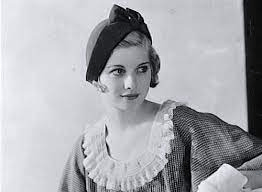
📷facebook. A young Lucille Ball
Lucille Desiree Ball was born August 6, 1911, in Jamestown, New York. She was the only daughter of Henry Durrell Ball, a lineman for Bell Telephone, and Desiree Evelyn Hunt Ball. They lived at 60 Stewart Avenue. The family belonged to the Baptist Church there, and many of her relatives were among some of the first European settlers in Massachusetts.
The family moved frequently for her father’s career, but Jamestown always had a claim on Lucy, and they celebrate her in many ways there. The family lived in Montana, New Jersey, and Michigan before her father passed away from typhoid fever at age 27 in 1914.
Her mother returned to New York, living in Celoron, a summer resort on Chautauqua Lake. The road she grew up on is now named Lucy Lane. Celoron had an amusement park with a boardwalk, the Pier Ballroom, a roller coaster, a bandstand, and a stage.
📷Good Housekeeping
Lucy’s mother remarried four years later. It was her stepfather who encouraged Lucy to audition for his Shriner’s chorus line, which gave her the first taste of what it would be like to be in show business. When she was 16 the family returned to Jamestown.
When Lucy was only 14, she was dating a 21-year-old hoodlum. Her mother was devastated by the situation and finally enrolled Lucy in the John Murra Anderson School for Dramatic Arts in New York City to encourage her in her theater career. Ball did not love the school, and her instructors told her she would not be successful in the entertainment business. Luckily, Lucy did not take their comments to heart. She later said that “one of the things I learned the hard way was that it doesn’t pay to get discouraged. Keeping busy and making optimism a way of life can restore faith in yourself.”
In an attempt to prove the school wrong, Lucy began working as an in-house model for Hattie Carnegie. This was where she first changed her hair. Being a brunette, Carnegie taught Ball to bleach her hair blonde. Her modeling was interrupted for two years when she dealt with the effects of rheumatic fever.
At the ripe old age of 21, Ball returned to New York City to pursue an acting career. She went back to the Carnegie agency and became the Chesterfield Cigarette Girl.
📷Brittanica
In 1933 she was in Roman Scandals as a Goldwyn Girl; while playing a slave girl, she had to have her eyebrows entirely shaved off, and they never grew back. Some of the things an actor goes through for roles is crazy. After that movie she moved to Hollywood to try a film career. After becoming a contract player for RKO Radio Pictures, she received a decent amount of work. At this time, she met the Marx Brothers, appearing in Room Service. She also worked with Fred Astaire and Ginger Rogers in several musicals.
When she registered to vote in 1936, both she, her brother, and her mother registered as Communists. During that year she signed a document as a Communist supporting Emil Freed for assembly and was appointed delegate to the State Central Committee of the Communist Party of California.
Ball later claimed she never had a strong political affiliation. In 1944, Lucy can be seen in a newsreel fund raising for Franklin Roosevelt. She also mentioned that she voted for Eisenhower in 1952 when he was on the Republican docket. In 1953 Ball met with HUAC and gave a sealed testimony. She said that she voted Communist at her grandfather’s insistence and did not know she had been appointed a delegate. Before filming episode 68 of their show, her husband and co-star Desi addressed the audience and said Lucy was not a Communist; she was just influenced by her grandfather. He joked that “the only thing red about Lucy is her hair, and even that is not legitimate.”
📷pinterest
In the late thirties, she dabbled in radio to earn some additional money. She was a regular on “The Phil Baker Show” and on “The Wonder Show” where she met announcer Gale Gordon.
In 1940 Lucy met Desi Arnaz when they both appeared in the movie Too Many Girls. They fell in love immediately, and before the year was out, they eloped. Arnaz was drafted in 1942, but a knee injury kept him from active service, and he was placed in Hollywood organizing and performing USO shows for wounded GIs.
Lucy finally got her big break in 1943. Arthur Freed was making a movie based on the play “DuBarry Was a Lady”; he bought it for Ann Sothern, but when she turned it down, she recommended her best friend, Lucille Ball.
In 1944, Ball filed for divorce, but the couple reconciled before it went through. Lucy and Desi had Lucie in 1951 when Lucy was almost 40, and son Desi was born during the series and written into the scripts in 1953. Mom and son appeared on the first cover of TV Guide which came out in 1953.
📷HollywoodHistoricPhotos.com
Ball continued to make movies throughout the forties and kept a foot in radio. In 1948 she was cast as Liz Cooper on the radio show, “My Favorite Husband” on CBS.
When CBS wanted to transition the show to television, Lucy wanted Desi to be her television husband. CBS said no, so the couple went on the road with an act to prove the popularity of the them working together and CBS backed down.
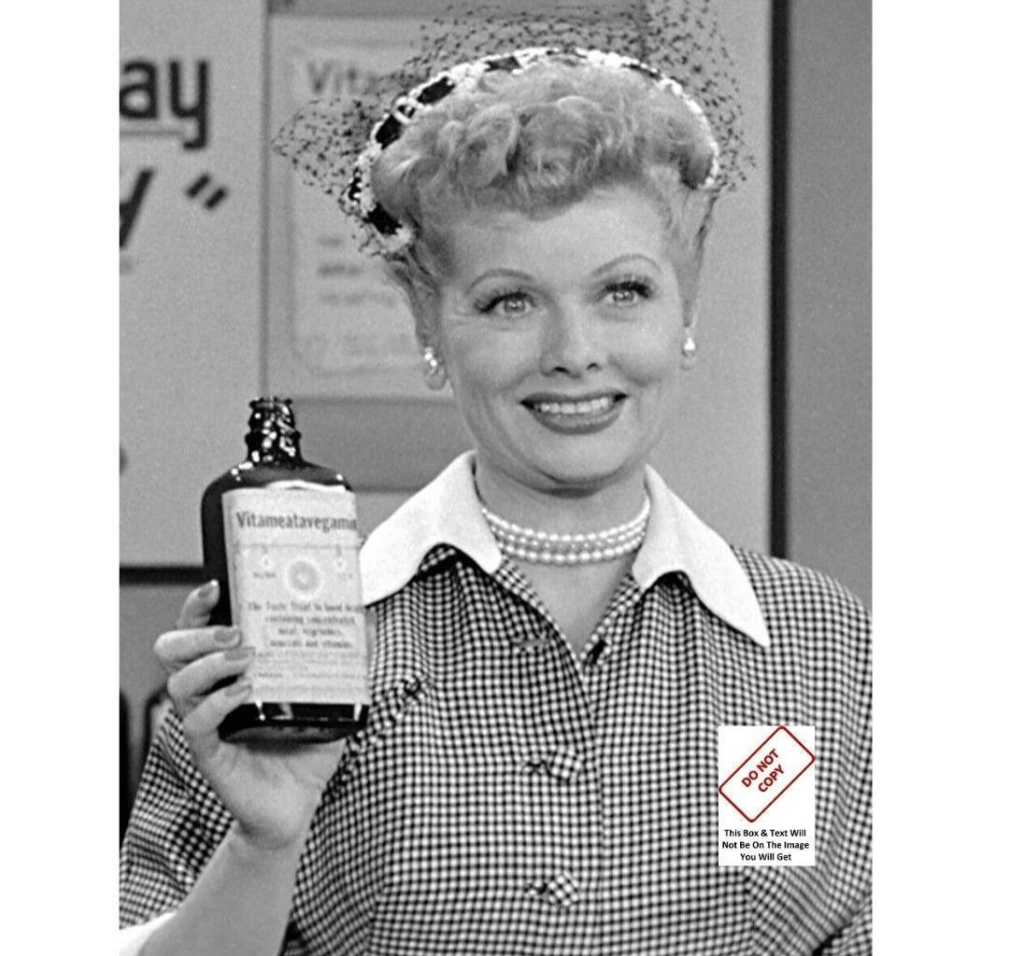
The show was incredibly successful. (If you want to learn more details about the series and all the history that it produced, keep an eye out for my blog which will post January 13, 2025.) The couple created their own production company and had many “firsts” with technology producing their show. During filming breaks of the show, Lucy and Desi made two movies: The Long, Long Trailer in 1954 and Forever, Darling in 1956.
After years of turmoil and ups and downs in their marriage, the couple divorced. However, they continued to remain in each other’s lives through their children and their relationship. Later in life, Lucy said “Desi was the great love of my life. I will miss him until the day I die.”
📷closerweekly.com Ball and Vance
Lucy bought Desi’s share in the production company which produced a variety of shows including Mission: Impossible, Star Trek, and The Untouchables. In 1967 Lucy sold her shares to Gulf+Western, owned by Paramount, for $17 million, which would translate into $138 million today.
Lucy married Gary Morton in 1961. At the time, Morton was a comedian 13 years younger than Lucy. He said he had never seen an episode of I Love Lucy. Ball hired Morton for her production company, teaching him the television business.
For the next decade, Lucy worked on a number of television specials. She also tried sitcom life again. She starred in The Lucy Show from 1962-68 and in Here’s Lucy from 1968-1974. We’ll discuss these shows the last week of January. Many of Lucy’s friends appeared on these shows. Her close friends included Mary Jane Croft, Judy Garland, Ethel Merman, Barbara Pepper, Ginger Rogers, Ann Sothern, Vivian Vance, and Mary Wickes.
📷ebay.com
Ball kept busy acting during the early 1980s. Desi Arnaz passed away in 1986. In 1988 Lucy had a mild heart attack. She appeared at the 1989 Academy Awards show and she and co-presenter Bob Hope were given standing ovations. She died a month later. Lucy had been a heavy smoker, and her cause of death was abdominal aortic aneurysm which is seen more in smokers.
Lucy always sent flowers to Carol Burnett on her birthday. The day before she died, she ordered them, and they were delivered a few hours after Carol learned of her death.
Lucy was cremated and her ashes were interred in Forest Lawn Cemetery with her mother’s remains. In 2002, both women’s remains were moved to the Hunt family plot in Jamestown. In Jamestown you can find the Lucille Ball Desi Arnaz Museum & Center for Comedy and the Lucille Ball Little Theater.
In 2009 a statue of Lucy was erected in Celoron. Many people called it “scary,” and it became known as “Scary Lucy,” which I totally endorse. In 2016, a more lifelike statue was created to replace Scary, but the scary statue had become so popular, it was left on display with the new one as its neighbor.
📷youtube.com The different sides of Lucy
Those two statues symbolize my relationship with the show. I appreciate the show and everything it did to create the classic age of television. Whether it’s technical filming strategies, the writing, the way the business was run, everything was important in this show. However, I have to admit, it’s not a show I choose to watch. It changed the entire course of television in similar ways that All in the Family would do a few decades later, but I honestly don’t enjoy watching either of these series. That might be a fault in my genes, but I also have to be honest.
However, Lucy Ricardo, while we may think of her as naïve and sophisticated, traditional and unconventional, submissive and disobedient, was an important icon in the way that women thought about themselves in the fifties.
Women had been brought in to work and gain independence while so many men were overseas fighting, and then they were asked to give it all up and go back to a domestic and tranquil life. Leslie Feldman, a political scientist and author of The Political Theory of I Love Lucy, writes that Lucy was “a transitional figure—she’s on the cutting edge. . . Are [women] going to stay home and be wives and mothers? Are they going to go to work? Or are they going to do both? And what if they really do better and earn more money than their husbands? What about that? That’s an element of Lucy too.”
📷biography.com
Lucy was a force in show business. While she was not alone in taking control of her own career—Donna Reed, Betty White, and Ann Sothern were also powerhouses in establishing their own companies and running them—Lucy did it with the nation watching her. Even the choices she made about whether to divorce Desi or not were all done in the public eye and were sending messages whether people chose to receive them or not.
Lucille Ball was an amazing actress and an amazing business person. Apart from whether I enjoy watching the show or not, it changed the history of television and the way sitcoms were written, cast, and remembered. Thank you, Lucille Ball, for not listening when your instructors told you that you would never make it in show business. You not only made it in television, you truly made television what it is today.
Continuing with our blog series about stars and shows from the fifties, I immediately thought about the show that is somewhat documentary, somewhat variety, somewhat talk show—This is Your Life.
The show aired on NBC from 1952-1961. It was created and hosted by Ralph Edwards. Guests were lured to the show for various reasons only to learn that they were the star of the show with appearances by their former colleagues, friends, and family. Edwards tried a reboot in 1971 that only lasted for a year, and Joseph Campanella tried again in 1983 but it was not successful.
Edwards had been asked by the US Army to do something special for paraplegic soldiers at a rehab hospital in California. He decided to talk about a young soldier’s life to help him realize the value of his past and have hope for his future, something like It’s a Wonderful Life with Jimmy Stewart. In the forties, it became a radio show, alternating episodes about celebrities and ordinary people.
📷bigredbook.com Laurel and Hardy
Some of the most-loved episodes were about Johnny Cash, Dick Clark, Nat King Cole, Bobby Darrin, Don DeFoe, Shirley Jones, Buster Keaton, Laurel and Hardy, Harold Lloyd, Roy Rogers, Mack Sennett, Dinah Shore, Danny Thomas, Dick Van Dyke, and Betty White.
Some of his shows had complex elements and thought-provoking memories. In one episode, Rev. Kiyoshi Tanimoto was the guest. He survived the atomic bombing of Hiroshima. In the midst of bringing on family and friends, Edwards brought out Robert A. Lewis. Lewis was the copilot of the Enola Gay, the plan that dropped the bomb on Hiroshima. On another episode, Dr. Kate Newcomb from a small Wisconsin town talked about her million pennies drive. She was raising funds for a small community hospital. Viewers were so inspired, they donated more than $112,000 in pennies.
📷wikipedia.com
Some television fans loved the shows and the sentimental scenes; others made fun of the situations thinking it all too much. Edwards was criticized at times for bringing up subjects that were painful for the guests to endure on the air.
It caught on overseas as well and versions were produced in Australia, Chile, Denmark, France, Israel, the Netherlands, New Zealand, Norway, Peru, Spain, Sweden, and the United Kingdom.
The concept even made it into animation. In 1955 Warner Bros. animator Friz Freleng created “This is a Life?” which honored Bugs Bunny with Elmer Fudd as narrator. Daffy Duck, Yosemite Sam, and Granny all made appearances. In 1960, Walt Disney had “This is Your Life Donald Duck,” a tribute to Donald by Jiminy Cricket.
📷imdb.com
I have to admit that I have never seen the show; but I have seen tons of parodies about the series. The concept sounds good on paper but in the actual filming I think it got away from the producers and became a show that often forced people to live a bad experience all over again instead of just honoring where they currently were in their life journey.
As we begin week three in our blog series looking at some of our favorite families, today we are heading to Los Angeles to check in with the Warners and the Hughes.
O’Malley, Snyder, Kelly, Clark Photo: imdb.com
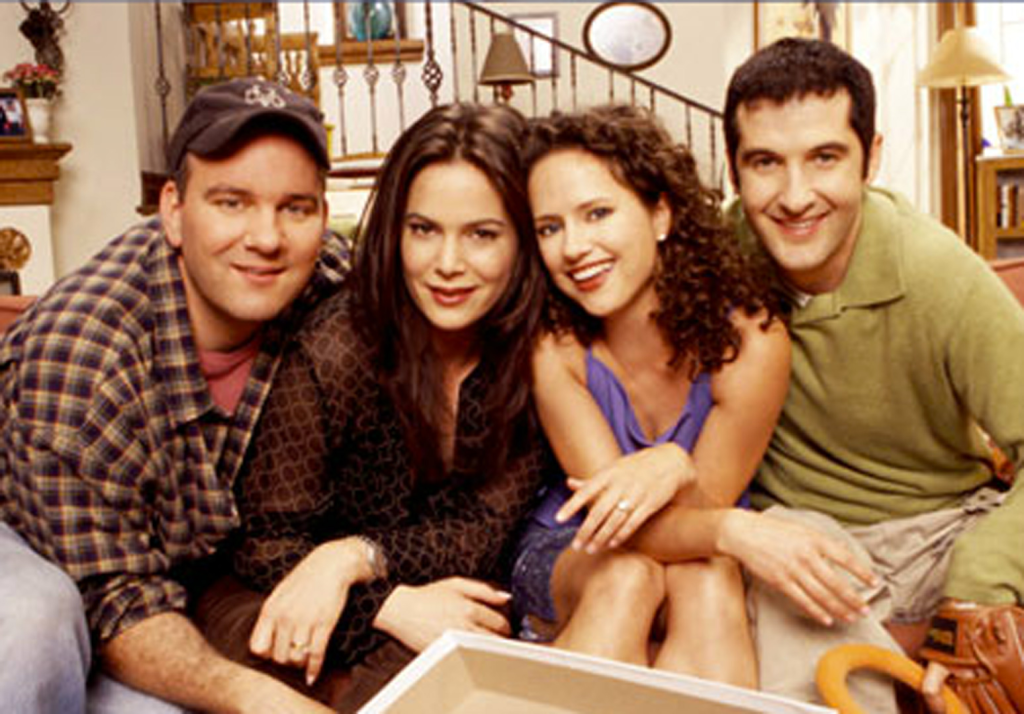
Created by Alan Kirschenbaum and Gregory Garcia, Yes, Dear was on CBS for five seasons from 2000 to 2006.
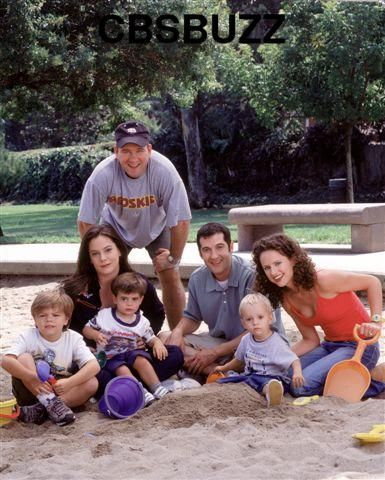
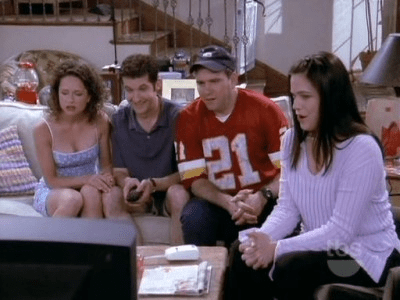
Greg (Anthony Clark) and Kim (Jean Louisa Kelly) Warner have a son Sammy (Anthony and Michael Bain); he is a film industry businessman and she is a stay-at-home mom. They have a peaceful, although maybe somewhat boring, life. Then Kim’s sister Christine (Liza Snyder) and brother-in-law Jimmy (Mike O’Malley) Hughes move into their guest house with their two overactive boys, Dominic (Joel Horman) and Logan (Christopher and Nicholas Berry, Alexander and Shawn Shapiro, Brandon Baerg). One of the gags of this show is Greg recalling Logan’s childhood; when he reflects back on it, we see all the different Logans.
Photo: pinterest.com
The Warners and the Hughes have very different lifestyles and views on life and parenting. Kim and Greg are a bit neurotic and try to hard to be the perfect parents. Christine and Jimmy, on the other hand, are down-to-earth and less concerned about doing everything perfectly.
For example, in one scene, the script is:
Dominic: Can I have some coffee, so I don’t fall asleep in school again?
Jimmy: Dominic, you are six years old, you can’t have coffee. Here, drink these Mountain Dews.
Rounding out the cast was Tim Conway and Vicki Lawrence as Greg’s parents Tom and Natalie, Jerry Van Dyke and Beth Grant as Jimmy’s parents Jimmy and Kitty, and Dan Hedaya and Alley Mills as the girls’ mother Jenny and father Don.
Tim Conway Photo: tigerdroppings.com
The theme song, “Family is Family,’ written and performed by Bill Janovitz summarizes the plot:
1,2,3! You got a wife and kid in love with you. Yes, Dear.
You swear to God they’re poking fun at you. Yes, Dear.
You live your life the best you can. Yes, Dear.
Until your family screws up the plan. Yes, Dear.
But family is family is family is family. Yes, Dear.
Yes, Dear. Yes, Dear.
The great Betty White Photo: twitter.com
Despite its decent ratings, critics never seemed to appreciate the show at all. The only Emmy award the show was nominated for was for Betty White as a guest star in 2003. Nominees that year included Georgia Engel, Betty Garrett, and Cloris Leachman; the winner was Christina Applegate for Friends. According to Nancy Tellem, president of CBS Entertainment, “there was a huge difference between the critics and mainstream America.”
On June 23, 2021, thewrap.com posted the 37 worst sitcoms of all time. While I can get behind My Mother the Car and Two Broke Girls, along with about 30 sitcoms I never heard of, I thought the inclusion of Yes, Dear was unfair. I can’t say this was ever a “must-see” for me, but there were plenty of worse sitcoms on the air.
The show held a steady 24th place for the first four seasons and then ratings increased, and the show placed 11th and 15th for the last two seasons. So, with ratings going up, why was the show canceled? CBS canceled the show after season four and then brought it back. However, after season six, Clark took an offer to host Last Comic Standing. With one of the four stars gone, CBS decided to be done with the show.
Photo: betaseries.com
Although the show was on the air for six seasons and was in syndication for a while, DVDs have never officially been released. I was not able to find out why that is the case.
When Kelly thought back to her time on the show, she said it was a fun show. “They gave me a lot of fun stuff to do. There was so much silliness.” Fun and silly doesn’t sound so bad. Maybe the show will become available on DVD or in syndication again soon, and you can judge for yourself.
As we look at some of our favorite character actors, today we learn more about Hazel’s friend Rosie: Maudie Prickett. Prickett had a prolific career with more than 300 credits between the stage, film, and television.
Photo: bewitchedwikifandom.com
Maudie was born in 1914 in Oregon. Her birth name was Maudie Marie Doyle; she married Charles Fillmore Prickett II in 1941 and used her married name for her career. Charles was the co-founder and manager of the Pasadena Playhouse and later became an orthopedic surgeon. They remained married until his death in 1954 and had two children.
Prickett would amass 64 movie credits, with her first being Gold Mine in the Sky in 1938. Her last three movies were made in 1969: The Maltese Bippy, Rascal, and Sweet Charity. She typically played maids, secretaries, spinsters, or nosy neighbors. One of her most recognized movie roles was as Elsie the Plaza Hotel maid in North by Northwest.
In 1952 she received her first television roles, appearing on This is the Life, Hopalong Cassidy, The Doctor, and The Adventures of Superman. While most people are familiar with Hopalong Cassidy and Superman, they may not recognize the other shows. This is the Life was a religious show that began in 1952 and ended in 1988; each episode was a mini-drama that ends with someone becoming a Christian. The Doctor was a medical show where Warner Anderson as the doctor presented a story and then provided comments after the episode. Most of the series dealt with some type of emotional problem.
The look we were used to with Maudie Photo: imdb.com
For the next two decades, Maudie was quite busy with her television career. She often made multiple appearances on a show as different characters. She had a nice blend of both dramas and comedies on her resume.
In 1961 she married Dr. Eakle Cartwright who died in 1962. In 1966 she would try marriage one more time when she wed the mayor of Pasadena, Cyril Cooper who lived five more years.
While watching your favorite classic television shows, you will see her on westerns including Wagon Train, Bonanza, and Gunsmoke. She made her mark on medical series including Ben Casey and Marcus Welby MD. She also appeared in quite a few dramas including The Millionaire, The Untouchables, Lassie, Daniel Boone, The Mod Squad, and McMillan and Wife.
However, it was the sitcom genre that kept her busiest. During the fifties, she could be seen on Topper, Father Knows Best, Leave It to Beaver, and The Donna Reed Show. The sixties found her on Dennis the Menace, Bachelor Father, The Danny Thomas Show, Mister Ed, My Three Sons, Petticoat Junction, The Andy Griffith Show, The Doris Day Show, Gomer Pyle USMC, and Get Smart. During the seventies, she took roles on Mayberry RFD, Bewitched, Love American Style, and Room 222.
Best Friends – with Shirley Booth on Hazel Photo: pinterest.com
All of her recurring roles were on sitcoms: Date with the Angels, The Jack Benny Show, and Hazel. Date with the Angels was Betty White’s second sitcom, and Maudie played Cassie Murphy, a neighbor of the newlyweds. On The Jack Benny Show, she played Mrs. Gordon, the secretary of the Jack Benny Fan Club. Many people remember Prickett from Hazel where she played Rosie. Hazel and Rosie were best friends and always came through for each other but were also very competitive, especially when an eligible bachelor was involved.
In 1976, Maudie passed away from uremic poisoning at the young age of 61. Uremia occurs when there is an increase of toxins in the blood and usually occurs when the kidneys no longer filter them out. It can be treated with medication, dialysis, and transplant surgery, but for some reason, hers must have been untreated which lead to her death.
On Bewitched Photo: sitcomsonline.com
Maudie was a very busy lady, accumulating 164 acting credits between 1938 and 1974. I’m not sure if she was okay with being typecast or if she would have liked some other types of roles, but she certainly made the roles her own. You have to wonder how much more she would have accomplished if she had lived another twenty or thirty years. Her personal life was sad, having three husbands die before her and then she herself dying as middle age was beginning.
I know you read this comment a lot if you follow my blog, but we have another one of those character actors I wish we knew more about. The Television Academy rarely interviews them, and it is tough to find much information beyond their professional resume. One day I will make good on my promise and write a book about these wonderful people who made classic television so fun and believable.
As we continue looking at some of our favorite actresses, today we get to spend some time with Beverly Archer. Beverly was born in Oak Park, Illinois in 1948 but grew up in California.
Photo: behindthevoiceactors.com
Beverly knew she wanted to enter the acting profession and studied at both San Francisco State University and UC Santa Barbara where she majored in drama. But once she graduated, she decided acting wasn’t for her. She worked for Wells Fargo for two weeks and then accepted a job with Abbey Rents in Los Angeles where she worked for three years. She says she was lonely and not having fun, so she started taking acting classes again and working with theater groups.
Unlike a lot of actors who have to spend decades before nabbing their first series, the first two television roles Beverly received were regulars. However, Beverly paid her dues working in commercials before appearing on a series. She said they gave her confidence that she could make a living acting, so she was able to quit her job.
The Nancy Walker Show Photo: memorabletv.com
In 1976, she appeared on The Nancy Walker Show. She played Nancy’s daughter, Lorraine. In a recent interview with Sitcoms Online, Beverly said she ran into a guy she had done some theater with who had become an agent. He signed her and got her the audition for the show. Archer was reading the script with several other actresses but apparently, she was the only one who found the scene very funny. Nancy then read with her and the producers felt they could be family. She says she was in the right place at the right time.
With Oliver Clark on We’ve Got Each Other Photo: sitcomsonline.
Unfortunately, the show only lasted one season, but in 1977, Beverly was offered the role on We’ve Got Each Other. The plot for this show was that Stuart Hibbard (Oliver Clark) worked at home, cleaning and cooking while his wife Judy (Archer) worked in LA for photographer Damon Jerome (Tom Poston). Stuart had to deal with domestic situations and his next-door neighbor Ken (Martin Kove) while Judy dealt with work situations and secretary Donna (Renn Woods). Like her first show, this sitcom only lasted one season as sell.
In 1976 she accepted another permanent role as Mrs. Robert Bernard. She met her husband through an acting teacher. He was also an actor, doing a lot of voice-over work.
During the 1980s, she would receive offers to play recurring characters on four shows.
Photo: tumblr.com
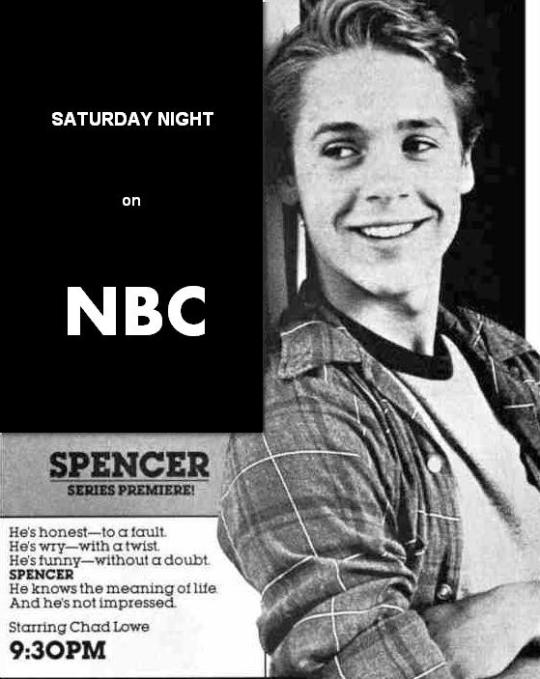
On Spencer, she played Miss Spier, a divorced friend of Spencer’s mother. Most episodes show Spencer, played by a very young Chad Lowe, humorously dealing with the drama of high school.
In 1985 she was on ten episodes of Washingtoon. This is a little-remembered show that aired on Showtime. The plots centered around a senator who wasn’t too bright and Archer was his secretary on the show.
In 1988, she appeared on ALF as neighbor Mrs. Byrd.
Photo: sitcomsonline.com
One of her best-known roles occurred on Mama’s Family. Beverly portrayed Iola Boylen from 1986-1990. In the Sitcoms Online interview, Archer talked about being on Mama’s Family. She explained that the network version was cancelled, and Joe Hamilton decided to recreate it in syndication. At that time, no one really did syndication shows. Archer says he was a pioneer in the field. Betty White and Rue McClanahan moved over to Golden Girls, so there was a gap for a new character and Archer was hired for the syndicated show. She says some of her favorite moments on the show were working with Ken Berry. She described him as the funniest person on the planet.
Photo: tumblr.com
Beverly tried her hand at writing and received credits for scripts for Mama’s Family, Working Girl and ALF.
In addition to these regular roles, she guest starred on a variety of shows, including It Takes Two, Family Ties, The Fall Guy, and My Sister Sam.
Photo: allstarpics.famousfix.com
During the decade of the nineties, Beverly was again lucky enough to gain a recurring role on five additional shows: Married . . . with Children, Aahh Real Monsters, Jumanji, The Young and the Restless, and Major Dad. On Married . . . with Children, she was a sexually repressed librarian who falls in love with Bud.
On Major Dad, she played the role of Alva Bricker, gunnery sergeant. During an interview with Jerry Buck in 1992, Archer says she used John Wayne for her role model for Alva because he was the only Marine she could remember. Describing her character on the show, Archer says “She’s the best Marine on the base. I think the driving force behind the characters is that she’s the best. But the personal stuff is fun to play. She has a wild sex life, but the crux is that she’s incredibly efficient as administrative chief of the commanding general’s office.”
Photo: ebay.com
After portraying so many school-marm types of characters, she was happy to have a different sort of character to work with. Beverly says Gunny has a macho-style to her femininity. She treated relationships the way men typically did. She didn’t want to be tied down to one man.
Beverly joined the cast in season two. Once again, she benefitted from the fact that several characters from the first season were let go. The show was produced by Rick Hawkins who also worked with her on Mama’s Family. Archer loved the fact that Gunny was so different from Iola on that show.
She also guest starred on nine shows, including Full House, Love and War, and Grace Under Fire throughout the 1990s.
Photo: avelyman.com
In 1995 she was part of the fun, satire, The Brady Bunch Movie, playing a teacher who gets caught stealing.
Beverly accepted that she was typecast in many of her roles. As she described it, “Nobody’s going to let me play a normal human being, certainly not a lead. Certainly not a normal next-door neighbor. I’m there to add a character twist. That’s my living and with this mug, what do you expect?”
Beverly retired in 2002. Beverly may have retired, but she was not sitting around the house twiddling her thumbs. She opened an antique shop in the Catskills in upper New York which she ran for about eight years, spending half the year in New York and half in California. She finally moved the shop to California to eliminate the bicoastal living.
Photo: Xiem Gallery
She also wanted to do a lot of traveling. Now she is sculpting with clay and getting to travel. She studied her craft in Italy. In 2008, Beverly had an exhibit at the Xiem Gallery in Pasadena, CA, entitled “2008: A Year of the Pig: A Beginner’s Journal.” The exhibit included some of her thoughts on her art:
“There was so much to learn. Despite the fact that I began with 365 pigs I never thought back then that I would be able to count on two hands the number of pieces I have made that are not critters. I cannot seem to divorce myself from them. Nor do I want to. Our relationship to other animals is quite a complex one, of course. We tend to imbue them with attributes and feelings we admire. We find our domestic companions delightful, amusing, courageous and intelligent…..all attributes we would like to see in ourselves. We even find the critters we eat to be companionable as well as useful. Perhaps I will branch out eventually. Perhaps to wild animals. We think them fascinating, noble and mysterious. And yet, we threaten them, hunt them or ignore them and fail them constantly. One can’t know for certain but I imagine that in years hence I will still be working on the animal form. There is so just much to learn.”
While I’m sad, her retirement took her out of our living rooms, she seems to have found a wonderful new career. Since writing my blog, and writing in general, has become my almost-retirement career, I understand the passion and satisfaction she is experiencing in her new art life.
Photo: famousbirthdays.com
When asked about the type of roles she wanted to play or would like to have if she had not retired, Beverly responded that “I loved doing comedy, and there is no greater gift than coming to work laughing every day.” I hope she is still laughing every day, and I thank her for the many days of laughter she provided for us.
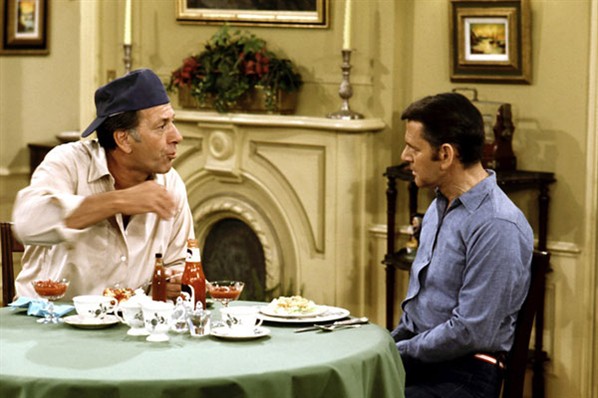
The Odd Couple debuted in 1970. Today we are celebrating its fiftieth anniversary with fifty fun facts.
Fifty Fun Facts
1. Although the show was based on The Odd Couple, a movie written by Neil Simon, Simon did not want his name associated with the television show. However, once he began watching it and realized the quality of the show, he changed his mind and made an appearance during the fifth season in “Two on the Aisle.”
2. The Odd Couple was based on Simon’s brother and a friend of his who were living together and having some conflict. While watching their interactions, he decided it would be a great idea for a play.
3. The Odd Couple had many lives: it began as a play, was made into a movie starring Walter Matthau and Jack Lemmon in 1968, a tv show in 1970, a revised play about women, another tv show starring Matthew Perry and Thomas Lennon in 2015 which was on the air three years.
4. In 1982, an African American version of the show was created starring Ron Glass and Demond Wilson. Called The New Odd Couple, it wasn’t new because it used the original eight scripts from the Klugman-Randall series. It was canceled part way through the season.
5. The show was developed by Garry Marshall and Jerry Belson.
6. The Odd Couple first aired on Friday, the 13th (November 13, 1970).
7. Garry Marshall appears in four different episodes: the one mentioned in fact #3 and as a drummer and as Man 1 and Man 2.
8. Garry’s sister Penny Marshall played Oscar’s secretary Myrna Turner. On her last appearance, she marries a man named “Sheldn” (the “o” had been eliminated from his birth certificate. Sheldn was played by Rob Reiner, Penny’s husband at the time. Garry and his sister Ronnie played Myrna’s siblings Werner and Verna in the same episode.
9. Oscar’s ex-wife Blanche was played by his real wife, Brett Somers. During the show Brett Somers and Jack Klugman got a divorce in real life.
10. The Odd Couple ran on Broadway for 964 performances.
11. In 1985, Simon rewrote the play with female leads, Olive and Florence. Rita Moreno and Sally Struthers were the leads.
12. Originally Dean Martin and Art Carney were considered for the part of Felix.
13. Both Mickey Rooney and Martin Balsam were considered for the role of Oscar.
14. Actor Richard Stahl appears in nine different episodes as nine different characters.
15. Jerry Paris, Jerry Helper from The Dick Van Dyke Show, directed 18 of The Odd Couple episodes.
Photo: pokerlistings.com
16. Oscar plays poker regularly with a group of guys including Murray, Roy, Speed, and Vinnie. Sometimes Felix is allowed to play with them.
17. Murray’s wife who is often talked about but seen in only one episode is Mimi.
18. A cartoon was created for Saturday mornings called “The Oddball Couple.” Spiffy and Fleabag, a cat and dog, are based on Oscar and Felix.
19. The first season was filmed in the same apartment as the 1968 move with one camera and a laugh track. Randall hated that set-up and the next year they began using three cameras and filmed in front of a live audience.
20. Oscar and Felix were said to live at 1049 Park Avenue in New York which was a real address. The actual building was used during the opening credits and exterior shots. Usually a 1966 Ford four-door station wagon or a red VW Beatle are often seen outside the building. The actual tenants got mail for Oscar and Felix.
Photo: movieforum.com
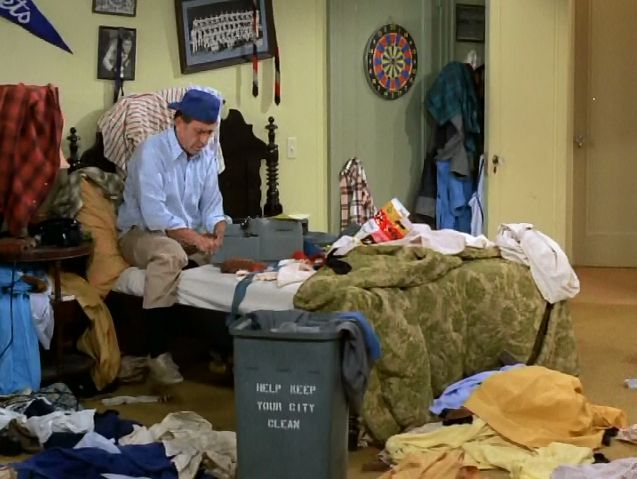
21. One problem the producers had was how to show Oscar was a slob and Felix a neatnik. They couldn’t have the kitchen or living room messy because obviously Felix would keep it clean. Finally, they decided to create Oscar’s bedroom and it was always a mess.
22. During the first season of the show, the guys date two English sisters, the Pigeon sisters, who live in the same apartment building.
23. The Odd Couple was not a ratings success and every season, it was up for cancellation. The summer rerun ratings saved it each year.
24. For some reason, there were inconsistent stories on the show about how Felix and Oscar met. One episode said they were childhood friends. Several references talk about how they met in the army. One episode told the story of how they met while serving on jury duty together.
Photo: youtube.com
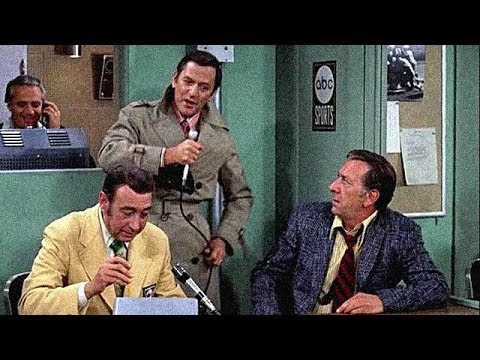
25. Howard Cosell was brought onto the show to help boost ratings. That was a bit of a gamble since Cosell was voted most loved and most hated sportscaster.
26. Tony’s middle name is Leonard and his sister’s name is Edna. Those were the names given to Felix’s two children on the show.
27. Monty Hall showed up twice on the show. He and Oscar had been college roommates.
28. Oscar’s favorite meal is lasagna with French fries and Boston cream pie is his favorite dessert.
29. Don’t let Oscar order pizza. When he orders one with the works, it includes a fried egg on top.
30. Felix and Murray played in a band that featured 1930s music called The Sophisticatos. In one episode they had to play country music and changed their name to Red River Unger and his Saddle Sores.
31. Oscar’s middle name is Trevor.
32. When Elinor Donahue was hired to play Miriam, Felix’s girlfriend, her last name was Welby. Donahue worked on Father Knows Best with Robert Young who later went on to star in Marcus Welby MD.
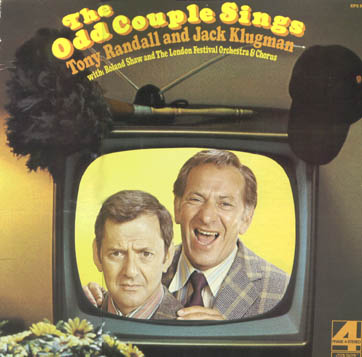
33. Klugman and Randall recorded an album “The Odd Couple Sings” for London Records.
34. ABC always wanted guest stars on the show to boost the ratings, so the writers started including guest stars that would not boost the ratings, opera singers and ballet dancers for instance, which drove the network crazy.
35. In one episode, singer Richard Fredericks is injured playing in one of Oscar’s soft ball games so Oscar has to stand in for Fredericks in Rigoletto, an opera that Felix was producing.
36. Like Harvey Korman and Tim Conway, Jack and Tony used to crack each other up. On one episode they dress as a horse to appear on Let’s Make a Deal. Klugman had to hide himself because he was laughing so hard.
Photo: pinterest.com
37. Klugman’s favorite episode was when the two friends made an appearance on Password with Allen Ludden and Betty White. Felix, who had always wanted to be on the game show, caused a lot of problems on the show and eventually they threw him off the show. His adlib when that happened was “Oh, boy, what a gyp.” Klugman said that was how he felt when Tony died.
38. You can always tell when Felix is really upset because he begins honking.
39. In one episode, Dick Clark plays himself as a radio DJ. He calls Oscar to let him know he has won a new car.
40. Both Willie Aames and Leif Garrett play Leonard, Felix’s son. They would both go on to successful careers and they would both act in the same show again when they appeared on Family.
41. When Oscar tries a dating service, he uses the fake name of Andre La Plume and ends up on a date with Felix’s ex-wife.
42. When Oscar saves Felix’s life, Felix attempts to play “Home on the Range” on his saxophone to thank him.
43. On one episode, the train breaks down in a tunnel. Felix decides to entertain the passengers with an improvised hand puppet he calls Harvey Hankie.
44. Jack Klugman and Tony Randall promoted several products together. They did commercials for the game Yahtzee and their photo was on the box for years. They also did a promotion for Eagle Snacks and Yoplait yogurt.
45. Klugman believed in syndication of the show. He convinced Randall to give up part of his salary for the syndication rights. It was the right move, and they made a lot of money after the show was cancelled.
46. Both Klugman and Randall were up for Emmys every year the show was on. Jack won in 1971 and 1973. When Randall won in 1975, the show had been cancelled and he mentioned during his acceptance speech that he wished he had a job.
47. The final episode had two planned endings. Felix and his ex-wife are getting remarried and Oscar is getting his home back. If the series didn’t get picked up, the marriage took place. If the series did get picked up, the wedding was cancelled by Gloria because Felix was so picky about the wedding details.
48. In 1993, Randall and Klugman worked together filming a television movie called The Odd Couple: Together Again. Klugman had gone through throat cancer treatments and this was written into the movie script. The plot of the movie is Felix helping Oscar recover and becoming overly involved in his daughter’s wedding.
49. Although Klugman didn’t appreciate what the show meant to people when it first began, later in life, he said “he would have people come up and tell him, ‘I grew up with you. I sat on the couch with my mother or my father, and we laughed with you.’ And suddenly the people have faces, and names, and feelings. It’s been invigorating! You know, you don’t count on that; you don’t know that you’re really entertaining people or having an effect on people’s lives. I had a guy from Sports Illustrated who did an interview with me say he became a sportswriter because I was a sportswriter on The Odd Couple. Yeah, it’s like wow, you’re kidding. Now I’m getting this in person, and I really love it.”
50. Randall and Klugman became life-long friends while working on the series. They developed a close bond. Because they both had a lot of character, they became close and helped take care of each other in old age.
As we continue the “Living in the Past: Timeless Comedies,” we travel back to the frontier for Best of the West. Like the show we discussed in my last blog, When Things Were Rotten, this series was also a rapid fire of gags, puns, and one-liners.
Photo: wikipedia.com
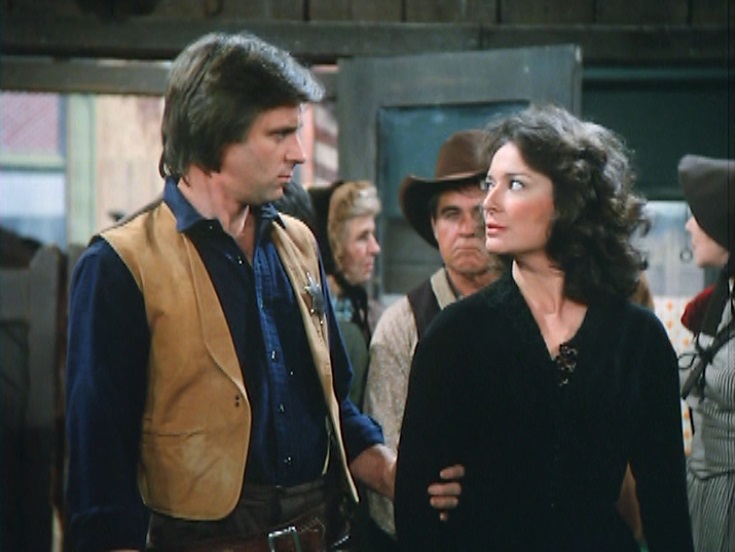
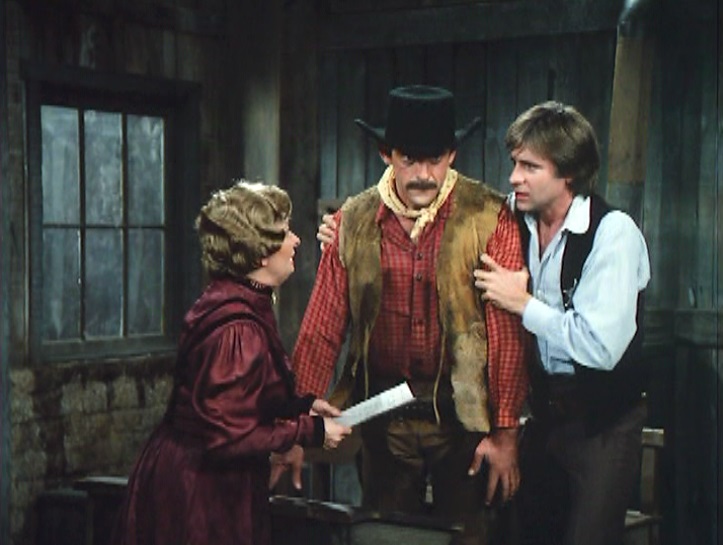
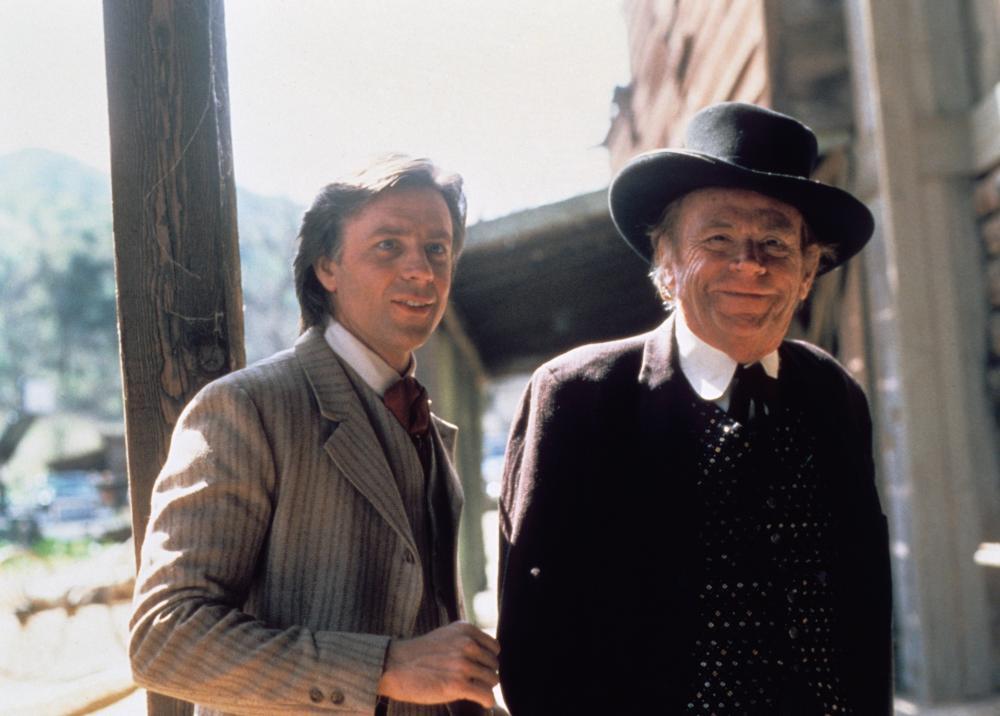
Westerns ruled the airwaves in the 1950s, but with the demise of Gunsmoke in 1975, the cowboys shows had all ridden off into the sunset. The Best of the West made its debut in 1981. The show, created by Earl Pomerantz, was a parody of the previous decades of oaters. Civil War veteran Sam Best (Joel Higgins) moves his family from posh Philadelphia to Copper Creek at the western border in 1865. He was not your typical western hero—more of a city slicker.
Photo: imdb.com
A store owner by trade, he knew little about guns or fighting. After arriving in the town, he accidentally scares off The Calico Kid (Christopher Lloyd), one of the “bad guys,” and the townspeople lobby him to be their mayor.
Sam’s nemesis is Parker Tillman (Leonard Frey), who runs the saloon with a slew of other bad guys, most notably his sidekick Frog Rothchild Jr. (Tracey Walter). With Sam are his southern belle wife Elvira (Carlene Watkins) and his smart-alecky son Daniel (Meeno Peluce). Sam is also friends with the town doctor, Jerome Kullens (Tom Ewell), who is a bit of a lush.
Photo: imdb.com
Sam reminds me a bit of F-Troop’s Will Parmenter. He’s a likable guy placed in a situation that he did not pursue. Sam’s family is not happy in their new setting. They had gotten used to the comforts of a big city. Elvira is beside herself because she can never get the dirt off the floor, until Sam reminded her it was literally a dirt floor.
Photo: imdb.com
The plots on this show were a bit similar to many of the story lines we became familiar with from decades of westerns. In one show the doctor’s mail-order bride is described as having a vivid personality with a past to match. In one episode, Sam and Tillman try to convince the railroad company to connect with Copper Creek. Another example is when Sam shoots himself in the leg and the jail begins to fall apart, and the town reconsiders his ability to lead them, or the classic tale of Elvira and Daniel exploring a cave that is booby-trapped and ready to collapse around them.
Photo: imdb.com
The show never seemed to catch on with viewers. It was hard to fault the writers. David Lloyd, Sam Simon, and Earl Pomerantz were working together on Taxi, and they would go on to write for Cheers in 1982.
Photo: imdb.com Dixie Carter
The show also had some amazing celebrity guest stars: Dixie Carter, Chuck Connors, Andy Griffith, Al Lewis, and Betty White.
Photo: imdb.com Andy Griffith
For a while, parodies like Airplane! were all the rage, and maybe the fad had just played out.
Perhaps, western fans, with their fond memories of growing up with Bonanza and The Rifle Man, just weren’t ready to make fun of their childhood shows.
Photo: imdb.com Betty White
It was hard to find information about the show. As you can see in these photos, the majority of them came from imdb.com; there just aren’t many photos out there otherwise.
ABC didn’t outright cancel the show, but they took a lot of time trying to decide whether to renew it or not. In the meantime, Joel Higgins got tired of waiting and accepted the role of Edward Stratton on Silver Spoons. With the star gone and the ratings mediocre, the show ended after 22 episodes.
Photo: pinterest.com
Silver Spoons would be the show that brought Joel Higgins success. However, he had an interesting career. He graduated from Michigan State with a degree in advertising. He went to work for General Motors for six months. When he enlisted in the Army, his title was Special Services Sergeant in Charge of Entertainment. This role seemed to redirect his path. Post-Army life, he was busy with both television roles and theater performances. He also started a business with two friends. They wrote more than 200 jingles for a variety of products, including Kool-Aid, M&Ms, Schwepps Soda, and Coors beer, as well as several themes for shows such as Life with Lucy, one of Lucille Ball’s many shows.
Photo: imdb.com The Calico Kid
His family members Carlene Watkins and Meeno Peluce never found their “Silver Spoons.” Carlene had been on The Secret Empire in 1979. After Best of the West, she would go on to be part of the cast of five more shows–It’s Not Easy, Mary, The Tortellis, Dear John, and Bob–none of which lasted very long. Peluce was part of the Bad News Bears from 1979-80 and later would land a regular role on Voyagers from 1982-83. He did make appearances on many shows, including Silver Spoons in 1984.
Photo: collider.com
Many viewers seem to have fond memories of this show. If you want to see what the show was like, CBS-DVD released the show as a manufactured-on-demand DVD in 2017. While this series might not portray the best of the west, it certainly was not the worst of the west either.
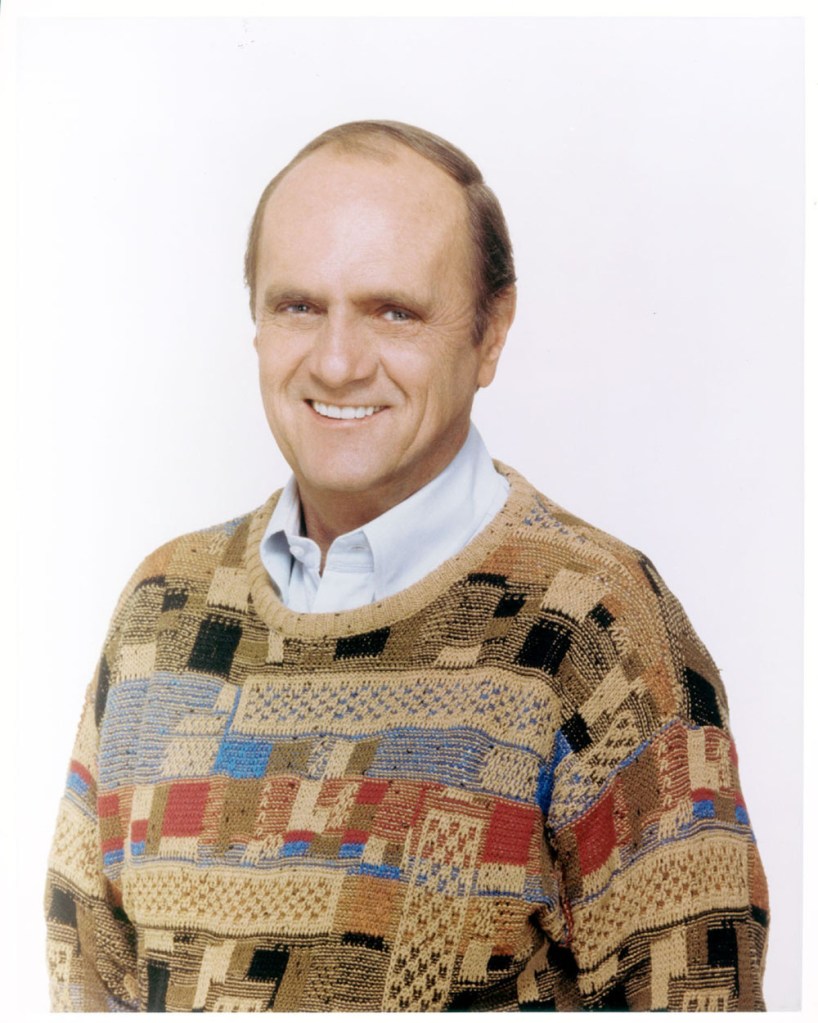
This month I wanted to honor one of our most beloved television comedians: Bob Newhart. Next week we’ll spend some time learning more about The Bob Newhart Show.
Photo: spotify.com
Newhart was born George Robert Newhart in 1929 in Oak Park, IL. He grew up in a typical midwestern family where his father was part owner of a plumbing and heating supply company, and his mom was a housewife. As a young boy, he always wanted to be called Bob. He had a Catholic education and went on to Loyola University of Chicago in 1947. Graduating in 1952 with a business degree, he was soon drafted into the US Army in the Korean war where he stayed until 1954. He considered getting a law degree and went back to Loyola. He decided not to pursue that; some sources site that he was asked to behave unethically during an internship which led him down a different career path.
He worked as an accountant and as an unemployment office clerk. In 1958 he was hired as a copywriter for Fred Niles who was a television producer in Chicago. It was while working here that Newhart and a colleague began entertaining each other by making telephone calls about absurd scenarios. They sent these to radio stations as audition tapes. A radio station disc jockey Dan Sorkin introduced Newhart to a Warner Brothers Records executive who signed him in 1959 based on those recordings. Bob then began creating stand-up routines which he performed at nightclubs.
Photo: discogs.com
He released an album in 1960 which changed his life. Titled, The Button-Down Mind of Bob Newhart, the comedy album made number one on the Billboard charts, and he won a Grammy for best new artist. A follow-up album, The Button-Down Mind Strikes Back was released soon thereafter. He would continue releasing comedy albums in 1961, 1962, 1964, 1965, 1967, 1971, and 1973.
During a 2005 interview for American Masters on public television, Bob stated that his favorite routine was Abe Lincoln vs Madison Avenue which was on his first album. A promoter for Abraham Lincoln has to deal with his reluctance to boost his image. A tv director named Bill Daily suggested the routine to him. Daily would be known later as Howard Borden on The Bob Newhart Show (as well as Roger Healey on I Dream of Jeannie).
The success of that first album led to a variety show titled The Bob Newhart Show. It only lasted a year, but it did receive both an Emmy nomination and a Peabody award. Apparently, he didn’t enjoy his time during the show so much. Halfway through the season he wanted to quit, but his agent explained that being under contract meant that was not possible. At a later date, he referred to his first show, saying “It won an Emmy, a Peabody Award, and a pink slip from NBC. All in the same year.”
He began making the rounds on television shows, appearing on The Dean Martin Show 24 times and The Ed Sullivan Show 8 times. He guest hosted The Tonight Show Starring Johnny Carson 87 times. When discussing his appearances on Johnny’s show, he stated “I remember once when I emceed The Tonight Show in New York, I arrived with my manager’s son. After a while, they asked, ‘When are the rest of your people coming?’ I had to say, ‘This is it.’”
Photo: huffingtonpost.com
In 1962 Newhart accepted his first movie role, Hell is for Heroes, starring Steve McQueen. He would continue to do movie roles throughout his career including the Christmas classic Elf, but the small screen would make him famous.
In 1963 Buddy Hackett introduced Bob to Virginia Quinn, whose father was character actor Bill Quinn. They wed in January of 1963 and 57 years later are still happily married.
Photo: zimbio.com
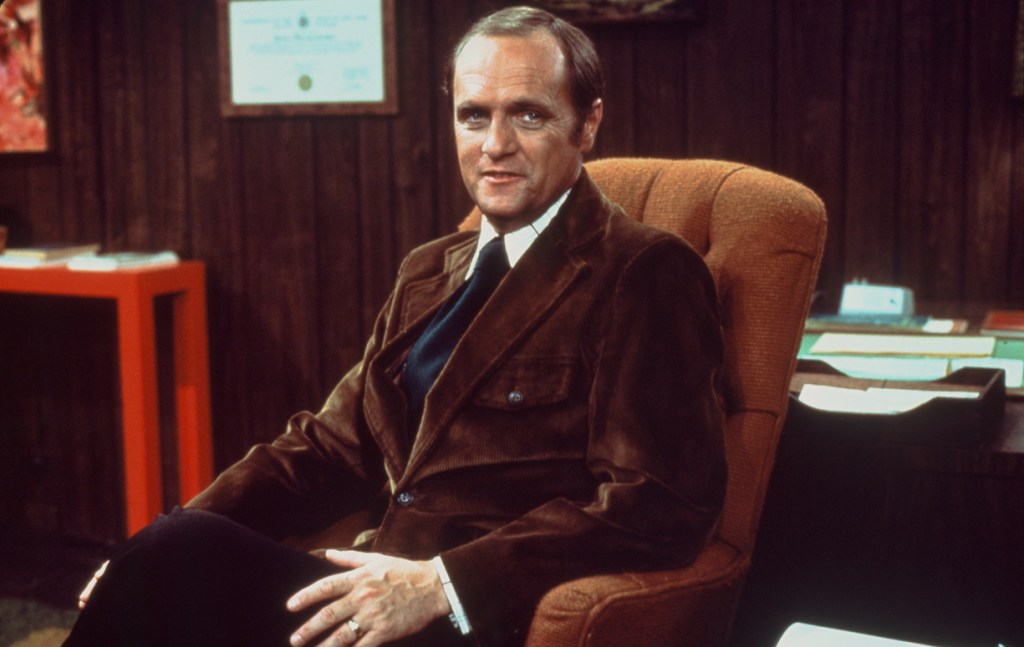
For the next decade, he continued to accept movie and television roles. In 1972, television history was made when The Bob Newhart Show debuted. Until 1978, Newhart played Bob Hartley, psychologist, and we got to know his unusual patients, quirky co-workers, and eccentric friends, including neighbor Howard Borden. Bob chose a psychologist based partly on his old telephone routines. As he said, “Much of my humor comes out of reaction to what other people are saying. A psychologist is a man who listens, who is sympathetic.”
Photo:epiguides.com
In 1982, Bob gave television another go for another eight years. Simply titled Newhart, the show featured Bob as Dick Loudon, an innkeeper and author from Vermont. He still had quirky co-workers and eccentric friends.
Photo: austenauthors.net
On cue a decade later in 1992, Bob showed up in a new show even more simply titled, Bob as Bob McKay a comic book writer and artist who had retired long ago and was trying to get back into the workplace. Unfortunately, after 33 episodes the show was canceled due to low ratings.
Photo: imdb.com
In 1997, Newhart starred in his last sitcom, George and Leo. As George Stoody, a bookstore owner, Newhart offers a temporary home to a full-time magician and part-time criminal who recently robbed a Mafia-owned casino. The series failed to catch on with viewers, and it was canceled after a season as well.
Photo: listosaur.com
Though he never took on another sitcom, Newhart has made appearances with recurring characters in several shows. In 2003, he showed up on ER as Ben Hollander. In 2005, he was Morty on Desperate Housewives. As Judson, he guest starred on The Librarians.
Photo: thewrap.com
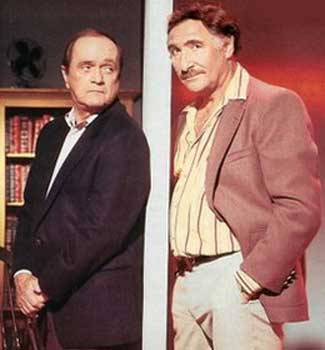
Perhaps, younger audiences know him best as Arthur Jeffries or Professor Proton on The Big Bang Theory. He had been Sheldon’s boyhood hero who played the professor on television. Sheldon idolized the professor while the professor tolerated Sheldon.
Photo: upi.com
It’s hard to believe with all of his years being a successful television comedian, but Newhart won his first Emmy in 2013 for his role of Professor Proton. I can’t argue with the nominees for most of the 1970s during the airing of The Bob Newhart Show–names like Tony Randall, Jack Klugman, Alan Alda, and Hal Linden. Even with my bias of Norman Lear shows, I get nominating Carroll O’Connor every single one of those years. I understand the tough competition. What I don’t understand is the fact that he was never nominated during that eight-year period. When Jack Albertson wins, and Bob Newhart is not even nominated that is wrong. During the Newhart years, he was at least nominated three times. But I don’t understand it when John Ritter wins for Three’s Company or Richard Mulligan for Soap and no nomination for Bob Newhart. What especially appalls me is the fact that The Bob Newhart Show was only nominated one year; I can accept the fact that it got beat out by The Mary Tyler Moore Show. I cannot accept is that during this same time, Three’s Company, Mork and Mindy, and Welcome Back Kotter received nominations, and The Bob Newhart Show did not. Anyway, this blog is not about the television academy and its procedures, so let’s move on.
Photo: flickr.com
Even though he was never awarded with an Emmy for his time as Bob Hartley, TV Land placed a life-sized statue of Newhart in front of Navy Pier, complete with an empty couch. He was best friends with Suzanne Pleshette, his wife from the show, and spoke at her funeral. He remembered their time together, “Her laugh. Her laugh. We just laughed. We just had a great time. We all loved each other and respected each other and we got paid for it.” Bob also remains close friends with Marcia Wallace who played his receptionist Carol on the show.
Photo: sitcomsonline.com
While Bob has appeared as different characters throughout his career, he has also remained the same character. With his deadpan delivery and slight stammer, he perfected the straight-man role, surrounding himself with wacky castmates. He has often cited George Gobel and Bob and Ray as influences in his comedy career. When discussing his career choice, he explained “I like the humor to come out of character. When you’re going for a joke, you’re stuck out there if it doesn’t work. There’s nowhere to go. You’ve done the drum role and the cymbal clash and you’re out on the end of the plank.”
Photo: barnesandnoble.com
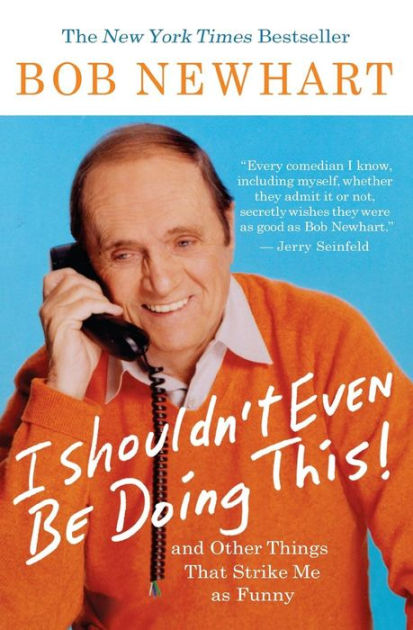
In 2006, he released a book I Shouldn’t Even Be Doing This. It’s a memoir with some of his classic comedy routines. Actor David Hyde Pierce reported that “the only difference between Bob Newhart on stage and Bob Newhart offstage is that there is no stage.”
Photo: parade.com
I am so appreciative of those stars who agree to entertain us for our entire life, such as Betty White, Carol Burnett, and Bob Newhart. They are classic comedians who can make us laugh no matter what. Bob’s view on comedy was that “laughter gives us distance. It allows us to step back from an event, deal with it and then move on.” What an amazing career and what an amazing man. With all its negatives and sometimes destructive tendencies, television can be a harmful place, but a comedian like Bob Newhart demonstrates what a positive and uplifting experience television can be when done right. Thanks for doing it right for sixty years.























 thewritelife61