
As we continue with our “Work It Out” blog series, today we are taking a long ride with Taxi. This show was created for ABC by James L. Brooks, Stan Daniels, David Davis, and Ed Weinberger and produced by John Charles Walters Co. The show was apparently inspired by an article in The New Yorker, “Night Shifting for the Hip Fleet” by Mark Jacobson in 1975. The article profiled several drivers who worked the night shift for a New York cab company. Taxi was in business from the Fall of 1978 to the Spring of 1982 on ABC and then drove over to NBC for a year.
The show is set primarily at the Sunshine Cab Company in Manhattan. Louie De Palma (Danny DeVito) is the dispatcher that everyone loves to hate. Brooks said that when they went to visit a company as the night drivers were just coming back from their shifts, they saw a dispatcher taking a bribe from a driver for a clean cab. That gave them the idea of Louis. DeVito described Louie as someone who “made life miserable for everyone. The manifestation of what was going on inside of him came out in a mean-spirited way to those around him. Deep down he just wanted people to love him.”

Drivers included Alex Reiger (Judd Hirsch) who considers cab driver his profession as opposed to a temporary get-by job. Elaine Nardo (Marilu Henner) is a single mother who also works at an art gallery. In the first episode when Elaine is hired, Reiger introduces the crew by saying, “You see that guy over there? Now he’s an actor. The guy on the phone? He’s a prize fighter. This lady here: She’s a beautician. The guy behind her? He’s a writer. Me? I’m a cab driver. I’m the only cab driver in this place.”
Tony Banta (Tony Danza) a boxer, and Bobby Wheeler (Jeff Conaway) a struggling actor are other coworkers. We also get to know the Reverend Jim Ignatowski (Christopher Lloyd), an aging hippie who gets a job driving and Latka Gravas (Andy Kaufman), an immigrant mechanic. Latka was a weird character, and I have to say that I did not enjoy him on the show. Andy Kaufman invented the character for a comedy act. During the show, he met and married Simka (Carol Kane).
The person who probably had the easiest audition was Danza. He said that when he went to read for the show, he had broken his third metacarpal on his right hand and had a black eye from knocking out a guy in the ring in Brooklyn. He had never acted before and didn’t really know what he was doing.
Although the show was a sitcom, there were a lot of important issues tackled during the run of the show including addiction, parenthood, obesity, animal abuse, homosexuality, racism, gambling, grief, divorce, and sexual harassment, among others.

This show had more than its share of important guest stars. Ruth Gordon and Eileen Brennan both were nominated for Emmys for their guest appearances, with Gordon winning hers. Other stars who showed up included Marcia Wallace, Penny Marshall, Dr. Joyce Brothers, Edwin Newman, George Wendt, Ted Danson, Tom Selleck, Tom Hanks, and Bubba Smith.
Brooks wrote for The Simpsons and The Mary Tyler Moore Show. Daniels also wrote for The Mary Tyler Moore Show and was best known for The Tonight Show. Davis was one of the writers behind The Bob Newhart Show and Weinberger would go on to write for The Cosby Show. It was no surprise that this show was known for its amazing writing, and the series was nominated for 31 Emmys during its five seasons, it won 18 of them, most impressively it won Outstanding Comedy in 1979, 1980, and 1981. Kane, Hirsch, DeVito, and Lloyd and all won Emmys for acting. James Burrows won two for directing.
Taxi had one of the most-recognized theme songs from the 1980s. “Angela” was written and performed by Bob James.
I did not hear much about conflict on the set, although several performers, including Hirsch, indicated they did not care much for Kaufman. Kaufman had it written in his contract that he only work two days a week, so for most of the filming a guy with a sign around his neck that said “Andy” worked with the cast, so I don’t think there was necessarily a lot of bonding with him anyway.
Conaway was fired after 69 episodes. It was apparently well-known that he had a major addiction problem, and when one of the producers discovered him passed out when he was supposed to be filming, they wrote him out of the episode and then wrote him out of the show.
The cast seemed very happy and like a family. Henner said that they could always express an opinion about their character and thoughts on a scene. Brooks said Burrows was able to bridge the two worlds of writers and actors. He spent time with actors all day and then went to the writers’ room to talk to them and was the liason between the two. Henner agreed and said that Burrows was brilliant at adding memorable moments to a scene. She said in one episode she was losing her mind a bit and someone says the champagne is flat and the producer had her bend over and blow bubbles in the glass. She said it was brilliant.
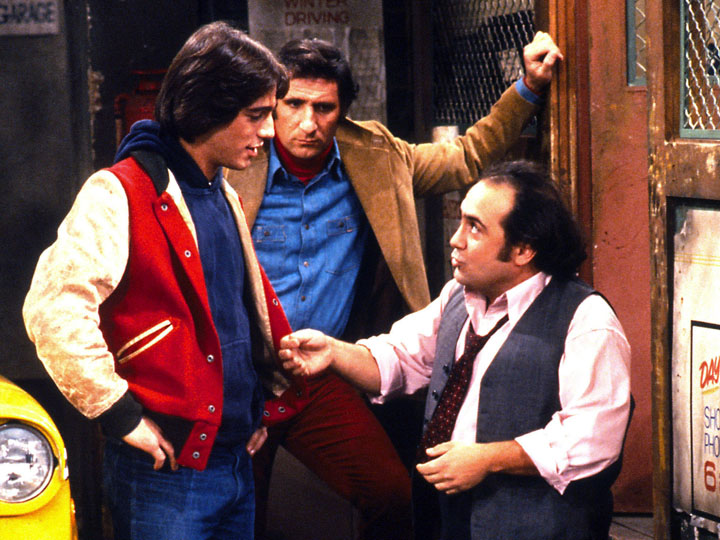
DeVito also mentioned a scene that was special for him. One night when Louie was all alone in the garage, he took out the mic and sang a song. Then he said, “I always wanted to do that.” It was a very heart-warming moment and made Louie more interesting and gave him more depth.
Burrows said that most of the cast was young and they all bonded so well. Sometimes they went roller skating, to dances, and they even had a softball team. Rhea Perlman was on the show off and on and during one of their lunch breaks, she and DeVito got married.
Henner talked about their weekly parties. She said everyone at Paramount wanted to hang out with them including the cast of Happy Days, Mork & Mindy, Laverne & Shirley, and Bosom Buddies. She said that John Travolta and Frances Ford Coppola stopped by. John Belushi hung out with DeVito a lot and was there for one of their get-togethers and he died the next day.

Hirsch said the group wanted something to do after the show because they didn’t want to go home; they wanted to hang out together more than anything else.
Brooks probably summed up the show the most eloquently. He said that “there’s a lot of things that take a glow in retrospect. The great thing about Taxi was that there wasn’t a moment on the show they didn’t appreciate how lucky there were to have it. That was the show’s energy. I’ve never seen anything like it. . . People show up at the right time and everyone’s lucky enough to have each other at a certain point. It becomes a beautiful team sport.”
Isn’t that the best tribute anyone could give a show? I’m glad they all had an appreciation for it, and I’m glad they included us in their family.


 thewritelife61