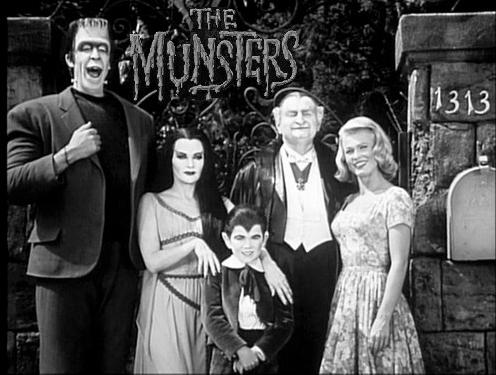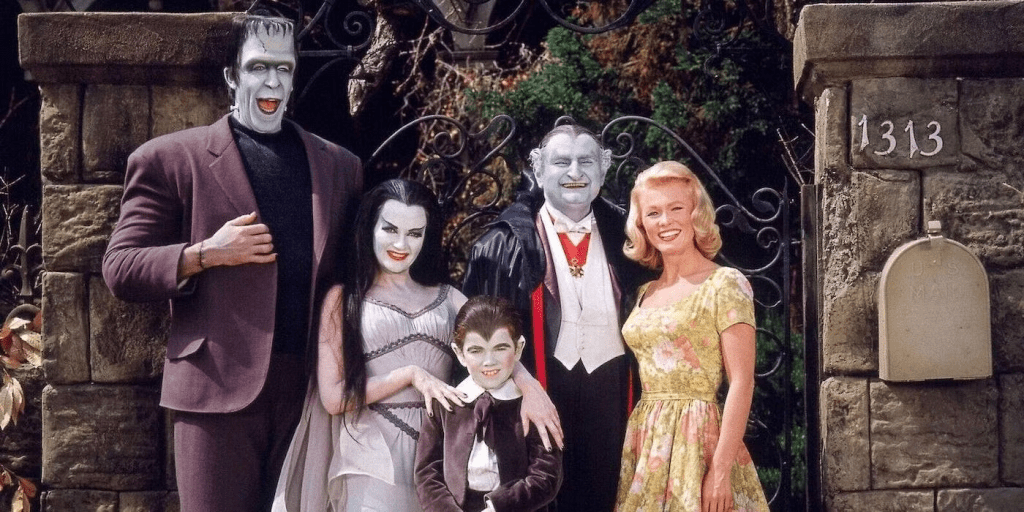
The Munsters: The All-American Family?

The Munsters Photo: collider.com

This month’s blog “theme is “Kinda Creepy.” These are not shows that will give you nightmares or have you sleeping with the nightlight on. But they did have a touch of ghoul or terror. First up is one of our All-American families, The Munsters.

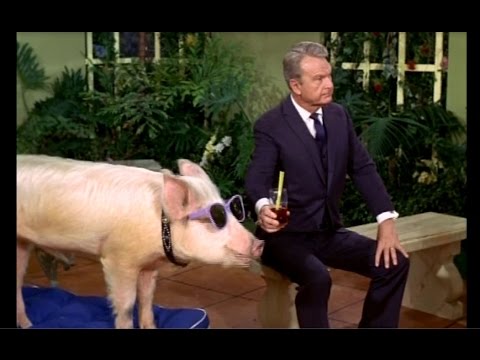
The creators of Leave It to Beaver, developed this series to be a satire of suburban life. The opening credit shows Lily handing her family their lunches as they run out the door just like Donna Reed did in The Donna Reed Show in the fifties. The Munsters are a perfectly normal family except for a few eccentric and trivial things like Herman (Fred Gwynne) being a Frankenstein, Lily (Yvonne De Carlo) being a vampire, Grandpa (Al Lewis) who can turn into a bat, and werewolf son Eddie (Butch Patrick). In real life, Lewis was a year younger than De Carlo who played his daughter and Gwynne was four years younger than De Carlo.
Photo: ebay.com

Living with the family is Lily’s niece Marilyn (Beverly Owen/Pat Priest), who seems a little abnormal to the family but looks like any high school girl of the time, except a little bit prettier. Owen was engaged when she got the part and did not think the show would be picked up. When it became popular, the cast convinced the network to release her from her contract, and Priest, who looked very similar, took over. Gwynne and Lewis had previously been part of the cast of Car 54, Where Are You? and were good friends. (To learn more about their friendship and their individual careers, see my blog from July 10, 2017.)

This series aired on CBS, and ABC featured The Addams Family whom we’ll meet next week. Both shows debuted in 1965 and were off the air after two seasons.

There were a few recurring characters including Paul Lynde as Dr. Edward Dudley (Dom DeLuise also played Dr. Dudley in one episode), Herman’s boss Mr. Gateman (John Carradine), and Clyde (Chet Stratton), a colleague of Herman’s.

Paul Lynde Photo: pinterest.com

The family lives at 1313 Mockingbird Lane. Herman works for Gateman, Goodbury and Graves, a funeral parlor, as a grave digger. In an interview with Daily Variety, Al Lewis, explained that with the unusual family, “they could do a lot of satirical pointed things on society that you couldn’t do on an ordinary show.”

The show actually had four pilots which I don’t think I have ever seen before. The first one was filmed in 1964 with Gwynne, Lewis, and Owen. Joan Marshall was Phoebe, Herman’s wife and Nate Derman was Eddie. For the second pilot, De Carlo replaced Marshall and changed her name to Lily. In the third edition, Patrick was brought on board to replace Derman. The cast stayed intact for the fourth pilot, but Eddie’s character was changed a bit. He was a bit of a brat and they toned it down.

The family had a pet dragon named Spot that lived under the stairs. When the staircase opened up, you could see the fire he was breathing and sometimes you would see his tail only.

Photo: hagerty.com

Makeup for the show was credited to Bud Westmore who had worked for Universal during their monster movie phase. However, the actual work was done by several people. Perc Westmore worked with Grandpa. Abe Haberman applied Lily’s new face, while Michael Westmore worked with Patrick and Priest. Bill Mumy was the original choice for Eddie, but his parents said “No” when they learned about how much makeup would be used for each episode.

Patrick was asked about the cast and how they got along in an interview with Fox News. He said it was a good relationship. If he had to pick another actor whom he bonded with more than another it would probably be Lewis. He discussed the amazing comedic timing that Gwynne and Lewis shared. He said that the person he enjoyed working with the most was his makeup man, Westmore. He said he was the first person he saw every morning. He also mentioned Westmore was a very handsome guy who owned a Jaguar and was a bachelor, so he looked up to him as a role model also.

Photo: vintageeveryday.com

Karl Silvera did Herman’s makeup. Gwynne had the toughest time of all the characters. He had to spend two hours in the makeup chair first thing in the morning. He wore forty pounds of foam rubber padding and drank copious amounts of lemonade. Despite that, he lost a lot of weight doing the show. In one month, he lost ten pounds. They also put a piece of foam latex on his head to flatten the top. His shoes were asphalt paver’s boots with four-inch soles. The producers rented a compressed air tank and would poke the nozzle inside his collar to blow cool air on him.

The show aired on Thursday nights at 7:30. Many shows began filming in color in the mid-sixties, but the studio did not want to pay the extra $10,000 per episode, so it was shot in black and white. For its debut year, it was number 18, tied with Gilligan’s Island, but it took a drastic drop for season two and landed at number 61. The show competed with The Flintstones and Daniel Boone in year one In year two, Batman debuted in color and The Munsters’ viewers switched networks in droves. The show was canceled with 70 episodes for syndication. From the comments that I read, I’m not sure Lewis and Gwynne would have continued another season anyway. They wanted a different type of humor and, of course, Gwynne had to endure so much with his costume.

If you were looking at the merchandising that accompanied the show, you would never guess it was only on for two seasons. Between 1965-68, 16 Gold Key Comics were produced. The show rolled out Colorforms, car model kits, both a Herman Munster doll and a puppet, and View Masters. You could also purchase several different action figure sets, a board game, and a lunch box, among other items.

Although the show, not surprisingly, never received an Emmy nomination, it was up for Best Television Series for a Golden Globe in 1965 which did surprise me.

The theme song was an instrumental, simply titled “The Munsters’ Theme.” It was composed by Jack Marshall. It was nominated for a Grammy in 1965. There are lyrics for the song, written by Bob Mosher, but they were never used on the air.

For a show that was only on the air for two seasons, it has had a lot of staying power. I think that it was so different and the fact that The Addams Family was also on two seasons and very similar just provided it with that perfect fan base. I do remember watching the show and buying The Munsters coloring books and paper dolls, but I don’t remember it being a “must see” for me. Of course, I was only five when it was canceled, so I primarily saw it in reruns. Sadly, I would also choose Batman over The Munsters, so I understand why the viewers drifted. However, it is never a waste of time to watch Fred Gwynne and Al Lewis in action. If you never watched the show or want to binge watch it, seventy episodes is an easy one to get through.

Viewers Found Best of the West “So-So of the West”

As we continue the “Living in the Past: Timeless Comedies,” we travel back to the frontier for Best of the West. Like the show we discussed in my last blog, When Things Were Rotten, this series was also a rapid fire of gags, puns, and one-liners.

Photo: wikipedia.com

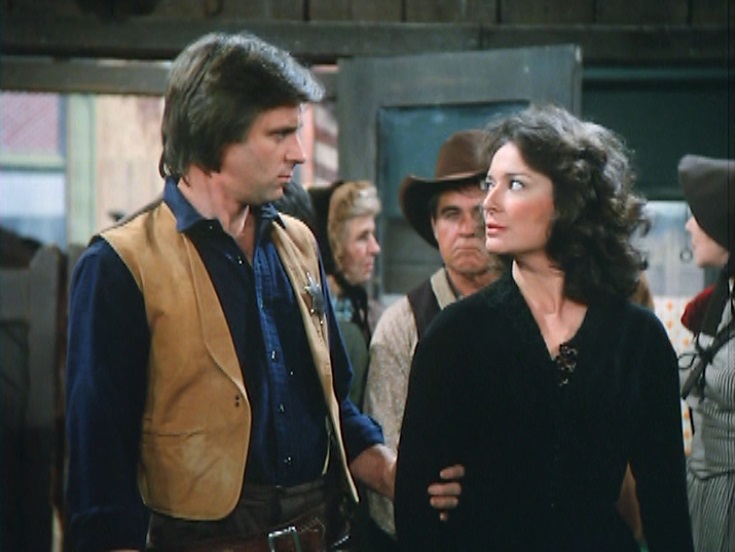
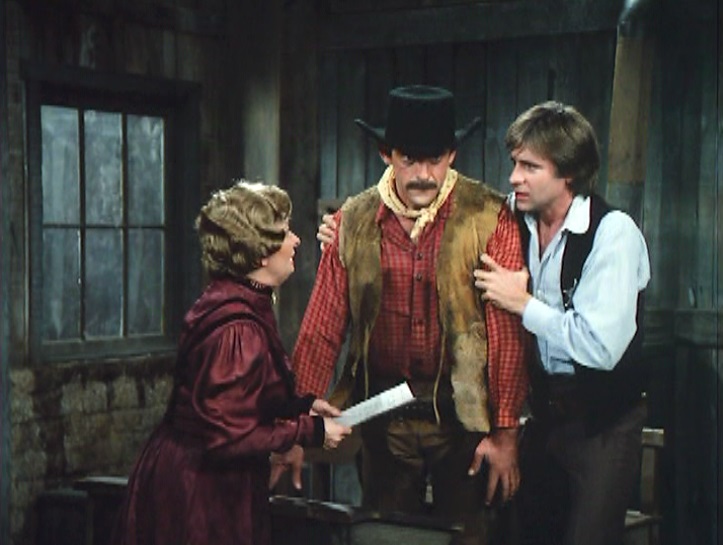
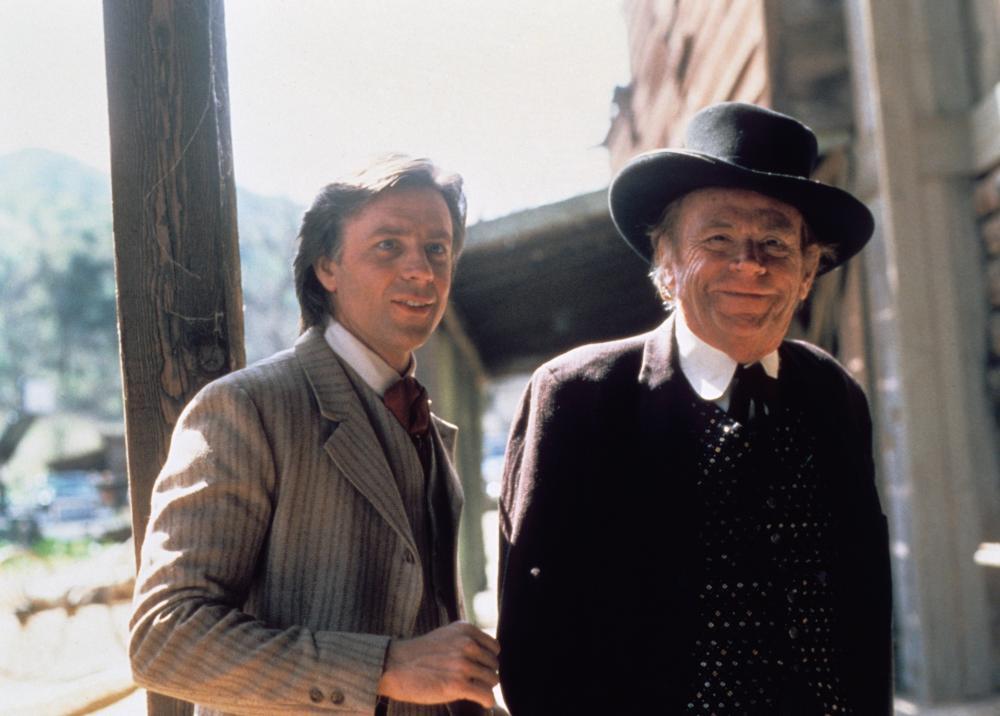
Westerns ruled the airwaves in the 1950s, but with the demise of Gunsmoke in 1975, the cowboys shows had all ridden off into the sunset.  The Best of the West made its debut in 1981. The show, created by Earl Pomerantz, was a parody of the previous decades of oaters. Civil War veteran Sam Best (Joel Higgins) moves his family from posh Philadelphia to Copper Creek at the western border in 1865. He was not your typical western hero—more of a city slicker.

Photo: imdb.com

A store owner by trade, he knew little about guns or fighting. After arriving in the town, he accidentally scares off The Calico Kid (Christopher Lloyd), one of the “bad guys,” and the townspeople lobby him to be their mayor.

Sam’s nemesis is Parker Tillman (Leonard Frey), who runs the saloon with a slew of other bad guys, most notably his sidekick Frog Rothchild Jr. (Tracey Walter). With Sam are his southern belle wife Elvira (Carlene Watkins) and his smart-alecky son Daniel (Meeno Peluce). Sam is also friends with the town doctor, Jerome Kullens (Tom Ewell), who is a bit of a lush.

Photo: imdb.com

Sam reminds me a bit of F-Troop’s Will Parmenter. He’s a likable guy placed in a situation that he did not pursue. Sam’s family is not happy in their new setting. They had gotten used to the comforts of a big city. Elvira is beside herself because she can never get the dirt off the floor, until Sam reminded her it was literally a dirt floor.
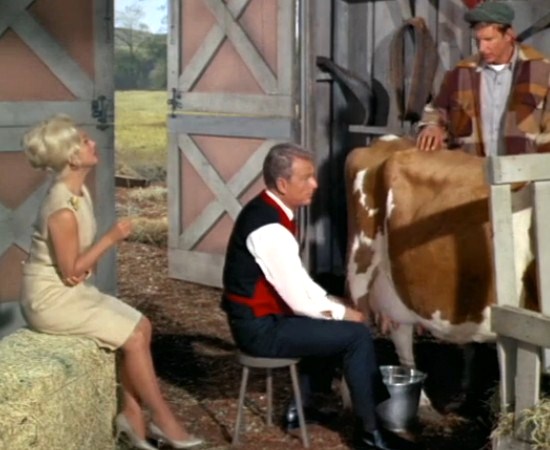
Photo: imdb.com

The plots on this show were a bit similar to many of the story lines we became familiar with from decades of westerns. In one show the doctor’s mail-order bride is described as having a vivid personality with a past to match. In one episode, Sam and Tillman try to convince the railroad company to connect with Copper Creek. Another example is when Sam shoots himself in the leg and the jail begins to fall apart, and the town reconsiders his ability to lead them, or the classic tale of Elvira and Daniel exploring a cave that is booby-trapped and ready to collapse around them.

Photo: imdb.com

The show never seemed to catch on with viewers. It was hard to fault the writers. David Lloyd, Sam Simon, and Earl Pomerantz were working together on Taxi, and they would go on to write for Cheers in 1982.

Photo: imdb.com
Dixie Carter

The show also had some amazing celebrity guest stars: Dixie Carter, Chuck Connors, Andy Griffith, Al Lewis, and Betty White.

Photo: imdb.com
Andy Griffith

For a while, parodies like Airplane! were all the rage, and maybe the fad had just played out.

Perhaps, western fans, with their fond memories of growing up with Bonanza and The Rifle Man, just weren’t ready to make fun of their childhood shows.

Photo: imdb.com
Betty White

It was hard to find information about the show. As you can see in these photos, the majority of them came from imdb.com; there just aren’t many photos out there otherwise.

ABC didn’t outright cancel the show, but they took a lot of time trying to decide whether to renew it or not. In the meantime, Joel Higgins got tired of waiting and accepted the role of Edward Stratton on Silver Spoons. With the star gone and the ratings mediocre, the show ended after 22 episodes.

Photo: pinterest.com

Silver Spoons would be the show that brought Joel Higgins success. However, he had an interesting career. He graduated from Michigan State with a degree in advertising. He went to work for General Motors for six months. When he enlisted in the Army, his title was Special Services Sergeant in Charge of Entertainment. This role seemed to redirect his path. Post-Army life, he was busy with both television roles and theater performances. He also started a business with two friends. They wrote more than 200 jingles for a variety of products, including Kool-Aid, M&Ms, Schwepps Soda, and Coors beer, as well as several themes for shows such as Life with Lucy, one of Lucille Ball’s many shows.

Photo: imdb.com
The Calico Kid

His family members Carlene Watkins and Meeno Peluce never found their “Silver Spoons.” Carlene had been on The Secret Empire in 1979. After Best of the West, she would go on to be part of the cast of five more shows–It’s Not Easy, Mary, The Tortellis, Dear John, and Bob–none of which lasted very long. Peluce was part of the Bad News Bears from 1979-80 and later would land a regular role on Voyagers from 1982-83. He did make appearances on many shows, including Silver Spoons in 1984.

Photo: collider.com

Many viewers seem to have fond memories of this show. If you want to see what the show was like, CBS-DVD released the show as a manufactured-on-demand DVD in 2017. While this series might not portray the best of the west, it certainly was not the worst of the west either.

Go Green, Green Acres That Is

In the 1950s, a lot of the top shows were set in residential or suburban areas:  Father Knows Best, Ozzie and Harriet, the Donna Reed Show, and December Bride to name a few.  In the early 1960s, the rural sitcom became the hottest genre.  In 1963 The Beverly Hillbillies was #1, Petticoat Junction was #4, and The Andy Griffith Show was #5. Filmways offered Paul Henning the chance to produce a new rural show with no pilot necessary.  Filmways was created in 1952, and the company was behind many successful shows including The Debbie Reynolds Show, The Pruitts of Southampton, Mr. Ed, The Addams Family, and Cagney and Lacey.

Paul Henning approached Jay Sommers to create the new rural comedy. Sommers based the series on a radio show he had written in 1950 —  Granby’s Green Acres.  Granby was based on a book, Acres and Pains by S.J. Perelman. The radio show only lasted for 13 episodes and starred Gale Gordon and Bea Benaderet. Granby was a former banker who moved to the country to run a farm.  He also had a daughter, and the general store owner was a major character, Will Kimble, played in the first episode by Howard McNear. A couple of titles proposed were Country Cousins and The Eddie Albert Show, but the final decision was Green Acres.

green4

Green Acres ran on CBS from 1965-1971 with solid ratings. It produced 170 episodes, all filmed in color.  Richard Bare directed most of the shows. At the end of each episode, Eva Gabor would say “This has been a Filmways presentation dahling.”

While the Beverly Hillbillies took a family out of the mountains and put them in Beverly Hills, Green Acres went with the opposite scenario.

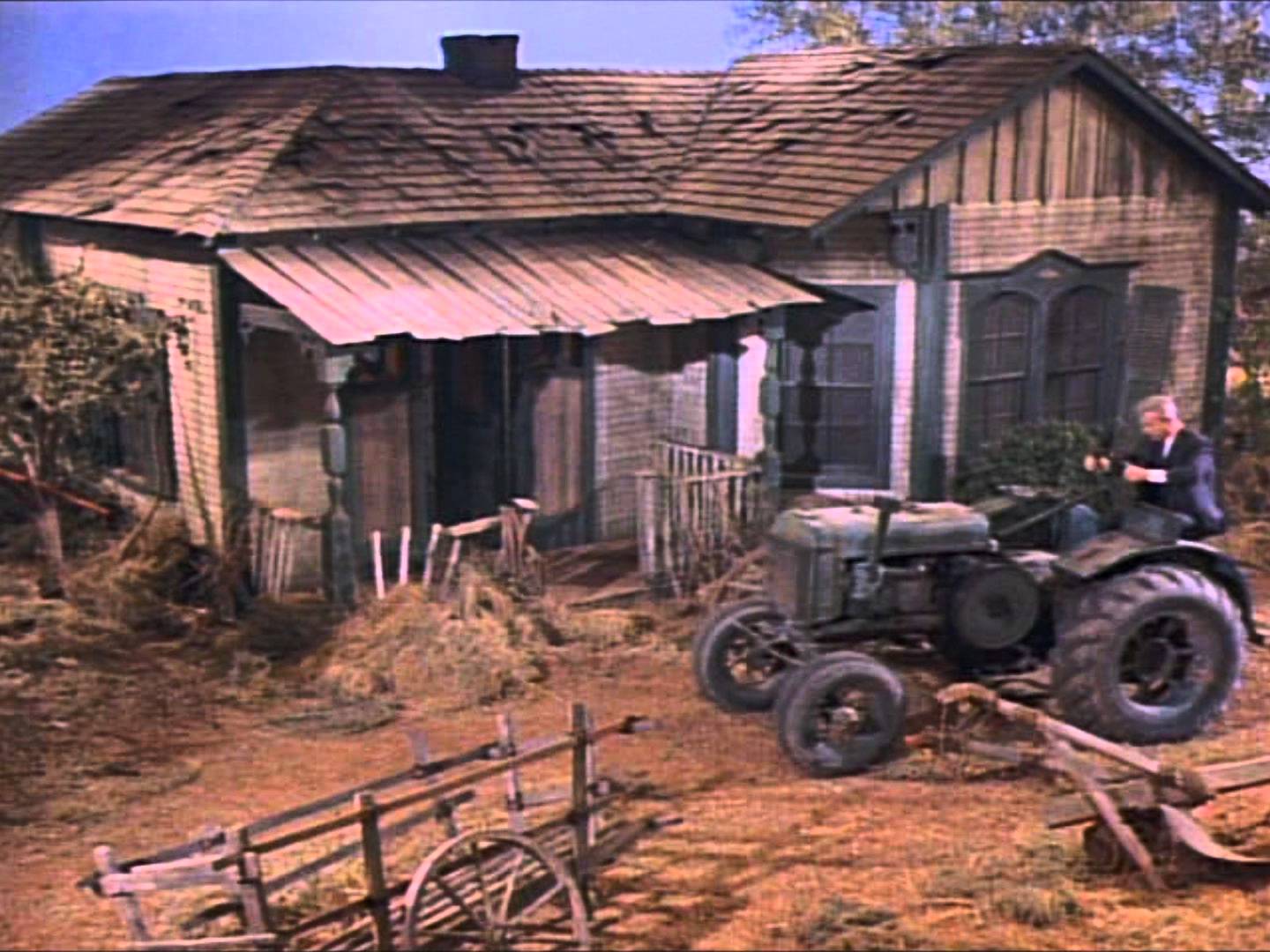
The premise of the show was that Oliver Douglas  who had been a busy attorney in New York City decides he wants to move to the country to run his own farm. His wife Lisa  does not agree. He buys a farm unseen in Hooterville. We are never told where Hooterville is, and I think everyone has their own idea of which state it might be in. The house and farm are more run-down and dilapidated than Lisa ever imagined in her worst nightmare.  The citizens of Hooterville are a quirky set of characters.

green7

The debut show was done as a documentary narrated by John Daly, a former newscaster and the host then of What’s My Line.  Eddie Albert and Eva Gabor appeared on What’s My Line later in the fall as a thank you to Daly. As you can see below, Oliver’s mother is horrified by his choice.

green18

The theme song is memorable and tells the backstory of the Douglases:

Oliver: Green Acres is the place to be – Farm living is the life for me –Land spreading out so far and wide – Keep Manhattan, just give me the countryside.

Lisa: No, New York is where I’d rather stay – I get allergic smelling hay – I just adore a penthouse view – Darling, I love you but give me Park Avenue

Oliver: The chores

Lisa: The stores

Oliver: Fresh air

Lisa: Times Square

Oliver: You are my wife

Lisa: Goodbye city life

Both: Green Acres, we are there

Snippets of country and New York city were shown while the stars sing, and ends with both of them in the same pose as “American Gothic” by Grant Wood.

green1

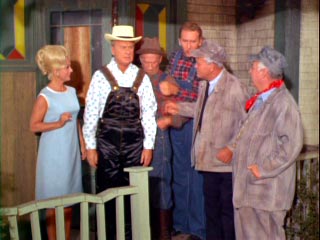
Like the Andy Griffith Show, the series worked because of the interaction between these Hooterville citizens who become believable for us. Let’s meet the cast of characters.

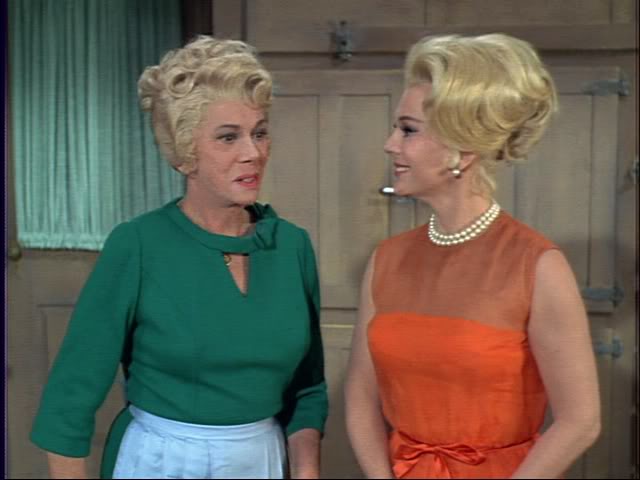
Oliver Wendell Douglas (Eddie Albert) – Oliver is intelligent, hard-working, and practical to a fault.  He has to deal with a kooky wife, a disapproving mother (played by Eleanor Audley who was only 5 months older than Albert), and the quirky neighbors that surrounded him. However, Oliver has a respect for the wisdom these people have about farming and rural life.  Despite the fact that he seems to be the only sane person in the valley, it’s obvious he truly has an affection for the folks he lives with.

albert

Lisa Douglas (Eva Gabor) – Lisa grew up in a wealthy Hungarian family. Her misuse of the English language is one of her endearing qualities. She has a hard time adjusting to farm life.  In one episode she is using a stapler to fix Oliver’s socks.  While Oliver is telling her how woman for centuries have sewn socks, Fred Ziffel, the most experienced farmer in Hooterville enters the room and tells her he notices she is mending socks; his wife does it the same way. Despite the fact that Lisa did not want to leave the city, she adapts to living in the country quickly and develops an understanding with the neighbors Oliver never attains.

green31

Eb Dawson (Tom Lester) – Eb is the farmhand who lives with the Douglases.  He comes off as naïve, but we understand Eb is much smarter than he lets on.  He is always trying to get less work for more money.  He calls them Mom and Dad which Lisa loves but drives Oliver crazy.

green17

Mr. Eustace Haney (Pat Buttram)- Mr. Haney is the unethical and dishonest salesman who originally sold Oliver the farm, which belonged to his family. He is always showing up to sell them something they need at outrageous prices. [Pat Buttram was Gene Autrey’s sidekick in the movies and tv; Smiley Burnette, Charley, who runs the Cannonball, the local train on Green Acres and Petticoat Junction, was Autrey’s sidekick in radio and movies and  Buttram replaced him when he moved on.]

green5

Sam Drucker (Frank Cady) – Sam was a busy guy; he ran the general store, he was the newspaper editor, was the only printer in town, he was part of the volunteer fire department, he was the justice of the peace, and he’s the postman. Apart from Oliver, he was the smartest and most sane person in the valley, and he and Oliver often commiserated about the crazy life going on around them.

Hank Kimball (Alvy Moore) – Mr. Kimball was the county agricultural agent who was supposed to help Oliver adjust to farming. He often loses his train of thought and rarely follows through on the news or information he is supposed to relay.

moore

The Monroe Brothers – Alf (Sid Melton) and Ralph (Mary Grace Canfield) are a brother and sister team that Alf portrays as brother and brother in order get work. Their projects are never finished on time, and rarely finished the right way.

green8


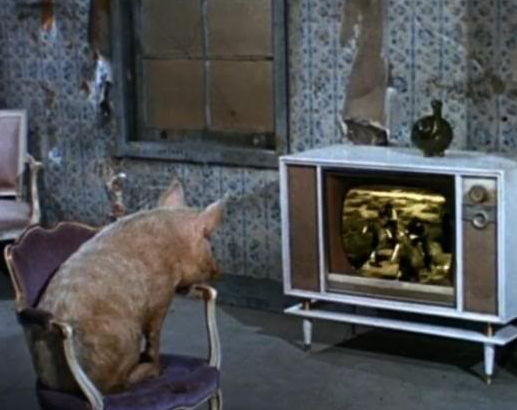
Fred and Doris Ziffel (Hank Patterson and Barbara Pepper/Fran Ryan) – the Ziffels were successful farmers.  They had no children, but they had a pet pig that they considered a son.


Arnold Ziffel – Arnold Ziffel was their pet pig and one of the most intelligent people in Hooterville. He understands English, attends the local grade school, lives inside in his own bedroom, can sign his name, and is a bit addicted to television watching, especially westerns. A new pig was used each season because they grew so fast. The Union demanded the pigs be payed $250 a day and were trained by Frank Inn. In 1967 Arnold won a Patsy award.

green20

Some of the other animals featured on the show included Eleanor the Cow; Bertram the rooster; Alice the hen; and Mr. Haney’s dog, Cynthia, a basset hound who had a huge crush on Arnold.

Green Acres had its fair share of guest stars including Parley Baer, Robert Cummings, June Foray, Alan Hale Jr., Elaine Joyce, Gordon Jump, Bernie Kopell, Al Lewis, Rich Little, Al Molinaro, Pat Morita, Jerry Van Dyke, and Jesse White.

The show was 25% surrealism, 25% satire, and 50% just plain fun.

Some of the running gags on the show were the fact that people, except Oliver, could see the credits running, and Lisa often commented on them. A lot of the jokes were at Oliver’s expense.  He was the only one in town who could not understand Arnold’s grunts. Also, whenever Oliver got passionate about something, he went into a monologue, usually patriotic, and everyone but him could hear fifes playing.

green3

Lisa’s hotcakes were good for many projects, just not eating. The Douglases had a feud with the phone company because they were supposed to move their phone inside.  Whenever they had to use the phone, Oliver had to climb up a phone pole to talk. Oliver had a Hoyt-Clagwell tractor which was usually breaking down, catching on fire, or falling apart.

green29

We also had the stark extremes of sophisticated New York living and rural life.  Lisa continued to dress in beautiful gowns and furs.  They slept in a huge, expensive bed, with an elaborate chandelier over their heads, but their closet had no back so neighbors walked in on and off. The fire department marching band often practices at Sam Drucker’s store but for all five years whenever they practice, they only know one song, There’ll Be a Hot Time in the Old Town Tonight.

Although Lisa continues to threaten to move back to New York City, aided and abetted by Oliver’s mother, we know she loves him and will never leave without him.  Despite their arguments, Lisa and Oliver are frequently seen kissing and hints are given about them retiring to their room together. In real life, Albert and Gabor were dear friends and they are both buried in Westwood Village Memorial Park Cemetery in Los Angeles. Tom Lester, Eb, credited Albert with helping him as an actor and being a surrogate father to him; the two remained close friends until Albert passed away.

green10

There are many cross-overs with Petticoat Junction and the Beverly Hillbillies. Sam Drucker was featured in both Green Acres and Petticoat Junction. Some of the characters visited each other on various episodes. It is funny that Bea Benaderet starred in Petticoat Junction as well as the radio show Granby’s Green Acres which means Green Acres was based on her radio show and was a spin-off of her television show. In 1968, a Beverly Hillbillies Thanksgiving Show united cast members from all three shows.

green9

green6

With 170 episodes, it’s hard to come up with the best five, but after looking at various polls and tv guide reviews, I will do my best to represent the majority’s votes:

“Music to Milk By” – Eb wants to win a radio contest and he has to listen day and night which cuts into his chores, especially when the cow swallows the radio.

radio

“I Didn’t Raise My Pig to be a Soldier” – Arnold Ziffel gets a draft notice. Oliver acts as his attorney before the draft board. They are assuming Oliver is making fun of them with the pig and the real Arnold is elsewhere. After a lot of explanations and some time in jail, Oliver convinces them Arnold is really a pig.  The end of the show has Oliver back before the draft board because Ralph Monroe, a woman, who they think is a man, has been drafted.

draft

“The Hooterville Image” – The town agrees Oliver needs to do chores in overalls. He has been farming in a vest and dress shirt. They finally convince him to become more accepted by switching his attire until they see the overalls Lisa’s dress designer came up with.

green28

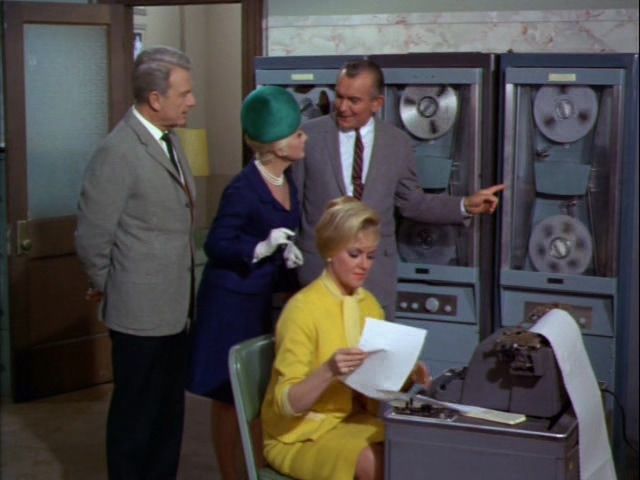
“The Computer Age” – Ralph Monroe joins a computer dating service. Oliver and Lisa disagree on whether that is a good idea. Oliver thinks it is. He also thinks computers are the best way to run a farm. To prove her point, Lisa uses the service to see if she and Oliver would have been paired up.

computer

“A Star Named Arnold is Born, Parts 1 and 2” – Arnold appears in a play at the local theater. Lisa arranges for an old friend to give him a chance in show business. In the second part, Lisa and Oliver chaperone his trip to Hollywood to star in a motion picture.

arnold

Oddly enough the top four were all from season 2, and “A Star Named Arnold Is Born” is from season 3.

green16

In Spring of 1971, Green Acres was still pulling in good ratings.  However, the Rural Purge of 1971 got rid of all shows that had country leanings whether they were audience favorites or not.


In full disclosure, I loved Petticoat Junction growing up, and I could not stand the Beverly Hillbillies.  I thought Green Acres was okay but if I missed it that was okay too.  As I’ve gotten older, I still love Petticoat Junction, and I still don’t care for the Beverly Hillbillies, but I have developed a much greater appreciation for Green Acres.  If a show was capable of having a sense of humor, this one did.   It never took itself seriously.  Eddie Albert was willing to be the straight guy to the rest of the ensemble. The character interaction worked, and no dialogue came off as too zany.  The citizens might not have always agreed or understood each other’s lifestyles, but they had affection and respect for each other. Lisa’s reading the credits and different characters addressing the audience brought us in on the jokes and made us part of the Green Acres family. Now when I watch the show, I laugh out loud – a lot! I don’t laugh at the characters, I laugh with them. For being a rural sitcom, this show has some sophisticated humor.  If you have not watched the show in a while, you owe it to yourself, as well as the cast and crew who created it, to get to know the folks in Hooterville.


The Friendship and Careers of Fred Gwynne and Al Lewis

Fred Gwynne was born in New York in July of 1926 and died in Maryland in 1993.  Al Lewis was born in New York in April of 1923 and passed away in New York in February of 2006. At first glance, they don’t seem to have a lot in common, but a closer look reveals why they enjoyed a long friendship.

Fred Gwynne

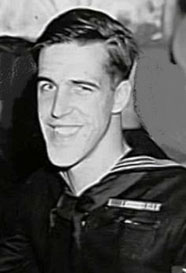
Fred Gwynne grew up in New York and had a very wealthy and advantaged upbringing.  He was a radioman in the Navy during World War II.  When the war was over, Gwynne entered Harvard, studying drawing and dramatics. He became a member of their Hasty Pudding Club, being involved with many theatrical productions. Gwynne graduated in 1951 and went on to work for a Shakespeare repertory company. He was a talented man with a variety of interests and earned his living from several careers.  He was a copywriter, a musician, a book illustrator, and a commercial artist.

gwynne2

In 1952, he made his Broadway debut, acting with Helen Hayes in “Mrs. McThing.” The play ran for 320 performances.  In 1953, he performed in his second Broadway play, “The Frogs of Spring” which had a much shorter run.  In 1954, he had a small role in On the Waterfront with Marlon Brando.

He also began appearing on television in the 1950s, and most of his roles were on dramas such as Kraft Theater or DuPont Show of the Week.

The one exception was The Phil Silvers Show where he appeared in 1955 and 1956. The producer of this show, Nat Hiken, went on to create a similar show called Car 54 Where Are You? about New York policemen.  He cast Gwynne as one of the leads, Francis Muldoon. The show ran for two seasons and when it was cancelled, Gwynne went back to his theatrical dramas.

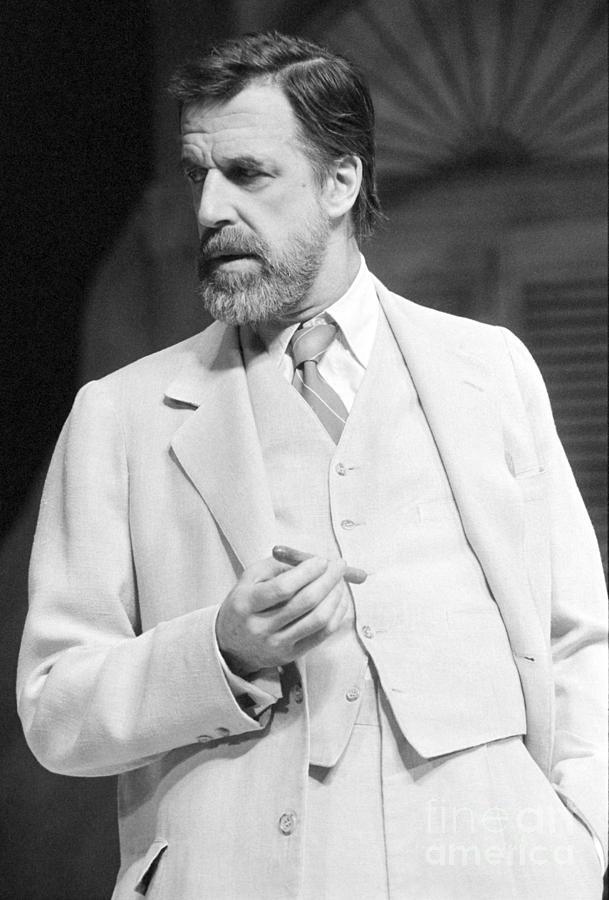
In 1964, the creators of Leave It to Beaver, decided on a different concept for a show called The Munsters.  Fred was cast as the lead role.  While this show also ran two years, the part of Herman Munster was much harder to overcome than Francis Muldoon had been.  Gwynne struggled to find new roles, and when he was unsuccessful, he went back to Broadway.  He did make one pilot during these years for a show called Guess What I Did Today, but no network picked it up. His favorite Broadway performance was Big Daddy in 1974 when he starred in “Cat On a Hot Tin Roof.”

gwynne7bigdaddy

During the 1980s, his cinema career picked up and he ended up with 15 movies to his credit from 1979-1992. Included in this list are The Cotton Club, The Secret of My Success, Fatal Attraction, Ironweed, Pet Sematary, and My Cousin Vinny.

His book writing and illustrating also continued.  His first book, The Best in Show, was published in 1958.  The King Who Rained came out in 1970, and Simon and Schuster published A Chocolate Moose for Dinner in 1976 and A Little Pigeon Toad in 1988.

Throughout most of his career, Gwynne lived a quiet life far from Hollywood. He was married to his first wife Roxy from 1952-1980 and his second wife from 1981 until his death from pancreatic cancer in 1993.

Al Lewis

Al Lewis claimed he was born in 1910 and was a circus performer in the 1920s.  He also said he went to Columbia and graduated with a PhD in child psychology.  After he passed away, his son confirmed that he was born in 1923, and Columbia had no record of him attending school with his given name or his stage name.  His son thought he made himself older to get the role of Grandpa in The Munsters because in real life Yvonne DeCarlo was a year older than he was.

Some of his other jobs included a salesman,  hot dog vendor for the Brooklyn Dodgers, waiter, pool room owner, and store detective.  He was a good basketball player in high school and apparently worked as a basketball scout at some time in his early life. A friend convinced him to join an actor’s workshop in 1949 and that led to a career in vaudeville. In the 1950s and 1960s, he appeared in a variety of TV shows including US Steel Hour, Route 66, Lost in Space, and Gomer Pyle.  He too was cast in the Phil Silvers Show which later resulted in his role of Patrolman Leo Schnauzer in Car 54 Where Are You?

lewis8

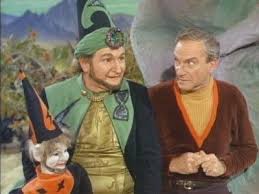
In 1964, he too was offered a role in The Munsters. In 1966 when the show went off the air, he continued making television appearances and starred in cinema movies.  During the 1970s and 1980s, he appeared on Night Gallery, Green Acres, Love American Style, Here’s Lucy, Taxi, and Best of the West.  His career featured 22 films including They Shoot Horses Don’t They, Boatniks, Used Cars, Married to the Mob, and a remake of Car 54 Where Are You?

lewis5shoothorses

Like Gwynne, he was married twice:  to Marge from 1956-1977 and to Karen from 1984 until his death from heart complications in 2006. Lewis also published several children’s books during his acting career.

Midway through his career he opened an Italian restaurant, Grandpa’s Bella Gente, which Gwynne designed the logo for. He also got into radio and was featured on Howard Stern’s Show often.

lewis6

It is surprising that both of these stars were in two sitcoms which both lasted only two years. Let’s take a look at the shows that made them household names.

Car 54 Where Are You?

gwynnelewis4

This sitcom, set in the 53rd precinct in Brooklyn was an early Barney Miller. Gwynne played Francis Muldoon.  His partner, Gunther Toody, was his exact opposite.  While Muldoon was a bachelor, an intellectual, calm and quiet, Toody was married, naïve, excitable, and talkative. In one show, when the precinct is debating splitting up the two men, Muldoon says “I guess most of the men are smarter than Gunther and less trouble than Gunther, but  . . . well, I’m so used to Gunther.  When he chatters away, the days just fly by.  I’d just be lost without Gunther.” Gunther concurs, “You mean ride around with someone next to me that’s not Muldoon? Francis is a quiet man. He doesn’t say a word. He just sits there all day thinking. It’s very comforting for a man like me to know there’s someone next to him doing the thinking for both of us.” Of course, they split them up only to partner them up again because no one else could take the silence or constant chatter.

Al Lewis played Officer Leo Schnauzer, appearing in every episode.

Policemen were split on their view of the show.  Some took offense and felt they were portrayed in a negative light, while others enjoyed it and identified with some of the comedic elements. It was filmed in The Bronx at Biograph Studio.  There was a large sign out front identifying it as the 53rd precinct till a woman came in pleading to save her from her abusive husband and the sign was quickly taken down.

Originally titled Snow Whites, the show aired at 8:30 eastern time Sunday nights between The Wide World of Disney and Bonanza.  The only clue I could find for the original name was that the show was sponsored by Proctor and Gamble who made several detergents for clothing. It was filmed in black and white, but the police cars were red and white so they would show up better on black and white film. The show also starred Beatrice Pons, Charlotte Rae, Nipsey Russell, Alice Ghostley, and Larry Storch.

Perhaps what the show is best remembered for was its catchy theme song.  Anyone who viewed an episode or two can probably remember the fun lyrics:

There’s a hold up in the Bronx, Brooklyn’s broken out in fights.

There’s a traffic jam in Harlem that’s backed up to Jackson Heights.

There’s a scout troop short a child; Kruschev’s due at Idlewild . . .

Car 54, where are you?


The Munsters

gwynnelewis1

In 1964, the creators of Leave It to Beaver decided to feature another “wholesome” family who just happens to live at 1313 Mockingbird Lane in Mockingbird Heights. The family consists of Grandpa who is always experimenting in his lab; Herman who is the funeral director at Gateman, Goodbury, and Graves; his wife Lilly, a vampire; their son Eddie who is a werewolf; and their beautiful black-sheep Marilyn.  Marilyn was beautiful but they viewed her as odd looking and she seemed to get a lot of dates but when she brings them home, they never ask her out again. The family also owns two pets – Spot, a prehistoric animal Grandpa rescued and Igor, a bat.  They lived a somewhat normal life but drank bat milk and cooked in a cauldron. On the hour, a cuckoo clock chimed and a raven, voiced by Mel Blanc, appeared and said “Nevermore.”

gwynne4

All the actors had to endure a two-hour make-up session, but Gwynne had the worst time because he had to wear 40-50 pounds of padding.  One day he lost 10 pounds filming under the lights.  They gave him gallons of lemonade between takes and later rigged a way to blow cool air on him underneath the material.

The entire family could have been played by different actors.  John Carradine was offered the role of Herman. The pilot featured Joan Marshall as the wife and instead of Lilly, her name was Phoebe. Marilyn was played by Beverly Owens for 13 episodes and then Pat Priest took over for the rest of the show’s run. Eddie was first offered to Bill Mumy, Will Robinson from Lost in Space, and Grandpa to Bert Lahr from The Wizard of Oz.

After the show was cancelled, the Munster mobile often traveled to memorabilia shows.  There was also a Dragula built with purple silk upholstery and chrome pipes for the exhaust. Although the show was only on the air for two years, there were a lot of collectibles such as board games, lunch boxes, paper dolls, and coloring books.

gwynnelewis6

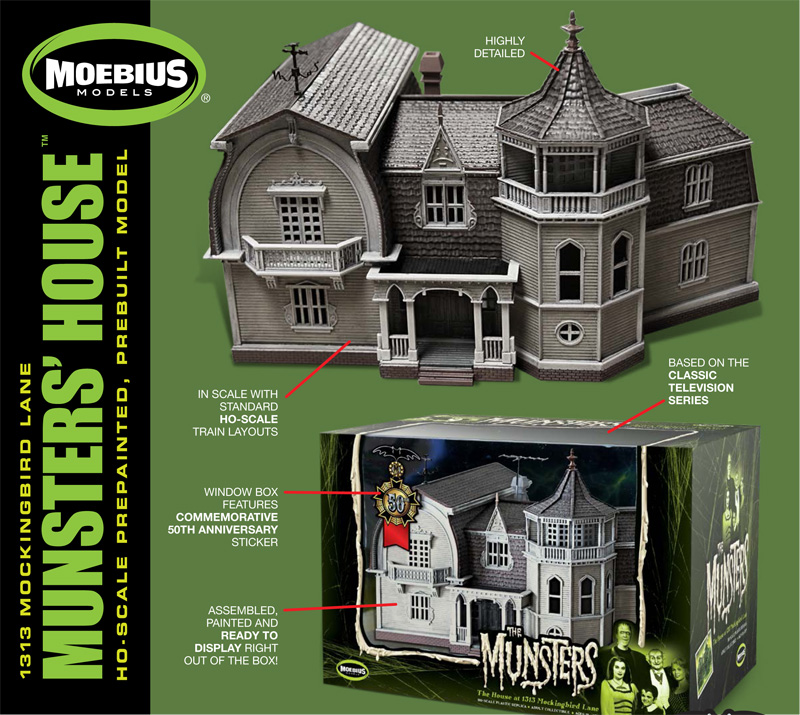
In 2001, the McKee family of Waxahachie, Texas was such a huge fan of the show that the family built their 5000+ square foot house to exactly resemble the Munsters’ home including the crooked weather vane and grand staircase that lifted up to feed Spot.

Both Gwynne and Lewis were born in New York.  They both appeared on the show Brenner early in their careers. Both were tapped from their roles in The Phil Silvers Show to play roles on Car 54 Where Are You? They both went on to star in The Munsters.  Neither of them ever had another series.  They both chose to live on the east coast. They both wrote children’s books.  They were each married twice and married to their second spouse for the rest of their lives. They both had a lot of success in the movies as well as television. They were both men with fascinating careers before they ever entered acting.  I learned a lot about these interesting friends.  Happy Birthday to Fred Gwynne would have been 91.