Sale of the Century: Might Feel Like a Century Ago

This month our blog series is “Life is Just a Game,” and we are looking back at some of the game shows that debuted in the fifties and sixties. Today we are ending our series with Sale of the Century.

📷tvinsider.com Host Jim Perry

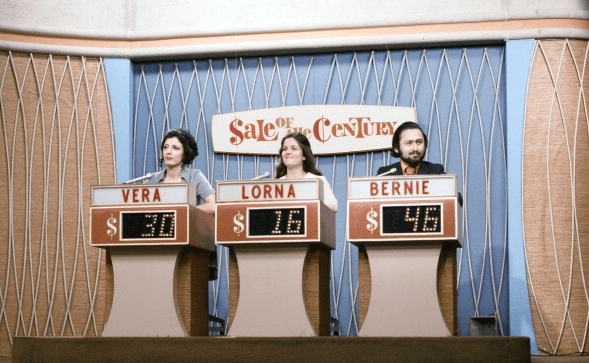
On September 29, 1969, three game shows debuted on NBC. Letters to Laugh-In and Name Droppers didn’t last long. The third was Sale of the Century. Compared to the other game shows we have learned about this month, Sale of the Century was not a long-lived show; it was canceled in 1973. I don’t remember the first two years of the show when Jack Kelly was the host, but I remember watching with Joe Garagiola, a former baseball player, when he did the emcee tasks. I loved this show for some reason. From 1983-1989 another version was aired, hosted by Jim Perry.

Jack Kelly was best known as Bart Maverick in the show Maverick from 1957-1962. He took a break from acting to host this game show but after two years, he decided to go back to his acting career. He ended up with 120 credits, so he was a busy and well-respected actor. After this show, he did appear regularly in Get Christie Love and The Hardy Boys/ Nancy Drew Hour.
📷buzzerblog.com

Joe Garagiola was a baseball player with the St. Louis Cardinals, Chicago Cubs, Pittsburgh Pirates, and San Francisco Giants from 1946-1954. In 1951, he led the National League in fielding percentage for catchers. He later did some color commentary for his son’s team, the Arizona Diamondbacks. He did give acting a try and ended up with 3 credits, two which were playing himself. However, game shows was where he made his mark, hosting for He Said, She Said; To Tell the Truth; Strike It Rich; and Joe Garagiola’s Memory Game.

Jim Perry was the typical game show host. He started out in show business as a singer and worked with Sid Caesar in his comedy routines. In the seventies he began doing game shows. In total, Jim Perry hosted approximately ten different game shows (including unsold pilots) in a career that spanned about 25 years. 
📷pinterest.com instant bargains

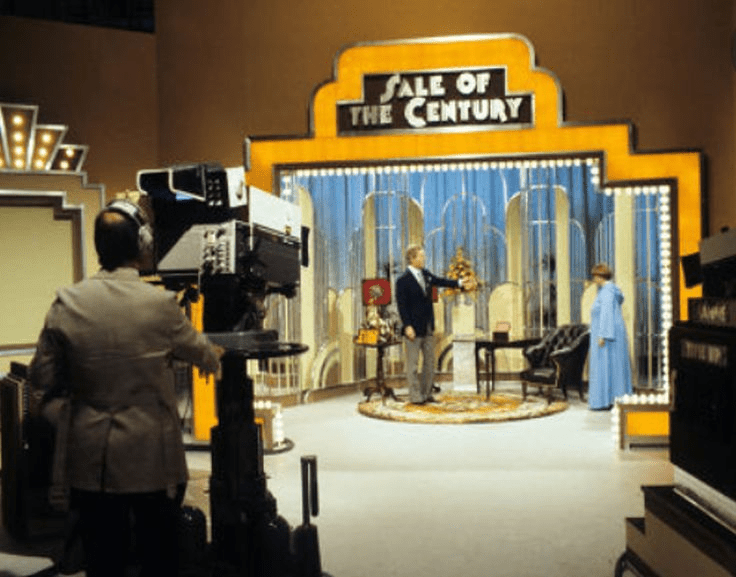
In the original version of the television game show, there were three contestants who each started the game with $25, and the host would ask a general-knowledge, trivia-type question. Whoever answered it got $5. The second half of the game, the questions were worth $10. They also lost that amount if they gave the wrong answer. Off and on during the game a dinging would be heard, and an Instant Bargain was brought on stage. The bargain was a great prize at a reduced rate, like a television for $15. Whoever was leading got a chance to buy the item; if they did, that amount of money was taken off their board. Whoever won the game got to go shopping with their money or they could come back the next day to try to win more in order to buy a bigger prize.

Like the other game shows we learned about, none of the original episodes were kept because they were recorded over. The UCLA Film and Television Archive does have nine episodes of the show in its collection. There are also some episodes from 1985-86 and 1992-94 versions that ran on USA later.

📷gameshowswiki.com

The theme song was composed by Al Howard and Irwin Bazelon. Howard was also the executive producer of the show. I couldn’t find any other composing done by Howard. He would later produce Supermarket Sweep from 1992-1994. According to imdb.com, Bazelon wrote the score for the television production of What Makes Sammy Run?, and incidental music for “The Taming of the Shrew” and the “Merry Wives of Windsor” for the Shakespeare Festival Theatre in Stratford, Connecticut. He joined ASCAP in 1955, and his compositions include “Brass Quintet,” “Five Pieces for Cello, Piano,” “Five Pieces for Piano,” “Sonatina,” and “Piano S.”

You could play the game at home with Milton Bradley’s versions from the original series or the American Publishing Corp.’s game from 1986.

Fun fact, Tim Hollerin of Connecticut was the show’s biggest winner. In 1985, he took home cash and other prizes to the value of $166,875.
📷facebook.com

I’m guessing that this show wouldn’t hold up as well after so many decades. The general trivia questions might not resonate with this generation, and prices are so incredibly different, that it might just feel very dated. That said, I would love to catch an episode or two because I do remember enjoying it so much.
The Word is . . . Password

This month our blog series is “Life is Just a Game,” and we are looking back at some of the game shows that debuted in the fifties and sixties. Today we are taking a peek back at Password. A funny moment occurred that first year when one of the celebrities was Jack Benny. The word he had to describe was “miser,” and he said, “Me” which got a lot of laughs.

📷boomerjourney.com

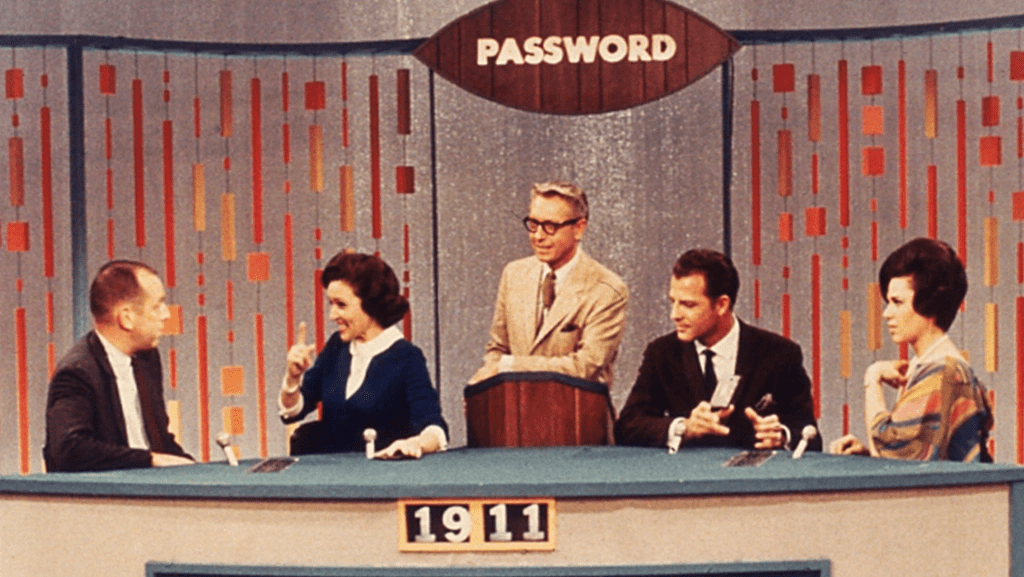
The Goodson Todman partnership created many game shows over the years. One of their first was Password. It debuted in 1961 on CBS at 2pm ET. Allen Ludden, a former G.E. College Bowl host was chosen as the emcee. Ludden is also known as the husband of Betty White whom he met on the game show.

Ludden was born in Mineral Point, Wisconsin. After his father passed away from Spanish flu, his mother later remarried, and the family ended up in Texas. Ludden graduated from the University of Texas with honors in 1940, later returning for his Masters in English. He served in the US Army in charge of the Pacific theater entertainment district. In 1948, he became the program director for New York radio station WCBS and in 1959 was program coordinator for all CBS owned-and-operated stations. Ludden began hosting shows for teens and then College Bowl. His opening catch phrase while hosting Password became “Hi Doll” which he said was meant for his mother-in-law Tess White.

📷instagram.com Carol Burnett and Elizabeth Montgomery

The rules of the game were that teams were formed with one contestant and one celebrity. The word was given to one player on the team and the other player had to guess what the word was based on one-word clues. If the player failed to guess the word within the five-second time period, play passed to the opposing team. This continued until the word was guessed. The quicker the word was guessed, the more points a team received.

The first team to reach 25 points won $100 for the contestant. That partnership got to play the Lightning Round where the celebrity gave the clues, and the contestant got five passwords within a minute. They received $50 for each right answer.

On July 11, of 1966 Secretary of Defense Robert McNamara updated the country on the progress of the Vietnam War one afternoon. CBS went with the coverage of the live news while NBC aired its soap opera Days of Our Lives and ABC aired its new show which began the same day, The Newlywed Game. Quite a few people turned off CBS that day and during the next few months, Password continued to lose viewers to these two shows. The next spring, Password was cancelled.

After the show was canceled, reruns were sold to CBS which it placed in syndication in the late 1960s. It became so popular that the show began to be filmed again in Hollywood. In 1971, it was placed on the network schedule when Dark Shadows ended. It held its own until 1973 when The Young and the Restless took a huge share of the market, and both Password and Jeopardy saw deep declines in ratings. In 1973 Password won the first Daytime Emmy Award for Outstanding Game Show.

In 1974 the show became Password All-Stars; in 1978 it became Password Plus; and in 1984 it became Super Password. CBS revived the show in 2008 as Million Dollar Password, but it ended by 2010. Jimmy Fallon produced a new version beginning in 2022 with Keke Palmer as host.

📷people.com

Sadly, the episodes from the first version no longer exist. There were rumors that the videotapes were recycled and used for Family Feud.

The Milton Bradley Company introduced a home version of the game in 1962, releasing 24 editions from then until 1986 which they also did with Concentration.

I always enjoyed watching this game. One of my favorite portrayals of the show was when Oscar Madison and Felix Unger go on Password during an episode of The Odd Couple. Since you can’t watch the original shows, check out the Odd Couple episode (season 3, episode 11) for some fun.

📷mooningemini.com The Odd Couple on Password

Concentration: Let’s Take a Minute To Think About It

This month our blog series is “Life is Just a Game,” and we are looking back at some of the game shows that debuted in the fifties and sixties. Concentration was broadcast beginning in 1958. It was on the air in one form or another until 1991. One of the tough things about these game shows is that many of them had different versions that occurred off and on for decades and some created nighttime series as well.

📷wikipedia.com

Concentration combined the memory game where kids match up pairs with a rebus puzzle that was revealed underneath when game pieces were matched. It was created by Jack Barry and Dan Enright. Barry had a few credits for writing and acting (he played a reporter on both Batman and The Addams Family). He met Dan Enright at WOR radio in New York, and they formed a partnership in 1947 producing The Joe DiMaggio Show. In 1953, the pair began creating game shows and that is where most of their career was spent.

Norm Blumenthal created the rebus puzzles for the original game. He ended up preparing 7300 television puzzles and all the puzzles used in the home game sold by Milton Bradley. (MB developed 24 different editions of the home game during its run beginning in 1958 and ending in 1982.) Norm’s first puzzle was “It Happened One Night,” and his last puzzle was “You’ve Been More Than Kind.” Blumenthal is also the author of When Game Shows Ruled Daytime TV and Picture Puzzle Pandemonium.

📷pinterest.com

At that time, most game shows were produced in New York, and Concentration was filmed at 30 Rockefeller Plaza.

The original version was on NBC for fourteen and a half years. Hugh Downs was the host, and Bob Clayton was the announcer. When Hugh left the show in 1969 to concentrate more on The Today Show, Clayton took over duties except for a brief six-month period when Ed McMahon took the lead. The hosts all wore navy blue blazers with the Concentration logo embroidered on the breast pocket.

Hugh Downs did a bit of everything during his career. He was an actor, broadcaster, announcer, tv host, news anchor, producer, author, game show host, and music composer. He is best known for being Jack Paar’s sidekick on The Tonight Show from 1957-1962, hosting Concentration from 1958-1969, being part of the cast of The Today Show from 1962-1971 (1239 episodes), and hosting Live from Lincoln Center for PBS from 1990-96. He was also one of the first inductees into the American TV Game Show Hall of Fame in Las Vegas in 2007.

📷etsy.com

Bob Clayton became a vaudeville singer at age 15 and after high school studied drama. After graduation, he became a radio announcer and continued as an announcer for most of his career except for a brief foray into acting when he appeared in Jerry Lewis’ The Bellboy.

In addition to the original show, there were two nighttime versions and a syndicated version that was on from 1973-78. In 1987 it was revived again as Classic Concentration hosted by Alex Trebek until 1991.

While the different versions featured slightly different concepts, rules, and prizes, we’ll just look at the original. Two contestants competed against each other. The first contestant called out two numbers; there were 30 numbers on the board. If they matched, the contestant had that prize added to their board. If they didn’t match, the other person got their turn. Matched numbers revealed part of the puzzle. The winner was the first person to figure out the puzzle. In addition to prizes, there were Wild Cards which matched any card, Take One Gift from your opponent, and Forfeit a Gift. The contestant who solved the puzzle received all the prizes on their board. Champions could return until they lost or won 20 games.

The show was on every weekday. It moved around from 11:30 to 11 to 10:30. In 1966, the show was filmed and broadcast in color. The series easily beat its competition in the mornings until 1972 when The New Price is Right debuted on CBS at the same time. It took away 50% of Concentration’s viewers and the show was canceled in early 1973.

📷ebay.com

The Concentration theme was composed by Paul Taubman. Taubman owned a club overlooking Central Park called The Penthouse Club. He played quintessential lounge music on the organ and piano. He provided background music for many game shows and was the musical director and musician for 5053 episodes of the soap opera The Edge of Night.

I always enjoyed watching this show growing up. When I was in upper grade school, one of our neighbors appeared on the show and won a mink coat among other prizes. With all the game shows that have been resurrected in nighttime versions the past two years, I wonder why this one has never returned to the air.