Bracken’s World: Ahead of Its Time

As we wind up our What in the World? blog series this month, we end with Bracken’s World. Just like the other shows we covered, this one began in the sixties, 1969, and just like the others, it was on for less than two seasons.

Dorothy Kingsley created the series for NBC. This was her only foray into television; she was a screenplay writer for most of her career. Kingsley wanted to concentrate on the “little people” who work at the studio, rather than the executives. In one blog I read that props from Twentieth Century Fox where the show was filmed were often carted around in the background for authenticity. It would be fun to go back and make a list of the props that were shown around the set; specifically mentioned were props from Planet of the Apes and Land of the Giants.

Watch.plex.tv.com captures the essence of the show in its description “In the glitzy realm of Century Studios, powerful executive John Bracken shapes Hollywood’s fate, navigating ambition, romance, and betrayal through the eyes of his astute secretary Sylvia, who holds the key to both secrets and success.”

Century Studios was a movie studio. John Bracken owned the company, and he was never seen during the first season. Similarly to the way Charlie interacted with Charlie’s Angels, we only heard Bracken on the telephone, voiced by Warren Stevens. Sylvia Caldwell (Eleanor Parker) was his secretary. There were some impressive cast members in this show including stunt man Dennis Cole, Jeanne Cooper, Madlyn Rhue, Linda Harrison, Elizabeth Allen, Karen Jensen, and Laraine Stephens. Most of them played starlets waiting for their big break. Peter Haskell as producer Kevin Grant seemed to be responsible for a lot of the success of the show. Tom Selleck had a recurring role of Roger Haines during the first season. The characters dealt with the problems of the movie industry—drugs, sex, alcohol, and amoral executives.

Being a Hollywood studio, there were also a lot of great guest stars including Anne Baxter, Shelley Fabares, Sally Field, Lee Grant, Carolyn Jones, Ricardo Montalban, Edward G. Robinson, Martin Sheen, Richard Thomas, Forrest Tucker and Raquel Welch.

The series was on Friday nights in the hole filled when Star Trek was canceled. It was referred to as the “Friday night death slot.” The show’s competition was Love American Style and CBS Friday Night at the Movies, which started an hour before Bracken’s World did. I’m not sure when this death slot switched because at that same time, I recall loving Friday nights in the early seventies featuring The Brady Bunch, The Partridge Family, Room 222, The Odd Couple, and Love American Style.

The show’s ratings were not good, so for the second season, things were changed a bit. Parker left part way through season one because she didn’t like the scripts. We now got to see John Bracken in person, but he sounded like Leslie Nielsen who played him instead of John Warren. Dennis Cole was also shown out the door.

Jeanne Cooper had a very different view of the show than Parker. Cooper played one of the starlet’s mom who was also her agent. She said that it allowed viewers to go behind the scenes of a movie studio to get a realistic depiction of what happened when the cameras were off. She said that the cast can take much more time filming movies to discuss the script, but that is not the way television works, and Parker never understood the difference between the two mediums. Cooper felt the writing was much more sophisticated than shows had produced before and that it led the way for shows like LA Law and Boston Legal.

According to Cooper, there were two reasons for the demise of the show. One was that she said Bracken should never have been exposed. He should have stayed a voice who ran a studio like a Louis B. Mayer type. She also said the show was very expensive to produce. Often shows were ordered six at a time back then which gave the crew some wiggle room to have a few expensive shows and then cut back when it got viewers locked in to average out the cost. NBC would only buy two or three at a time. Finally, Stan Rubin, the executive producer, said NBC had to agree to a minimum of four-episode commitments at a time and they refused, so the show was canceled.

The show did seem to be a bit ahead of its time. Perhaps if it had debuted a few years later, it would have found more viewers.

Good Morning World: Tune In

As we are in the middle of our What in the World? blog series, today it’s a forgotten sitcom from the sixties: Good Morning World.

📷wikipedia.com

This series was created by Sam Denoff and Bill Persky, the team behind That Girl. The concept was based on Persky and Denoff’s time as writers for a New York radio station in the fifties.

In fact, William B. Williams, a WNEW DJ was given screen credit because the title was based on his daily greeting, “Hello, World.” William B. Williams was quite a character and an icon in the world of music. He was born in 1923 and after attending the University of Syracuse, he got a job with WAAT in New Jersey. He filled in for a DJ who failed to come to work but then was fired for, believe it or not, wearing red socks to work. He was hired by WNEW in New York City. He became a beloved radio icon. The radio station said at his funeral there was a huge crowd outside which included taxi drivers, sanitation workers, bookies, waitresses, singers, songwriters, politicians, housewives, first responders, and even the Rockettes.

📷radiohalloffame.com William B. Williams

According to the radio station’s website, “William B. Williams respected singers and songwriters, music and musicians, and it showed. He had a permanent, perhaps profound, effect on the lexicon of pop music.

He bestowed the ‘Count’ on Basie and the ‘Duke’ on Ellington. Billie Holiday was ‘Lady Day.’ Ella Fitzgerald was the ‘First Lady of Song.’ Louis Armstrong was ‘Pops.’ Sinatra was ‘Francis Albert,’ the ‘Chairman of the Board.’ Nat ‘King’ Cole was simply ‘Nathaniel.’”

The show was produced by Sheldon Leonard and Carl Reiner. Looking at that alone and you would expect it to be a hit.

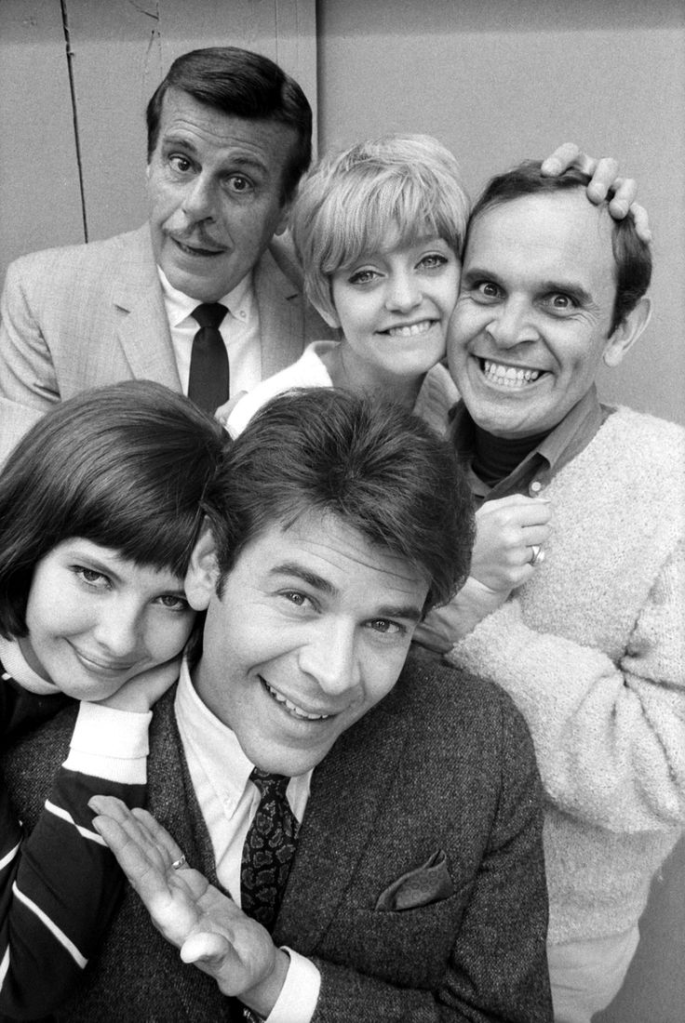
The premise was two radio disc jockeys who have a morning show, “Lewis and Clarke,” in Los Angeles. Dave Lewis is happily married, and Larry is a lady’s man and party boy.

They had some problems casting this show. Roddy McDowell and Sharon Farrell were cast as the married couple. Then Ron Rifkin replaced McDowell. Then they were both let go and David Lewis was played by Joby Baker, his wife Linda was played by Julie Parrish, and Ronnie Schell was cast as Larry Clarke.

📷pinterest

Billy de Wolfe and Goldie Hawn were fun additions to the cast. De Wolfe played Roland Hutton, the stuffy station manager. Hawn was Linda’s best friend Sandy Kramer.

The series debuted on CBS in 1967. It was on Tuesday nights, sponsored by Procter and Gamble. It was competing with N.Y.P.D., a police crime show and Tuesday Night at the Movies which began half an hour before Good Morning World.

Given that the talent behind The Dick Van Dyke Show was contributing to this show as well, it’s not surprising that it seems to be a mixture of The Dick Van Dyke Show and the later Mary Tyler Moore Show. Like Dick Van Dyke, the show features the DJs’ home and work life; like Mary Tyler Moore, you have a Lou Grant-type manager, and we learn about life at a radio station.

The theme music was by David Grusin. The opening was a different look for a sitcom. It’s a bouncy theme that begins with an alarm clock ticking, the guys quickly getting ready, morning traffic, life in LA, and the two DJs barely getting into their chairs before the show started.

The show was not awful in ratings, but the network had two concerns. They still were not sure Baker and Parrish were the right actors to play the married couple, and Parrish had some health concerns that affected the show. They were also concerned that the show did not pull in more of the viewers who were watching The Red Skelton Show which was on before Good Morning World. I don’t think that is surprising. I’m guessing people who enjoyed watching Red Skelton would not love this show as much and vice versa. Full disclosure, I am not a Red Skelton fan. I didn’t find his humor funny, and I have read too many stories shared by actors and writers who experienced his ego and lack of respect dealing with coworkers.

📷imdb.com

The network made the decision not to renew the show for a second season. Schell, who had been playing a private on Gomer Pyle: USMC, another Leonard/Reiner show, returned to military life with a promotion to corporal.

Goldie Hawn was free to accept an offer to appear on Martin and Rowan’s Laugh In which was a turning point for her career. De Wolfe became part of the cast of his close friend Doris Day’s show.

Baker never starred in another show, but he was a busy character actor. Parrish was later cast in Return to Peyton Place and also stayed busy in television; she later had a recurring role on Beverly Hills 90210.

This would be an easy series to binge watch with 26 episodes available. S’more Entertainment released the series on DVD in 2006 and its’ on Roku, so viewers can check it out for free.

My World . . . And Welcome To It: Just a Fantasy

This month we are in the midst of What in the World? Every sitcom has the word “world” in it. On deck today is My World . . . and Welcome to It. This half-hour show was based on the cartoons of James Thurber. It debuted in 1969 and was on the air for a year.

📷martin crookall- wordpress.com

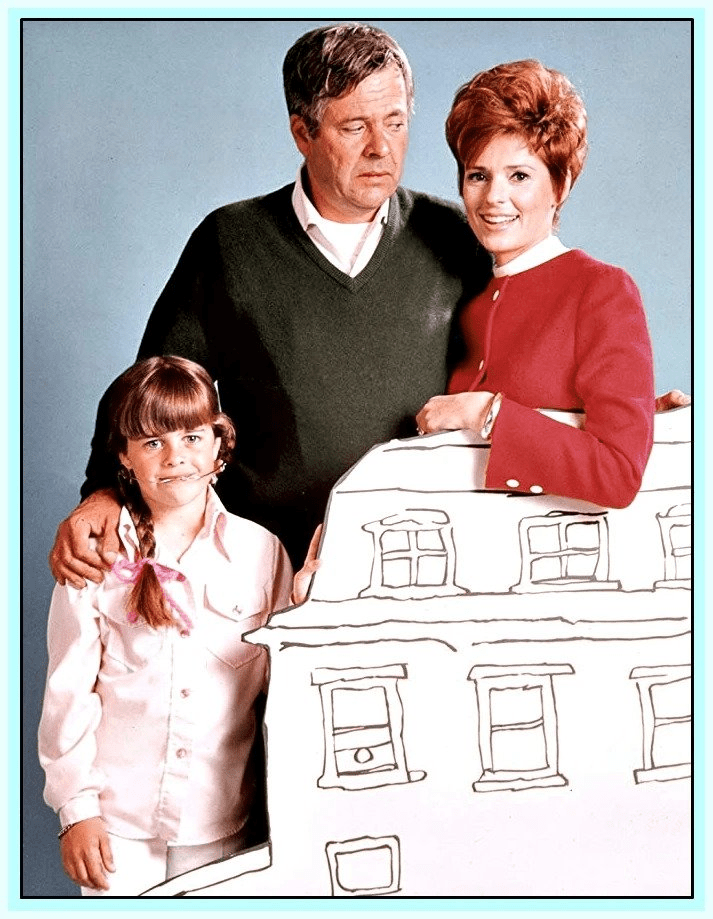
William Windom played John Monroe a cartoonist who works for a magazine similar to the New Yorker called The Manhattanite. Monroe lives with his wife Ellen (Joan Hotchkis) and their daughter Lydia (Lisa Gerritsen). John often daydreams about his daughter’s future and the “older” Lydias were played by Talia Shire and Cindy Williams.

The name John Monroe was Thurber’s alto-ego in his book Owl in the Attic. He frequently daydreams and those are cleverly incorporated into the series.

The episodes opened with John observing different aspects of his life. The use of the cartoons created a fantasy life dream world where he escaped life situations he could not process.

Mel Shavelson created the show for NBC. He wrote and directed the pilot with one of my all-time favorites Sheldon Leonard as executive producer. The animation in the series was done by DePattie-Freleng Enterprises.

Rounding out the cast was Henry Morgan as Philip Jensen, a magazine writer based on Robert Benchley and Harold J. Stone as editor Hamilton.

📷moviedatabase.com

The show was on Monday nights at 7:30 and was up against Gunsmoke. While it had a lot of great reviews from the critics, the viewers were not there in droves. Percy Shain of the Boston Globe referred to the show as “a joy and treasure.” Bob Williams of the New York Post wrote that it was “it’s warm, it’s witty, and it’s a sophisticated cut above the best of the TV network situation comedies.”

Not every critic treated it so kindly, however. Jack Gould of the New York Times felt it was “hackneyed gibberish relieved only by an occasional Thurber drawing” and Norman Mark of the Chicago Daily News decided that it “tried to appeal to all parts of the TV audience and failed.”

Perhaps Barry Harrison of the Washington Evening Star understood the show better than the other critics and had “an uneasy feeling [that] it is not long for TV.” His prediction came true when the series was canceled after one season.

According to Howard Anderson Jr. in his Television Academy interview, one of the major reasons for the cancellation was that it was so expensive to do the filming with a blue screen behind Windom for all the animation.

And then after it was canceled, it won the Emmy for Outstanding Comedy and Windom picked up the Emmy for Leading Role in a Comedy. The series it was up against included Love American Style, Room 222, The Bill Cosby Show, and The Courtship of Eddie’s Father. Windom won over Lloyd Haynes in Room 222 and Bill Cosby of The Bill Cosby Show.

📷billmadison.blogspot.com

The fans did send a lot of mail to the network, but with the so-so ratings and the fact that the animation made this one an expensive show to create, NBC did not put it back on the schedule.

After the show ended, Windom created a one-man play based on Thurber’s works and toured the country throughout the seventies. Perhaps if the network had given it some time after winning the Emmys, this show might have been more successful. It sounds like an interesting concept, although I also get the feeling that it might not have appealed to women; many of the descriptions I read discussed John’s fantasies that his wife and daughter were things to escape from. It’s worth taking a look at and seeing how it has fared over the last sixty years.

Shirley’s World: Doomed to Fail

As we ponder the What in the World? blog series this month, today we are taking a look at Shirley’s World.

This sitcom starred Shirley MacLaine as a photographer. For a variety of reasons, this show was doomed to fail. Let’s learn why that was the case.

📷imdb.com

ABC aired this show in 1971. It was co-produced by ITC Entertainment, a British company and American producer Sheldon Leonard. As I’ve said many times, Sheldon is one of my favorite classic television people. When he did a show, quality was guaranteed. In this sitcom, Shirley Logan (Shirley MacLaine) worked at World Illustrated magazine and her editor Dennis Croft (John Gregson) sent her around the world on assignments. However, Shirley always managed to find herself in dangerous situations while trying to help clients she was only supposed to photograph. One site described it as “the indomitable and highly resourceful Shirley met more than her share of high drama and intrigue—meeting would-be Soviet defectors, interviewing film stars, and even becoming a circus clown—with a few hilarious moments along the way.”

The opening of the show is very confusing. It’s a collage of photos one after another of Shirley with her camera out and about. If you didn’t know what the show was about, and it sounds like a lot of the crew and cast never did figure that out, you would assume this was a documentary or a mystery show. It does not read as a comedy.

There is a similarity to Sheldon Leonard’s series I Spy with shows set around the world. Rather than being videotaped, this series was shot on film. Because it was set all over, the producers decided against a laugh track or live audience. This gave the sense of a mini film; although laugh tracks can be annoying, the lack of laughter was also a detriment for a sitcom.

📷rewatchclassictv.com

I could not determine what set things off, but MacLaine and her British crew had what was often described as a “mutual loathing” of each other. She also seemed to have issues with the writers. After voicing often how much she disliked some of the scripts, she was banned from seeing them until 48 hours before shooting began. Eleven writers were credited with scripts, including Rob Reiner. From what I read about “fans,” the writing did leave a lot to be desired.

The show aired Wednesday nights. It was up against the second half of Medical Center and the NBC Mystery Movie which included Columbo, McMillan and Wife, and McCloud. So not only was it against two shows in the top 20, but if someone began watching either of those two shows, they were not switching halfway through the episode to watch Shirley’s World.

David Hofstede reviewed the show in his Comfort TV blog in February of 2023 (https://comforttv.blogspot.com/2023/02/shirley-you-cant-be-serious-visiting.html). As he tells us, “I gave up after ten episodes because all of them suffered from the same flaws. There’s nothing here for a viewer to follow that seems at all credible. Shirley MacLaine’s acting talent is unquestionable, from The Apartment to Sweet Charity to Terms of Endearment. Yet here she doesn’t seem to know what to do with the character or the situations she encounters. She laughs in serious moments—is that because she didn’t know what else to do?”

📷rewatchclassictv.com

Another review mentioned that apart from one small reference to Shirley being from Idaho, we don’t know anything about her.

In the early decades of television, we saw many stars who made that transition to television beautifully—Burns and Allen, Jack Benny, Debbie Reynolds, but there are also plenty like Henry Fonda and Jimmy Stewart who didn’t.

I understand 20/20 is everything as we look back in time, but it’s hard to understand how this show even got on the air. We have a great film star in MacLaine and an amazing producer in Leonard, and that is about it for the positives.

The show was expensive to create due to overseas locations and untypical filming techniques, it was poorly written, the character was never developed, the bi-nation crew didn’t get along, it was put on the schedule against two top-twenty shows that were an hour long, and never seemed to figure out if it was a sitcom, a drama, or a mystery.

Some things are just not meant to be, and Shirley’s World appears to be one of them.